

A report from MSP Insights found that 81% of MSPs are not paid on time, with an average wait of 60 days or more for late payments. However, late payments are just one of the factors that complicate billing for managed service providers (MSPs).
Billing in a Managed Service Provider (MSP) business can feel like a maze of spreadsheets, services, and tedious processes. Unraveling this complexity is crucial not just for peace of mind but also for an MSP’s bottom line.
By simplifying billing and leveraging tools such as MSP-specific billing platforms, MSPs can save hours of work, improve cash flow, and maintain client satisfaction.
In this article, we will break down why MSP billing gets so convoluted, reveal the hidden costs of billing inefficiencies, and share five actionable strategies to streamline billing operations.
{{toc}}
Why MSP Billing Gets So Complex So Quickly
MSP billing can become complex due to the diverse services and pricing models offered by managed service providers.
Many MSPs juggle a mix of recurring managed services, one-off projects, the sale of software licenses, cloud subscriptions, and usage-based charges. Each service may have its own rate, billing cycle, or contract payment terms.
As a result, MSPs commonly handle multiple services with varying pricing and billing frequencies, creating a challenging environment for manual processing.
Billing must account for details such as prorated mid-period additions, usage spikes, and service tier changes, which require more data tracking and adjustments than a straightforward flat fee.
Without the right systems in place, it’s easy to struggle with tracking invoices and ensuring accuracy. This complexity results in increased administrative work. The process becomes inefficient and error-prone if billing tools can’t support features like automated payments or usage tracking.
In short, the more fragmented and manual a billing workflow is, the more time-consuming and risky it becomes.
Why does this happen for MSPs?
Unlike a simple product business, an MSP’s revenue often comes from custom packages and variable charges.
One client may be on a bronze, silver, or gold service tier pricing model, another pays per device or per user, and a third is billed for the actual cloud resources they consume. Keeping all these straight manually is a recipe for mistakes.
Additionally, data is often siloed: service usage might live in a PSA system (Professional Services Automation), invoices are issued from accounting software, and payments are tracked in another tool.
When information is scattered across systems (or locked in spreadsheets), it requires constant manual reconciliation. Teams spend hours moving data between platforms and fixing inconsistencies, instead of focusing on clients or growth.
Conversely, a well-integrated approach, such as consolidated billing, can eliminate these pain points, which this article will explore in detail with concrete strategies.
{{ebook-cta}}
The Hidden Costs of Complex Billing
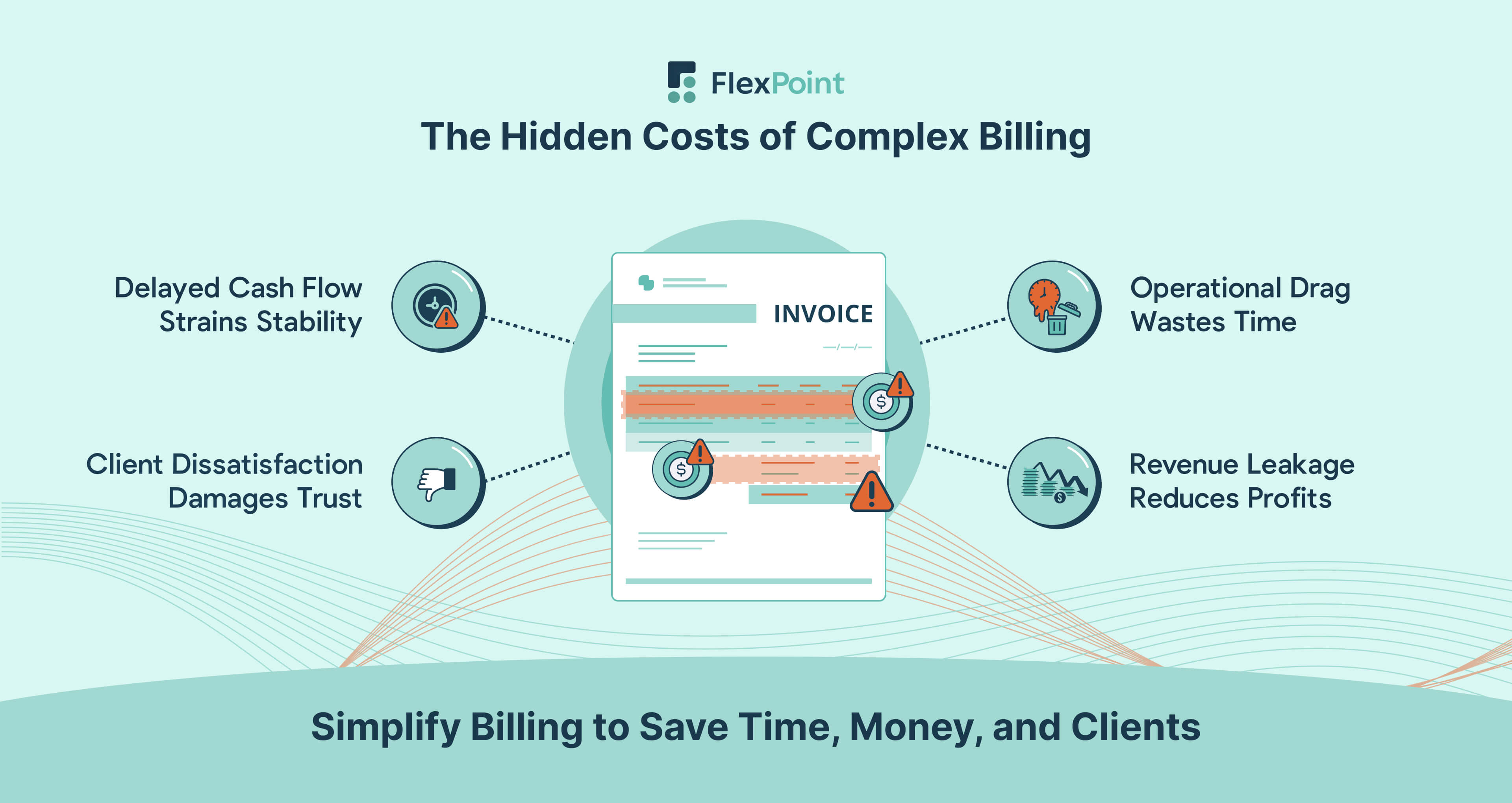
Complex billing drains time and money from MSPs.
Below are some of the hidden costs and consequences that stem from billing inefficiencies:
1. Delayed Cash Flow
Inefficient billing processes often result in late invoices and slow collections, which can harm an MSP’s cash flow.
These delays leave MSPs short on working capital. This makes it harder to pay expenses or invest in growth. The longer billing takes, the longer an MSP waits to get paid, creating a cash flow squeeze that can threaten a company’s stability.
Recurring delays can also disrupt cash flow projections and render financial planning unreliable, especially when payments expected within 30 days are stretched to 60 days or more.
To cover operational costs during these gaps, MSPs may be forced to rely on credit lines or short-term loans. This can increase financial risk and incur additional interest costs, further eroding profits.
2. Client Dissatisfaction
Billing mistakes or confusing invoices can frustrate clients and damage an MSP’s professional image. Each invoice error or unexpected charge undermines the trust the business has built.
Repetitive billing errors harm profitability and anger clients, potentially leading them to consider other providers. Clients notice when billing is inconsistent, unclear, or frequently corrected, and it creates payment friction.
A frustrating billing experience can quickly erode the goodwill you’ve earned through exemplary service. A Microsoft study found 95% of satisfied clients remain loyal to service providers, so keeping clients happy with billing really matters.
3. Operational Drag
Billing complexity also carries a steep operational cost. Your team’s time is valuable, and every hour spent fixing invoices or chasing down data is an hour not spent on high-value activities, such as serving clients or generating new business.
Fragmented billing workflows require staff to dedicate excessive time to manual reconciliation and error correction. It’s not uncommon for teams to spend countless hours each billing cycle merging data from PSA tools, spreadsheets, and accounting systems.
In these cases, an MSP is essentially paying employees to do work that could be automated or simplified. Over the course of a year, those labor costs and lost productivity really add up.
4. Revenue Leakage
Manual and ad-hoc billing practices can result in missing billable items, undercharging, or failing to adjust prices in response to rising costs. These minor billing errors accumulate into substantial revenue leakage over time.
Billing “leaks” are essentially revenue lost due to inaccuracies or blind spots in your process.
According to a 2020 survey by the Boston Consulting Group, 45% of executives report that revenue leakage is a systemic issue within their organizations.
Unfortunately, these leaks aren’t minor.
NetSuite estimates that companies struggling with revenue leakage may experience earnings reductions of 1% to 5%, depending on the size and scope of the issue.
If real-time usage isn’t tied to billing, services delivered might never be invoiced, which is an entirely preventable loss. In many cases, this stems from reliance on spreadsheets or manual workflows that allow mistakes to slip through.
For instance, unbilled project overages or forgotten license costs quietly erode margins when they're missed in end-of-month reviews.
Manual invoicing is especially prone to errors. Delays in generating invoices often result in underbilling or skipped charges for add-on services.
According to DocuClipper, automated data entry systems reach accuracy rates between 99.959% and 99.99%, whereas manual entry tends to fall between 96% and 99%. Although the gap may appear narrow, its real-world implications are substantial.
Imagine entering 7,500 records: automation might result in just one to three errors, but manual input could introduce 75 to 300 errors. That’s not a slight discrepancy; it’s a direct threat to billing accuracy, especially for MSPs that rely on precise financial reporting.
This comparison highlights the impact automation can have on reducing data mistakes and maintaining consistent, error-free operations.
What’s worse, most companies lack a dedicated strategy to prevent revenue leakage. BCG reports that 59% of organizations lack full-time revenue assurance personnel, meaning the responsibility often falls through the cracks.
In short, a complex billing operation can lead to slower cash inflow, unhappy clients, lost revenue, and higher operational costs. These are hefty penalties for something as routine as invoicing.
Fortunately, you can mitigate these effects by simplifying and streamlining your billing process.
Next, we will explore five proven and reliable strategies to eliminate billing complexity and reclaim that lost time and revenue.
5 Proven Strategies to Simplify MSP Billing
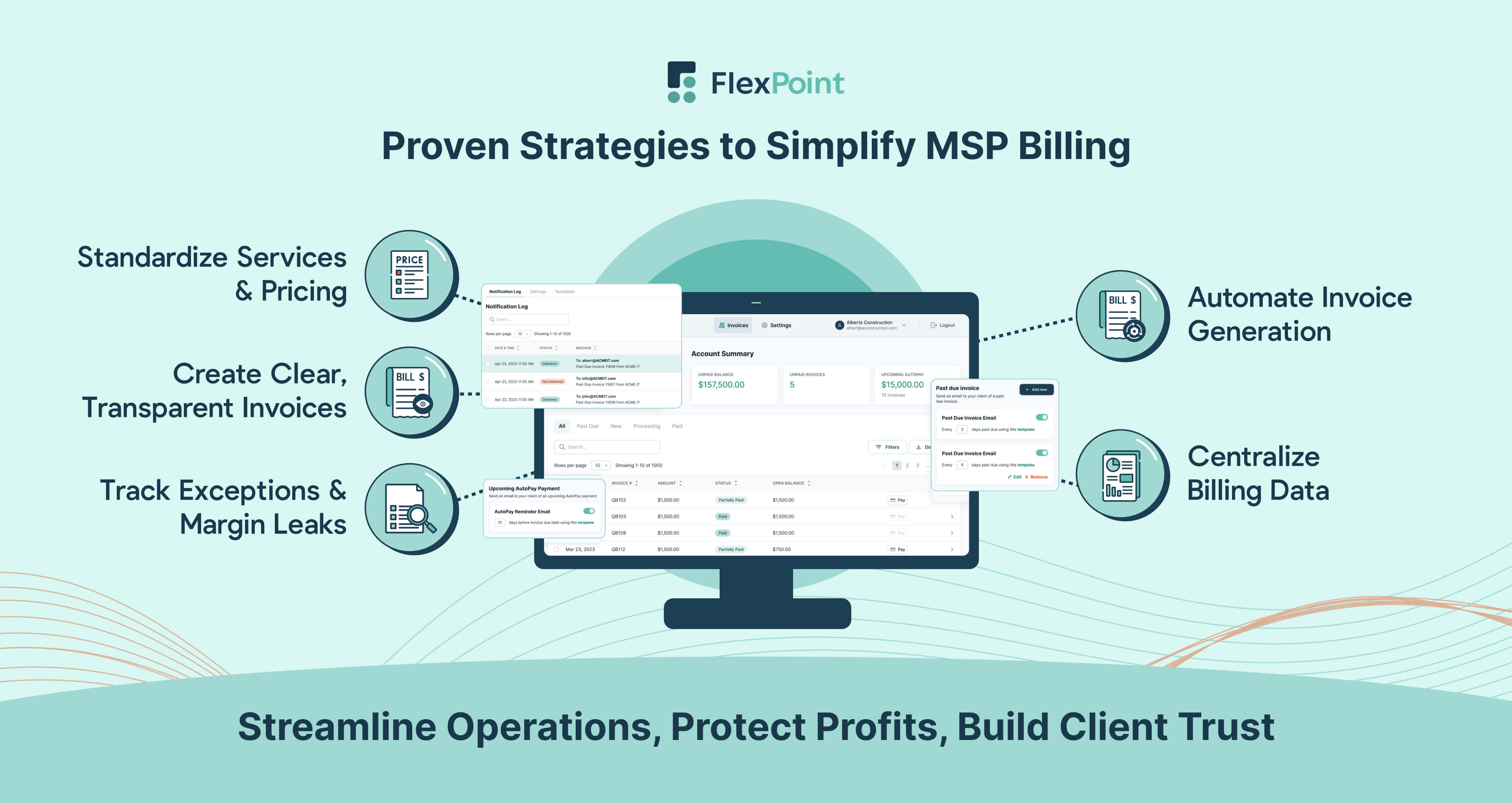
MSPs should adopt a proactive approach to eliminate billing headaches and build a more efficient operation.
Here are five actionable strategies to simplify your billing process and save time, all while improving accuracy and client satisfaction:
1. Standardize Service Packaging and Pricing Logic
One effective way to cut down billing complexity is to standardize what you sell and how you price it.
Instead of reinventing the wheel for each client, define a set of service packages or bundles with clearly defined offerings and pricing logic.
Standardized service packages (e.g., tiered support plans or fixed per-user pricing) make billing predictable and repeatable. They reduce the need for one-off, custom invoice line items that often lead to confusion or mistakes.
By formalizing pricing rules, MSPs also gain better control over profit margins. When every service engineer or sales representative isn’t cutting unique deals, special terms are applied consistently and profitably.
Conversely, inconsistent pricing and ad-hoc discounts can quickly erode margins if not governed properly.
A standardized pricing model, coupled with a streamlined approval process for any exceptions, prevents revenue from leaking through unwarranted discounts or underpriced services.
It also simplifies automation because an MSP can configure its billing system to apply the same rules every time, with fewer manual adjustments.
From the client’s perspective, standardization brings clarity. Clients know what to expect on their invoice each period because the services and fees were defined up front. This transparency reduces billing-related questions or disputes.
The key is to review and streamline your service catalog regularly: eliminate overly complex pricing schemes and stick to a handful of models your billing software (and clients) can easily understand.
You can still offer customization if needed, but anchor it to a standard package, plus clearly document any add-ons or adjustments.
2. Create Clear and Transparent Invoices for Clients
A clear and easy-to-understand invoice is crucial for maintaining client satisfaction and ensuring timely payment. As an MSP, you want your invoices to answer questions, not raise new ones. To achieve this, make invoicing clear, detailed, and transparent.
Each invoice should indicate the services provided, the service period, the rate or quantity, and the total charge.
It might look something like this:

Transparent invoicing builds trust. When clients can easily connect the charges to the work performed or the service delivered, they’re less likely to dispute an invoice. It also reduces back-and-forth communications. Clients won’t need to call asking for clarification if everything is spelled out.
Consider providing supporting data or reports if you have any usage-based charges or overage fees.
Being clear and upfront on invoices also means no surprise charges. Always communicate scope changes or additional fees in advance of billing. It’s wise to design a clean and professional standard invoice template that incorporates your branding and features an organized layout of charges.
Review your invoices for industry jargon as well. Use plain language for line item descriptions that non-technical clients can understand.
Finally, timeliness is a key aspect of transparency. Send invoices promptly and at consistent intervals.
Clients may question its accuracy or urgency if an invoice is delayed by weeks.
Clear and timely invoicing not only enhances client satisfaction but also facilitates faster payments. Clients can approve and pay an invoice faster when they understand it.
3. Automate Invoice Generation Across All Pricing Models
Manual invoicing is a significant time sink and source of errors. Embracing automation is arguably the biggest time-saver for MSP billing.
With the right software, you can automatically generate invoices for every pricing model you offer, including flat monthly fees, per-user or per-device charges, hourly work, or usage-based subscriptions.
Automating invoice generation means your system pulls in all the relevant data (from contracts, time entries, monitoring tools, etc.), calculates the totals, and creates professional invoices without human number-crunching.
This saves your staff countless hours each month and virtually eliminates arithmetic mistakes and omissions.
Consider this common scenario: you provide a cloud service that charges per gigabyte of storage used. When this is handled manually, someone must log into the portal, retrieve the usage statistics, calculate the charge, and add it to the invoice.
Automated billing software can do all of that for you instantly.
The moment a billing period ends, usage data is captured via integration, and an invoice line item is created. Nothing falls through the cracks.
In fact, one of the most preventable forms of revenue leakage is unbilled services, which occur when delivered services are never included on an invoice.
Automation ensures that every service, license, and overage is accounted for each cycle, so you’re not leaving money on the table.
Moreover, automation is flexible.
Modern MSP invoice automation software can handle complex billing rules, such as prorating a partial month for a new user, applying tiered pricing rates when usage thresholds are met, or generating separate invoices for different sites or projects as needed. You can set it up once and let it run.
For example, FlexPoint’s invoicing automation supports recurring and usage-based models by syncing with your PSA and monitoring tools, then automatically creating accurate invoices on schedule.
By automating these workflows, MSPs have significantly reduced their billing cycles. The result is not only saved time, but also faster invoicing means faster payment, improving your cash flow.
Evaluate cloud-based MSP billing software that integrates with existing systems (PSA, accounting). The ongoing time savings and reduction in billing headaches quickly repay the upfront effort to configure automation.

Finance teams can then focus on reviewing exceptions and conducting strategic analysis, rather than manually processing routine invoices.
4. Centralize Billing Data Across Teams and Systems
A common culprit behind billing complexity is fragmented data, which is information spread across multiple teams and systems. To simplify, strive to centralize and connect all the pieces of your billing puzzle.
In practice, this means integrating your key systems (e.g., PSA, accounting software, and payment processor) or utilizing a unified billing workflow that serves as a single source of truth for all billing information.
When your service data, contract details, and payment status all live in one place, you drastically reduce the back-and-forth that plagues manual processes.
Consider the traditional patchwork that many MSPs rely on: the service delivery team logs hours or device counts in a PSA, the finance team maintains a separate billing spreadsheet, and payments are processed through a standalone gateway. This disjointed approach requires manual reconciliation at every turn.
By contrast, centralizing billing data means, for example, your PSA and billing system are in sync, so client contracts and tickets flow into invoices automatically.
Likewise, payments recorded via your payment portal update the invoice status in your system without requiring someone to re-key it. Sales, service, and finance can refer to the same live data when answering client questions or planning revenue.

The impact on efficiency is considerable. When systems aren’t connected, internal workflows slow down, and small errors become costly as teams spend hours reconciling data and fixing invoices that should have been right the first time.
A centralized billing approach eliminates duplicate data entry and reduces human error by removing the need for copying information between systems.
It also provides complete visibility.
At any moment, you can see:
- What’s been billed
- What’s pending
- Where there might be issues
There are several ways to centralize. One is to adopt a comprehensive MSP billing platform that offers built-in integrations to popular MSP tools.
For instance, FlexPoint integrates with PSA systems (such as ConnectWise, HaloPSA, AutoTask, SuperOps), as well as accounting software (such as QuickBooks Online, QuickBooks Desktop, Xero). This allows data to flow seamlessly and keeps everything aligned.
Another approach is to use APIs or middleware to integrate your existing systems, although this can be more challenging to maintain.
Either way, the goal is the same: one cohesive billing ecosystem instead of a dozen isolated parts.
5. Track Billing Exceptions and Margin Leaks in Real Time
Even with automation and standardization, an MSP can’t entirely “set and forget” its billing.
It’s essential to implement real-time tracking for exceptions (i.e., anomalies or potential errors that require human attention) and closely monitor profit margins for each account.
By monitoring these in real-time (or at least regularly), an MSP can catch minor issues before they become significant revenue leaks.
One example of these exceptions could be when a contract has a built-in price escalation or renewal that wasn’t applied.
Let’s say an annual 5% price increase was due this month and wasn’t reflected on an invoice; you can correct it immediately rather than losing that revenue permanently.
Another example is if a client’s usage suddenly spikes far beyond their subscription level. An alert can notify you to review whether an overage charge or upgrade is needed.
Any scenario where the billed amount deviates from the expected or the margin on a service falls below a threshold should raise a red flag.
Setting up dashboards or alerts for these exceptions is a best practice. Many modern billing platforms feature reporting capabilities that highlight unusual billing entries or provide margin analysis per service or client. Use these tools to your advantage.
Real-time exception tracking also helps maintain client trust. If there’s a billing mistake (which can happen even in well-managed systems), proactive identification and communication are crucial.
It’s far better to catch an error and correct the invoice before the client even notices, rather than having the client discover it later. It demonstrates diligence and reliability.
Margin leak prevention goes hand in hand with this. Regularly review your billing vs. costs to ensure you are making the expected profit.
Small margin erosions, including a few dollars here and there from not updating a rate, add up across dozens of clients.
Ultimately, a combination of automated checks and periodic payment audits will protect your MSP from silent profit drains. This approach provides you with peace of mind, knowing that your billing is efficient and financially optimized.
Streamlining and Simplifying Billing with FlexPoint
The strategies above outline what to do; FlexPoint’s billing platform is an example of how to do it in practice.
FlexPoint is a purpose-built MSP billing automation platform that enables all five of the simplification strategies discussed above under one roof. By using a solution like FlexPoint, MSPs can significantly reduce billing complexity and ensure that no revenue is lost in the process.
How does FlexPoint help?
For starters, the platform centralizes billing operations.
FlexPoint integrates with popular MSP tools, including PSA systems and accounting software, to unify your data and eliminate silos.
Service catalogs, client contracts, usage data, and invoice records are all consolidated into a single platform. This is precisely what MSPs need to implement Strategy #4: centralized data. This means less time spent juggling spreadsheets and more accurate billing across the board.
For example, tekRESCUE, a Texas-based MSP and FlexPoint client, reported increasing its billing efficiency by more than 75% after adopting the platform.
Before adopting the platform, tekRESCUE managed billing through a combination of QuickBooks and manual spreadsheets to track recurring payments, paused accounts, and client billing details. As the company grew, this fragmented approach became increasingly time-consuming and error-prone.
FlexPoint automated their invoicing, payment tracking, and client communications, significantly reducing the administrative burden. Invoices are now generated and sent on time without manual oversight, and real-time alerts notify the team of payment issues or bounced messages, allowing them to focus on exceptions rather than routine tasks.
The switch also improved the client experience. Clients can securely store payment information, access reports, and review upcoming charges through branded client portals, all without direct staff involvement.
FlexPoint’s integration not only streamlined tekRESCUE’s internal processes but also enabled them to offer more flexible payment options to clients, including short-term financing. This has made the company a more attractive partner for both new and existing clients, without adding complexity to their billing operations.

Alt Text: tekRESCUE Results from Using FlexPoint
FlexPoint also excels at automation and standardization.
MSPs can configure standardized service packages and