


For the most part, overdue invoices follow the same pattern.
When the due date passes and the reminder goes out, the client will reply with an explanation or even an apology, a question, or an estimated payment date. And your payment (eventually) arrives.
But what do you do when they don’t respond… even after a dozen touchpoints?
At that point, collecting payment becomes much harder because you've lost visibility into what's actually happening.
With a silent client, you don’t know if the invoice reached the wrong person, if the primary contact left the company, if there’s financial stress they’re facing, or if there’s an internal problem no one has raised. Maybe your primary contact left the company.
Those situations have one thing in common: they all look exactly the same from your side. Like nothing.
Before deciding how to escalate, you first need to understand why communication stopped.
The strongest collections processes recognize that silence changes the problem you're trying to solve. Recovering payment is still the goal, but your first priority becomes rebuilding enough context to decide what needs to happen next.
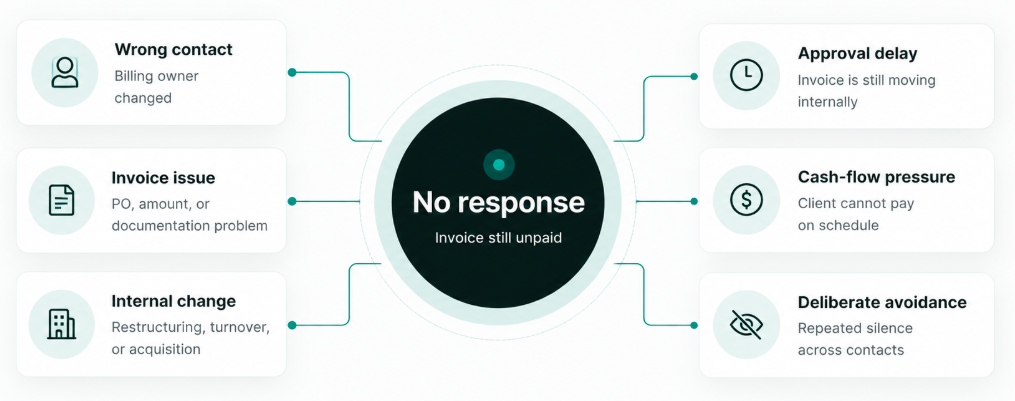
Use the diagnostic below for some general guidance on how to proceed:
Why clients stop responding about overdue invoices
When clients are communicating—even if payment is delayed—you can adjust your approach based on what they're telling you. Every response helps you make a better decision.
Once communication stops, that feedback disappears.
Instead of deciding how to collect the invoice, you're trying to determine what kind of situation you're dealing with in the first place. It essentially puts you several steps backward.
A missed payment from a client who changed accounting teams deserves a very different response than one from a client who has ignored multiple attempts to reconnect or has called you back but been evasive (a different kind of silence). Treating those situations the same way is risky and unproductive.
That's why sending increasingly urgent reminders isn't always the best next step. Before escalating externally, it's worth taking a closer look at everything your own team already knows.
Start with the information you already have
When a client goes quiet, it’s easy to hone in on the next email you’ll send. After all, it’s easy to think that with just the right words, you may get the response you’re looking for.
But you can’t if there’s something else happening.
That’s why a better starting point is the information already sitting inside your business.
Look beyond the aging report and review the relationship as a whole (the most common piece of advice across the posts we’ve covered about reclaiming late payments). Has this client always paid on time? Has payment slowly become less consistent over the past few months? Did this invoice include a large project or unexpected hardware purchase? Was there a recent conversation about budget, scope, or upcoming renewals?
Those details provide invaluable context before another collection email ever leaves your inbox.
It also helps to talk with the people who interact with the client every day.
Your account manager may know the controller recently left the company, a technician may have heard about an acquisition or internal restructuring during a support call, or customer success may already be aware of budget concerns that never reached the finance team.
Nuanced information like that doesn’t appear on an invoice, but it often explains why payment has stalled.
Gathering that context also reduces the risk of making the relationship worse. A formal collections notice sent before your team has compared notes can create unnecessary tension if the delay stems from a legitimate operational issue rather than an unwillingness to pay.
Contact the client through a different channel
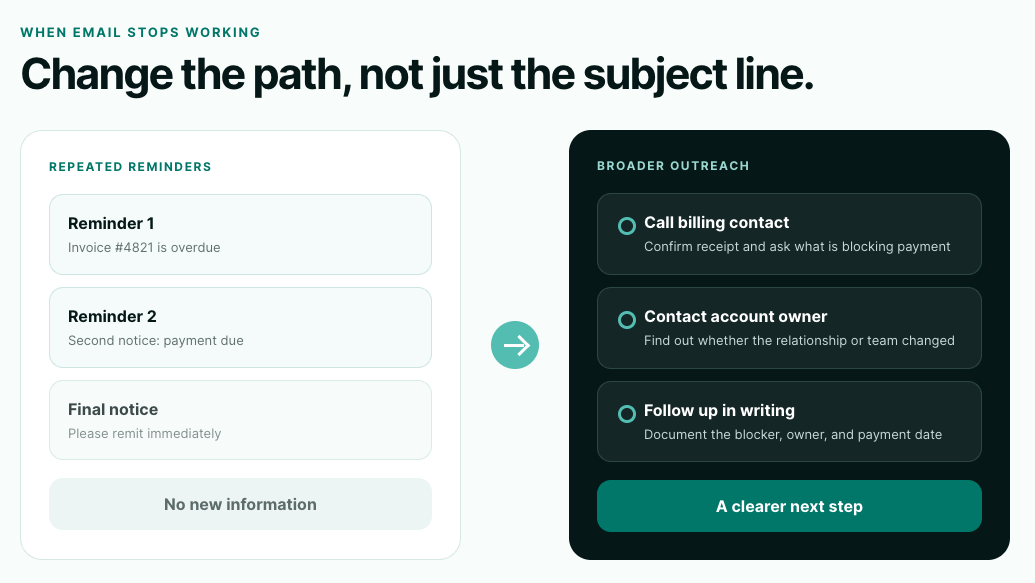
Once you've developed a better understanding of the situation, it's time to reach back out. The mistake many businesses make at this stage is assuming the only variable they need to change is the tone of the reminder.
The first email is friendly, the second is more direct, the third adds more urgency. Eventually, the subject line changes to "Final Notice" and the message becomes increasingly formal.
But if the underlying problem that caused the silence hasn't changed, neither will the outcome.
No matter how firm a reminder becomes for a client who is facing a barrier or if you are making a mistake, resolution still isn’t guaranteed. So instead of asking, "How do I get them to pay?" try asking, "What information am I still missing?"
That shift in mindset changes the purpose of your outreach. Rather than sending another generic payment reminder, get them on a call if you can.
Emails can be ignored, sent to spam, or something else. If you can get on a call with someone at the company and you realize you’ve been calling the wrong person or someone has moved to a different company, you can at least get the right contact information of the person who manages their books.
For example, if your reminders have only gone to accounts payable, it may be time to involve someone else you've worked with before. An account manager, business owner, or operations contact may be able to confirm whether the invoice reached the right person or whether something has changed internally. The goal isn't to pressure more people into paying the invoice. It's to reconnect with someone who can help move the conversation forward.
Even a brief voicemail asking whether the invoice reached the appropriate contact is less confrontational than another written demand for payment, especially if you've worked with the client for years.
The language you use does still matter.
Compare these two approaches:
"Your invoice is now 45 days overdue. Please remit payment immediately to avoid further action."
Versus:
"I wanted to check in because we haven't been able to reach anyone regarding Invoice #4821. I wanted to make sure it reached the right person and see if there's anything holding up the payment process."
They address the same overdue invoice, but they invite very different responses. The second acknowledges that something may have changed without assuming bad intent. That gives the client room to explain the situation instead of feeling like they need to defend themselves.
But that approach shouldn't continue indefinitely. If multiple attempts across different channels go unanswered, you've gathered information of a different kind. At some point, silence becomes a pattern rather than an exception.
That's when the conversation shifts again.
If you're looking for a broader reminder schedule and escalation timeline, see our 4-Step Escalation Framework for Late MSP Payments.
Escalate in clear stages
Every business extends a degree of trust when it continues providing services before receiving payment. As long as communication remains open, that trust is easier to justify.
Never-ending silence changes that equation.
Once a client has ignored repeated outreach or been evasive, the question becomes whether continuing to extend credit still makes business sense.
You have a few options at this point:
- Apply relevant pre-documented late fees (make sure it is legal in your state)
- Offer a payment plan (if that is refused move on)
- Suspend services (if they still don’t pay, move to the next step)
- Send the account to collections
Of course, that doesn't mean every silent client should immediately be sent to collections. Long-standing customers who have consistently paid on time deserve a different level of patience than clients with an established history of missed commitments. That means that the above process could be extended slightly as a show of goodwill.
However, patience should always be paired with clear boundaries. Continuing to deliver services month after month without communication or a realistic payment plan increases your exposure while making eventual recovery more difficult.
When you've exhausted reasonable attempts to reconnect, it may be time to move into a more formal process. Depending on your contracts and internal policies, that could include involving legal counsel or a third-party collections agency.
Those decisions are never enjoyable, particularly when the client has been with you for years.
But delaying them indefinitely rarely protects the relationship. Even if a client was a good client for some time, the cost-benefit analysis can indicate it may be time to “fire” that client.
Make sure silence never comes as a surprise
By the time a client stops responding altogether, you've already lost valuable time.
The invoice is overdue, communication has broken down, and your team is trying to reconstruct what happened by searching through email threads, payment records, and internal conversations.
At that point, collecting the invoice isn't the only challenge. You're also trying to rebuild the context you wish you had from the beginning.
The best AR processes make that work unnecessary.
When payment history, reminder activity, client communication, and outstanding invoices all live in one place, it's much easier to spot changing payment behavior before a client disappears completely. A customer who suddenly starts paying later than usual or stops engaging with reminders gives you an opportunity to step in while the conversation is still productive.
That's where automation can help.
Platforms like FlexPoint bring invoice history, reminder activity, payment status, and client communication into one place. Instead of piecing together information from several systems, your team can quickly understand where the conversation stands and decide on the appropriate next step.
Automated reminders and AR Agents also help ensure every client receives consistent follow-up without relying on someone remembering to send the next email.
Also crucial: If your team doesn't have documented escalation stages, it's worth creating a formal collections policy before situations like this arise. A consistent process removes guesswork for both your staff and your clients.
Some overdue invoices are simple oversights. While others point to larger operational or financial issues inside the client's business. The challenge is knowing which situation you're dealing with before making the next move.
When a client goes silent, sending another reminder isn't always the answer. Taking a step back, gathering the right information, and responding with intention gives you a much better chance of recovering the payment while preserving the relationship you've worked hard to build.
The best collections decisions start with better information
When a client goes silent, it's easy to assume the worst. (Especially if the invoice is substantial and you’re waiting on it for your bills, payroll, or something else.)
Sometimes you'll be right, and your client is reneging on submitting payment. Other times, the silence has a far more ordinary explanation—a staffing change, an internal approval delay, a billing question that never reached the right person, or a business that's temporarily under financial strain.
The challenge is that those situations often look the same until you have enough information to tell them apart.
That's why effective collections are more so measured by how well you understand the client before sending a dozen reminders. A thoughtful phone call may resolve an issue that five automated emails never would. In other cases, the information you uncover will confirm that it's time to escalate and protect your business.
Either way, better decisions begin with better information.
And clients don't usually become unresponsive overnight. There are often small changes leading up to that moment—slower payments, missed commitments, unanswered reminders, or shifting communication patterns. The sooner you recognize those signals, the more options you have.
Robust AR software and internal processes will help you identify problems earlier, respond consistently, and preserve valuable client relationships whenever possible. When silence does happen—and eventually it will—you'll quickly have the context you need to respond with confidence rather than guesswork.