

One of the most unsettling moments for an MSP isn't when a client who's always been difficult to collect from misses another payment. At that point, you already know the pattern.
It's when a client who's paid every invoice on time for years suddenly doesn't.
It's easy to jump to conclusions. Maybe they're unhappy with your service. Maybe they're preparing to leave. Maybe they're experiencing financial trouble and don't want to say it outright.
Those possibilities certainly exist, but they're far from the only explanations.
In reality, payment behavior often changes because something inside the client's business has changed. Even something as simple as a merger or leadership transition can temporarily disrupt a payment process that had worked smoothly for years.
That's why treating every overdue invoice like a collections problem can be a mistake. When a long-term client suddenly stops paying, your first objective isn't collecting the invoice as quickly as possible. It's understanding why the behavior changed in the first place.
Research from Atradius continues to show that payment delays remain common across B2B organizations, even among businesses that ultimately pay in full. The challenge is learning to distinguish between an operational disruption, a billing question, temporary cash flow pressure, and a genuine relationship issue.
Because each calls for a different conversation.
In this guide, we'll walk through how to identify what changed, how to approach the first conversation without damaging the relationship, and how to recognize when it's time to shift from solving a problem to protecting your business.
Start by assuming something changed
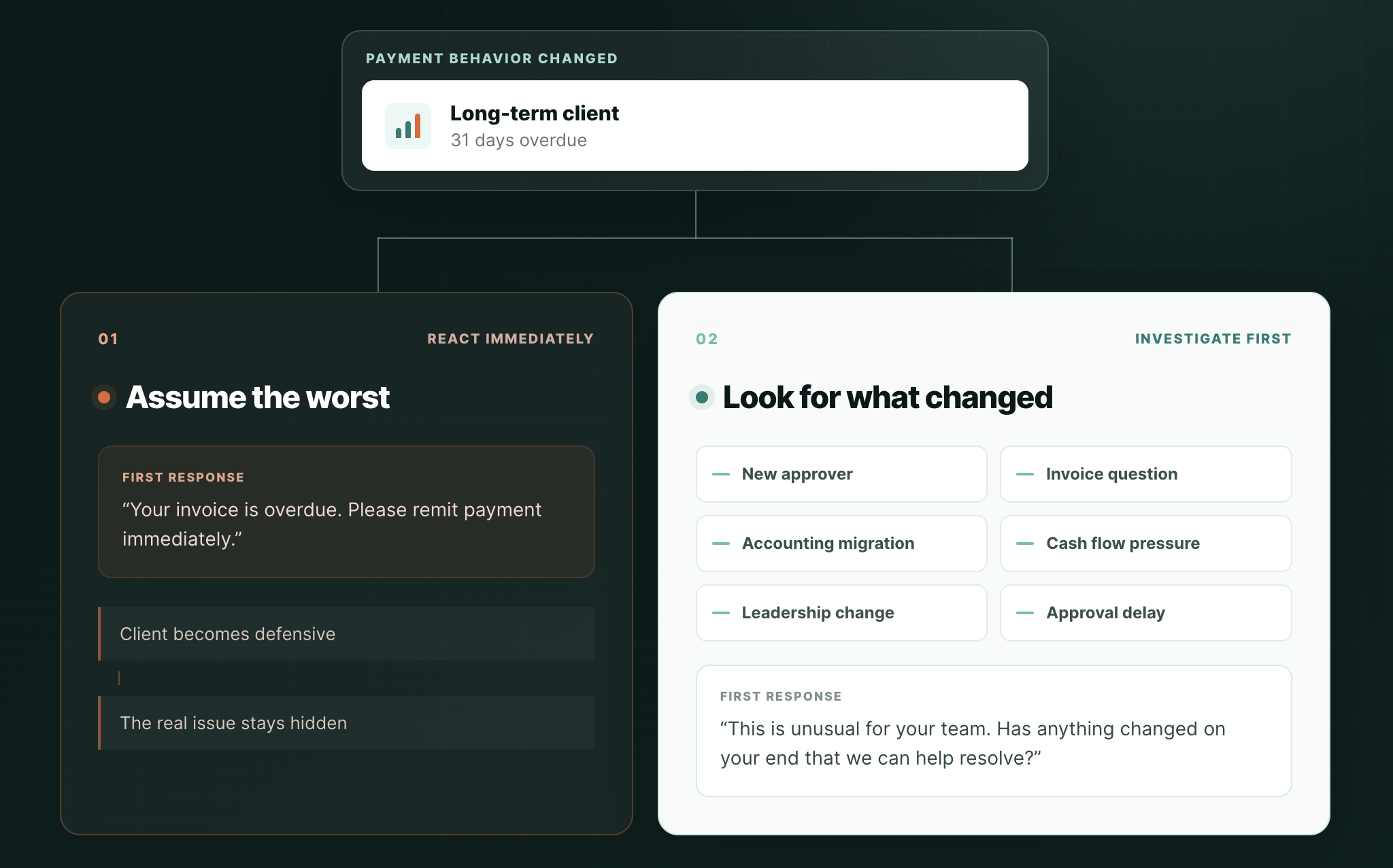
When a dependable client suddenly stops paying, your first instinct should be curiosity.
Businesses rarely change payment behavior without a reason. Sometimes that reason is financial, but just as often it's operational like we mentioned above.
For example: a new controller takes over, invoices begin routing through a different approval process, the company migrates to new accounting software, or a finance team is stretched thin during an acquisition or year-end close.
None of those situations reflect dissatisfaction with your service, yet every one of them can delay payment.
That doesn't mean you should ignore the overdue invoice. It means you should avoid assuming you already know why it's overdue.
Instead of asking, "Why haven't they paid?" ask yourself, "What's different than it was three months ago?"
Instead of approaching the client with the assumption that they're avoiding payment, you're approaching them with the mindset that something has changed and you're trying to understand what it is so you can fix it.
Even though you provide services to them directly in the form of technical support, your service does extend to how they experience you when it comes to billing. And it’s important to keep that perspective.
This will lead to a faster and more productive resolution.
Reach out like you're solving a problem together
If this client has spent years paying you on time, they've earned something valuable: the benefit of the doubt.
Rather than immediately referencing payment terms or late fees, acknowledge that the change in payment behavior stands out.
A message like this is often enough to start the conversation:
"Hi [name], I noticed this invoice is still outstanding, which is unusual for your team. I just wanted to check whether everything made it to the right person or if anything has changed on your end that we should know about."
That approach feels very different from a collections notice. It recognizes the client's history, avoids making assumptions, and invites them to explain what's changed without feeling like they're already on the defensive.
In many cases, you'll uncover the issue almost immediately.
Especially if they have been historically responsive.
Sometimes the invoice is simply sitting in an approval queue that nobody realized had stalled.
Even if the issue ultimately turns out to be financial, you've positioned yourself as someone trying to solve a problem rather than someone trying to win an argument.
Look for patterns before you look at one invoice

It’s also important to emphasize that one overdue invoice does not tell the whole story.
Before deciding how serious the situation is, step back and look at the broader relationship beyond them being generally a good client.
Has the client's average payment time gradually increased over the past six months? Have invoices started taking longer to approve? Are projects moving more slowly? Has your primary point of contact changed? Has the client recently expanded, downsized, or reorganized?
Small changes like these often appear long before payment stops altogether and will paint a more cohesive picture for you when it comes time to communicating with your client.
It's equally important to examine your own side of the relationship.
Did this invoice include work outside the normal agreement? Was it significantly larger than previous invoices? Did pricing change at renewal? Have you introduced new billing practices or line items that might require additional explanation?
Sometimes what looks like a collections issue is actually an expectation issue.
A client who has always paid promptly may simply be waiting for clarification before approving an invoice that's different from what they're used to seeing.
Looking beyond the current invoice gives you context. And in accounts receivable, context is crucial.
Don't ignore the possibility of financial trouble
Sometimes, the explanation really is financial.
When businesses experience cash flow pressure, they rarely stop paying every vendor overnight. Instead, they begin prioritizing payments. (You’ve probably been in a similar place at some point.)
Payroll, taxes, rent, and critical suppliers usually come first, while other invoices gradually stretch from Net 30 to Net 45, then Net 60, and sometimes longer.
That doesn’t mean your client has no intention of paying. It may simply mean they're trying to manage limited cash while keeping the business running.
If your conversations suggest cash flow is becoming the real issue, acknowledge it directly rather than pretending it isn't there. Depending on the relationship, that might mean discussing a temporary payment plan, splitting a larger balance into smaller installments, or agreeing to revised payment dates until the situation stabilizes.

For larger invoices, financing can also provide another path forward. FlexLine, built into FlexPoint's client payment portal, allows clients to finance qualifying invoices over $10,000 with repayment terms ranging from 1 to 12 months. The MSP still gets paid, while the client gains additional flexibility without needing to delay the project or ask you to carry the balance yourself.
Supporting a client through temporary financial pressure will strengthen a long-term relationship, but flexibility should still have clear boundaries.
Document any revised payment terms, establish firm due dates, and avoid letting temporary arrangements quietly become permanent.
If you're trying to balance supporting good clients without taking on unnecessary financial risk, you may also find our post "Are you running a bank or an MSP?" helpful.
Because ultimately your goal isn’t to become a permanent lender, it's to determine whether your client is experiencing a temporary challenge or whether their payment behavior reflects a larger issue that requires a different response.
Know when it's time to escalate
At the same time, not every overdue invoice deserves the same level of patience.
If reminders continue going unanswered, promised payment dates repeatedly come and go, or communication becomes increasingly inconsistent, the conversation needs to change. At that point, you've moved beyond a temporary operational issue and into a collections issue.
Many MSPs hesitate here because they've spent years building the relationship. And the instinct is understandable. But avoiding difficult conversations will create more uncertainty for both sides.
Instead, be transparent about what happens next.
Reference the conversations you've already had, summarize the outstanding balance, and explain the next step in accordance with your agreement. Depending on your payment policy, that could mean pausing new project work, requiring payment before additional services are performed, or beginning your formal collections process.
None of those actions should feel sudden if you've communicated consistently from the beginning. (In most cases, having a clear, respectful conversation is exactly what preserves the relationship.)
They're simply the next step in a process your client already understood when the relationship began.
That consistency matters because the longer an account sits unresolved, the harder it often becomes to collect. Research from the Credit Research Foundation has found that the likelihood of recovering an overdue invoice declines as accounts continue to age. Waiting another month rarely makes a difficult collections conversation easier. It usually makes it more expensive.
If you're building or refining your escalation process, our post on How to Handle Late Payments from MSP Clients walks through reminder timing, communication strategies, and when it's appropriate to move from friendly follow-ups to formal collections without damaging the client relationship.
Build a process that catches problems earlier
One unexpected late payment is also an opportunity to evaluate your own AR process.
Ask yourself whether there were earlier signals you could have noticed.
Aside from sudden catastrophes, most payment problems will develop gradually, and the businesses that spot those trends early are often able to resolve them before invoices become seriously overdue.
That's one reason many MSPs are investing in stronger accounts receivable processes rather than simply sending more reminder emails. Because businesses using AR automation software were 52% more likely to be paid within two weeks of an invoice's due date than businesses relying on manual processes.
Consistent follow-up, clear payment policies, automated reminders, and better visibility into payment behavior make it much easier to recognize when a long-term client's habits begin to change.
Your primary goal can be collecting invoices faster, but the best way to get there is being able to easily identify blockers for your clients even before they become a problem.
Better context leads to better conversations
You’ll likely have noticed one theme that keeps showing up throughout this article: context.
Every good decision depends on understanding what's actually happening before you respond. The challenge is that gathering that context often means jumping between your PSA, accounting platform, email history, payment records, technician notes, and internal conversations just to answer a single client question.
The work itself usually isn't difficult, but it is time-consuming and requires significant focus.
That's exactly what purpose-built AR platforms are designed to solve.
Instead of piecing together invoice history, payment activity, reminder emails, and supporting documentation across multiple systems, platforms like FlexPoint centralize that information in one place.
That means that when a long-term client suddenly stops paying, your team can quickly understand the account's history before deciding how to respond.
FlexPoint's AR Agents take that a step further by displaying previous conversations, highlighting changes in payment behavior, recommending next actions, and answering routine invoice questions before someone even reaches out to the client.
The Agents will also communicate autonomously with the tone that you’ve set for each account: VIP, friendly neutral, or direct. In this case, a reliable client would deserve the VIP tone.
Technology doesn't replace the judgment that is ultimately required in these situations.
But it does give your team the the context they need to make better decisions, have more informed conversations, and spend less time investigating what happened.
Strong relationships deserve thoughtful conversations
When payment behavior suddenly changes, the trust you and your long-term client have built should shape your first response.
- Start by understanding the situation before assuming the worst.
- Ask questions before making accusations.
- Take the time to identify what's changed before deciding how to move forward.
At the same time, remember that protecting the relationship and protecting your cash flow aren't competing priorities. The healthiest client relationships are built on clear expectations, honest communication, and consistency from both sides.
Most reliable clients who stop paying are dealing with a problem you simply can't see yet.
The sooner you understand that problem, the sooner you can decide whether it calls for flexibility, clarification, or firmer boundaries.
A long-term client missing one payment shouldn't automatically become a collections story. It should begin as a conversation. More often than not, the quality of that conversation determines what happens next.
The difference between chasing payments and managing AR
When a long-term client suddenly stops paying, the most effective response isn't to ignore the issue or jump straight to collections.
It's to understand what's changed, communicate early, and respond consistently which is ultimately the same thing that all your clients deserve.
Sometimes that means answering a billing question. Sometimes it means working through a temporary cash flow challenge. And sometimes it means recognizing that the relationship has reached a point where firmer boundaries are necessary.
The goal is to have the right conversation at the right time.
As your MSP grows, those conversations become harder to manage manually. Payment history, reminder emails, invoice details, and client communication all become part of a much larger picture.
Having that context readily available makes it easier to respond better and protect your important relationships.
That's where FlexPoint can help. From automated reminders and centralized invoice history to flexible payment options and AR Agents, FlexPoint gives MSPs the tools to stay proactive instead of reactive, helping teams spend less time chasing payments and more time strengthening client relationships.
Want to see what a more proactive accounts receivable process looks like? Schedule a demo to see how FlexPoint helps MSPs automate collections while keeping the human side of client relationships intact.