

.png)
Underbilling is a hidden problem that hurts MSPs of all sizes, often going unnoticed until it causes serious financial harm.
Unlike obvious MSP business issues like client churn or competitive pricing pressures, underbilling quietly reduces profits through missed billable hours, untracked services, and undercharged projects.
Many MSPs don’t realize how much revenue they’re losing month after month, which adds up over time and threatens long-term business stability.
The financial impact is significant; some businesses lose up to 9% of their revenue to revenue leakage.
What starts as minor revenue leakage can turn into a significant drain on growth and profitability. Over time, these losses compound, especially when considering reduced profitability and missed opportunities to reinvest back in the business. Fixing underbilling is key to protecting revenue and ensuring sustainable success.
In this article, we will explain what MSP underbilling is, why it’s common in the industry, and its financial impact. We will also offer practical strategies to detect and prevent it for long-term revenue protection and growth.
{{toc}}
What Is MSP Underbilling?
MSP underbilling occurs when MSPs invoice clients for services that are less than the actual value of the services delivered. This creates a gap between what should be charged and what is billed.
It happens due to inadequate tracking systems, human error, or misunderstandings about service agreements.
Moreover, underbilling can manifest in various forms, including missed billable hours, untracked emergency support calls, forgotten hardware purchases, or failure to apply appropriate service-level premiums.
Imagine a mid-sized MSP managing IT services for multiple clients under fixed tiered-price contracts, and let’s assume that clients get five hours of emergency services/support as part of the agreement. Supposing a client experiences a critical server failure, a technician then troubleshoots the problem outside the standard agreement for five hours.
Due to poor time tracking, those hours are never billed. Now scale this manual error across the business, assuming the MSP generates $2 million in annual revenue.
Let's assume the MSP underbills by just 8% due to similar missed billable activities. That seemingly minor oversight adds up to $160,000 in lost revenue annually.
Over five years, that’s $800,000 in uncollected revenues, equivalent to four full-time technician salaries or the capital needed to expand the business operations, adopt new tools, or acquire strategic clients.
Underbilling isn't just a clerical error; it's a long-term barrier to profitability and growth.
The stealthy nature of underbilling lies in its tendency to remain hidden within day-to-day billing operations until the cumulative effect becomes significant enough to impact overall profitability.
Unlike obvious revenue problems such as client cancellations or disputed payments, underbilling operates silently in the background. It creates a slow but steady drain on resources.
In the upcoming sections, we will discuss the common causes and consequences, as well as how to avoid underbilling.
4 Common Causes of Underbilling in MSP Businesses
Underbilling in MSP environments isn't just a sign of poor business practices. It's a consequence of the operational complexity that most managed service providers (MSPs) face daily.
The reality is that nearly every MSP experiences some level of underbilling due to common, easily overlooked factors that can be systematically addressed once identified.
Understanding these root causes is the first step toward implementing practical solutions that protect your revenue stream.
Let’s review some of the common causes of MSP underbilling:
- Manual or Paper-Based Processes: When service technicians use handwritten notes or simple spreadsheets to track work, details often get lost. A note like “2 hours – server” might be missed, or emergency call times may go unrecorded, especially when technicians are focused on meeting the agreed-upon SLAs.
- Poor Tracking of Billable Activities: Many MSPs lose revenue by overlooking billable work outside standard tickets. Small tasks like quick support calls or follow-ups often go unrecorded, but over time, they add up to significant unbilled hours. Behind-the-scenes work, such as procurement, system setup, or technical research, often goes undocumented because technicians focus on completing tasks rather than logging time.
- Complex Pricing Structures: MSPs often juggle multiple pricing models such as hourly rates, flat project fees, and monthly retainers/MRR. When one client’s work spans multiple tiers, billing mistakes are more likely, such as using the wrong rate or omitting premium charges for off-hours work. Different billing increments, markups, and discounts add complexity, slow down invoicing, and increase the risk of underbilling.
- Lack of Integration Between Systems: When ticketing/PSA, accounting, and billing systems don’t integrate, crucial payment/invoicing data can be lost. A technician might log time but not mark it as billable, or expense receipts may never be logged to the billing system.
- Inadequate Client Agreements: Vague client agreements can lead MSPs to deliver additional services without proper payment. If “basic troubleshooting” isn’t clearly defined, service technicians may spend hours on complex issues that should be billed. Unclear terms for response times and SLAs also lead to missed billing when services go beyond the agreed-upon scope of work.
4 Hidden Financial and Operational Costs of MSP Underbilling
MSP underbilling goes far beyond minor calculation mistakes; it triggers a chain reaction of financial and operational challenges that can seriously threaten business stability and long-term growth.
What may start as minor billing oversights can quickly evolve into deeper issues, disrupting cash flow, weakening profitability, and hindering strategic decision-making.
MSP leaders who treat underbilling as a simple admin error risk are overlooking its impact on the organization’s financial health and ability to remain competitive.
Let’s explore the broader consequences of underbilling and why addressing it is critical to sustainable success:
- Lost Revenue: Flywire reports that inefficient payment processing costs 27% of companies 6–10% of their monthly revenue. Underbilling is especially harmful because it creates ongoing losses that add up over time. For example, one missed $200 emergency call may seem small, but repeated dozens of times each month can cost tens of thousands per year. In a competitive industry that operates on thin margins, replacing every lost dollar requires several new dollars in sales/marketing to acquire new clients. This makes these often overlooked losses a significant barrier to growth and cash flow stability.
- Cash Flow Disruptions: According to SCORE,82% of small businesses fail due to poor cash flow, making it crucial for MSPs to keep it healthy. Underbilling creates a misleading revenue baseline, which can lead to a sudden budget shortfall. These gaps often hit during crucial periods, such as payroll, vendor payments, or planned investments in equipment, staffing, or marketing, thus straining resources and potentially damaging vendor relationships.
- Damaged Client Trust: Hidden or unclear charges quickly damage trust, with 39% of clients leaving for this reason. Underbilling can have a similar effect. Sending retroactive invoices or billing corrections often leaves clients feeling confused, frustrated, and less confident in your professionalism. Large or repeated adjustments can make you appear organized or unfair, prompting slower payments or even drive clients to seek more transparent providers. Inconsistent billing can turn an otherwise smooth partnership into one marked by doubt and friction.
- Operational Inefficiencies: A QuickBooks study shows 65% of businesses spend about 14 hours a week on payment-related administrative tasks. For MSPs, this often means technicians and admins spend valuable hours fixing service records, verifying time entries, and addressing client concerns. At the same time, operations managers are pulled into damage control instead of driving growth initiatives. This reactive approach delays client onboarding, service upgrades, and new launches, ultimately reducing productivity and slowing business growth.
How to Identify Underbilling Issues in Your MSP
The key to effective underbilling detection lies in establishing regular payment audit processes. These audits allow MSPs to cross-reference service tickets, time logs, and invoices to uncover discrepancies and ensure billing accuracy.
By making these reviews a routine part of operations rather than a one-time fix, MSPs create ongoing accountability and reduce the risk of revenue leakage.
Let’s explore how to quickly identify underbilling issues in your billing workflows and business operations:
- Review Invoice Accuracy: To prevent underbilling, regularly compare invoices with service agreements, time logs, and ticket histories. Review them monthly or quarterly to catch missed charges, such as unbilled hours, after-hours work, or completed projects that were never invoiced. Treat audits as a regular part of your process rather than only doing them when problems arise. Assign a specific person to oversee them. Consistent reviews help you catch errors early, improve billing accuracy, reduce disputes, and protect your margins.
- Analyze Billing vs. Ticketing Reports: Regularly compare ticket data with invoices for the same period. This helps you spot resolved tickets that were never billed, misclassified work, or mismatches between time logged and time billed. Make it a routine task, not something you only do when revenue dips. Assign the responsibility to a specific person or team. If your PSA integrates with your billing and accounting tools, the process becomes faster and more accurate. Consistent audits improve workflows and help train staff. They also ensure contracts are accurate and foster a culture of precise billing. Over time, this prevents unnoticed revenue loss.
- Track Revenue Trends: Review your MRR (Monitoring Recurring Revenue) regularly to spot dips or inconsistencies. These changes should align with your service volume and client base. Break revenue down by client, service type, or technician to find anything unusual. Use your PSA or billing dashboards for monthly or quarterly reviews. Set benchmarks for acceptable changes and flag anything outside those limits. Making this a regular habit helps you catch underbilling early, fix it quickly, and keep revenue steady for long-term growth.
- Conduct Client Account Reviews: High-volume or complex clients are at higher risk for underbilling. Their needs change often, and extra work can go untracked. Review these accounts regularly, ideally every quarter. Check service agreements, time logs, tickets, and invoices together. Look for project work, emergency support, or scope changes that aren’t reflected in billing. Also check for outdated pricing tiers. Assign account managers or operations staff to handle the process. Make sure they document findings and keep contracts up to date.
{{ebook-cta}}
5 Practical Strategies to Prevent and Correct MSP Underbilling
Eliminating underbilling requires a strategic approach that addresses immediate revenue leakage and long-term operational improvements.
The following strategies are practical, achievable steps MSPs can implement to tighten billing practices and protect profitability.
1. Automate Billing Processes
According to Ardent Partners, automating invoicing can cut processing time by up to 81% compared to manual methods.
When technicians rely on manual, disconnected tools, billable hours are often missed or recorded incorrectly.
These manual processes create gaps between the work done and what gets billed, leading to lost revenue, especially in busy environments where small mistakes quickly add up.
A better approach is to switch to automated billing systems and integrate ticketing platforms and service agreements. These integrated systems automatically track tickets, time entries, and project milestones. They then match them to the correct billing terms.
Automation provides real-time insight into billable work, ensuring that nothing is overlooked. It eliminates manual entry, reduces errors, and saves time. Billing accurately reflects what services were delivered, whether it’s part of a monthly plan, an hourly rate, or a special project.
When a technician logs time or closes a ticket, the system instantly knows if the client’s agreement covers it or should be billed separately.
2. Simplify Pricing Models
According to Digital Zone, 94% of B2B customers expect transparent pricing and prefer clear, upfront pricing models. When pricing models are fragmented or poorly documented, you risk losing revenue and eroding client trust.
Clients may dispute unclear invoices, delay payments, or dispute charges they weren’t expecting.
Inside the business, the lack of a standardized pricing system leads to inconsistent billing practices and inaccurate financial forecasting.
To prevent underbilling, you should simplify your pricing by creating clear, standardized service tiers with well-defined inclusions and optional add-ons.
Instead of customizing pricing for each client, use consistent pricing logic across all services and document it in contracts.
Also, these pricing structures should align with tools such as PSA platforms (e.g., ConnectWise PSA, Autotask, SuperOps, HaloPSA). This way, billing is automatically triggered by completed work, such as tickets or project milestones, based on pre-set rules. This approach reduces payment errors, avoids confusion, and ensures clients know precisely what they’re paying for.
By simplifying your pricing model, you clarify client billing, reduce payment disputes, and help your team confidently apply charges without constant approvals.
It speeds up quoting, shortens sales cycles, simplifies onboarding new staff members, and produces cleaner data for better planning. As your MSP grows, standardized pricing is much easier to scale across new locations or service offerings.
3. Enhance System Integration
To prevent underbilling, MSPs must adopt integrated systems that connect PSA platforms directly with invoicing, ticketing, and accounting tools.
Directly integrating invoicing with PSA software and accounting systems (such as QuickBooks Online, QuickBooks Desktop, Xero) to significantly reduce reconciliation errors.
This ensures time entries, tickets, and project updates are automatically synced in real time.
The best PSA platforms sync data in both directions, so changes in one system are instantly reflected in others. That minimizes billing errors and keeps records accurate.
Integrated systems give you real-time visibility into all services. This makes invoicing faster, more accurate, and more complete.
Finance teams can be confident that all billable work is captured, improving cash flow and making month-end reconciliation far less stressful.
Integration also removes the need for manual data entry. Your staff can focus on higher-value tasks while maintaining clean, auditable records, a must for regulated industries.
4. Train Staff on Billing Procedures
To reduce underbilling, MSPs must consistently train their staff on clear billing procedures, not just during client onboarding. Training should cover what counts as billable work, how to log tasks accurately in the PSA system, and why timely, detailed time tracking matters.
Service technicians should know how to describe work clearly, tag it correctly, and enter it as close to real time as possible. They should also understand when and how to communicate billable work or scope changes to clients. This keeps billing accurate, transparent, and aligned with expectations.
Clear guidelines help technicians know precisely what to log and when. This reduces mistakes, speeds up invoicing, and makes it easier to justify charges. It also shortens payment delays and lowers the chance of disputes.
Over time, this builds a culture of accountability in which everyone understands how their role impacts the company’s financial health. The result is a more efficient, transparent, and profitable operation.
5. Regularly Review and Adjust
To prevent underbilling, MSPs must regularly review and update their pricing on a set schedule, ideally every quarter or six months.
These reviews compare what clients receive against what they’re being charged. They should also account for added services, new technologies, and rising labor costs.
Service agreements should be updated during this process. Clearly define what is included, what is billable, and outline support levels, response times, and escalation paths. Clear, up-to-date service agreements reduce billing disputes and build client trust by making expectations and costs transparent.
As the MSP grows, pricing should reflect not only the effort involved but also the value and complexity of the services delivered.
Regular pricing reviews help protect MSP margins by ensuring rates align with the actual work and expertise required.
Internally, these reviews improve visibility, reveal inefficiencies, and highlight opportunities to improve or automate services. They also make it easier to identify high-value clients and focus on strategic growth.
How FlexPoint’s Billing Software Helps MSPs Eliminate Underbilling
FlexPoint addresses MSP underbilling by transforming billing from a reactive task into a proactive, automated system that safeguards revenue at every stage.
In this section, we’ll explore how FlexPoint’s intelligent billing capabilities help MSPs eliminate underbilling and gain complete control over their revenue.
1. Automated Billing Workflows
FlexPoint helps prevent underbilling by automating the entire billing workflow from service delivery to invoice generation.
FlexPoint directly integrates and syncs with essential PSA software and accounting platforms.
This connection automatically flows service hours, contract terms, and client usage metrics into invoices. Real-time updates reduce manual errors and eliminate discrepancies. Every billable activity is captured and invoiced, ensuring nothing slips through the cracks.
With FlexPoint, MSPs can optimize profitability, improve accuracy, and protect revenue that might otherwise be lost to underbilling.
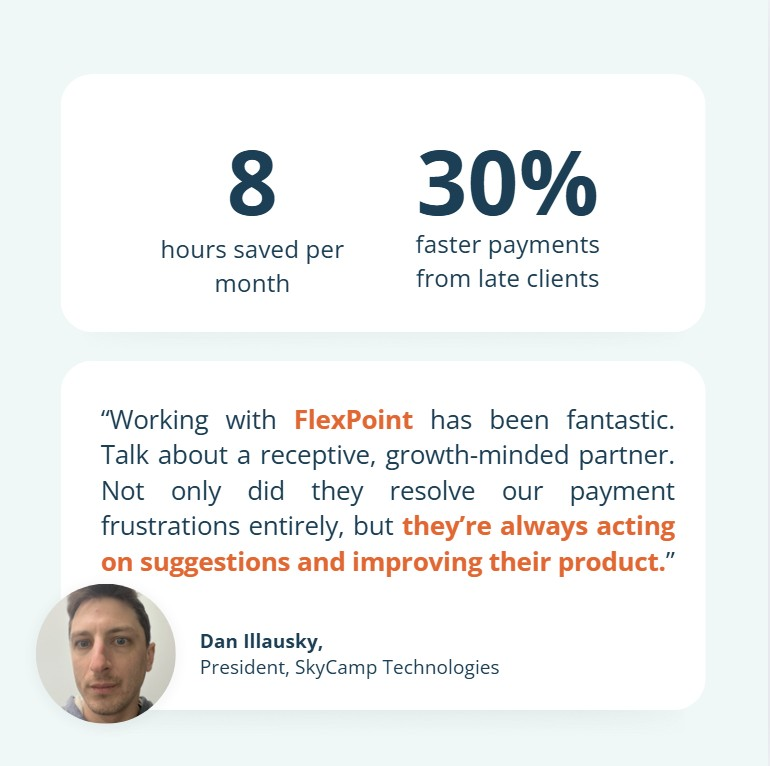
Let’s take, for instance, SkyCamp Technologies, an Ohio-based MSP, that used to juggle multiple payment processing platforms to address their billing needs.
Their ACH service via their credit card invoicing platform wasn’t optimized for small businesses, and QuickBooks ACH lacked full integration with that platform.
This meant that President Dan Illausky had to manually process each monthly ACH payment, as invoice amounts changed based on customer license counts, a time-consuming process.
SkyCamp sought end-to-end automation, a centralized billing and payments platform, and a modern interface to streamline administrative tasks and minimize potential errors.
Onboarding with FlexPoint was easy, and it could be synced with QuickBooks.
FlexPoint’s auto-syncing and reconciliation with QuickBooks Online ensured that all of SkyCamp’s accounting was in one place and made reconciliation low-maintenance.
As a result, using FlexPoint, SkyCamp achieved:
- 8 hours saved per month.
- 20% increase in AutoPay use.
- 30% faster payments from late clients.
2. Centralized Billing and Client Management:
FlexPoint streamlines billing and client management by consolidating all information into a single platform. This eliminates the data silos that often lead to confusion and revenue loss.
In addition, branded client portals enable MSPs to provide complete billing transparency. Clients can log in to see exactly which services were delivered, how much time was spent, and which charges were applied. FlexPoint retrieves all the data from the PSA to display this information to the client when they log in to the payment platform.
This level of visibility builds trust, reduces disputes, and makes clients more willing to pay for additional services.
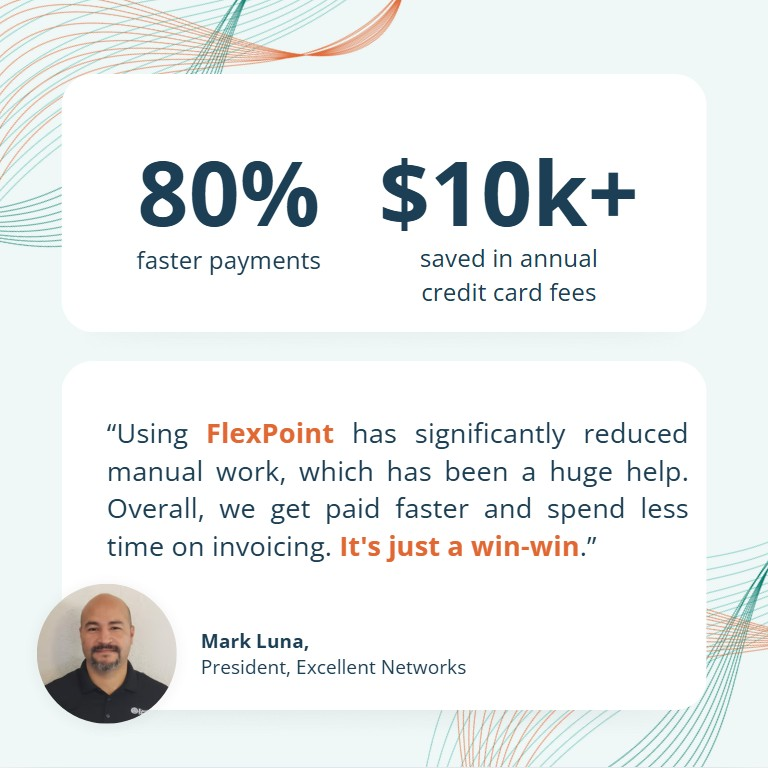
Excellent Networks, a Texas-based MSP, for instance, sent invoices through ConnectWise and collected most payments from customers via check, which sometimes got lost in the mail.
Mark Luna, President of Excellent Networks, and his lean team spent a lot of time and money on manual tasks that could have been automated.
Mark sought to streamline his company’s invoicing and eliminate this manual multitasking, as their accounting was "all over the place".
He researched what other MSPs were using as white-label payment portals and found FlexPoint.
FlexPoint’s client portal allows Excellent Networks’ clients to check their invoices and pay bills online.
This eliminated the need for Mark to send individual invoices and freed him from the end-of-year rush of invoice requests from accountants.
Clients have also shown a preference for FlexPoint’s ACH and AutoPay options, which have significantly reduced credit card fees for Excellent Networks.
This client portal ensures transparency and easy invoice access, reducing billing confusion and errors.
As a result, using FlexPoint, Excellent Networks achieved:
- 80% faster payments.
- 24 hours saved per year in billing time.
3. AutoPay and Payment Reminders
FlexPoint helps MSPs reduce underbilling and improve cash flow by automating key billing and payment processes.
One powerful feature is AutoPay, which allows MSP clients to set up automated payments processed on a predefined schedule.
This predictability in payment collection helps stabilize cash flow and eliminates the risk of missed payments or neglected invoices.
Furthermore, FlexPoint automates payment reminders, proactively notifying clients before and after due dates via email or SMS.
This reduces the administrative burden of manual follow-ups and ensures invoices remain top-of-mind for clients, drastically decreasing late payments and associated revenue gaps.
Consider, for instance, TAZ Networks, a Detroit-based MSP.
Gaby Patterson, the company’s accountant, was spending excessive time following up on overdue payments and resending invoices.
This results in a growing backlog of outstanding statements.
Gaby was manually entering all accounting statements and past due payments from QuickBooks. Hence, she sought a more standardized platform that offered automated payments and reduced payment processing fees.
TAZ Networks discovered FlexPoint and was immediately impressed by the platform’s reasonable pricing and easy-to-navigate interface.
The convenience of securely storing client credit card information via F




.png)