

The first 90 days after acquiring an MSP can determine whether the business becomes a well-integrated part of your portfolio or another operation your finance team has to manage separately.
The acquisition may be complete, but the work of integrating the business is just beginning. The business still has to keep working after all.
That's where financial integration becomes especially important.
For MSP acquirers, integrating a newly acquired business isn't simply a matter of moving its accounting records into a new system. It involves aligning billing processes, payment workflows, accounts receivable, financial reporting, and operational controls without disrupting the revenue the acquisition was intended to generate.
And while the first 90 days provide a useful window for establishing those foundations, not every financial system needs to be replaced within that timeframe.
The goal is to protect cash flow, establish visibility, and build a financial operating model that can support the acquired MSP and future acquisitions.
This guide outlines a practical 90-day financial integration action plan for MSP acquirers, including what to prioritize before close, what to accomplish in each phase, and how to measure whether the integration is working.
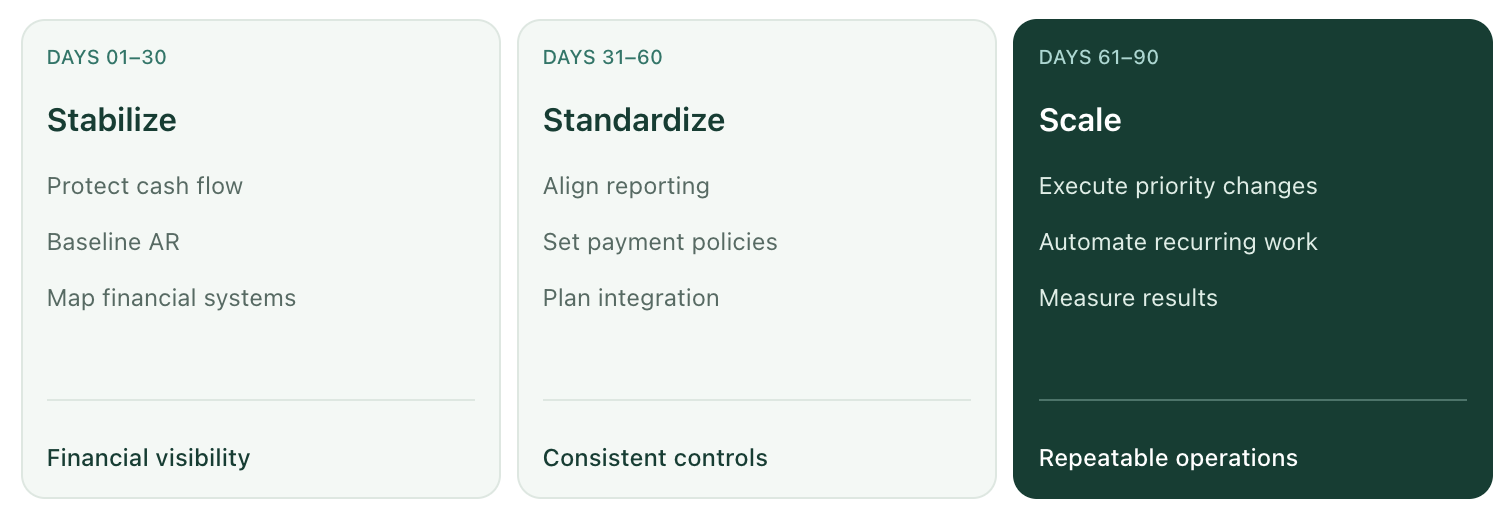
Quick answer: MSP acquirers should approach the first 90 days of financial integration in three phases. During days 1–30, stabilize billing and cash flow, establish financial visibility, and identify risks. During days 31–60, standardize reporting, payment workflows, and financial controls. During days 61–90, execute priority system integrations, automate recurring work, and establish a repeatable operating model. Full system consolidation may take longer, but the acquiring company should have reliable financial oversight and a clear integration plan by Day 90.
What is financial integration after an MSP acquisition?
Financial integration is the process of bringing an acquired business's financial operations into alignment with the acquiring company's reporting, controls, systems, and operating model.
For MSPs, that typically includes:
- Accounting and financial reporting
- Professional services automation (PSA) and billing systems
- Client agreements and recurring revenue
- Payment processing and AutoPay
- Accounts receivable and outstanding invoices
- Bank accounts and cash management
- Deposit reconciliation
- Vendor payments and financial controls
These processes are closely connected.
An MSP's PSA may generate invoices based on managed services agreements, its accounting system may serve as the financial system of record, and a separate payment platform may handle client payments and update invoice balances.
Changing one component can affect several others.
For example, migrating a PSA without understanding how invoices sync to accounting or how clients are enrolled in AutoPay can introduce billing errors, duplicate records, and payment delays.
Financial integration therefore requires more than selecting the systems the acquired MSP will use. It requires understanding how money moves through the business today and determining how that process should work after the acquisition.
Before Day 1: Establish your financial integration baseline
The best time to begin financial integration planning is before the transaction closes.
During due diligence, buyers typically focus on revenue quality, profitability, client retention, and the financial assumptions supporting the acquisition.
Those are essential considerations. But acquirers also need to understand how the acquired MSP actually generates invoices, receives payments, and maintains financial records.
A business can have attractive recurring revenue and healthy margins while relying on financial processes that are difficult to integrate or scale.
Before close, establish a baseline across five areas.
1. Revenue and client agreements
Understand how the MSP generates revenue and how that revenue is billed.
Review:
- Recurring managed services agreements
- Project-based and nonrecurring revenue
- Billing frequency and invoice timing
- Contract renewal dates and pricing arrangements
- Usage-based or variable charges
- Client-specific billing exceptions
Pay particular attention to agreements that require manual intervention each month.
Those exceptions may be manageable for the acquired MSP's current finance team, but they can become a significant operational burden when several businesses are brought into the same portfolio.
2. Accounts receivable
Request a current AR aging report and understand the quality of the outstanding balances.
Review the total amount owed, aging categories, disputed invoices, unapplied payments, and clients with significant overdue balances.
Don't assume that every outstanding invoice represents collectible cash.
Some balances may reflect billing disputes, inaccurate records, credits that haven't been applied, or services that were invoiced incorrectly.
You should also understand which pre-close receivables you would be acquiring and which will remain with the seller under the transaction agreement.
That distinction affects who owns follow-up, who receives the cash, and how those balances should be recorded after close.
3. Billing and payment systems
Document the systems involved in the MSP's billing lifecycle.
Identify its PSA, accounting software, payment processor, client portal, and any tools used for synchronization or AR automation.
Then map how those systems interact.
Where are invoices created? Which system maintains the authoritative invoice balance? How are payments applied? How do deposits reach the bank? What happens when a synchronization fails?
The answers will help determine whether the existing setup can remain in place temporarily or requires immediate attention.
4. Payment arrangements and cash flow
Understand how clients currently pay and when the business receives those funds.
Review the mix of ACH, credit card, check, and other payment methods, along with:
- Merchant-processing agreements
- Funding timelines
- Stored payment methods
- AutoPay enrollment
- Processing fees
- Bank accounts receiving deposits
- Pending settlements and payment reserves
A change in business ownership may affect merchant accounts, banking arrangements, or the ability to transfer stored payment information.
Confirm those requirements with the relevant financial institutions and payment providers before planning a cutover.
5. Financial reporting and ownership
Identify who currently owns billing, accounting, payment processing, reconciliation, and AR.
Some MSPs rely heavily on their founder or a single finance employee. Others use an outsourced accounting firm or distribute responsibilities across several departments.
Understanding those dependencies helps prevent important financial tasks from being overlooked during the transition.
It also reveals which processes need documentation before key employees or external providers change.
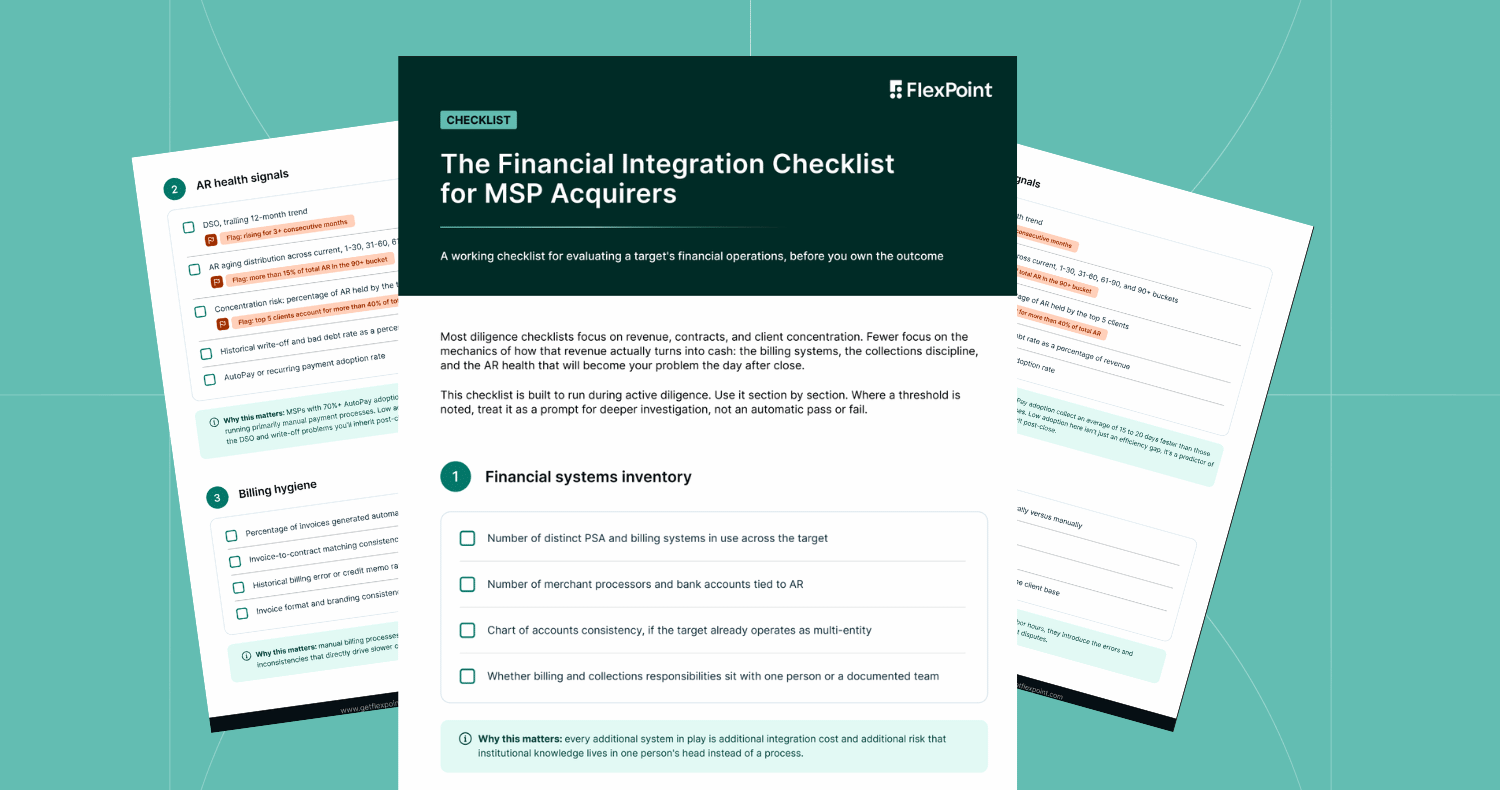
Related resource: Financial Integration Checklist for MSP Acquisitions
Days 1–30: Stabilize financial operations and protect cash flow
The first phase of financial integration should prioritize continuity.
The acquired MSP needs to keep operating while the acquiring company establishes oversight and learns how its financial processes work.
This is generally not the time to introduce unnecessary changes to client payment methods, billing systems, or accounting workflows.
Instead, focus on maintaining revenue collection, identifying immediate risks, and creating a reliable financial baseline.
Day 1: Keep the money moving
The first day after close should begin with a clear understanding of what needs to happen for the business to continue receiving and managing cash.
Confirm that scheduled invoices will still be generated, recurring payments will continue where authorized, and the appropriate people have access to the systems needed to operate the business.
A Day 1 financial checklist should include:
- Confirming access to billing, accounting, and payment systems
- Verifying bank accounts and authorized payment arrangements
- Reviewing pending ACH and credit card settlements
- Confirming the next billing cycle and AutoPay schedule
- Assigning responsibility for outstanding invoices and client billing questions
- Confirming payroll and vendor payment continuity
- Establishing a process for urgent financial or payment issues
Any changes to bank accounts, merchant accounts, or payment instructions should be coordinated with the relevant providers and approved under the transaction's legal and financial requirements.
The priority is straightforward: clients should still be able to pay, and the business should still receive and account for those payments correctly.
Days 1–10: Establish visibility into cash and AR
Once continuity is confirmed, establish a reliable view of the acquired MSP's financial position.
Begin with cash balances, expected incoming payments, outstanding receivables, upcoming obligations, and the timing of recurring billing.
This information should be available to the acquiring company's finance team even if the acquired MSP continues using its existing systems.
Create an initial financial reporting cadence that includes:
- Cash balances and near-term cash requirements
- Outstanding AR by aging category
- Expected incoming payments
- Unapplied payments and disputed invoices
- Recurring revenue and upcoming billing
- Payment-processing exceptions
- Significant vendor and payroll obligations
The exact reporting frequency will depend on the size and condition of the acquired business.
For an MSP with healthy financial operations, weekly reporting may be sufficient. A business with significant overdue receivables or cash flow issues may require closer monitoring.
The important thing is that the acquiring company doesn't have to wait until the next month-end close to understand what is happening financially.
Days 10–20: Review inherited accounts receivable
Inherited AR deserves particular attention during the first month.
The acquisition may include outstanding receivables that were generated under different billing practices, payment terms, or client relationships.
Start by separating balances into practical categories:
This helps the acquiring company avoid treating every overdue invoice the same way.
It also prevents unnecessary client friction.
A newly acquired MSP's clients may already be adjusting to a change in ownership. Contacting them about inaccurate balances or invoices that were previously paid can undermine confidence in the transition.
Establish clear ownership of inherited AR and document the next action for significant outstanding balances.
Days 20–30: Map systems and identify integration priorities
By the end of the first month, the acquiring company should have a documented view of how the acquired MSP's financial systems operate.
That includes the flow of information from client agreements and invoice creation through payment, accounting, and deposit reconciliation.
For each system, identify:
- What financial function it performs
- Which other systems depend on it
- Who owns its configuration and administration
- Whether it is working reliably
- Which manual processes surround it
- Whether it needs to be retained, integrated, or replaced
This is also the time to identify risks that could affect the next billing cycle or financial close.
For example, the acquired MSP may have a reliable PSA and accounting setup but a payment workflow that requires substantial manual reconciliation. Another MSP may have effective payment automation but inconsistent agreement data or invoice configurations.
Those businesses shouldn't necessarily follow the same integration sequence.
The system map should help determine which changes will deliver the greatest operational benefit with the least disruption.
What should be complete by Day 30?
By the end of the first phase, the acquiring company should have:
- Reliable access to financial and billing systems
- Continued billing and payment operations
- A baseline of cash flow and outstanding AR
- Clear ownership of inherited receivables
- A documented map of financial systems and workflows
- A list of financial risks and integration priorities
The acquired MSP doesn't need to be fully integrated at this point.
It does need to be financially visible, operationally stable, and ready for more deliberate changes.
Days 31–60: Standardize financial workflows and controls
Once the acquiring company understands how the acquired MSP operates, it can begin establishing a more consistent financial operating model.
This phase is about determining which processes should work the same way across the organization, regardless of whether every business uses the same software.
That distinction matters for MSP acquirers.
Full system consolidation may be the right long-term strategy, but consistent reporting, payment workflows, and financial controls can often be established before a complete migration.
Establish a common financial reporting framework
One of the first priorities should be aligning how the acquired MSP reports financial performance.
If the acquiring company operates multiple MSPs, it needs to compare their performance using consistent definitions.
That includes aligning:
- Revenue categories
- Recurring and nonrecurring revenue definitions
- Cost of goods sold and operating expense classifications
- AR aging categories
- Cash reporting
- Financial close procedures
- Key performance indicators
For example, one MSP may categorize certain project services as recurring revenue while another treats them as nonrecurring.
Without consistent definitions, portfolio-level reporting can become misleading even when each business's individual financial records are accurate.
The acquiring company's finance team should determine the appropriate reporting framework and map the acquired MSP's financial data into it.
Depending on the transaction and accounting requirements, this may also involve establishing a common chart of accounts or mapping existing accounts into a consolidated reporting structure.
Standardize billing policies
Billing practices often differ significantly between MSPs.
One business may invoice managed services agreements on the first of the month, another may bill in advance on the fifteenth, and a third may rely on several client-specific billing schedules.
Those differences aren't necessarily problems.
But the acquiring company needs to distinguish between legitimate contractual requirements and inconsistencies that create unnecessary administrative work.
Review policies around:
- Invoice generation and delivery
- Billing frequency
- Payment terms
- Invoice approvals
- Credits and adjustments
- Client-specific exceptions
- Payment reminders
- Dispute resolution
The goal is to establish a common approach wherever possible without violating existing client agreements or introducing avoidable disruption.
For example, the acquiring company may standardize how invoices are reviewed and how overdue accounts are handled while retaining different billing dates where client contracts require them.
Standardization doesn't mean forcing every client into an identical arrangement.
It means creating clear rules for how those arrangements are managed.
Align payment workflows
Payment processing is an especially important part of financial integration because it directly affects cash flow and client experience.
During this phase, determine which payment practices should be consistent across the acquired business and the wider organization.
Consider:
- Accepted payment methods
- ACH and credit card processing arrangements
- AutoPay enrollment and rules
- Payment funding timelines
- Client payment communications
- Deposit reconciliation
- Payment exception management
For MSP acquirers, this can also be an opportunity to evaluate whether existing payment platforms are creating unnecessary fragmentation.
Different payment providers may have different funding timelines, processing fees, reconciliation requirements, and client onboarding experiences.
Maintaining those differences indefinitely can make it harder to establish consistent financial operations across a growing portfolio.
However, changing payment providers should be planned carefully.
Before a transition, confirm whether eligible stored payment methods can be migrated, what client authorization is required, and how existing AutoPay arrangements will be handled.
A payment migration should simplify financial operations without interrupting recurring revenue.
Decide whether to consolidate, standardize, or retain existing systems
By this point, the acquiring company should have enough information to make an informed decision about the acquired MSP's financial technology.
There are generally three approaches.
The decision should be based on the acquired MSP's actual financial operations, not simply a preference for having fewer software tools.
For example, a well-functioning PSA may not need immediate replacement if the acquiring company can establish reliable reporting and consistent payment workflows around it.
On the other hand, an unsupported or poorly configured system may create risks that justify an earlier migration.
The most important thing is to make the decision deliberately.
Temporary retention should have an owner, a reason, and a review date. Otherwise, it can become permanent fragmentation by default.
Related: Billing Consolidation vs. Standardization After an MSP Acquisition
Create a consistent AR operating model
Financial integration should also establish how the acquired MSP manages outstanding invoices going forward.
That means more than setting a standard payment reminder schedule.
Define who monitors overdue accounts, how exceptions are prioritized, what happens when clients don't respond, and when issues need to be escalated.
A common AR operating model might include:
- Consistent aging categories and reporting
- Defined follow-up timing
- Clear ownership of disputed invoices
- Escalation procedures for significant overdue balances
- Standard payment communications
- Regular reviews of AR performance
- Visibility into account-level actions and outcomes
The acquiring company should also determine which recurring AR tasks can be automated.
As the portfolio grows, manually monitoring every account and deciding which invoices need attention can consume increasing amounts of finance team capacity.
Establishing a consistent process creates a foundation for automation and makes future acquisitions easier to integrate.
Related: How to Standardize Billing Across a Multi-Brand MSP Portfolio
What should be complete by Day 60?
By the end of the second phase, the acquiring company should have:
- A common financial reporting framework
- Defined billing and payment policies
- A consistent approach to AR management
- Documented financial controls and ownership
- A decision about which systems to retain or migrate
- An approved plan for priority integrations
The acquired MSP should now operate within a more consistent financial framework, even if some of its original systems remain in place.
Days 61–90: Execute priority integrations and build for scale
The final phase of the first 90 days is about turning the integration plan into a repeatable operating model.
Some MSPs will be ready for significant system migrations during this period. Others will need more time because of system complexity, client contracts, data quality, or broader integration priorities.
The goal isn't to complete every possible change before Day 90.
It's to execute the changes that are ready, reduce avoidable manual work, and establish clear ownership and timelines for what remains.
Execute priority system migrations
If the acquiring company has decided to migrate the acquired MSP's PSA, accounting software, or payment platform, this phase may be an appropriate time to begin or complete those changes.
The sequence will depend on how the systems interact.
For example, migrating a PSA may affect agreement data, invoice generation, client records, and accounting synchronization. Migrating a payment platform may affect stored payment methods, AutoPay enrollment, client communications, and deposit reconciliation.
Before executing a migration, confirm:
- Which system will serve as the authoritative source for each type of financial data
- How customer records, agreements, invoices, and payment information will be transferred
- How historical financial records will be retained
- Which integrations need to be reconfigured
- How the new workflow will be tested
- Who owns the cutover and exception resolution
- What contingency plan exists if the migration introduces problems
Test the complete financial workflow, not just whether individual systems are connected.
An invoice should be generated correctly, delivered to the client, paid through the intended method, reflected in the appropriate systems, and reconciled to the corresponding deposit.
If any part of that process fails, the migration isn't ready to be considered complete.
For higher-risk changes, consider a phased rollout or a controlled pilot before moving the entire acquired business.
Related: How to Handle PSA and Billing System Migration After an MSP Acquisition
Automate recurring financial work
Once core workflows are standardized, identify opportunities to reduce manual administration.
This is where financial integration can begin delivering operational benefits beyond improved reporting.
Consider the work your finance team performs every billing cycle:
- Sending or reviewing payment reminders
- Monitoring overdue accounts
- Matching deposits to underlying payments
- Investigating synchronization errors
- Updating payment information
- Responding to routine billing questions
- Preparing financial reports
Some of these tasks require judgment and should remain with the finance team.
Others are repetitive and can be handled through automation or agentic workflows, with appropriate oversight.
For example, automated deposit reconciliation can reduce the work of identifying which payments make up a bank deposit.
Rules-based AutoPay can help maintain consistent payment behavior across different client arrangements.
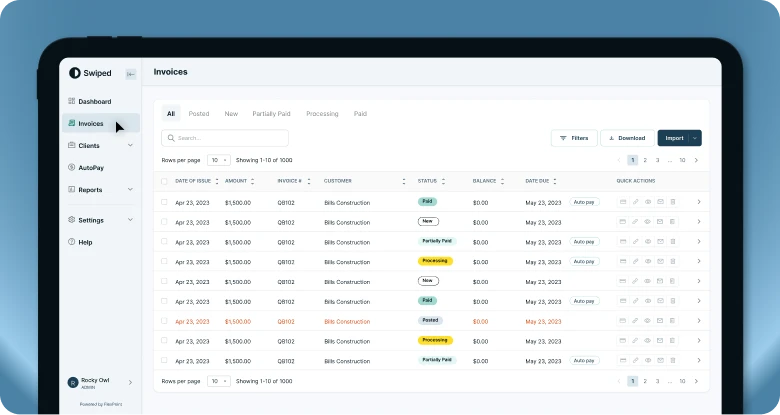
AR Agents can monitor accounts and follow through on recurring AR work that would otherwise require someone on the finance team to manage it manually.
The objective isn't to automate every financial decision.
It's to give the finance team more capacity to handle exceptions, support clients, and focus on higher-value financial work. That becomes particularly important for serial acquirers.
A financial operating model that requires additional manual administration for every acquired MSP can become increasingly difficult to scale.
Validate financial reporting and controls
By the end of the third month, the acquiring company should be able to produce reliable financial reporting for the acquired MSP.
That includes understanding its revenue, cash position, outstanding receivables, payment activity, and financial performance within the broader organization.
Review whether:
- Financial reports reconcile to the underlying accounting records
- Billing and payment data are consistent across connected systems
- Bank deposits can be traced to their underlying transactions
- Significant overdue balances have clear ownership
- Financial approvals and system access follow established controls
- Month-end close responsibilities are documented
Where discrepancies remain, assign an owner and resolution timeline.
The acquired business should no longer depend on informal explanations or individual employees to make its financial records understandable.
Document the integration playbook
The final step is to capture what the acquiring company learned during the first 90 days.
Every acquisition introduces different challenges, but the process of identifying, prioritizing, and resolving those challenges should become more repeatable over time.
Document:
- The financial information required before close
- Day 1 access and continuity requirements
- Standard reporting templates
- Billing and payment policies
- System integration decision criteria
- Migration and testing procedures
- AR ownership and escalation rules
- Common exceptions and how they were resolved
This turns the experience of integrating one MSP into a foundation for integrating the next.
It also helps prevent the organization from becoming dependent on the people who happened to manage the previous acquisition.
For serial acquirers, a repeatable financial integration playbook can be as valuable as any individual system migration.
The Day 90 financial integration scorecard
How do you know whether the first 90 days have been successful?
The answer isn't simply whether the acquired MSP is using the same PSA or accounting software as the acquiring company.
A more useful measure is whether the business is financially visible, operationally stable, and moving toward the intended financial operating model.
Use the following scorecard to assess progress.
Where possible, compare Day 90 results with the baseline established during the first month.
Useful measures include:
- Total outstanding AR
- Percentage of AR more than 60 or 90 days overdue
- Days sales outstanding (DSO)
- Percentage of eligible recurring invoices paid through AutoPay
- Payment funding timelines
- Number of unresolved reconciliation or synchronization exceptions
- Time required to complete financial close
- Hours spent on recurring billing and AR administration
Not every metric will improve within the first 90 days.
Inherited disputes, changes in billing timing, and seasonal revenue patterns can affect the numbers.
The objective is to establish reliable measurements, understand the direction of performance, and identify what needs further attention.
Five financial integration mistakes MSP acquirers should avoid
Even a well-planned acquisition can encounter problems during financial integration.
Many of the most consequential mistakes come from prioritizing the wrong work at the wrong time.
- Treating Day 90 as a mandatory migration deadline. Rushing a PSA, accounting, or payment platform migration can introduce billing errors and disrupt cash flow. Set deadlines based on operational readiness, dependencies, and risk rather than an arbitrary timeline.
- Changing payment workflows too quickly. Stored payment methods, AutoPay rules, and merchant accounts are closely tied to recurring revenue. Document existing arrangements and confirm migration requirements before making changes that could interrupt payments or require clients to re-enroll.
- Assuming inherited AR is accurate and collectible. Outstanding balances may include disputed invoices, unapplied payments, billing errors, or receivables that remain with the seller. Validate balances before assigning follow-up priorities or including them in cash flow projections.
- Confusing consolidated reporting with integrated operations. Consistent financial reports provide visibility, but they don't eliminate fragmented billing practices, payment systems, or manual work. Address both financial reporting and the processes behind it.
- Allowing temporary exceptions to become permanent. Retaining existing systems or workflows can be a sensible short-term decision. Give each exception a clear owner, a reason for keeping it, and a review date to prevent unnecessary complexity from accumulating with every acquisition.
Related: What Serial Acquirers Get Wrong About MSP Billing
How FlexPoint supports financial integration after an MSP acquisition
Even after aligning accounting and reporting, MSP acquirers may still face fragmented AR processes.
FlexPoint helps acquirers establish a consistent approach to billing, payments, and AR without requiring every acquired MSP to move onto the same PSA immediately.
- Standardize payments across different MSP systems. With native integrations for ConnectWise, Autotask, HaloPSA, and SuperOps, FlexPoint helps MSPs align payment processing, AutoPay rules, and client payment experiences while broader system integration decisions are underway.
- Improve cash flow visibility. FlexPoint provides visibility into invoices, payment activity, and outstanding receivables. Same-Day ACH is included across FlexPoint plans, subject to applicable allowances, eligibility, and cutoff requirements, helping MSPs access funds faster.
- Reduce manual reconciliation. Automated deposit reconciliation helps finance teams match bank deposits to their underlying payments, reducing recurring administrative work across acquired businesses.
- Support PSA and accounting synchronization. For MSPs using ConnectWise PSA and QuickBooks Online, GL Connect provides additional synchronization capabilities and visibility into integration activity and errors.
- Add AR capacity without adding headcount. FlexPoint's AR Agents take recurring AR work off the finance team's plate, monitoring accounts, following through on overdue invoices, and helping manage next steps as the portfolio grows.
By establishing consistent payment workflows, reconciliation, and AR processes, acquirers can build a repeatable financial operating model that makes each subsequent acquisition easier to integrate.
Conclusion: Make the first 90 days count
Financial integration after an MSP acquisition is about more than bringing financial records into a common system.
It's about ensuring the acquired business continues generating and receiving revenue, giving the acquiring company reliable financial visibility, and establishing processes that can support future growth.
And the first 90 days provide an opportunity to build those foundations.
Not every acquisition will follow the exact same timeline. So what matters is having a clear understanding of what successful financial integration looks like, who owns the work, and what needs to happen next.
Related articles