


Running multiple businesses under one parent company creates financial challenges that don't exist when you're managing a single operation.
In Intuit's 2026 Enterprise Technology Benchmark Report, 80% of multi-entity businesses reported significant bottlenecks in managing intercompany transactions and billing. Another 69% reported lacking the real-time visibility across entities needed to guide growth effectively.
Those findings aren't specific to managed service providers (MSPs), but they're particularly relevant to MSP platform companies pursuing acquisitions.
Each acquired MSP may have its own brand, customer relationships, PSA system, accounting setup, billing schedule, and payment process. As the portfolio grows, the parent company needs a consistent way to manage receivables and understand its cash position across every business.
The obvious solution might seem to be putting every acquired MSP on the same systems, sending identical invoices, and moving customers onto one payment portal.
But that approach can create unnecessary disruption, especially when the acquired businesses will continue operating under their existing brands.
The goal is to make their financial operations work together, not necessarily look the same.
The branding-continuity mistake
After an acquisition, there's often pressure to consolidate as much as possible. (One PSA. One billing system. One payment portal. One invoice template.)
The appeal is understandable. Standardization should make the portfolio easier to manage, reduce duplicated work, and give leadership a clearer picture of financial performance.
But there's a significant difference between standardizing how billing works and changing how customers experience it.
Consider an MSP that's served the same customers for ten years. Its clients recognize the company's name, receive invoices in a familiar format, and know where to go when they have payment questions.
Then the business gets acquired.
If those customers suddenly receive an invoice bearing an unfamiliar corporate name, with new payment instructions and a different portal, they may not immediately recognize it as legitimate.
Some will contact their account manager to verify the change while others may altogether delay payment while they confirm the details with their finance department.
A change intended to simplify operations for the parent company can end up creating additional work for both teams.
That's especially important in an industry built on recurring customer relationships.
MSPs depend on predictable monthly billing, established service agreements, and customers who know what to expect. Changing those arrangements unnecessarily introduces friction into a process that may already be working well.
For a multi-brand MSP portfolio, preserving the acquired company's identity can be a deliberate business decision.
Customers can continue receiving invoices under the MSP's established brand and accessing a familiar, appropriately branded payment experience, while the parent company standardizes the financial processes behind the scenes.
That doesn't mean billing should remain completely separate forever. It means the customer-facing brand and the underlying financial operation don't have to be consolidated at the same time.
Standardize the AR layer, preserve the brand layer
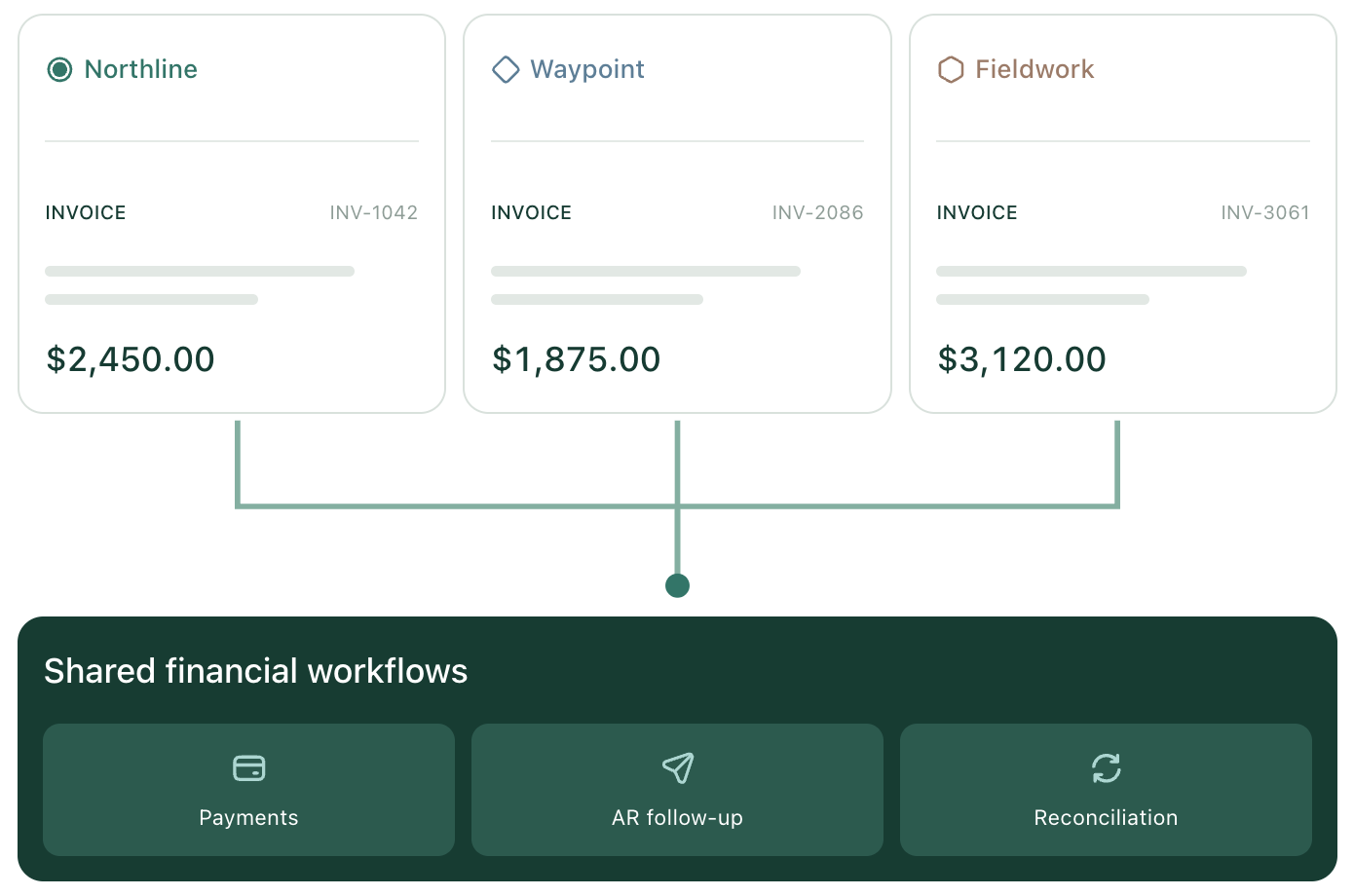
The most practical approach for many multi-brand MSP portfolios is to separate two parts of the billing experience.
The first is what customers see: the company name, invoice branding, payment portal, and communication style they've come to recognize.
The second is what happens behind the scenes: how payments are accepted, how overdue invoices are identified, how follow-up is handled, and how financial activity is reported.
The first can remain distinct across acquired MSPs but the second should be consistent.
Imagine a platform company with four MSP brands operating in different markets.
Each brand continues to serve its own customers, maintain its existing identity, and issue invoices under its established name.
Behind those experiences, however, the parent company establishes shared standards for payment acceptance, AR follow-up, reconciliation, and reporting.
The finance team can work from a consistent process rather than learning four entirely different approaches to managing receivables.
For example, one acquired MSP might currently follow up on overdue invoices after seven days, another after 30, and a third only when someone has time to review the aging report.
A standardized AR process establishes consistent rules for when invoices are reviewed, when customers receive follow-up, and when an issue needs human attention.
Those rules can be applied across brands without requiring every customer to receive a message from the parent company.
The same principle applies to payment methods and reporting.
Each brand can maintain an appropriate customer-facing experience while the parent company works toward consistent payment options, transaction visibility, and financial oversight.
This is the approach described as Option C: Shared AR and Payment Workflows in the MSP M&A Financial Integration Playbook.
Rather than requiring every acquired MSP to migrate immediately onto the same PSA and accounting system, the platform standardizes supported financial workflows across its existing environments.
A full system migration may still make sense later, but it doesn't have to be the first step toward consistent financial operations.
For MSP platform companies managing several acquisitions, that flexibility matters. It allows the business to improve how billing and payments are managed without making every integration dependent on a complete technology overhaul.
To see how this approach fits into a broader acquisition strategy, read Why Private Equity-Backed MSPs Choose FlexPoint.
Inter-company reconciliation across brands
Preserving separate brands is relatively straightforward from the customer's perspective.
The harder work happens in financial reporting.
Like mentioned earlier, 80% of multi-entity businesses identified inter-company transactions and billing as a significant bottleneck.
It's an important distinction: a parent company can have consistent payment processes across its portfolio and still face complicated accounting requirements when several legal entities operate under the same ownership.
Consider an MSP platform with three subsidiaries.
Each subsidiary invoices its own customers and receives payments into its designated bank account. The parent company needs visibility into the cash generated by each business, as well as an accurate consolidated picture.
At a minimum, finance needs to answer several questions:
- Which legal entity issued each invoice?
- Which entity received the payment, and where was it deposited?
- Does the payment match the correct customer balance and accounting record?
- Are financial results being reported consistently across the portfolio?
- Have transactions between related entities been identified and accounted for correctly?
Those last questions become particularly important when one subsidiary provides services to another or when the parent company allocates shared expenses across its businesses.
Inter-company transactions can't simply be added together as though they were external revenue.
For consolidated financial statements, qualifying inter-company balances and transactions need to be eliminated so the group doesn't overstate its revenue, expenses, assets, or liabilities.
Different account structures can make that work much more difficult.
One acquired MSP may categorize a transaction differently from another. Revenue may be recorded in different periods, or an inter-company receivable in one entity's books may not match the corresponding payable in another's.
Before the parent company can consolidate its financial statements, someone needs to reconcile those differences.
Revenue recognition can add another layer of complexity. Under ASC 606, companies must apply appropriate revenue recognition principles to their customer contracts. When subsidiaries use inconsistent account mappings or accounting practices, preparing comparable financial information can require additional review and adjustments.
Standardized payment workflows can improve transaction visibility and reduce some of the administrative work involved in matching payments and deposits.
But payment reconciliation and accounting consolidation aren't interchangeable.
A unified payments view doesn't automatically produce consolidated financial statements.
The finance team still needs appropriate entity-level accounting, consistent reporting definitions, and controls for inter-company activity.
For an MSP platform company, the practical goal is to make transaction data easier to trace and reconcile while preserving the legal and accounting distinctions that matter.
That means knowing which brand billed the customer, which entity owns the receivable, where the money settled, and how that activity should appear in both entity-level and consolidated reporting.
The cleaner those connections are, the less time finance needs to spend reconstructing them at month-end.
What “standardized enough” looks like across a portfolio
A multi-brand MSP platform doesn't need to eliminate every operational difference to achieve meaningful financial consistency.
The better question is whether leadership and finance can manage the portfolio as one business without losing visibility into its individual entities.
The MSP M&A Financial Integration Playbook uses a six-month integration horizon to evaluate whether financial operations are becoming more consistent.
For a multi-brand portfolio, several practical benchmarks are especially useful.
One view of payments, with visibility into each brand
Leadership should be able to understand payment activity across the portfolio without requesting separate spreadsheets from every acquired MSP.
That includes visibility into outstanding balances, payment status, deposits, and cash movement, with the ability to distinguish activity by brand or entity.
A consolidated operational dashboard can help the finance team spot trends and investigate exceptions while retaining the underlying entity-level detail.
That visibility should be based on the systems and accounts actually connected to the reporting environment. A payments dashboard is useful, but it isn't a replacement for bank reconciliation or a complete consolidated cash-flow statement.
Consistent AR follow-up across every business
Every brand should have a defined process for managing overdue invoices.
The timing, responsibilities, escalation rules, and exceptions should be clear, even when customer communications carry different brand identities.
That consistency matters as the portfolio grows.
Without it, the parent company may have one MSP following up promptly on unpaid invoices while another allows balances to sit untouched for weeks.
A shared approach creates more predictable financial operations without forcing customers into an unfamiliar relationship with the parent company.
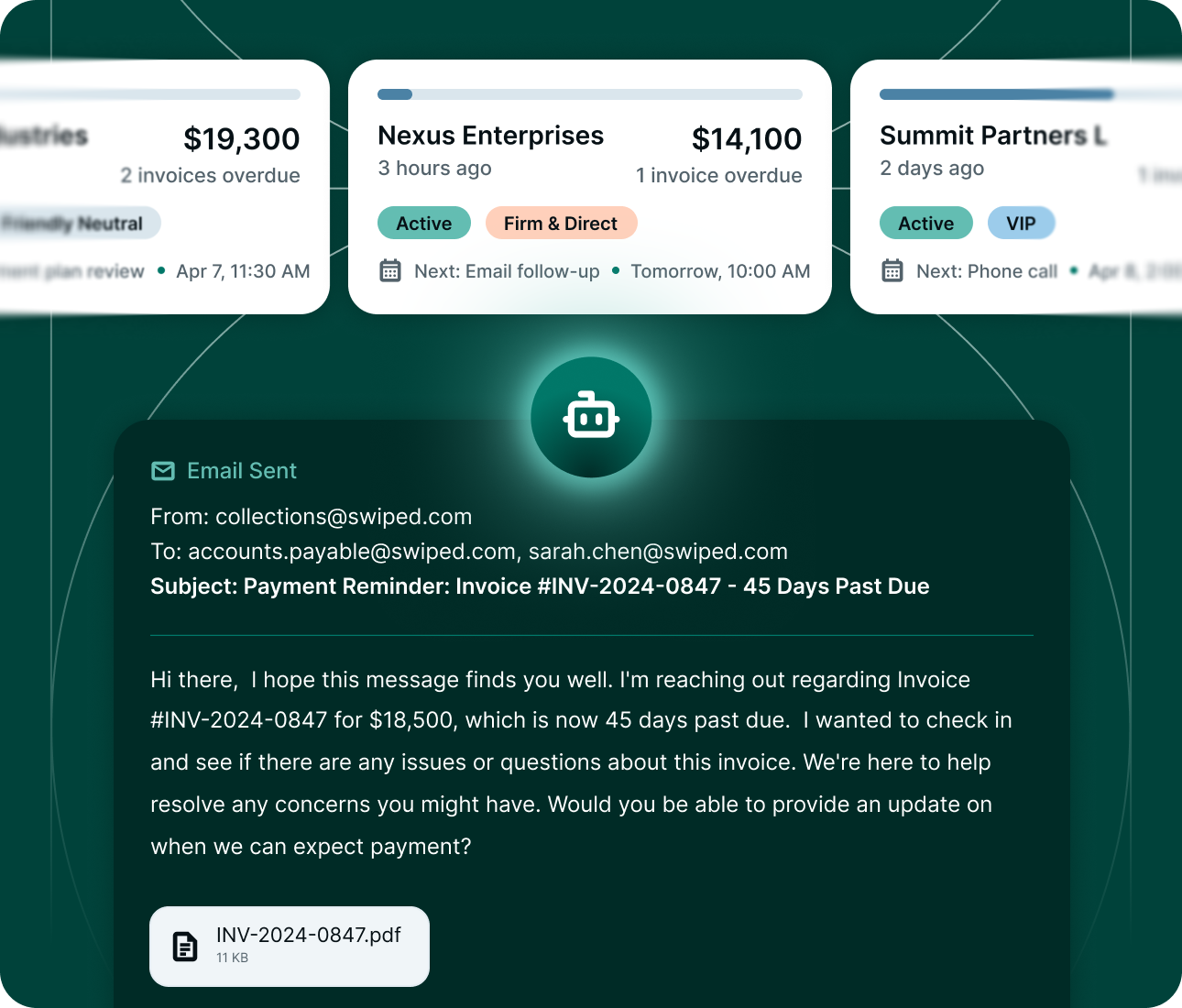
FlexPoint's AR Agents can support this by taking on recurring, supported AR follow-up work across connected environments.
Rather than requiring finance employees to repeatedly identify overdue balances and manage every routine follow-up manually, AR Agents add operational capacity while employees retain responsibility for exceptions, oversight, and customer situations requiring judgment.
Portfolio-level AR aging that can be trusted
An aging report should help the parent company understand how much money is outstanding, how long it's been unpaid, and which entities require attention.
That becomes difficult when acquired MSPs categorize balances differently, apply inconsistent follow-up practices, or maintain disconnected reporting processes.
A standardized portfolio-level AR aging view should use consistent aging buckets, reporting dates, and definitions.
Finance should be able to see the combined picture and then identify the specific customers, invoices, and entities contributing to it.
That way, a growing overdue balance doesn't disappear inside an aggregated portfolio number.
And importantly, none of these benchmarks requires every brand to send identical invoices.
One MSP might use its established logo and customer-facing language. Another might retain a separate payment portal experience. Both can participate in a more consistent financial operation behind the scenes.
The objective is to make the financial information comparable, the recurring work manageable, and the results reliable.
For platform companies evaluating their technology stack, FlexPoint's integrations provide a starting point for understanding how supported PSA and accounting environments can connect with payment and AR workflows.
One portfolio doesn't have to mean one brand
For an MSP platform company, the challenge is finding the right balance between operational consistency and the independence that made each acquired business valuable in the first place.
Consolidating every brand, system, and customer experience may seem like the simplest route to standardization.
But a multi-brand portfolio can preserve familiar customer relationships while establishing shared financial processes across its businesses.
Invoices can retain their established branding. Customers can continue interacting with the MSP they know. Meanwhile, finance can work toward consistent payment processes, AR follow-up, reconciliation, and reporting across the portfolio.
The result is a business that's easier to oversee without requiring every acquired MSP to look identical.
Standardization should make the portfolio easier to operate, not harder for customers to recognize.
The MSP M&A Financial Integration Playbook covers the financial decisions that follow an acquisition, including system integration options, billing continuity, and practical benchmarks for the first six months.
For MSP platforms looking to reduce recurring AR work as they grow, explore how FlexPoint's AR Agents can help support a more consistent approach to payment follow-up across connected businesses.