


After acquiring an MSP, one of the first operational questions is what to do with its billing systems.
Should the acquired business move onto the acquiring company's existing PSA and accounting systems? Or should it keep its systems in place, with the finance team consolidating the numbers afterward?
Most acquirers approach this as a choice between two extremes: leave everything separate or merge everything into one system.
But there's a third option worth considering.
You can standardize how payments, accounts receivable, and financial workflows operate across a portfolio without requiring every acquired MSP to use the same underlying software.
While a full migration may eventually be the right move, making it the default before evaluating the alternatives can introduce unnecessary disruption at an already sensitive point in the acquisition.
Here's how the three approaches compare, and where each makes sense.
Option A: Full billing consolidation
Full consolidation means moving the acquired MSP onto the platform company's existing technology stack, typically including its professional services automation (PSA) system, accounting software, and billing workflows.
Instead of managing several different systems, the parent company eventually operates from one.
Invoices follow the same process. Financial teams work within familiar tools. Reporting can become easier to manage, and new employees don't have to learn a different billing environment for every business in the portfolio.
For a platform acquiring a relatively small MSP with limited operational complexity, that simplicity can be valuable.
The challenge is getting there.
Billing migrations require more than transferring customer records. Recurring agreements, contract terms, billing schedules, historical invoices, payment details, tax settings, and accounting mappings all need to be accounted for. Even when the underlying data transfers successfully, the way two systems interpret that data may differ.
A contract that bills correctly in one PSA doesn't necessarily behave identically in another.
And because billing touches customers directly, errors can become visible quickly. An incorrect invoice, a missing payment method, or an unexpected change in billing cadence can create friction at precisely the moment the acquiring company is trying to preserve customer confidence.
The greatest cost of full consolidation is often the disruption required to reach the intended efficiency.
That doesn't make consolidation a bad strategy. It means the expected long-term benefit needs to justify the migration effort, operational risk, and time required to stabilize the new environment.
For some acquisitions, it will. For others, especially when the acquired MSP has a well-functioning billing operation or needs to retain its own brand identity, a full migration may solve fewer problems than it creates.
Option B: Keep existing systems and consolidate reporting
The second approach is to leave the acquired MSP's PSA, accounting software, and billing workflows largely untouched.
Each business continues operating as it did before the acquisition. The parent company then combines financial information at the reporting layer.
Initially, this can feel like the safest choice.
Customers see familiar invoices. Employees continue using systems they understand. There's no immediate migration project to coordinate, and the acquired business can focus on maintaining service quality through the transition.
For the first few weeks, that breathing room may be exactly what's needed.
The problems tend to emerge later.
When every MSP manages billing differently, the parent company's finance team becomes responsible for making those differences understandable. One entity may categorize receivables differently from another. Payment statuses may be tracked inconsistently. Reporting periods, invoice formats, and follow-up practices may vary.
Someone has to reconcile those differences before leadership can see the full picture.
Without reliable integrations or middleware, that often means spreadsheets, exports, manual adjustments, and recurring requests for clarification.
A controller who spends several hours consolidating reports each month may be able to absorb that work after one acquisition. After five or ten, the same process becomes considerably harder to sustain.
And reporting consolidation doesn't necessarily improve the underlying billing operation. It tells leadership what happened across the portfolio, but it doesn't create a consistent process for getting invoices paid or managing overdue balances.
The risk with Option B is that a temporary accommodation becomes a permanent operating model.
Keeping systems separate can be a sensible short-term decision. But unless the acquiring company establishes a plan to improve the workflows connecting them, the manual work tends to grow alongside the portfolio.
Option C: Standardization without full consolidation
The third approach separates the software an MSP uses from the financial processes the parent company wants to manage consistently.
Rather than forcing every acquired business onto the same PSA or accounting system, the parent company standardizes selected workflows across entities.
That might include how customers pay invoices, which payment methods are available, how recurring AR follow-up is handled, how payment activity is tracked, and how receivables are reported to the parent company.
The acquired MSP can continue using its existing PSA and accounting software, provided the necessary integrations and data flows are supported.
Its customers can continue interacting with the brand they already know.
Meanwhile, the acquiring business establishes a more consistent financial operation behind the scenes.
This addresses a common challenge in multi-entity businesses: fragmented billing processes that make it difficult to manage financial activity across subsidiaries.
Intuit's Enterprise Technology Benchmark reports that 80% of surveyed multi-entity businesses experience bottlenecks in managing intercompany transactions and billing.
That finding isn't specific to MSPs, but the underlying issue is relevant to acquisition-driven platform companies. Adding entities creates more financial activity to coordinate, and inconsistent workflows make that coordination harder.
Standardizing the AR and payments layer gives the acquiring business a way to improve consistency without immediately taking on a portfolio-wide systems migration.
For example, three acquired MSPs might continue using different PSA systems while adopting a common approach to payment acceptance, recurring invoice follow-up, and portfolio-level AR reporting.
The finance team can work toward more consistent visibility and procedures, while each MSP maintains the tools and customer relationships that already support its business.
Admittedly, there are limits to this approach as well.
Standardized payment workflows don't automatically produce consolidated financial statements, eliminate inter-company accounting requirements, or make incompatible systems communicate. The platform still needs reliable integrations, appropriate entity-level controls, and a defined accounting process.
But those requirements can be addressed separately from the decision to migrate every MSP onto one software stack.
For platforms expecting to make additional acquisitions, that flexibility can be particularly valuable. Instead of repeating a full billing migration after every deal, the organization can establish a repeatable set of financial workflows that new entities adopt as part of integration.
The goal is to make the next acquisition easier to absorb without requiring every acquired business to operate identically.
For a closer look at how that approach can work in practice, see why private equity-backed MSPs choose FlexPoint.
A simple decision framework for MSP acquirers
There's no universal answer to billing consolidation after an acquisition. The right approach depends on the size of the acquired business, the platform's acquisition strategy, the condition of its existing systems, and how much operational change the business can absorb.
A useful starting point is to compare each option across two dimensions: the disruption required upfront and the ongoing cost of maintaining it.
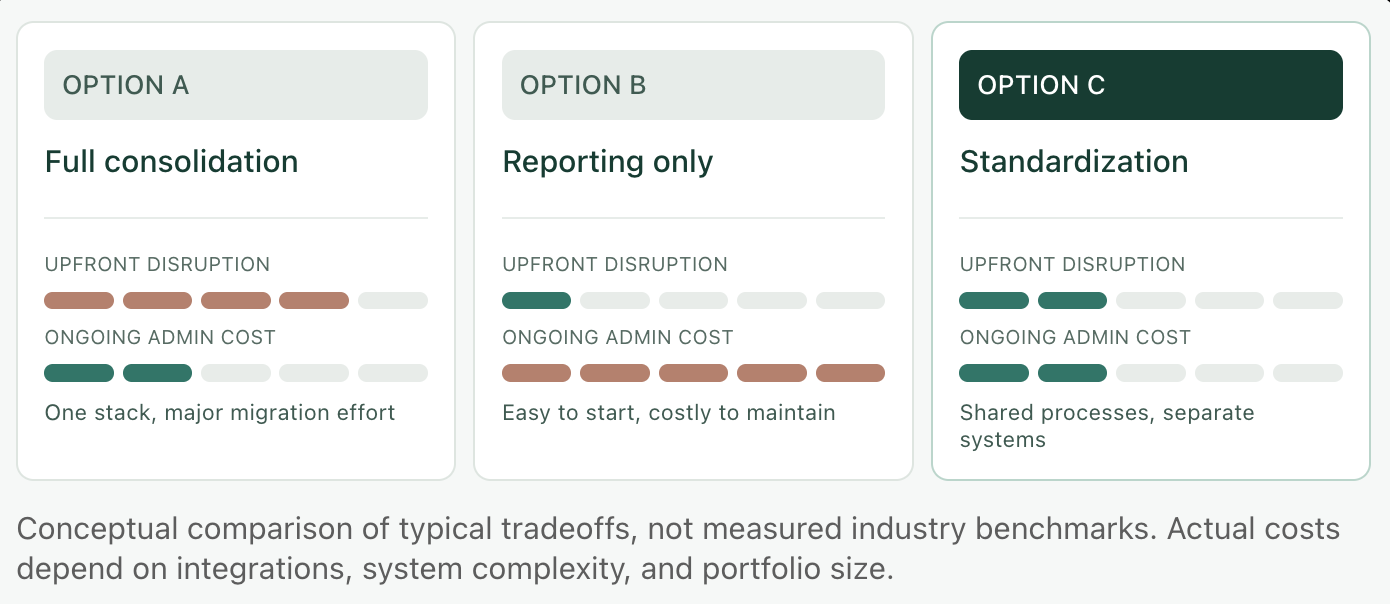
Full consolidation is most compelling when the acquired MSP is relatively small, its existing systems offer little strategic value, and the parent company has the resources to manage a controlled migration. It's also worth considering when the business will be fully absorbed into an existing operation rather than maintained as a distinct entity.
Reporting-layer-only consolidation is usually best treated as a transition. It can provide immediate continuity while the finance team evaluates the acquired business, but it should come with a timeline for addressing manual work and inconsistent processes.
Standardization without consolidation is often the better starting point for multi-brand portfolios, active roll-up strategies, and acquisitions where customer-facing continuity matters. It allows the platform to establish consistent financial processes without making every acquisition dependent on a large systems migration.
Before committing to an approach, ask four central questions:
- What actually needs to be consistent? Is the problem inconsistent payment processing, unreliable AR visibility, or the underlying PSA itself?
- What would a migration disrupt? Identify the customer agreements, recurring billing arrangements, integrations, and historical records that would need to move.
- What will this cost to maintain after the first year? Include software, integration support, manual reporting, and finance-team time.
- Will this approach still work after the next acquisition? A solution that works for two MSPs may become difficult to manage across ten.
These questions help separate operational requirements from a general preference for having fewer systems.
Make the integration decision before the migration begins
Billing is one of the few back-office functions customers interact with regularly. That makes it an unusually sensitive part of financial integration after an acquisition.
A parent company can spend months getting its systems aligned, only to create problems with invoices, payment methods, or customer communication that were working perfectly well before the deal.
At the same time, leaving every acquired MSP to manage billing independently creates its own long-term costs. As the portfolio grows, inconsistent processes make it harder to manage receivables, understand performance, and build a repeatable integration model.
The better approach is to decide which parts of billing need to be shared and which can remain independent.
For some acquisitions, that means full consolidation. For others, it means standardizing financial workflows while preserving existing PSA and accounting systems. And in the early stages of integration, it may mean keeping things separate temporarily while the acquiring business prepares for a more deliberate transition.
What matters is making that choice intentionally, with a clear understanding of the operational tradeoffs.
A well-defined integration strategy also makes future acquisitions easier to manage. Instead of debating the entire billing architecture after every deal, the platform can establish a consistent approach, identify exceptions, and focus its resources where change will have the greatest impact.
For a more detailed framework covering system integration decisions, sequencing, and financial operations after an MSP acquisition, download the MSP M&A Financial Integration Playbook.