


If you're preparing to sell your MSP to a private equity-backed buyer, it's easy to assume the most important number is revenue growth.
And growth certainly matters. But private equity firms aren't simply looking for MSPs that can generate more revenue. They're looking for businesses that can turn that growth into sustainable earnings without adding the same amount of overhead along the way.
In other words, they're evaluating operational leverage.
An MSP growing 25% annually might look attractive at first glance. But if that growth requires a proportional increase in headcount, administrative work, and operating expenses, the business may be less appealing than a slower-growing competitor with stronger margins and more efficient operations.
This matters particularly for private equity firms pursuing a buy-and-build strategy: acquiring an established MSP platform company and expanding it through additional acquisitions.
The U.S. managed services market continues to offer room for expansion. IMARC Group estimates that the market will grow from $77.2 billion in 2025 to $181.8 billion by 2034.
But a growing market doesn't automatically make every MSP an attractive acquisition.
For a private equity sponsor, the real question is whether the business has the financial consistency, management structure, and operational capacity to support future growth.
Here's what that evaluation looks like and what MSP owners can do to prepare.
Operational leverage matters more than growth alone
Operational leverage describes a company's ability to increase revenue without increasing operating expenses at the same rate.
For an MSP, that might mean adding more managed service customers without needing to hire another billing specialist, substantially expand the finance team, or create an entirely new set of administrative processes.
Consider two MSPs.
Both generate $5 million in annual revenue. Both are growing, and both have a healthy customer base.
The first MSP has doubled its revenue over several years, but its expenses have grown nearly as quickly. Every new customer adds more manual billing work, more administrative exceptions, and more demands on the owner.
The second MSP has grown more steadily. Its service agreements are standardized, its financial processes are documented, and much of its recurring billing and payment follow-up happens through established workflows.
A private equity buyer may see greater opportunity in the second business.
Not because growth is unimportant, but because the second MSP has demonstrated that it can support additional revenue without rebuilding its operations every time the business expands.
That's the difference between growing a company and building one that can scale.
What PE buyers want to see
Sponsors will examine how revenue growth has affected margins, employee utilization, and overhead.
They'll want to understand whether the MSP can add customers without requiring significant new administrative capacity, whether service delivery is consistent, and whether critical processes depend on individual employees.
They'll also look for opportunities to improve efficiency after an acquisition.
For an owner preparing to sell, this means that operational improvements made before a transaction can be just as relevant as another year of revenue growth.
Predictable cash flow and EBITDA quality
EBITDA is one of the most common measures used in valuing an MSP.
It stands for earnings before interest, taxes, depreciation, and amortization. Buyers often use it, along with appropriate adjustments, to assess operating profitability and compare potential acquisitions.
But there's an important distinction between EBITDA size and EBITDA quality.
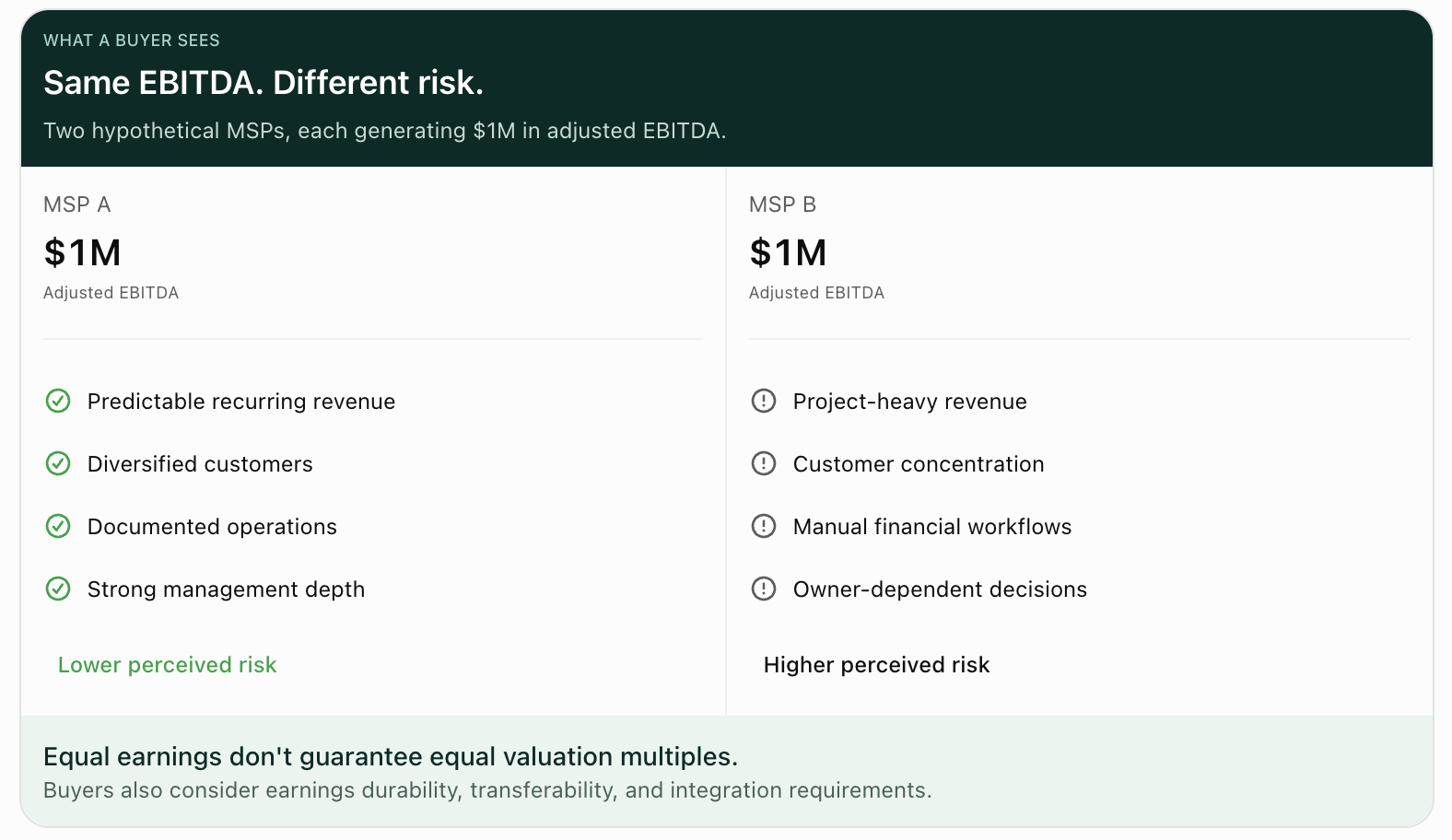
Two MSPs can report the same EBITDA while presenting very different levels of financial risk.
Imagine one MSP generates $1 million in adjusted EBITDA, primarily through recurring managed service contracts with consistent margins and strong customer retention.
Another reports the same amount, but relies heavily on irregular hardware projects, one-time implementation revenue, and a small number of large customers.
The earnings might look identical in a valuation spreadsheet. Their predictability is not.
A buyer evaluating the first MSP has more evidence that its earnings can continue after closing. The second may require additional scrutiny around revenue timing, customer concentration, and future demand.
Recurring revenue is only part of the picture
A recurring revenue mix of roughly 70–75% or higher can be a useful screening benchmark for a mature MSP, although it's not a universal private equity requirement.
Buyers will also investigate the quality of that revenue.
Are customers renewing? Are contracts profitable? Are recurring services priced appropriately? Does revenue depend on one or two unusually large accounts?
CustomerGauge's B2B benchmarks put annual churn for the broader IT services category at approximately 12%. That isn't an MSP-specific target, but it illustrates why retention deserves attention alongside new customer growth.
An MSP with strong recurring revenue today can still present meaningful risk if customers are leaving faster than the business can replace them.
Cash flow tells buyers something EBITDA can't

EBITDA also doesn't tell the entire story of how efficiently a business converts revenue into cash.
An MSP can recognize revenue, report healthy earnings, and still struggle with overdue invoices, inconsistent payment terms, or slow reconciliation.
For example, a company with $6 million in annual revenue generates approximately $16,400 in revenue per day.
If its days sales outstanding (DSO) increases by 15 days, that represents approximately $247,000 more tied up in receivables, assuming a stable revenue run rate.
That doesn't mean the revenue is lost. It means the business is waiting longer to collect cash it has already earned.
For a private equity buyer, that delay can affect working capital requirements, acquisition financing, and the cash available to support future investments.
This is why billing accuracy, AR aging, collection speed, and reconciliation practices matter during diligence.
They help buyers determine whether reported profitability is supported by a business that reliably turns invoices into cash.
Systems that scale across future acquisitions
A private equity-backed MSP acquisition often has a larger objective than improving the performance of one company.
The sponsor may be building a platform that can acquire and integrate additional MSPs over several years.
In a typical buy-and-build strategy, the platform company serves as the foundation. It may already have a management team, financial infrastructure, and operational processes capable of supporting a larger organization.
An add-on acquisition is another business purchased to expand that platform's customer base, geographic presence, service capabilities, or market share.
That distinction changes how buyers evaluate an MSP.
A sponsor considering a platform investment needs to know whether the business could absorb the next three, four, or five acquisitions without its financial operations becoming unmanageable.
And even when evaluating an add-on, the buyer needs to understand how difficult it will be to integrate that company into the existing portfolio.
Complexity should shrink as the portfolio grows
Imagine a platform that acquires four MSPs.
Each business uses a different PSA, accounting system, and payment processor.
If every acquisition adds another manual reconciliation workflow, another set of billing exceptions, and another reporting spreadsheet, the platform's administrative workload grows alongside its revenue.
The organization may be larger, but it isn't necessarily more efficient.
Now consider a platform that allows acquired MSPs to retain the operational systems they need while standardizing key financial workflows across the portfolio.
The finance team can establish consistent processes for payment acceptance, invoice visibility, AR follow-up, and reconciliation without necessarily forcing every business through an immediate full-system migration.
This doesn't eliminate every integration challenge. But it can reduce the amount of duplicated financial work created by each acquisition.
That's the kind of scalability a sponsor wants to understand.
For a closer look at this approach, see how FlexPoint supports multi-entity portfolios.
The six factors that can move an MSP's valuation multiple
An MSP's valuation isn't determined by EBITDA alone.
Buyers also evaluate the risk and durability of the earnings they're acquiring.
That's why two MSPs with identical adjusted EBITDA can receive different valuation multiples.
Six factors are particularly important.
1. Revenue mix
How much revenue comes from recurring managed services versus projects, break-fix work, and hardware sales?
A business with a higher proportion of contracted, recurring services generally offers more visibility into future revenue.
Buyers will also examine whether recurring contracts generate healthy margins rather than simply increasing revenue volume.
2. Growth and margins
Is the MSP growing consistently, and is that growth profitable?
Buyers want to see revenue trends alongside gross margin by service line, operating expenses, and adjusted EBITDA.
Strong growth is less compelling if margins deteriorate as the business expands.
An MSP that can explain which services generate the best returns gives a buyer more confidence in its future earnings.
3. Customer risk
How concentrated is revenue among the largest customers?
What do retention, churn, and customer tenure look like?
A business that depends on one major account for a significant portion of revenue may face greater risk than one with a more diversified customer base.
Buyers will also look for evidence that customer relationships can survive a change in ownership.
4. Contract quality
Not all recurring revenue is equally secure.
A buyer will examine contract length, renewal terms, termination rights, pricing provisions, and whether agreements can be assigned following an acquisition.
For example, an MSP may report strong recurring revenue but have customers operating under short-term agreements that can be canceled with little notice.
That changes how confidently a buyer can project future earnings.
5. Transferability
Can the business operate successfully without its current owner?
An MSP whose founder personally manages major customer relationships, approves financial decisions, and resolves operational problems may be harder to transfer.
A capable management team, documented responsibilities, and clear succession plans reduce that dependence.
Buyers want confidence that the business they're acquiring will continue functioning after the seller steps away.
6. Operational quality
Are financial records accurate and current? Can the company reconcile invoices, payments, and deposits consistently? Are processes documented and repeatable?
Operational quality is often less visible than revenue growth, but it can have a significant influence on buyer confidence.
A business with reliable reporting and established financial controls is easier to evaluate, integrate, and manage after closing.
An MSP with the same EBITDA but poorly documented processes may require additional diligence, transition support, or investment after the acquisition.
The larger point is that a valuation multiple reflects more than current profitability. It also reflects how much confidence a buyer has in the business's future earnings and the work required to sustain them.
Financial discipline is a signal of management quality
A private equity firm can't personally observe every operational process inside an MSP before making an acquisition.
Due diligence provides access to financial statements, contracts, reports, and management interviews. But buyers still need to form a judgment about how consistently the business is managed.
Financial processes offer useful evidence.
If an MSP can produce accurate monthly reporting, explain changes in margins, reconcile deposits, and account for overdue invoices, it suggests that management understands what's happening inside the business.
If those answers require weeks of spreadsheet reconstruction, buyers may question what else depends on undocumented processes.
That doesn't automatically mean the company is poorly managed.
Smaller MSPs often grow faster than their administrative systems, and an owner may have prioritized customers and service delivery over back-office infrastructure.
But those gaps become more important when a buyer needs to verify earnings and plan an integration.
What buyers notice during diligence
Consider a buyer requesting an AR aging report.
One MSP produces an up-to-date report, explains its oldest balances, identifies disputed invoices, and shows how payments are reconciled.
Another produces an aging report but can't easily explain which balances are collectible, which customers have informal payment arrangements, or why deposits don't consistently match the accounting records.
The second MSP might still be profitable. But the buyer now has more uncertainty to investigate.
The same applies to revenue reporting, customer profitability, service margins, and financial adjustments.
Reliable records make it easier for buyers to distinguish actual business performance from accounting inconsistencies or one-time exceptions.
They also make the acquisition process less dependent on the seller personally explaining how everything works.
This is one reason financial readiness is worth addressing before an MSP begins talking to buyers.
You don't need a perfect finance department. You need records and processes that another team can understand, verify, and eventually operate.
What makes an MSP attractive to private equity?
Private equity buyers aren't all looking for the same company.
Some want a platform with an established leadership team and infrastructure for future acquisitions. Others are seeking smaller add-on businesses that expand an existing portfolio.
Their investment strategies, preferred company sizes, geographic priorities, and valuation approaches will differ.
But the underlying questions are often similar.
Can the business generate reliable earnings? Can it retain customers? Can it grow without proportional increases in overhead? And can another management team operate it successfully after closing?
For MSP owners considering a sale, those questions provide a practical starting point.
Improving recurring revenue quality, documenting financial processes, reducing owner dependence, and strengthening reporting can make the business easier for a buyer to evaluate.
It can also make the MSP more resilient and easier to manage, whether or not a sale happens.
For owners preparing to approach potential buyers, FlexPoint's MSP Exit Readiness Guide includes a Readiness Checklist and Attractiveness Scorecard to help identify areas worth improving before diligence begins.
And for readers interested in how acquisition-driven MSP platforms approach financial standardization, read Why Private Equity-Backed MSPs Choose FlexPoint.
If you're managing a growing MSP portfolio and want to see how FlexPoint can help standardize payments, AR workflows, and financial visibility across supported systems, book a demo.
The most attractive MSP isn't necessarily the one growing the fastest.
It's the one a buyer can understand, trust, and confidently build on.