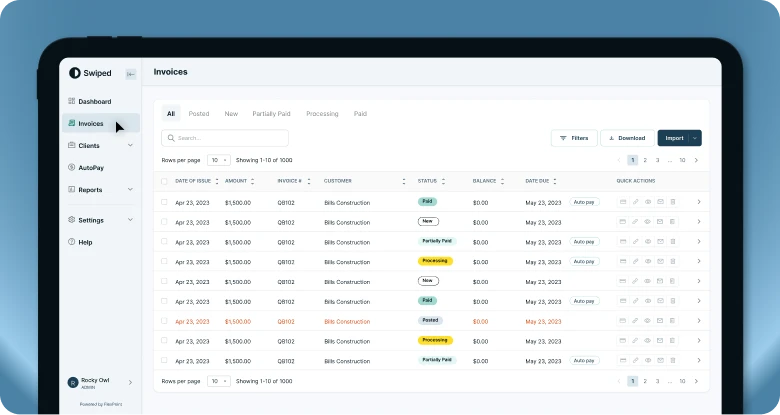


Acquiring another MSP is one thing. Integrating it into a growing portfolio is another.
Add-on acquisitions accounted for 75.9% of U.S. private equity buyout activity in Q2 2025, according to PitchBook. The buy-and-build strategy has become a defining feature of private equity, particularly in fragmented industries where acquiring smaller businesses offers a path to scale.
But buying businesses and building an integrated business are two very different things.
Harvard Business Review has cited research finding that more than two-thirds of roll-up strategies failed to create value for investors. While that finding isn't specific to MSPs, it points to a problem every serial acquirer should take seriously: adding companies to a portfolio doesn't automatically create the operational efficiencies that make those acquisitions worthwhile.
For MSP platforms, one of the earliest places that gap becomes visible is billing.
Every acquisition brings another set of customer agreements, payment methods, PSA configurations, accounting processes, and accounts receivable (AR) workflows. Without a plan to bring those financial operations together, the complexity accumulates.
Eventually, the question evolves into just how many more businesses the existing operation can support.
The “10 acquisitions, no integration” mistake
Imagine an MSP platform that completes ten acquisitions in three years.
On paper, the strategy is working! Revenue is growing, the customer base is expanding, and the business has established a repeatable acquisition process.
Behind the scenes, the finance team is managing ten different ways of getting paid.
One acquired MSP uses ConnectWise PSA. Another runs on Autotask. A third has a different accounting setup. Some customers pay through stored payment methods, others receive manual invoices, and others still rely on checks or bank transfers.
Each company may have been operating reasonably well before the acquisition. The problem emerges when the platform needs to manage them collectively.
Leadership wants consistent reporting across the portfolio. Finance needs to understand outstanding receivables, reconcile deposits, and maintain visibility into cash flow. Customers expect their invoices and payment arrangements to continue working without disruption.
Yet every new acquisition adds another set of processes that someone needs to understand, monitor, and maintain.
This is where acquisition pace can outstrip integration capacity.
A platform might have the capital to complete three more deals, but that doesn't mean its finance and operations teams have the bandwidth to absorb three more billing environments.
And if those environments remain disconnected, the work doesn't disappear after the acquisition closes. It becomes part of the platform's ongoing operating burden.
The constraint on a successful MSP roll-up isn't always the ability to close the next deal. It's the ability to integrate the last one.
Why billing complexity compounds with every acquisition
Billing complexity doesn't necessarily increase in proportion to the number of MSPs acquired.
Five small acquisitions can create more coordination work than one acquisition five times their size, particularly when each business arrives with different systems, payment arrangements, and administrative practices.
Consider what happens when an MSP platform acquires another business without standardizing its financial workflows.
The finance team now needs to understand another invoicing process, monitor another set of outstanding balances, and reconcile payments from another billing environment.
That alone creates additional work.
But the challenge becomes more complicated when the platform needs a consolidated view of the entire portfolio.
Which customers have overdue invoices? Which payments have settled? Which deposits have reached the bank? Are outstanding balances being reported consistently? Are the same follow-up practices being applied across every acquired entity?
When those answers live in separate systems, producing a reliable portfolio-wide picture requires additional coordination.
And every acquisition introduces another set of exceptions.
One business might invoice customers at the beginning of the month, while another bills according to individual contract dates. One may have established automatic payment arrangements; another may depend on someone manually following up on overdue invoices.
These differences matter because they're recurring, not temporary.
A data migration is a solitary project while billing is an ongoing operation.
Without standardization, the finance team can find itself repeating the same reconciliation, reporting, and payment follow-up work across an expanding collection of businesses.
The result is an MSP acquisition strategy that generates revenue growth while also increasing the administrative effort required to support it.
That undermines one of the central promises of a buy-and-build strategy: creating efficiencies through scale.
Standardize financial workflows, not necessarily every system

The instinct after an acquisition is often to consolidate everything.
Move the acquired MSP onto the platform company's PSA. Migrate its accounting system. Replace its billing tools. Bring every business onto the same technology stack.
There are situations where this makes sense.
But a full migration also requires careful planning, data mapping, testing, and coordination. Service agreements, invoice schedules, customer records, payment arrangements, and accounting entries all need to be handled correctly.
For a platform completing acquisitions regularly, forcing a full-system migration after every deal can create an integration backlog of its own.
There's another approach: standardize the financial workflows without immediately consolidating every underlying system.
An acquired MSP can continue using its existing supported PSA and accounting platforms while the parent company establishes consistent processes for billing, payment acceptance, AR follow-up, and reconciliation.
Instead of requiring every business to operate on identical software from day one, the platform creates a more consistent financial operation across different systems.
This distinction matters.
The platform can work toward shared payment experiences, better visibility into receivables, and more consistent reconciliation processes without making every acquisition dependent on a large-scale software migration.
It also gives leadership more flexibility. A full PSA migration can still happen when there's a clear business reason to pursue one, rather than becoming an automatic prerequisite for financial integration.
For serial acquirers, this approach helps separate two decisions that don't always need to happen together:
- System consolidation: Which PSA and accounting platforms should the business use long-term?
- Financial standardization: How should billing, payments, AR follow-up, and reconciliation operate across the portfolio?
The second decision often needs attention immediately, even when the first will take months to resolve.
For more on the financial integration decisions facing growing MSP platforms, read Why Private Equity-Backed MSPs Choose FlexPoint.
Grow the portfolio without growing the AR workload
Standardizing financial workflows addresses one part of the integration problem. The next challenge is keeping those workflows running as the portfolio expands.
Consider payment follow-up.
At one MSP, a finance employee might spend part of the week reviewing outstanding invoices, identifying overdue balances, contacting customers, and checking whether payments have arrived.
Now multiply that process across five or ten acquired businesses.
Even with better visibility, someone still needs to do the work.
Traditionally, a growing MSP platform has two options: ask the existing finance team to manage more accounts or hire additional people to handle the increasing workload.
Neither is an especially attractive long-term scaling strategy.
This is where agentic automation becomes useful.
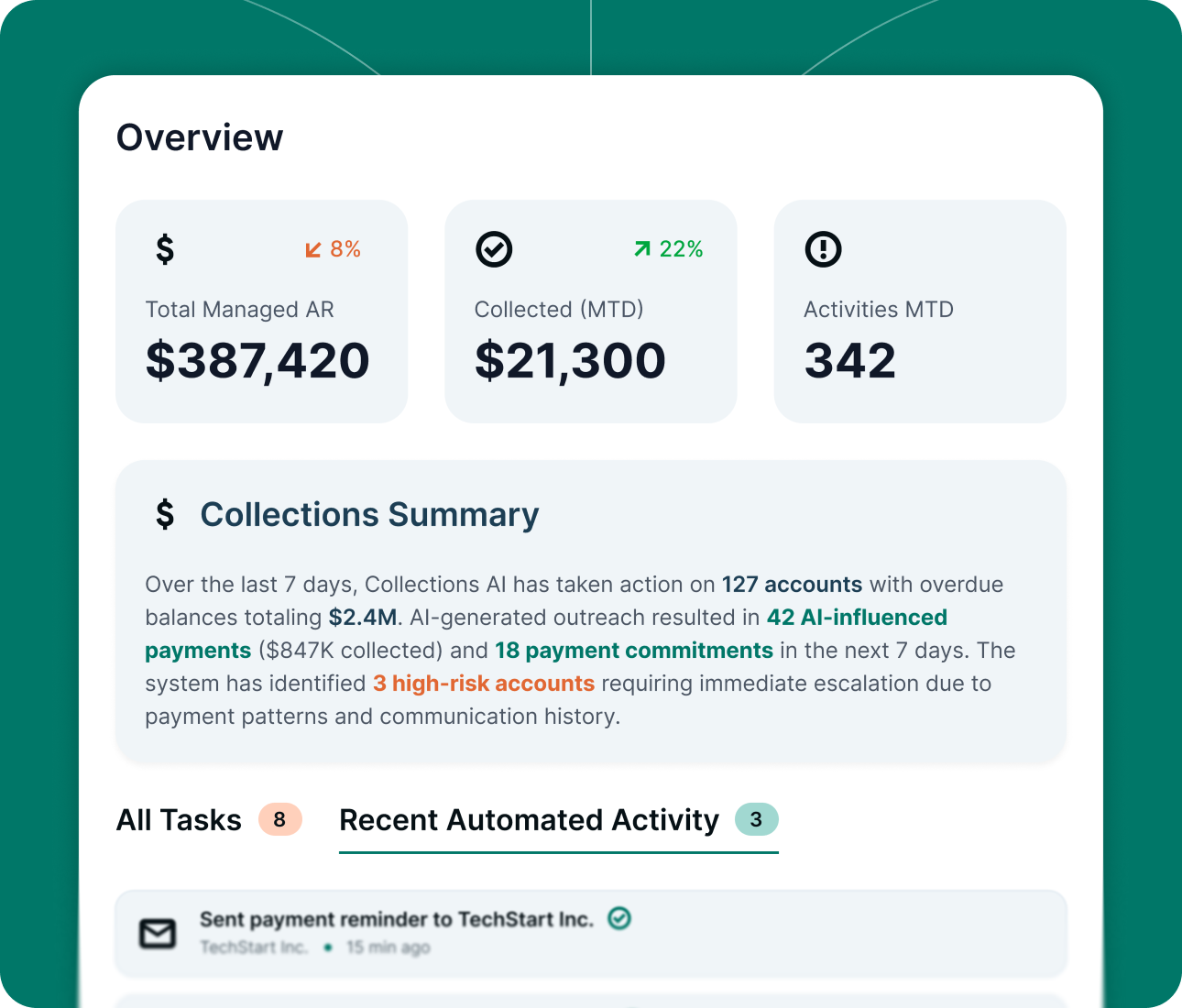
FlexPoint's AR Agents act as additional teammates for recurring accounts receivable work. They can take on supported follow-up activities that would otherwise require someone to repeatedly review balances, identify invoices needing attention, and follow through with customers.
For a serial acquirer, the value extends beyond reducing individual administrative tasks.
It creates a way to apply more consistent AR processes as new businesses join the portfolio.
Instead of developing a separate manual follow-up routine for every acquired MSP, the platform can establish a repeatable approach across supported environments.
That helps the finance team maintain continuity as the customer base grows, without requiring administrative headcount to increase at the same rate as acquisition volume.
It also means employees can spend less time on repetitive follow-up and more time investigating exceptions, resolving customer questions, and managing the financial decisions that require human judgment.
AR Agents don't eliminate the need for finance oversight, and they aren't a substitute for accurate billing data or sound integration planning.
They add operational capacity to a process that otherwise becomes increasingly difficult to manage as the portfolio grows.
For a buy-and-build strategy, that's an important difference.
The goal isn't simply to automate tasks within one MSP. It's to build financial operations that can support the next acquisition without having to rebuild the process each time.
Deal velocity depends on integration capacity
A successful MSP roll-up needs more than a strong acquisition pipeline.
It needs an operating model capable of absorbing new businesses without creating a growing backlog of financial work.
That starts with recognizing billing integration as a strategic decision rather than an administrative cleanup project.
When every acquisition introduces another independent billing and reconciliation process, the portfolio becomes harder to manage with each deal. Finance teams spend more time coordinating systems, maintaining visibility, and following up on payments.
But when financial workflows are standardized early, newly acquired businesses can fit into a more consistent operating model—even when their underlying PSA and accounting systems remain different.
That gives MSP platforms more room to grow without making every acquisition a new operational starting point.
The strongest buy-and-build strategies don't just create a repeatable process for acquiring MSPs. They create a repeatable process for operating them.
Plan the next acquisition before it closes
Whether you're integrating a recent acquisition or evaluating your next target, the financial decisions made early can determine how much complexity the business inherits later.
Download the MSP M&A Financial Integration Playbook for a practical framework covering financial records, integration decisions, and billing continuity during the first 90 days after an acquisition.
And before your next deal, use the MSP Pre-Diligence Checklist to identify financial and operational questions worth investigating before you commit to an acquisition.