


Who's buying managed service providers in this economy?
The short answer: a lot.
MSPs are being bought mostly by private equity-backed platforms (like Thrive, Ntiva, and Ekco), permanent-capital holding groups (led by Evergreen Services Group), founder-led roll-ups (like The 20 MSP), and a newer class of AI-backed holding companies (like Thrive Holdings' Shield Technology Partners). Outside investors were involved in 80% of MSP and MSSP deals in Q1 2026, up from 68% a year earlier, according to Omdia. Platforms trade at roughly 12 to 13x EBITDA and add-ons at 9 to 10x, per Drake Star's Q3 2026 update, and that gap drives much of the consolidation.
Roll-ups get a bad rap in some corners of the channel, but the capital flowing into managed services has given retiring founders a reliable exit, given growing MSPs the money and back-office muscle they couldn't build alone, and pushed the whole industry toward better tooling and more professional operations. As Omdia principal analyst Jessica Davis put it, consolidation has helped MSPs at retirement age find an exit and helped others get the capital they needed to grow.
Below, we break down who's buying heading into 2027, what they pay, what they check during diligence, and why your billing and AR data affects your price more than most owners expect.
How many MSPs are being acquired?
Roughly 280 MSPs a year have changed hands since 2022, and 2026 is on pace to beat 2025. Aventis Advisors counts about 2,500 MSP acquisitions from 2015 to 2025, with volume peaking at 304 deals in 2024.
Deal counts vary depending on who's counting. Aventis counts 291 MSP deals in 2025. Solganick, which folds in managed security providers, counts 466 MSP and MSSP transactions worth $4.3 billion, up 20% on 2024. Omdia counts publicly announced deals only and lands lower. Each tracker defines the market a little differently, so the totals don't exactly match.
But they do agree on the trend:
- 2026 ran hot. Omdia counted 64 MSP acquisitions in Q1 2026, up 73% year over year. Drake Star logged 111 M&A deals in Q2 and 110 in Q3, plus 12 private placements.
- Private equity is involved in more deals. A fund took part in about half of MSP acquisitions in 2025, up from 15% in 2015, and add-ons to PE-backed platforms grew from one deal in ten to four in ten over the same stretch, per Aventis.
- Repeat buyers take the lead. Buyers with three or more MSP acquisitions took 36% of deals from 2023 to 2025, versus 22% from 2015 to 2019. Yet the market is still wide open: more than 500 different buyers bought an MSP from 2023 to 2025.
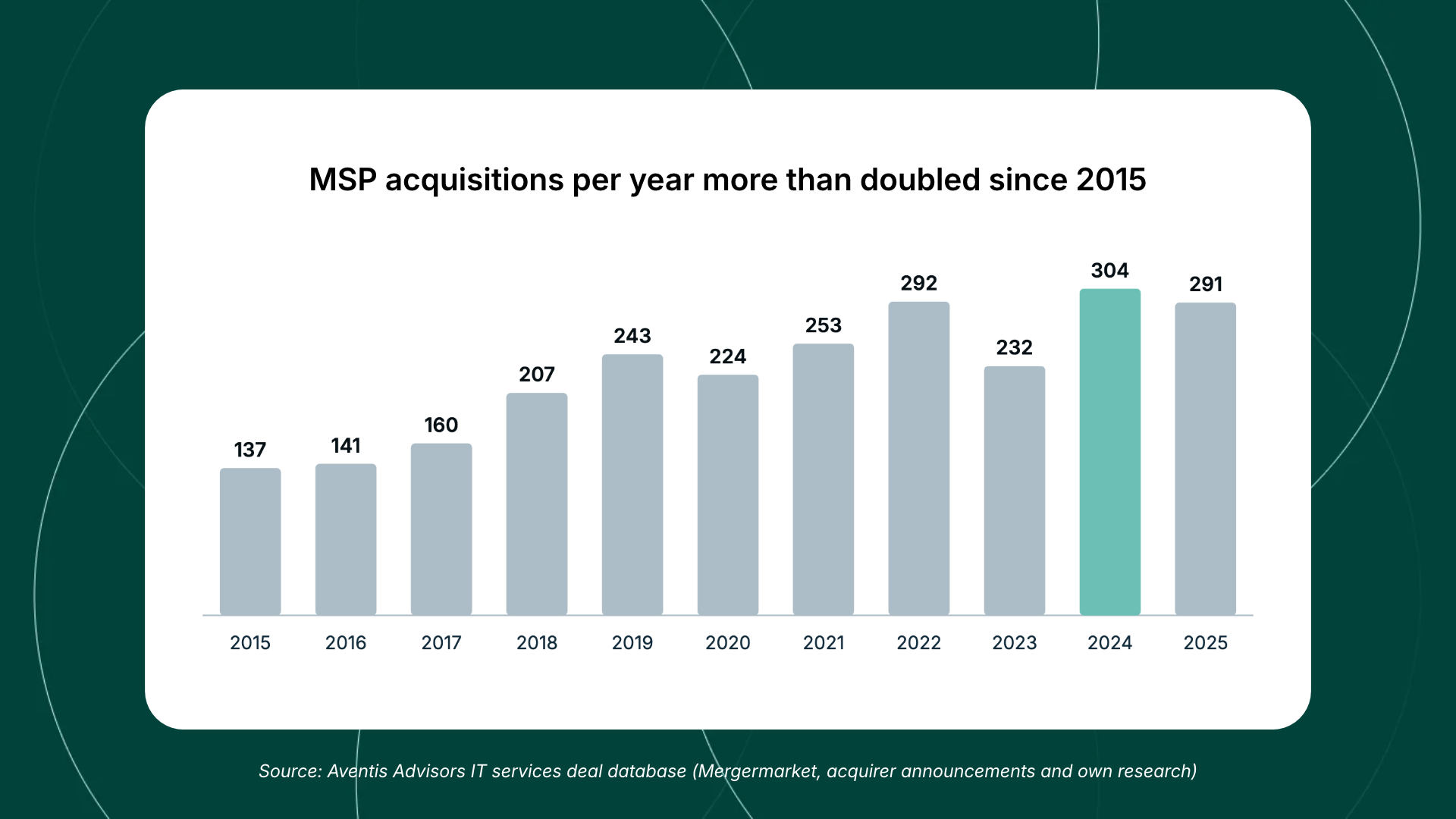
Volume has held near 300 deals a year since 2022, with 2024 the high-water mark so far. At the time of writing this, though, there's still a six weeks left in 2026.
What are MSPs selling for in 2026?
The median MSP sells for about 9.9x EBITDA, but size and scale move the number more than anything else. Here's how the major sources break it down.
The gap between platform and add-on multiples is why roll-ups work. A platform buys a smaller MSP at around 9x, and once that MSP is part of a business valued at 13x, its earnings are worth more. For sellers, that means buyers pay more for MSPs that are easy to integrate, and billing is a big part of that (more on this below).
One caution for sellers: Drake Star noted that deal flow from MSPs with $2M to $6M in EBITDA picked up over summer 2026, and more supply may put modest pressure on multiples. Demand is strong, but sellers have more competition than they did a year ago.
Price expectations are becoming a sticking point too. According to Solganick, 57% of dealmakers cited valuation expectations as the main reason deals fell through in the first half of 2026, up from 28% in 2025. Well-run MSPs under $2M in EBITDA can still clear 10x when multiple qualified buyers compete.
What kinds of buyers acquire MSPs?
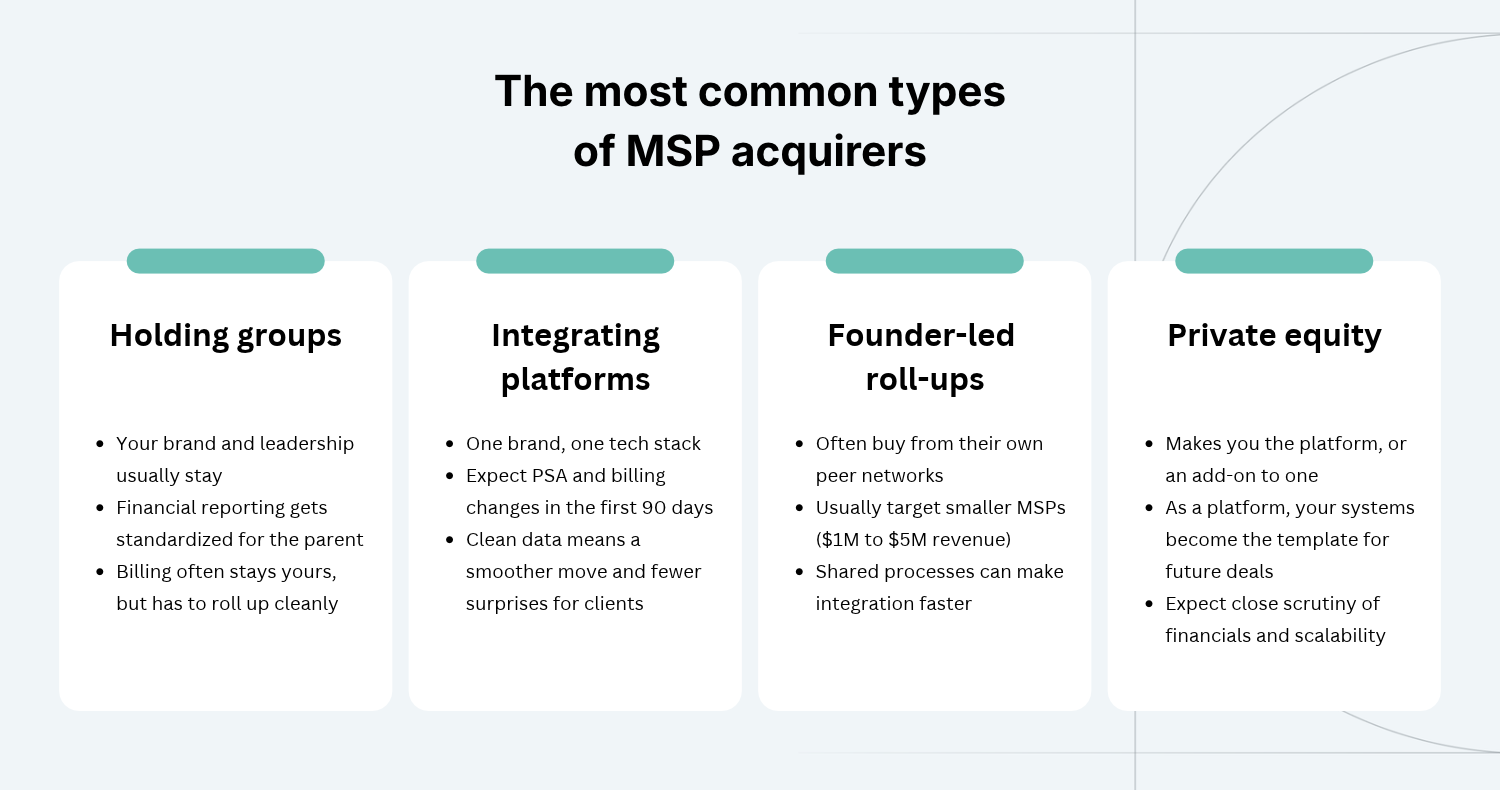
Most MSP buyers fall into four camps: holding groups that keep your brand, integrating platforms that fold you into theirs, founder-led roll-ups that buy from their own networks, and private equity funds buying directly. The type of buyer determines what happens to your brand, your team, and your billing after the deal closes.
Here's who's been busiest, according to Aventis Advisors' 2015 to 2025 deal count:
FYI: Thrive the MSP platform (backed by Court Square and Berkshire Partners) is a completely different company from Thrive Holdings, the Thrive Capital affiliate that OpenAI invested in. More on the second one in a minute.
Holding groups: keep your name, join the family
Holding groups buy MSPs and let them keep operating under their own brands. Evergreen Services Group is the heavyweight here. Omdia confirmed 47 Evergreen acquisitions in 2025 alone, and its Lyra Technology Group platform passed $1 billion in annual recurring revenue in June 2025. Evergreen's stated goal is $5 billion in revenue by 2030. Evergreen says on its website that it looks for at least $3M in revenue and $500K in EBITDA with high recurring revenue.
What it means for you: Your brand, leadership, and client relationships largely stay put. The parent company still needs clean, comparable financial reporting from every company it owns, which means your invoicing, collections, and revenue recognition need to roll up neatly, even if your logo stays on the door.
Integrating platforms: one team, one stack
Integrating platforms bring every acquisition onto a shared operating model, usually under one brand. Thrive, Ntiva, Ekco, and Air IT all work this way. The 20 MSP is the most aggressive example: it moves each acquisition onto its technology stack within 60 to 90 days, from LOI through full integration.
What it means for you: Expect your PSA, accounting, and billing processes to change. The faster and cleaner your data migrates, the smoother your first 90 days (and any earnout tied to them) will go.
Founder-led roll-ups: buying from the inside
The 20 MSP deserves its own category. Omdia reports it has acquired and integrated 48 MSPs in under four years without a private equity sponsor, making it the second most acquisitive company in the MSP market behind Evergreen. Its advantage is a member network of about 175 MSPs that already use its shared technology, services, sales, and billing processes. By the time The 20 makes an offer, it already knows the target's financials, customers, and culture.
The 20 targets MSPs with $1M to $5M in revenue and was aiming for 12 to 15 acquisitions in 2026. Most PE platforms target larger MSPs, so The 20 gives smaller owners an exit option they might not otherwise have.
Private equity buying directly
Funds also buy MSPs outright, either to start a new platform or to add to one they already own. Shore Capital Partners made all seven of its MSP buyouts from 2024 on, and Abry Partners, KKR, and EQT have all been active. Drake Star counted 12 private placements in Q3 2026 alone, double the prior quarter, led by PE platform investments in MSP Corp., ECI, PLENTICON, and OryxAlign.
What it means for you: If a fund wants you as a new platform, you're the foundation everything else gets built on. They'll scrutinize whether your systems can absorb five, ten, or twenty more companies. If your billing depends on one person who knows where everything lives, a platform buyer will flag it early.
Are AI-focused companies buying MSPs?
Yes. It's one of the bigger changes in MSP M&A over the past year. A new kind of buyer pairs acquisition capital with in-house AI engineering, buying MSPs specifically to rebuild how they operate. The most visible example is Shield Technology Partners, backed by Thrive Holdings, which counts OpenAI among its owners.
Here's the timeline:
That's $200 million and 20 MSPs in about 15 months.
How AI-backed buyers think differently
Traditional platforms buy MSPs and then look for efficiencies. AI-backed holding companies buy MSPs because of the efficiencies they think they can unlock. Shield's Forge platform targets helpdesk tickets, account management, and project engineering, and Channel Dive reports it closed tickets nearly 25 times faster than technicians in testing.
When Shield's head of technology described which AI agent gets reused most across its portfolio, it wasn't a helpdesk agent. It was a billing reconciliation agent.
That tracks. Almost every MSP has the same issue: vendor costs from Pax8, Microsoft, and distributors need to be accurately mapped to the line items invoices to clients. A problem that shows up across an entire portfolio is a natural place to start automating.
Clean data is a problem FlexPoint was built for. We sync billing data across PSA and accounting tools so invoices match what you billed, payments match deposits, and AR Agents handle the follow-up so overdue invoices get paid. It's also a useful signal of where buyers expect the back office to be automated.
Will AI-backed buyers replace traditional PE roll-ups?
No. They're a new addition to the market. What AI-backed buyers are changing is the bar. According to Drake Star's Q2 2026 update, buyers now pay for MSPs that have embedded AI into service delivery, not ones that just sell it as a service line. Across buyer types, operational maturity now carries more weight in pricing.
Who will be buying MSPs in 2027?
Mostly the same buyers that are active today, along with a few new ones. The biggest consolidators have raised fresh capital or publicly committed to keep buying, and new categories of buyer are circling the recurring revenue MSPs generate.
The largest buyers have capital to keep going. Evergreen is chasing a $5 billion revenue goal by 2030. Your.Cloud's parent raised €800 million in January 2025, and Thrive named a head of corporate development in October 2025 while saying it was "doubling down on M&A". The 20 MSP has said international expansion may become part of its strategy, and that it may eventually consider outside capital.
Global systems integrators are moving in. Accenture launched a midmarket IT services unit called Accenture Edge in June 2026, and Omdia's Jessica Davis noted that one analyst flagged Accenture had technically crossed over into being a pure-play MSP by Omdia's definition. Cognizant's $600 million acquisition of Astreya led Q2 2026 deal value.
Specialized MSPs get higher offers. Drake Star's Q3 2026 headline was that strategic buyers are paying up for specialization, and that generalist MSPs without a clear angle are the ones feeling pressure. Security is the obvious example: Omdia tracked 14 MSSP deals in Q1 2026 alone, half of them PE-backed.
AI maturity matters more in diligence. This is already happening. Buyers have already started pricing AI adoption into offers, and the MSPs that can show automated operations (not just an AI service line on the website) will be the ones commanding the top of the range.
Solganick expects AI service delivery to become part of how buyers underwrite deals through 2027, with automation of tier-one support priced in as future margin. MSPs that need to add headcount to grow are being repriced against those that don't.
For sellers, 2027 should be a strong but more selective market. Buyers will be active, and the best offers will go to MSPs that are specialized, well run, and easy to integrate.
What do MSP buyers look for in diligence?
Buyers pay for predictable, recurring revenue that can run without the founder. Diligence is how they confirm your revenue is actually recurring, actually collectible, and likely to stay after you step back.
The main factors, according to Aventis, Drake Star, and other M&A advisors:
- Recurring revenue on managed-service contracts. As Omdia's Davis put it plainly, ARR is what attracted private equity to managed services in the first place, because it's so predictable.
- Low founder dependence. If every client relationship runs through you, the business may struggle once you step back.
- Low client concentration. If a few clients make up most of your revenue, losing one after closing has a big impact.
- Specialization. Vertical expertise and security capabilities command a premium in 2026.
- Operational maturity, including AI. Buyers want proof that automation is already working inside the business.
What moves the multiple?
Some of these factors have a measurable effect on price. Solganick's Q3 2026 report puts numbers on them in turns, where one turn equals one times EBITDA. On an MSP with $2M in EBITDA, one turn is worth about $2M in sale price.
Why billing and AR show up in your valuation
Your billing and AR data is where buyers verify most of that list. Recurring revenue only counts if contracts match invoices and invoices turn into cash. A buyer's quality of earnings team will pull your AR aging, calculate your days sales outstanding, compare what you contract against what you bill, and look for revenue leaking out through unbilled licenses or missed usage.
And the multiple only applies to EBITDA the buyer believes. Aventis advises sellers to ask whether an offer's multiple applies to reported EBITDA or a figure the buyer has adjusted. Messy billing gives buyers reasons to adjust it down.
Common billing red flags in diligence:
- Receivables aging past 60 or 90 days. 43% of US B2B invoices are paid late, and the longer an invoice sits, the harder it is to collect. Automated follow-ups that start when an invoice goes out keep balances from aging in the first place.
- Collections that depend on the owner remembering to send a reminder at 9 p.m. Buyers see that as founder dependence. When AI agents handle reminders and follow-ups, collections keep running no matter who's in the office.
- Vendor costs that don't match what clients are billed. Every unbilled Microsoft seat or distributor SKU lowers margin and EBITDA. Syncing PSA and distributor data before invoices go out catches those gaps before a buyer does.
- Paper checks and deposits matched to invoices by hand. Offering ACH and card payments, with automatic deposit reconciliation, gets cash in faster and gives buyers a clean record of what was paid and when.
- Spreadsheets bridging the PSA and the accounting system. If nobody can produce a clean revenue report without a week's notice, diligence will drag. Connected billing and accounting data means the numbers are ready when buyers ask.
All of these can be fixed before you go to market, and fixing them improves cash flow whether you sell or not. Automating billing reconciliation and collections with a platform like FlexPoint also gives buyers revenue data they can verify.
What happens to billing after an MSP acquisition?
It depends on who bought you. Integrating platforms usually consolidate billing onto one system and one process, while holding groups more often standardize reporting and leave each company running its own invoicing. In both cases, billing tends to change early, and mistakes are easy to make.
We've written more on choosing the right model in billing consolidation vs. standardization after an MSP acquisition and on standardizing billing across a multi-brand MSP portfolio. Clients notice billing changes quickly. An incorrect invoice right after a sale can put a relationship at risk, and first-year churn can cut into earnout payments.
FlexPoint helps on both sides of a deal. For acquirers, it gives every company in the portfolio the same billing, payment, and collections engine without forcing a rip-and-replace of the PSA, so integration is faster and reporting rolls up cleanly. For sellers, running on it before a sale means the buyer inherits an automated, reconciled process instead of a project. AR Agents also keep payment follow-ups running during the transition, so collections don't stall.
How do I get my MSP ready to sell?
Start 12 to 18 months before you want to go to market, and focus on the things a buyer will verify: recurring revenue, financial clarity, and how much of the business depends on you. Here's a practical checklist.
- Know your numbers cold. MRR, growth rate, churn, gross margin, and EBITDA margin. Buyers will ask for them early.
- Reconcile what you buy against what you bill. Match every Microsoft seat, distributor SKU, and license to a client invoice. Unbilled usage lowers your margin and the EBITDA a buyer will credit.
- Clean up your AR aging. Collect or resolve old balances, and get your days sales outstanding down before buyers review it.
- Take yourself out of collections. If you're the one chasing late invoices, automate it. Founder dependence in billing counts against you just like founder dependence in sales.
- Make contracts and invoices tell the same story. Every recurring charge should trace back to a signed agreement with clear terms.
- Connect your systems. Your PSA, accounting, and billing platforms should share data without a spreadsheet in the middle.
- Show your AI work. Document where automation already runs in your operations, from ticket triage to billing reconciliation. Buyers are asking about it.
- Talk to more than one buyer. With 500+ active buyers in the market, comparing offers shows you what your business is really worth. Ask to speak with founders the buyer has already acquired.
Half of this list is back-office work. M&A headlines focus on capital and AI, but a lot of your sale price depends on how well your finance operations run. Book a FlexPoint demo to see what automated billing and AR could look like before a buyer ever asks.
Related articles