


Signing a letter of intent (LOI) can feel like the moment you've finally sold your MSP. You've found a buyer, agreed on a valuation, and already started imagining what comes next.
But a signed LOI is not a completed sale.
Industry estimates suggest roughly one in three signed LOIs never reach closing. Even deals that eventually close can undergo significant changes to price, payment terms, or the seller's future responsibilities along the way.
Most explanations of the MSP acquisition process focus on what buyers should investigate.
But this article is about what happens on the other side of the table: what you'll be asked to prove, which decisions you'll need to make, and how to protect the exit you've spent years building toward.
Here's what to expect from the initial offer through your first months, and potentially years, after closing.
1. An LOI is just the opening move, not the finish line
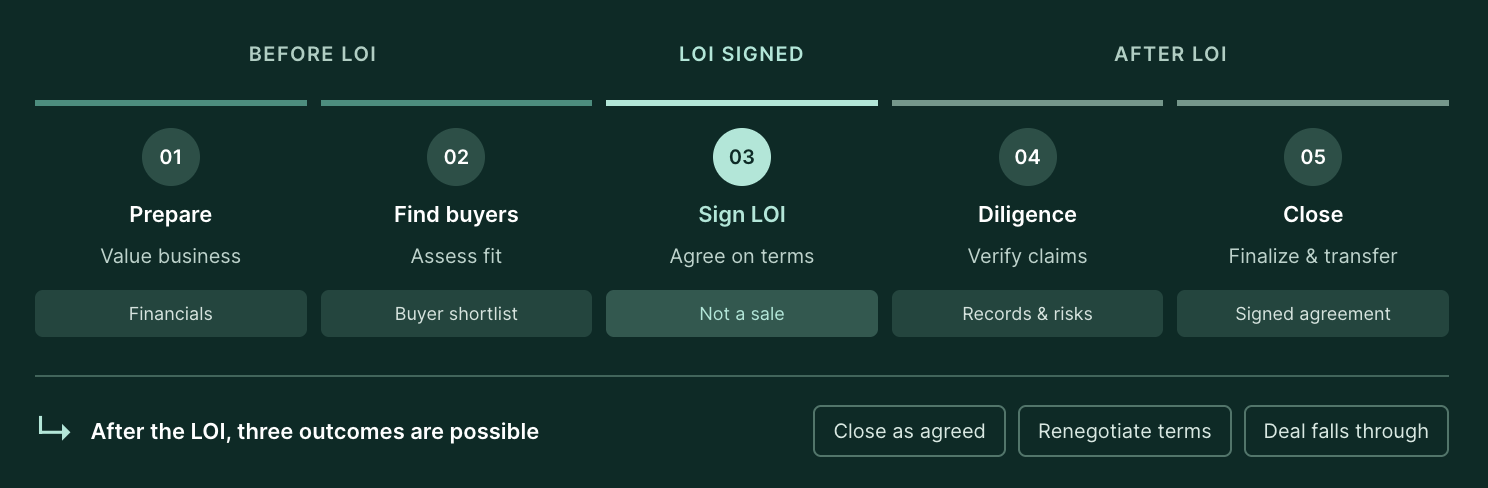
A letter of intent outlines the proposed terms of an acquisition before the parties negotiate and sign a definitive purchase agreement.
It typically establishes an initial valuation, the proposed deal structure, major conditions to closing, and an expected timeline. It may also include an exclusivity period during which you agree not to negotiate with other prospective buyers.
Most of the proposed economic terms are generally nonbinding, but provisions covering exclusivity, confidentiality, expenses, or other matters may be binding. That's why an LOI deserves careful legal review even before formal diligence begins.
While an LOI is the buyer saying they're interested enough to investigate the business further, it isn't a guarantee that they'll complete the purchase on the proposed terms.
Axial's 2025 Dead Deal Report examined 75 unsuccessful transactions that had reached the signed-LOI stage. The report highlights how frequently financial findings, renegotiation disputes, and financing problems can derail an acquisition after both parties have already invested considerable time.
Broader industry estimates suggest roughly a third of signed LOIs fail to close, while a meaningful share of completed deals experience a post-LOI adjustment to price or terms.
For a seller, the important distinction is between the number initially offered and the deal that ultimately closes.
A buyer might propose $5 million for your MSP, then discover during diligence that your adjusted EBITDA is lower than reported or that a major customer contract is less secure than expected.
That could lead to a reduced purchase price, a larger earnout, additional protections for the buyer, or a decision to walk away.
Not every adjustment is unreasonable.
Sometimes new information genuinely changes the economics of a transaction. But you should understand which assumptions support the original offer and what could cause those assumptions to change.
Before signing an LOI, ask your advisors to help you clarify the proposed purchase price, how it will be calculated at closing, the sources of financing, any expected earnout or rollover equity, and the circumstances under which the buyer may seek revised terms.
The closer those expectations are to reality at the outset, the fewer surprises you'll have later.
2. What diligence actually tests, from the seller's side
After signing an LOI, the buyer begins verifying the business they've agreed in principle to acquire.
This is due diligence.
For an MSP owner, diligence can feel like having years of business decisions examined all at once. The buyer may request financial statements, customer contracts, billing records, employee agreements, vendor arrangements, insurance policies, and information about how your services are delivered.
And diligence has become more extensive.
Research from Bayes Business School and SS&C Intralinks, examining more than 900 global M&A transactions, found that the average pre-announcement diligence period increased from 124 days in an earlier study to 203 days in the more recent analysis.
Those figures cover a broad range of M&A transactions, not a typical MSP-specific LOI-to-close timeline. Still, they illustrate how much time and documentation buyers may devote to verifying an acquisition.
Financial surprises are a major reason deals fail
Axial's 2025 report found that diligence-related problems accounted for approximately 46.6% of the unsuccessful LOIs it examined.
That included 25.3% attributed to findings outside formal quality-of-earnings work and another 21.3% involving quality-of-earnings or EBITDA discrepancies.
Other reported reasons included renegotiation disputes (14.7%) and financing constraints (10.7%).
For an MSP seller, those percentages point to a practical problem: the information used to justify the offer must hold up when the buyer asks for supporting evidence.
Consider an MSP reporting $400,000 in adjusted EBITDA.
The seller has added back $75,000 in expenses, including owner-related costs and several purchases described as one-time.
During diligence, the buyer discovers that some of those expenses are actually recurring and that replacing the owner's operational responsibilities will cost more than expected.
The buyer may conclude that sustainable EBITDA is lower than the figure used to establish the purchase price.
The issue isn't necessarily that the seller intentionally misrepresented anything. But the discrepancy can create doubt about the quality of the financial information and the price the buyer is willing to pay.
What buyers will ask you to produce
For an MSP, common diligence requests include:
- Financial records: Historical financial statements, tax returns, adjusted EBITDA calculations, general ledger detail, and supporting documentation for add-backs.
- Revenue and contracts: Recurring revenue schedules, customer agreements, renewal dates, service commitments, and customer concentration data.
- Accounts receivable: AR aging reports, days sales outstanding (DSO), payment disputes, write-offs, and collection trends.
- Operations: Service delivery procedures, PSA and accounting workflows, vendor dependencies, cybersecurity practices, and key employee responsibilities.
- Legal and personnel records: Employment agreements, intellectual property ownership, insurance, outstanding disputes, and other potential liabilities.
Buyers may also interview members of your management team, review customer retention, and examine whether the business can operate without your day-to-day involvement.
The goal isn't simply to provide every document requested. It's to provide information that is complete, consistent, and explainable.
If your recurring revenue report shows one number, your PSA shows another, and your accounting system shows a third, you'll need to explain the differences.
A routine diligence question can become a much larger issue when the records don't reconcile.
That's why preparation before an LOI matters. You have more room to investigate discrepancies, document adjustments, and resolve outstanding issues before a buyer is actively evaluating whether to change the terms of the deal.
For a more detailed look at the financial records worth organizing, read How to Prepare Your Finances Before Selling your MSP.
3. Compare more than the headline number
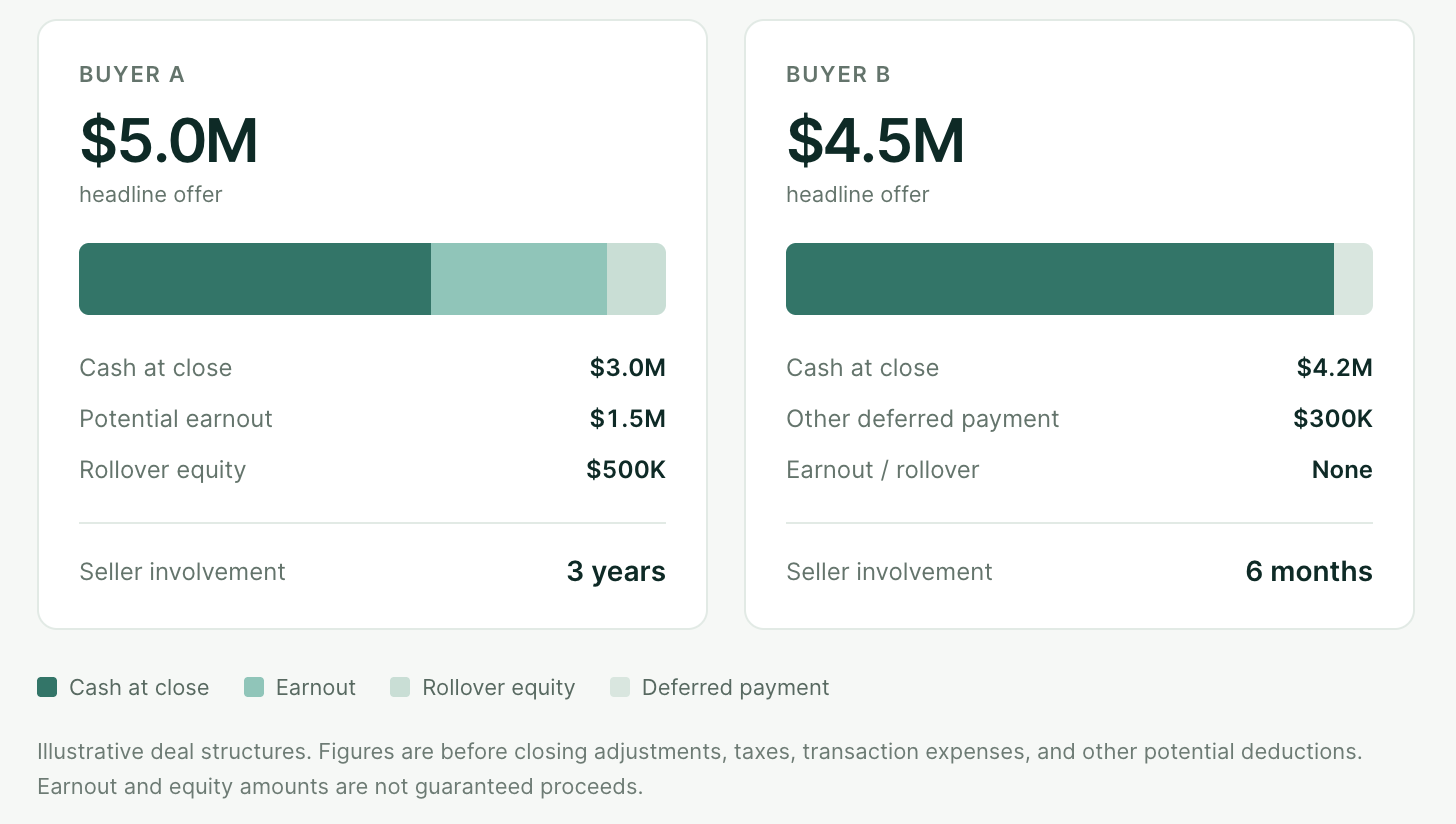
Suppose two buyers make offers for your MSP.
One offers $5 million. The other offers $4.5 million.
The first offer looks better until you examine how and when you'll actually receive the money.
A purchase price can include several different forms of consideration:
Cash at closing: The amount paid when the transaction closes, before applicable adjustments, expenses, taxes, or amounts withheld.
Earnout: Additional payment contingent on the business achieving specified results after closing.
Rollover equity: Ownership you retain or reinvest in the acquiring business, with value dependent on its future performance and liquidity.
Escrow or holdback: A portion of the purchase price retained temporarily to address potential claims, adjustments, or other contractual obligations.
These details can make two offers with similar headline values produce very different outcomes.
Earnouts are more common than sellers may expect
According to SRS Acquiom's 2025 M&A Deal Terms Study, earnouts appeared in approximately 22% of the non-life-sciences private-target deals it analyzed for 2024.
Among deals containing earnouts, the median potential earnout was approximately 31% of the payment made at closing.
That is not a guarantee that sellers receive the full amount. It describes the additional consideration they could potentially earn if the negotiated conditions are satisfied.
And because earnouts are contingent, the actual outcome depends on how the agreement is structured and how the business performs after closing.
A higher offer isn't always a better exit
Consider two hypothetical offers:
Both offers are simplified illustrations. Actual agreements may include debt adjustments, working-capital adjustments, escrow, taxes, transaction expenses, and other conditions that change the seller's net proceeds.
Buyer A offers a higher potential total value, but a substantial portion depends on future business performance and the value of retained equity.
Buyer B offers less on paper, but much more of the consideration is payable at closing, with a shorter transition commitment. Its remaining $300,000 would still need to be evaluated for timing, security, and payment conditions.
Neither is automatically better.
If your goal is to remain involved, help grow a larger organization, and participate in its future upside, Buyer A might be attractive.
If you want to step away relatively quickly and prioritize certainty of proceeds, Buyer B may be more aligned with your plans.
The point is to define what you want from the sale before comparing offers.
Are you trying to retire? Start another business? Continue leading your team? Reduce your responsibilities while retaining some ownership?
Your answer should influence which deal structure you're willing to accept.
For more on deciding whether the timing is right, read When is the Right Time to Sell an MSP?.
4. Diligence the buyer, too
Most MSP owners expect prospective buyers to investigate their businesses.
Fewer approach the process with the same level of scrutiny in the other direction.
That's understandable.
Receiving a serious offer after years of building a company can be exciting, particularly if you've never sold a business before.
But choosing a buyer means choosing the organization that will inherit your employees, customer relationships, and much of what you've built.
It may also mean choosing the people who will control the business while you're trying to earn contingent payments after closing.
Find out how the buyer behaves after an LOI
Axial's 2025 report identified renegotiation disputes as the primary reason for approximately 14.7% of the failed LOIs in its sample.
That figure does not measure how often buyers attempt a retrade across all transactions. It does, however, demonstrate that disagreements over revised pricing and terms can end a deal.
Before granting exclusivity, investigate the buyer's acquisition history.
How many businesses have they acquired? How many transactions have they successfully closed? Have they bought MSPs of a similar size? What happens to the companies after acquisition?
And whenever possible, talk to owners who have previously sold to them.
Ask whether the buyer followed the agreed timeline, whether the final terms differed materially from the LOI, how post-close responsibilities were handled, and whether earnout arrangements worked as expected.
You should also understand the buyer's financing.
A compelling offer isn't particularly useful if the buyer cannot secure the funding necessary to close.
If the buyer plans to combine your MSP with another organization, ask about the integration strategy. Will your employees remain in place? Will customer relationships move to a centralized team? Are there plans to consolidate platforms or change service delivery?
These questions matter even more when you're expected to remain involved after the sale.
You can't eliminate every risk by investigating a buyer. But you can learn enough to make a more informed decision before committing to exclusivity and stepping away from other opportunities.
5. Preparing for your own Day 1

Much of the acquisition process focuses on getting to closing.
But closing also marks the beginning of a transition that affects your employees, customers, and daily operations.
A buyer may have a detailed integration plan. That doesn't remove your responsibility to prepare the business for its side of the handoff.
Employee communication
Your employees may have questions about job security, compensation, leadership, benefits, and whether the company culture will change.
You won't necessarily have answers to every question before closing. And confidentiality obligations may limit what you can share during negotiations.
But you can work with the buyer and your advisors to establish when employees will be informed, who will communicate the news, and which details can be confirmed.
A clear communication plan is particularly important for managers and customer-facing employees who may need to help stabilize the transition.
Customer handoffs
Your customers need continuity.
If a customer has worked directly with you for years, the relationship may not transfer automatically to a new owner or account manager.
Identify which accounts depend heavily on your personal involvement, which contracts require consent or notification, and who will take responsibility for those relationships after closing.
Coordinate the timing and wording of customer communications with the buyer and legal counsel.
The objective is to avoid leaving customers uncertain about who supports them, how billing will work, or whether their services will change.
Knowledge transfer and operating systems
An MSP's operations often depend on knowledge that isn't fully documented.
That might include unusual billing arrangements, customer-specific service commitments, vendor relationships, recurring support exceptions, or decisions that have historically required the owner's approval.
Before closing, establish who owns each critical process and what information must be transferred.
Pay particular attention to your PSA, accounting system, payment workflows, and customer records.
If the buyer plans to migrate systems after closing, both teams need to understand how invoices, payments, recurring billing agreements, and historical financial records will be handled during the transition.
A poorly coordinated handoff can create unnecessary customer confusion and administrative work at exactly the moment the new owner is trying to establish confidence.
Your own transition responsibilities
Finally, clarify what you're personally expected to do.
Will you continue managing the business? Introduce the buyer to major customers? Train a replacement? Help integrate systems? Remain available for a defined period?
Those expectations should be reflected in the transaction documents and any employment or consulting agreement, not left to informal conversations.
A buyer's integration plan works best when you know what your part of it actually requires.
6. What happens to you after close?
For some MSP owners, closing means a relatively short transition followed by a clean departure.
For others, it means another year or more of active involvement.
The difference often comes down to the deal structure negotiated months earlier.
Your earnout may still be underway
SRS Acquiom's 2025 study reported a median earnout period of 24 months for the 2024 transactions it analyzed.
Earnouts lasting more than one year and up to two years represented approximately 38% of the earnout deals in that sample.
That means the financial outcome of a sale may remain unsettled well after the ownership transfer.
If your earnout depends on revenue, EBITDA, or customer retention, you need to understand how those metrics will be calculated and who controls the decisions that influence them.
For example, suppose the buyer changes pricing, moves customers into another business unit, or reallocates operating expenses.
Those decisions could affect the financial results used to calculate your earnout, even if the underlying MSP continues performing well.
That's why earnout agreements need clear definitions, reporting requirements, and provisions addressing how the business will be operated during the measurement period.
Rollover equity creates a different kind of exposure
If you retain equity in the combined organization, part of your eventual return depends on what happens to that business after the acquisition.
The buyer may plan additional acquisitions, operational changes, or an eventual sale to another investor.
Those plans can create upside, but they also introduce uncertainty.
Your equity may be subject to transfer restrictions, dilution, different share classes, or other provisions affecting when and how you can realize its value.
A seller considering rollover equity should understand the rights attached to that ownership and the realistic circumstances under which it could become liquid.
Your role may change before your involvement ends
Even if you stay with the company, you may no longer have the same decision-making authority.
You might move from owner and CEO to a regional leader, advisor, or employee of a larger organization.
That can be a welcome change if you want fewer administrative responsibilities and more time to focus on customers or growth.
It can also be frustrating if you're accustomed to making decisions independently.
Before closing, make sure your future responsibilities, reporting relationships, compensation, decision-making authority, and expected transition timeline are clear.
If you're still evaluating whether you're personally ready for that change, 7 Signs It's Time to Sell Your MSP is a useful place to start.
A successful MSP acquisition is more than a completed sale
Like so many things in this world, selling an MSP comes with much more complication than just receiving an offer and signing closing documents.
The LOI establishes the proposed deal. Diligence tests the information behind it. Negotiations determine how much you'll receive, when you'll receive it, and what risks you'll continue carrying. And the transition determines how the business moves forward under new ownership.
For sellers, the most important preparation is understanding those decisions before you're forced to make them.
That means knowing which financial claims you can substantiate, defining the exit you want, evaluating prospective buyers carefully, and planning for your responsibilities after closing.
Our MSP Exit Readiness Guide walks through these decisions in greater detail, including Part 4, Find the Right Buyer and the Right Deal, and An LOI Isn't the Finish Line.
It includes practical worksheets to help you compare buyers, examine deal terms, and prepare for the acquisition process.
Download The MSP Exit Readiness Guide to start preparing for the deal you actually want, not just the first offer you receive.