

For MSPs pursuing growth through acquisitions, finding the right business to buy is one of the most important decisions in the process.
But building an acquisition target list involves more than identifying MSPs with attractive revenue numbers or owners who may be interested in selling.
MSP acquisition activity remains strong. According to Drake Star's Q4 2025 Global MSP Report, the sector recorded 420 M&A transactions in 2025, with $4.3 billion in disclosed M&A deal value.
A strong target list helps buyers identify businesses that fit their growth strategy, evaluate opportunities consistently, and prioritize the MSPs most likely to deliver long-term value.
It also helps buyers identify potential financial and operational challenges before investing significant time and resources in a deal.
Whether you're pursuing your first MSP acquisition or building a multi-brand portfolio, here's how to develop an acquisition target list that supports your broader growth strategy.
Start with your MSP acquisition strategy
Before identifying individual MSPs, define what you want an acquisition to accomplish.
A business that makes sense for one acquirer may be a poor fit for another, even if it has strong financial performance.
For example, an MSP looking to expand into a new geographic market may prioritize an established local client base and regional leadership. An acquirer looking to expand its cybersecurity capabilities may place more value on technical expertise, security-focused recurring revenue, and specialized service offerings.
Common MSP acquisition objectives include:
- Expanding into new geographic markets.
- Increasing recurring revenue and customer density.
- Adding cybersecurity, cloud, or other specialized service capabilities.
- Entering new customer verticals or market segments.
- Building a larger MSP platform through multiple acquisitions.
- Improving operational efficiency through shared systems and resources.
These priorities are reflected in broader industry acquisition trends. Omdia's analysis of MSP M&A activity in 2025 identified cybersecurity, ERP, and automation among the areas shaping acquisition strategies as the managed services market continues to mature.
Your acquisition strategy should also account for how the acquired business will operate after close.
Will it retain its brand and leadership? Will it eventually move onto your existing PSA and financial systems? Will it operate independently with centralized financial reporting?
These decisions influence which MSPs are worth pursuing and what integration challenges your organization is prepared to manage.
Define your MSP acquisition target criteria
Once your acquisition strategy is established, translate it into specific criteria that can be applied consistently across potential targets.
Start by separating your requirements into three categories:
- Non-negotiables: Criteria an MSP must meet to be considered.
- Preferences: Characteristics that make a target more attractive but aren't required.
- Deal-specific considerations: Factors that need to be evaluated in the context of an individual opportunity.
For example, a minimum recurring revenue threshold may be a non-negotiable, while operating on your preferred PSA may be a preference. An MSP with a different PSA could still be a strong acquisition if its systems are well maintained and the business can support your integration strategy.
Key criteria for evaluating MSP acquisition targets
The following criteria provide a starting point for assessing strategic, financial, and operational fit.
The thresholds you establish should reflect your own acquisition strategy, financing capacity, and operating model.
A smaller MSP with strong recurring revenue, low client concentration, and reliable financial operations may offer more long-term value than a larger business with inconsistent margins, significant owner dependence, or complex integration requirements.
Where to find MSP acquisition targets
The best acquisition opportunities aren't necessarily the MSPs actively advertising that they're for sale.
Many MSP owners may be open to a conversation about their business without having formally entered a sale process.
Building a target list through multiple sourcing channels can help buyers identify both active opportunities and businesses that may become attractive targets over time.
MSP industry networks and peer groups
Industry relationships can be a valuable source of potential acquisition opportunities.
MSP peer groups, technology partner communities, industry conferences, and regional networking events give buyers opportunities to meet business owners and learn about their companies before discussing a potential acquisition.
These relationships can also provide insight into how potential targets operate, their reputation within the MSP community, and whether their owners might be open to future conversations.
M&A advisors and business brokers
Advisors specializing in managed IT services can introduce buyers to MSPs that are actively exploring a sale.
They may also provide access to opportunities that aren't publicly advertised.
Broker-led opportunities can offer a more structured acquisition process, but buyers should still evaluate each business against their own criteria rather than relying solely on the information presented in a deal summary.
Industry directories and partner ecosystems
MSP directories, technology vendor partner listings, and industry rankings can help buyers identify businesses by geography, service offerings, and market presence.
These sources are particularly useful when building an initial list of MSPs within a specific region or service category.
For example, CRN's 2026 MSP 500 recognizes North American MSPs across three categories: providers serving midmarket and enterprise customers, providers focused on small and midsize businesses, and managed security specialists.
These lists can be a useful starting point. However, directory information generally won't provide enough insight into financial performance, customer retention, or acquisition readiness. Treat it as a sourcing tool rather than a qualification tool.
Direct outreach
Direct outreach allows buyers to identify MSPs that fit their acquisition strategy, regardless of whether those businesses are currently for sale.
Start by researching the business, its leadership, its service offerings, and its market position. Then approach the owner with a conversation that reflects a genuine understanding of their company.
For many MSP owners, an acquisition is a significant personal and professional decision. Building a relationship before discussing deal terms can create a more productive starting point.
Referrals from your existing network
Existing portfolio companies, technology partners, lenders, accountants, and other MSP owners may be familiar with businesses that fit your acquisition criteria.
As your acquisition program develops, these relationships can become an ongoing source of potential opportunities.
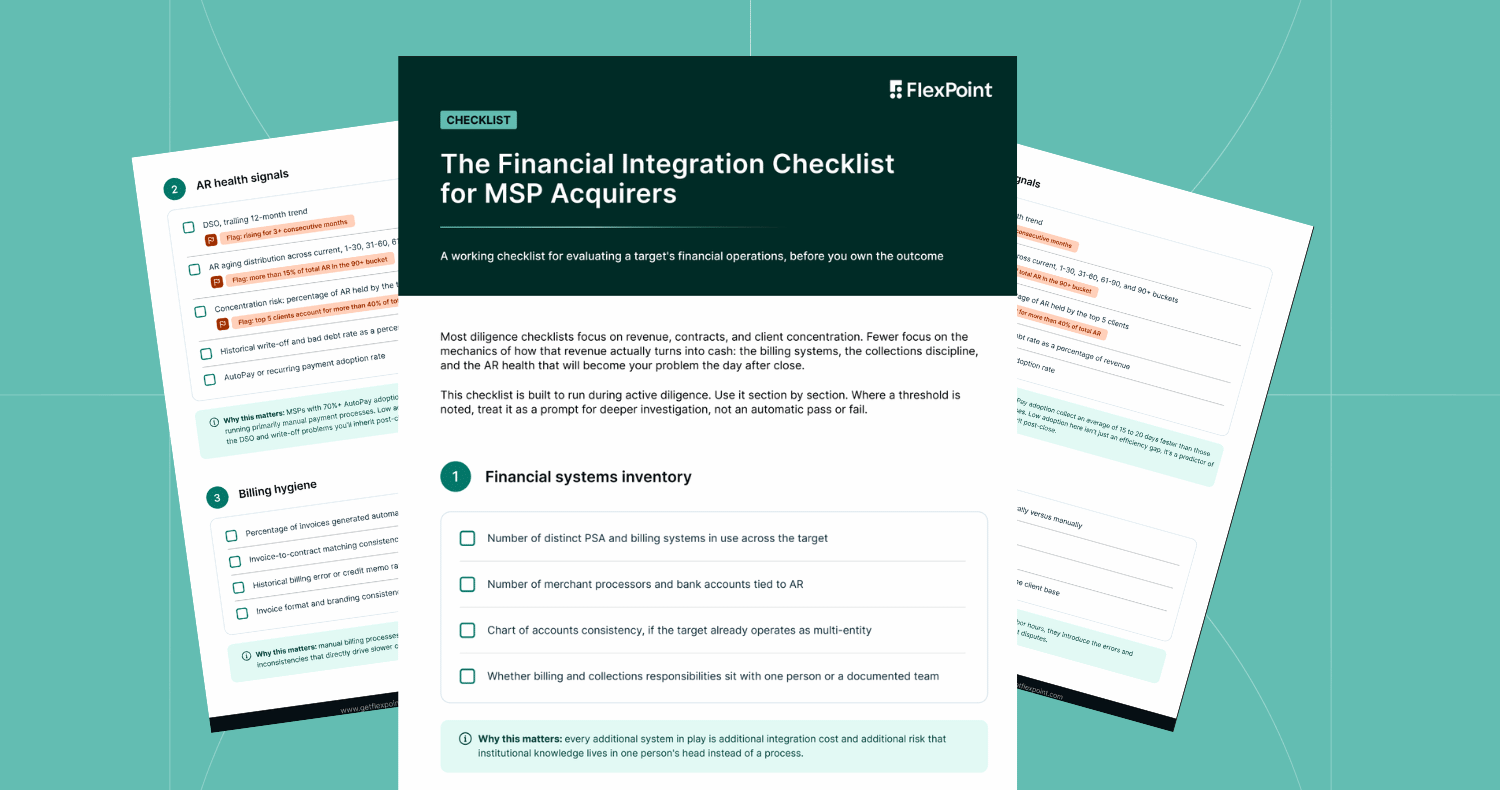
Evaluate financial and operational fit before prioritizing targets
Revenue and profitability are important indicators of acquisition potential, but they don't tell the entire story.
An MSP's financial operations can influence how reliably it generates cash, how much work is required to integrate the business, and whether its financial performance can be maintained after close.
Early in the sourcing process, detailed financial information may not be available. Use publicly available information and preliminary conversations to identify questions worth exploring, then validate those assumptions during due diligence.
Here are several areas to consider when evaluating potential targets.
Revenue quality
Understand how the MSP generates revenue, not just how much revenue it reports.
Recurring managed services revenue, project-based work, hardware resale, and other revenue streams can have different implications for margins, cash flow, and predictability.
Questions to explore include:
- How much revenue comes from recurring managed services agreements?
- How concentrated is revenue among the largest clients?
- How consistent are client retention and contract renewals?
- Are margins dependent on project work or one-time revenue?
These factors help buyers assess how sustainable the MSP's financial performance may be after an acquisition.
Billing and payment operations
An MSP's billing practices can reveal how much financial complexity an acquirer may inherit.
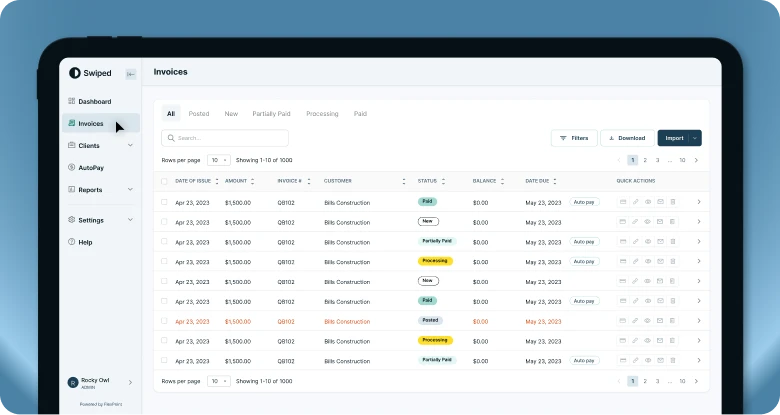
For example, two MSPs with similar recurring revenue may have very different payment workflows. One may use standardized billing, automated payments, and consistent reconciliation, while another relies on manual invoicing and payment follow-up.
During preliminary discussions, consider asking:
- Which PSA and accounting systems does the MSP use?
- How are recurring invoices generated and delivered?
- How do clients typically pay?
- Are AutoPay and payment workflows standardized?
- How much manual work is involved in billing and reconciliation?
These questions can help identify integration requirements before the acquisition reaches a more advanced stage.
Identifying the systems an MSP uses is only the first step. Buyers should also consider whether those systems can support their post-close operating model or require migration. Our guide to PSA and billing system migration after an MSP acquisition explores the risks and trade-offs involved.
Accounts receivable and cash flow
An MSP's reported revenue doesn't necessarily reflect when cash is received.
Past-due invoices, billing disputes, inconsistent payment terms, and manual AR processes can affect working capital and the resources required to manage the business after close.
When financial information becomes available, review AR aging, payment patterns, and the processes used to manage outstanding invoices.
It's also important to understand how receivables will be handled in the acquisition agreement. Some balances may transfer to the buyer, while others may remain with the seller.
Operational and owner dependence
Many MSPs have developed strong businesses around the relationships, knowledge, and day-to-day involvement of their founders.
For an acquirer, it's important to understand which responsibilities can transfer to the existing team and which depend heavily on the owner.
This applies to financial operations as well. If the owner is the only person who understands billing exceptions, client payment arrangements, or reconciliation processes, those responsibilities may become more difficult to manage after close.
Evaluate whether the MSP has documented processes, clear ownership, and the team capacity needed to maintain operations through a transition.
Build an MSP acquisition target scorecard
As your list grows, it becomes increasingly difficult to compare opportunities based on individual conversations or informal notes.
A target scorecard provides a consistent framework for evaluating MSPs against your acquisition strategy.
Start by assigning weights to the criteria that matter most to your organization. Then score each target using the same scale.
For example, an acquirer focused on building a scalable MSP platform might assign greater weight to recurring revenue quality, strategic fit, and financial integration readiness.
Use the interactive scorecard below to evaluate an MSP against six acquisition criteria. Enter your scores, document potential risks, and save a copy for your records. The example weights can serve as a starting point, but your acquisition strategy should determine which criteria matter most.
The weighted score is calculated by multiplying each category's weight by its score divided by five, then adding the results.
A few guidelines can make a scorecard more useful:
- Apply your non-negotiable criteria before calculating a weighted score.
- Distinguish verified information from preliminary estimates.
- Leave unknown criteria unscored rather than assuming the business performs well.
- Update scores as new information becomes available.
- Record the reasoning behind each score, especially when a target has unusual strengths or risks.
If some criteria remain unknown, track how much of the total score has been evaluated. Avoid directly comparing incomplete assessments with fully scored targets until the missing information has been verified.
A high score should indicate that an MSP deserves further investigation, not that it has already passed due diligence.
Prioritize your acquisition target list
Once potential targets have been evaluated, organize them into priority tiers.
A useful prioritization framework considers both how well an MSP fits your acquisition strategy and how realistic it is to pursue an opportunity.
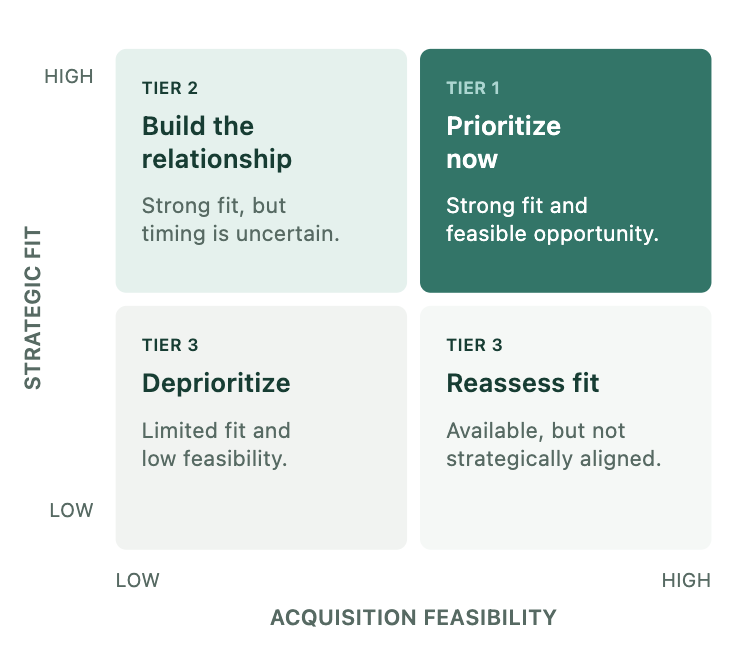
Tier 1: High-priority targets
These MSPs meet your core acquisition criteria and appear to offer strong strategic and financial fit.
They may also have owners who are open to a conversation, established leadership teams, or other characteristics that make an acquisition feasible.
Prioritize these businesses for deeper research, relationship building, and initial discussions.
Tier 2: Long-term opportunities
These businesses may be a strong strategic fit but have unresolved questions around valuation, timing, ownership transition, or integration requirements.
Keep them on your list and maintain relevant relationships. A target that isn't ready for an acquisition today may become an attractive opportunity later.
Tier 3: Lower-priority or monitor-only targets
These MSPs may meet some acquisition criteria but have significant gaps in strategic fit, financial quality, or operational readiness.
They may be worth monitoring, particularly if your acquisition strategy changes, but shouldn't take resources away from stronger opportunities.
Remember that prioritization is dynamic. An MSP's financial performance, ownership plans, and market position can change over time, as can your organization's acquisition capacity.
What to include in your MSP acquisition target list
Your target list should function as a working pipeline rather than a static directory of businesses.
A spreadsheet or CRM can be sufficient to get started, provided the information is organized consistently and kept up to date.
Include fields such as:
- Company name, website, location, and ownership.
- Estimated revenue, employee count, and service offerings.
- Customer segments and geographic coverage.
- PSA, accounting, and payment systems, where known.
- Strategic fit and preliminary financial assessment.
- Target score, priority tier, and information confidence.
- Owner contact information and relationship history.
- Current acquisition status, next action, and internal owner.
For active opportunities, you can also track information such as NDA status, preliminary valuation expectations, due diligence requests, and potential integration requirements.
The distinction between confirmed information and estimates is especially important. Public revenue estimates, employee counts, and other third-party data may be incomplete or outdated.
Record the source and date of important information so your team knows which assumptions need to be validated.
Five mistakes to avoid when building an MSP acquisition target list
- Prioritizing revenue over strategic fit. A larger MSP isn't necessarily a better acquisition. Consider how the business supports your growth strategy, the quality of its revenue, and whether your organization can integrate it effectively.
- Only pursuing MSPs that are actively for sale. A list built entirely from broker-led opportunities may overlook businesses that would be a stronger fit. Develop direct relationships and referral channels alongside traditional deal sourcing.
- Ignoring financial integration requirements. Different billing systems, payment arrangements, and manual financial processes can add complexity after close. Consider these requirements early rather than treating integration as a separate project.
- Treating incomplete information as confirmed. Preliminary estimates can help prioritize research, but they shouldn't be used as verified financial data. Track information confidence and validate assumptions as conversations progress.
- Building a list without a follow-up process. A target list only creates value if someone is responsible for moving opportunities forward. Assign ownership, define next steps, and review the pipeline regularly.
From acquisition target list to financial due diligence
A well-built target list helps you identify which MSPs deserve further investigation.
The next step is validating whether the business can deliver the financial and strategic value identified during the initial evaluation.
Financial due diligence should examine revenue quality, profitability, working capital, accounts receivable, billing practices, and the systems that support financial operations.
It should also help buyers understand what needs to happen after close.
For example, an MSP may have strong recurring revenue and an attractive customer base but rely on manual payment workflows or inconsistent reconciliation processes. Those issues don't necessarily make it a poor acquisition target, but they should inform integration planning and the resources required to support the business.
Read more: How to prepare for financial integration after an MSP acquisition
Build an acquisition strategy that can scale
As MSP acquirers grow their portfolios, the ability to integrate new businesses becomes increasingly important.
A repeatable approach to billing, payments, reconciliation, and AR can help prevent each acquisition from introducing an entirely new set of financial processes.
FlexPoint helps MSPs establish more consistent financial operations across supported PSA environments, including ConnectWise, Autotask, HaloPSA, and SuperOps.
With standardized payment workflows, automated deposit reconciliation, and AR Agents that take recurring AR work off the finance team's plate, acquirers can build operational capacity as their portfolios grow.
The result is an opportunity to approach future acquisitions with a clearer understanding of how new businesses can fit into the existing financial operating model.
Start building your MSP acquisition target list
The best acquisition target list is one that reflects your strategy, makes opportunities easier to compare, and helps you focus resources on the businesses most likely to create long-term value.
Start with clear acquisition criteria, build a diverse sourcing pipeline, and evaluate potential targets with both financial performance and integration requirements in mind.
The more consistently you approach these decisions, the easier it becomes to identify the right opportunities and prepare for what comes after the deal.
Related articles