


There can always be a reason to wait.
Maybe your MSP is having its best year yet and you want another twelve months of growth reflected in the valuation. Maybe you've watched acquisition activity pick up around you and wonder whether you should take advantage of it while buyers are interested. Or maybe buyers are already reaching out, but selling still feels like something you planned to think about three years from now.
That's what makes MSP exit planning difficult.
The market can be ready for your business before your business is ready for the market.
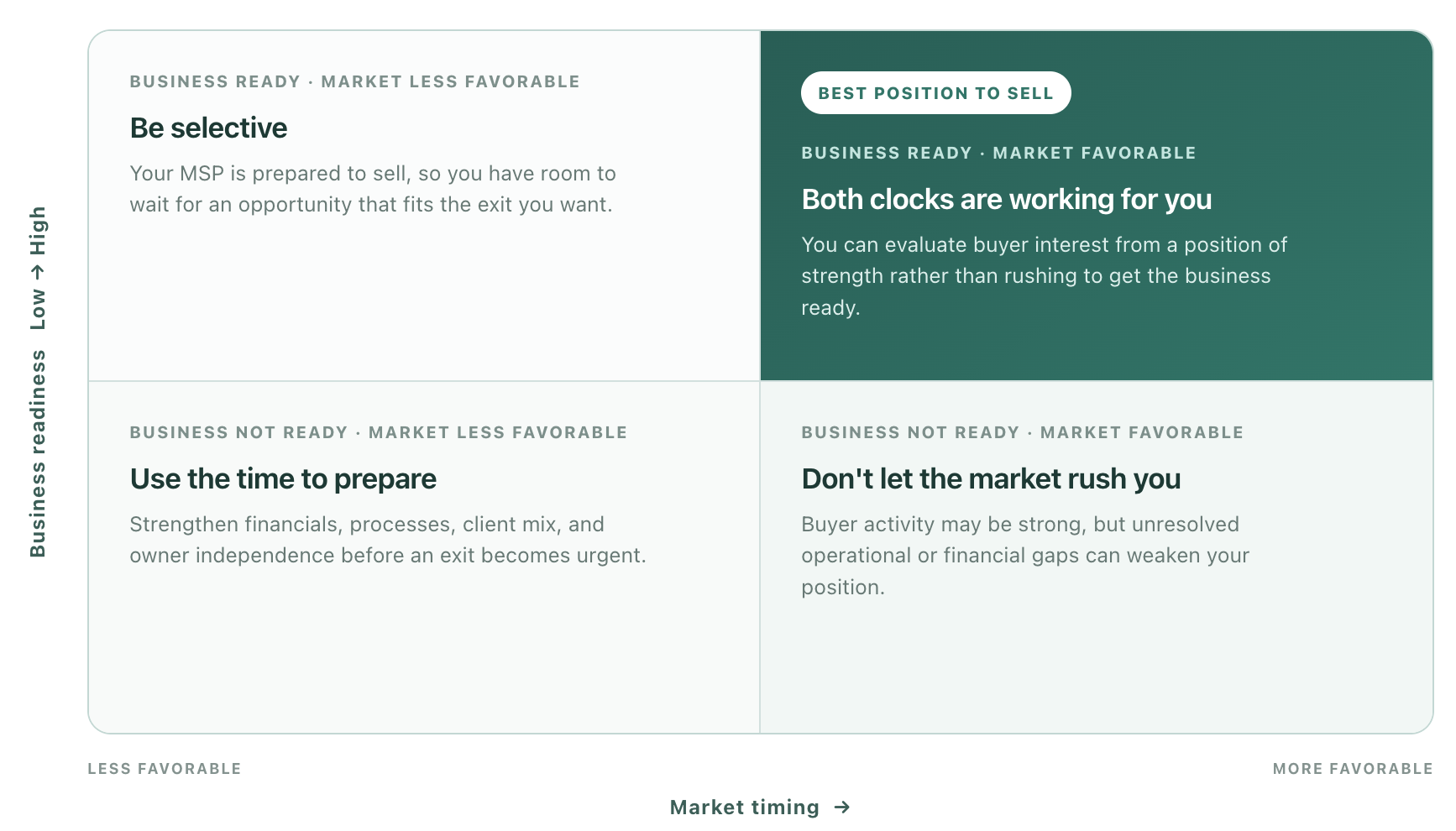
There are really two clocks running when you think about selling an MSP: the market clock and your readiness clock.
And the right time to sell isn't necessarily when the market is hottest. It's when those two clocks line up closely enough that you can make the decision from a position of strength.
The two clocks owners confuse: market timing vs. personal readiness
Imagine an MSP owner who gets an unsolicited offer during an active acquisition market. They've heard about other MSPs selling. Buyers seem interested in the space. Maybe the initial valuation sounds pretty good.
It feels like the window is open, so they take the meeting. Then diligence starts.
The financials need more cleanup than expected. A handful of important client relationships still run directly through the owner. Processes everyone assumed were documented turn out to live mostly in employees' heads. AR is aging. A few large clients account for more revenue than the owner realized.
Suddenly, the conversation isn't just about how much the MSP earns. It's about how much risk the buyer is taking on.
The market timing may have been excellent while the MSP's timing wasn't.
The opposite can happen just as easily.
The business becomes genuinely transferable, but the owner keeps waiting for another growth milestone, a slightly better multiple, or the perfect acquisition market.
Eventually something changes and the owner's own appetite for another three years isn't what it used to be. The business may still be valuable, but some of the leverage the owner spent years building has disappeared.
Neither owner necessarily made an irrational decision, but they were just watching one clock.
A good MSP exit strategy pays attention to both.
Signs the market currently favors sellers
There are good reasons MSP owners are hearing so much about acquisitions.
The underlying managed-services market continues to grow. IMARC Group valued the U.S. managed services market at $77.2 billion in 2025 and projects it to reach $181.8 billion by 2034, representing a 9.68% compound annual growth rate from 2026 through 2034.
And there is optimism at the MSP level, too.
According to CompTIA's IT Industry Outlook 2026, 51% of MSPs expect to exceed their annual revenue and profitability targets this year.
None of that means every MSP should be looking for a buyer right now.
A growing market doesn't automatically make an individual business attractive, and active buyers don't guarantee an attractive deal. But it does help explain why owners are seeing acquisition conversations become a more normal part of the MSP landscape.
Roll-up and platform-company activity
Consolidation has become a familiar part of the MSP market.
Private equity-backed platform companies and larger MSPs can use acquisitions to enter new geographic markets, add customers, bring in talent and capabilities, and grow recurring revenue faster than they could organically.
That means a healthy MSP can potentially appeal to several kinds of buyers.
For sellers, more acquisition activity can create leverage, but it also raises the bar for understanding what makes your particular business attractive.
A buyer isn't acquiring “the MSP market.” They're acquiring your contracts, customers, employees, systems, processes, cash flow, and future earning potential.
PE appetite for add-on deals
Add-on acquisitions are especially relevant because a buyer doesn't necessarily need your MSP to become an entirely new standalone platform.
A private equity-backed MSP may already have executive leadership, finance infrastructure, sales resources, technology, vendor relationships, and an integration playbook.
Acquiring another MSP can add revenue, customers, employees, geography, or specialization to that existing operation without requiring the sponsor to recreate all of that infrastructure from scratch.
That can make established MSPs attractive acquisition targets, but it also changes the questions buyers ask. They need to understand how easily the new business can fit into a larger organization.
Revenue matters, but so does the quality and predictability of that revenue.
A business that looks strong from the outside can become much less attractive if diligence uncovers inconsistent financial reporting, significant customer concentration, poor cash collection, or processes that depend heavily on the owner.
We've written more about the operational side of that equation in Why Private Equity-Backed MSPs Choose FlexPoint.
Signs your business is ready
A hot acquisition market can't make an unprepared business transferable.
One of the clearest signs of readiness is that revenue isn't heavily dependent on you personally.
If major clients expect the owner on every call, the owner closes most meaningful sales, and important operational decisions stop when the owner goes on vacation, a buyer isn't just acquiring the MSP.
The same applies to the rest of the operation.
Core processes should be documented and repeatable enough that another organization can understand how the MSP works. And, similarly, financials should make everything that happens to the money straightforward to explain rather than requiring weeks of cleanup and caveats.
Client concentration matters, too.
A business can have strong recurring revenue and still carry significant risk if one or two clients represent a disproportionate share of it. Buyers want confidence that the revenue they're acquiring is durable, not that one cancellation could materially change the economics of the deal.
These aren't the only indicators of readiness, and they aren't a substitute for a proper assessment.
They're a quick way to distinguish a business that's performing well from one that's actually prepared to change hands.
All the reasons to sell
There's another question that comes before “Is this a good time to sell?”
What do you actually want the sale to accomplish?
It's easy to reduce an exit to valuation, but owners sell MSPs for very different reasons. Two founders with nearly identical businesses can rationally choose completely different timelines because they're optimizing for completely different outcomes.
For some owners, the priority is speed and certainty. They may already know they're ready for the next chapter and value a straightforward transaction with a high probability of closing over squeezing every possible dollar out of the business.
Others are primarily pursuing the maximum financial outcome. They're willing to spend another twelve or eighteen months strengthening margins, improving operations, or growing recurring revenue if they believe the work can materially improve what the business is worth.
Then there's continued upside. An owner may be comfortable selling control today if rollover equity or another structure lets them participate in the future growth of the combined company. In that case, evaluating the buyer and what they're building can become nearly as important as the cash consideration at close.
For some MSPs, an acquisition is a way to gain growth resources. Capital, recruiting, sales capacity, technology, operational expertise, or access to a larger organization may allow the business to reach a scale that would have been difficult to achieve independently.
Other owners care deeply about legacy and continuity. They've spent years building a team and serving clients they know personally. A theoretically higher offer may not be the better exit if the buyer's plans for employees, customers, or the company itself conflict with what the owner wants to preserve.
And selling doesn't always mean leaving.
Some owners want ongoing involvement, whether that's continuing to lead their MSP, taking on a larger role inside the acquiring company, or helping guide the next phase of growth without carrying all of the responsibilities of ownership themselves.
These aren't minor preferences to sort out once an LOI arrives. They change the definition of “right time.”
The cost of waiting too long
There are plenty of good reasons to wait before selling an MSP.
If growth strategies or cleaning up your records are what an extra year is being used for, waiting may meaningfully improve the eventual exit.
The danger is assuming that waiting itself creates value.
If the business is still dependent on you twelve months from now, you've added another year of owner dependency. If one employee still holds a disproportionate amount of institutional knowledge, you've carried that key-person risk forward. If financial reporting remains inconsistent, the eventual cleanup has only gotten larger.
Those weaknesses can also compound.
In the case of AR, an MSP can look profitable on an income statement while a meaningful amount of that revenue is still sitting in unpaid invoices. As DSO rises, more working capital remains tied up in receivables rather than sitting in the bank where the business can actually use it.
That matters long before an acquisition because cash sitting in AR can't be distributed, reinvested into growth, used to hire, or deployed elsewhere in the business.
FlexPoint's DSO Calculator gives you a quick way to see how long it's taking your MSP to turn outstanding invoices into cash. It's a relatively small measurement, but it can reveal a larger operational problem that is easy to ignore while revenue is growing.
The same principle applies across the business. If you already know an operational weakness will eventually come up in diligence, waiting only helps if you're using that time to address it.
That's the difference between delaying an exit and preparing for one.
How financial readiness changes your timeline
Consider two MSP owners who receive essentially the same unsolicited email from a buyer.
The first has spent the previous year preparing for the possibility of an exit, even though they weren't committed to selling.
They've also thought through the personal side of the transaction and know what outcome they want for themselves.
When the buyer's email arrives, it's simply an option.
Now imagine a second owner receives the same email.
They haven't seriously thought about selling before. The initial offer sounds interesting, so they begin digging into the business from a buyer's perspective for the first time.
Suddenly they're trying to clean up financials while evaluating a valuation, figuring out why old invoices remain outstanding while answering diligence questions, and documenting processes while deciding whether they even want to leave.
The opportunity may still work out. But the owner is no longer controlling the timeline in the same way. The buyer has effectively started the clock for them.
That's what financial readiness changes.
Preparing an MSP for a potential sale doesn't mean committing to sell it. It simply gives the owner the ability to respond to an opportunity without having to rebuild the back office at the same time.
Clean reporting makes it easier to understand performance. Better AR improves cash flow. Documented financial processes reduce dependency on individual employees. Automation can create capacity without requiring every increase in revenue to bring an equivalent increase in administrative headcount.
Those improvements have value even if the owner ultimately decides not to sell.
In fact, that's one of the better tests for whether an exit-preparation project is worth doing. If the work only makes the MSP look better for three months during diligence, it may be cosmetic. If it makes the company easier to run, it's useful whether a sale happens next year or five years from now.
That's also why investments in the back office can matter more than they initially appear. We've written about how back-office AI and automation can affect MSP operations, particularly when repetitive financial work is consuming capacity that could be spent elsewhere.
The goal of exit preparation is to reach a point where a buyer can start the conversation tomorrow and you still get to decide what happens next.
Know where you stand before the market decides for you
There probably won't be a morning when you wake up, check the market, look at your financials, and discover that every variable has finally aligned.
There will always be another milestone you could hit. And that's exactly why the two clocks are useful.
The market clock tells you what opportunities exist outside your business. Are buyers active? Is consolidation continuing? Are MSPs like yours attracting interest? Could today's market give you multiple credible paths to an exit?
Your readiness clock tells you something more important: whether you're actually in a position to take advantage of those conditions. Is the business transferable without you? Are the financials clear enough to survive scrutiny? Is cash collection disciplined? Are important processes documented? Have you decided what you want from a sale beyond the largest possible number on the first page of an offer?
You don't need both clocks to be perfect, but you need to understand where each one stands.
And if both the market and the business are in a strong position, it may be time to stop treating an exit as a distant hypothetical and start understanding what your options really are.
The advantage comes from figuring this out before a buyer forces the question. An inbound offer is a much easier thing to evaluate when you already understand the business you're bringing to market and the outcome you'd need to make selling worthwhile.
That's the purpose of the MSP Exit Readiness Guide. It gives owners a concrete way to evaluate the financial, operational, and strategic pieces that affect an eventual sale, identify the gaps that could create friction later, and start addressing them while they still control the timeline. You don't need to have decided to sell to begin preparing for the possibility.
And if a full exit-readiness exercise feels premature, start smaller.
Use the DSO Calculator to see how efficiently your MSP is currently turning revenue into cash. It's one number, but it's a useful window into whether the financial operation underneath your growth is as healthy as the topline makes it look.
The goal isn't to predict the single perfect moment to sell. It's to build enough readiness that when the right moment does arrive, you recognize it and have the freedom to act on it.





.png)