


When acquiring a managed service provider (MSP), buyers spend considerable time evaluating recurring revenue, profitability, customer retention, and operational efficiency.
But payment compliance tends to receive less attention.
Yet as buyers acquire MSPs across multiple states, differences in how those businesses accept payments, recover credit card processing costs, and manage customer payment information can introduce financial and regulatory risks.
One acquired MSP might absorb processing fees. Another might apply a credit card surcharge. A third might offer discounts to customers who pay via ACH.
Each approach comes with its own financial implications and compliance considerations. And consolidating these businesses under a single operating model can expose issues that were not apparent when they operated independently.
For private equity firms and strategic buyers pursuing MSP roll-ups, understanding these differences before close can help protect margins, reduce compliance exposure, and prevent disruptions to customer payments after acquisition.
This article is intended for general informational purposes and does not constitute legal advice. Payment regulations and card network requirements are subject to change.
1. Understand how surcharging rules vary across states
Credit card surcharging allows businesses to recover some of the costs associated with accepting credit card payments by passing those costs on to customers.
However, surcharging is not governed by a single nationwide standard. So businesses must consider applicable state laws, card network requirements, and the terms of their merchant processing agreements.
Some jurisdictions restrict surcharging, while others impose specific requirements related to surcharge amounts, pricing disclosures, and how fees are communicated to customers.
For example, New York's Attorney General explains that businesses subject to its credit card pricing requirements must display the full credit card price or present both the cash and credit card prices. Simply notifying customers that a percentage will be added to their bill is insufficient.
For MSP buyers, this creates a challenge when acquired businesses serve customers across state lines.
Before extending an existing surcharge policy across an acquired portfolio, buyers should establish:
- Which legal entities accept customer payments.
- Where those entities operate and their customers are located.
- Which jurisdictions' requirements apply to their transactions.
- How payment platforms accommodate different surcharge rules.
- Whether existing policies have been reviewed by legal counsel.
The goal is to understand the compliance requirements of the combined business before introducing a standardized payment policy.
Questions about surcharging? Learn more here:
2. Review card network compliance alongside state regulations
Even where credit card surcharging is permitted under applicable law, MSPs must comply with card network requirements.
According to Visa's U.S. merchant surcharging guidance, merchants implementing surcharging must follow requirements that include:
- Providing advance notice to their acquiring bank.
- Excluding debit and prepaid card transactions.
- Limiting surcharges to the applicable merchant discount rate or 3%, whichever is lower.
- Providing appropriate customer disclosures and transaction receipts.
- Transmitting surcharge information through the appropriate transaction data field.
Buyers should also review the requirements of other accepted card networks and their payment processors.
An MSP may have a surcharge policy that appears financially effective but is incorrectly configured within its billing or payment platform.
For example, a manually applied percentage-based fee could inadvertently extend to ineligible payment methods. Similarly, a surcharge disclosed on an invoice may not be properly reflected in the payment portal or transaction receipt.
These issues can become more difficult to identify when multiple acquired MSPs use different payment systems.
3. Evaluate how processing fees affect acquisition economics
Surcharge recovery can influence an MSP's operating expenses and reported profitability.
During financial due diligence, buyers should understand how much of the target's current processing expense is offset by customer-paid surcharges and whether those savings can reasonably continue after acquisition.
Consider a hypothetical roll-up involving three MSPs:
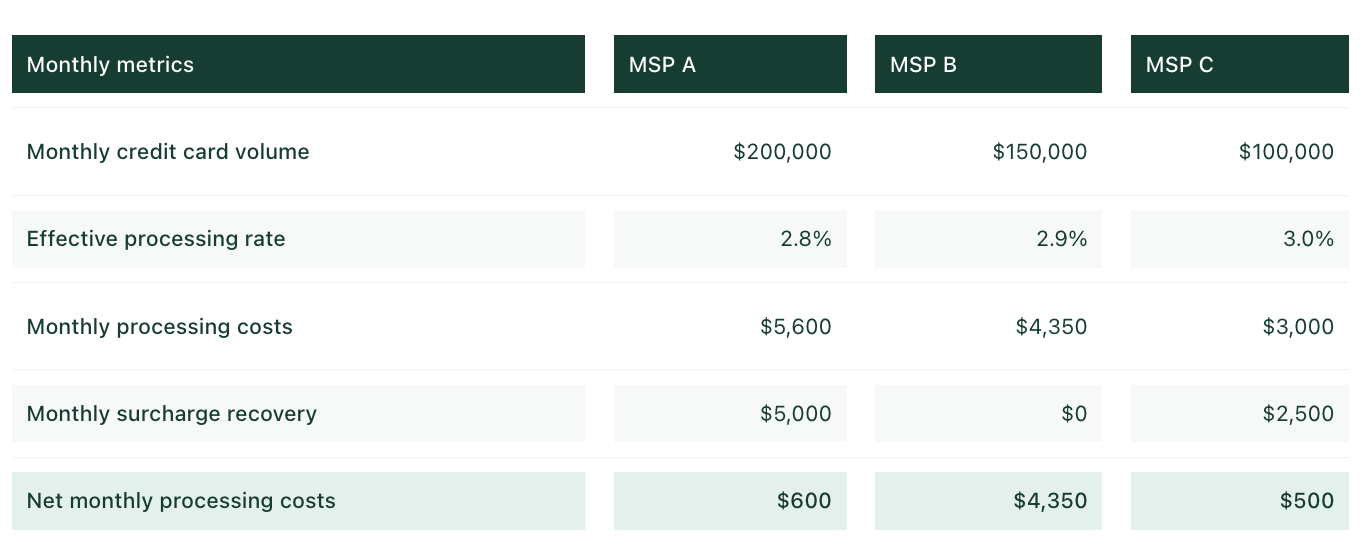
Across the three businesses, annual credit card processing costs total $155,400 before surcharge recovery.
Existing surcharge policies offset $90,000 of those expenses annually.
If the buyer eliminates surcharging across the portfolio without changing processing rates or customer payment behavior, annual operating costs could increase by $90,000.

On the other hand, extending surcharging across the portfolio without evaluating applicable requirements could introduce new compliance risks.
Buyers should account for these differences when assessing normalized profitability, potential cost savings, and post-acquisition operating expenses.
4. Identify payment compliance risks before closing the deal
Surcharging is only one component of payment-related due diligence.
Acquiring an MSP also means taking on payment infrastructure, merchant relationships, recurring billing arrangements, and processes for handling customer financial information.
Buyers should request documentation covering the following areas before close:
If historical payment practices do not meet applicable requirements, buyers should work with legal counsel to evaluate potential liabilities and determine whether remediation is necessary before closing.
Identifying these issues early allows buyers to account for remediation costs, contractual obligations, and integration requirements rather than discovering them after ownership has transferred.
It's also important to recognize that outsourcing payment processing does not eliminate an MSP's PCI DSS responsibilities. The PCI Security Standards Council explains that merchants remain responsible for evaluating their providers' compliance, documenting shared responsibilities, and completing applicable compliance validation.
5. Standardize payment controls without overlooking regional requirements
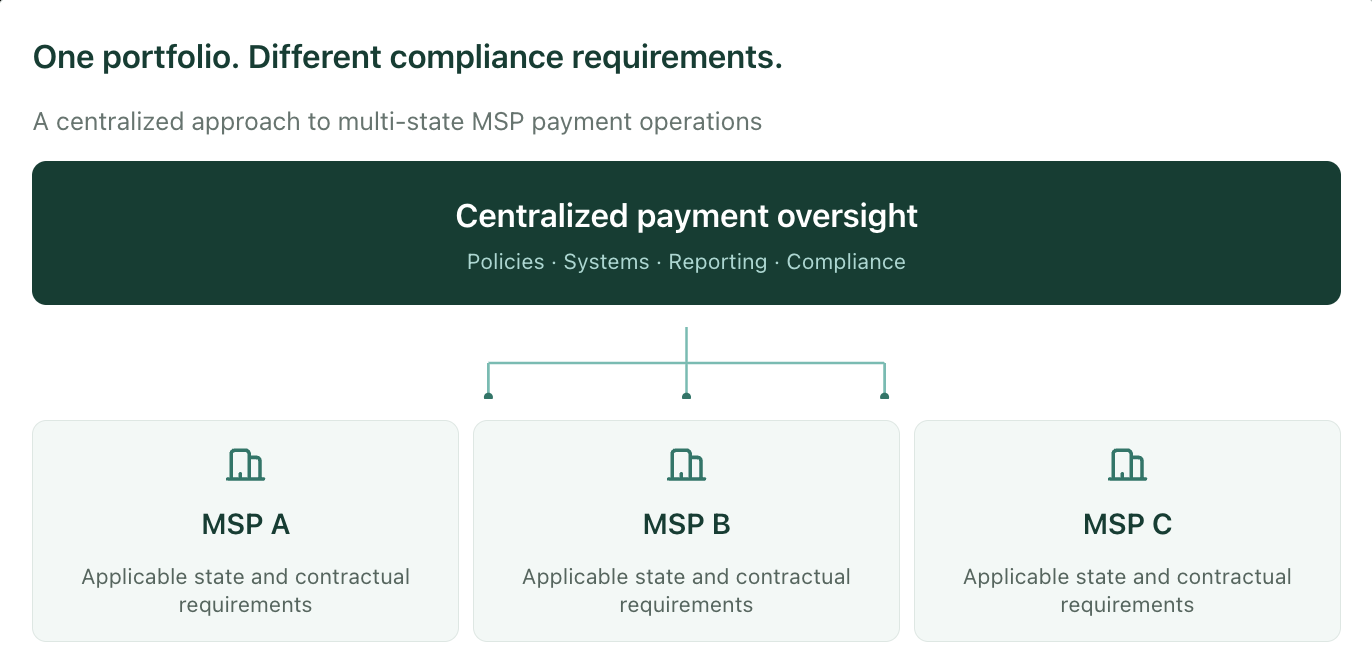
One of the benefits of an MSP roll-up is the opportunity to reduce operational complexity by standardizing financial processes.
However, standardizing payment operations does not necessarily mean implementing identical surcharge policies across every acquired business.
Instead, buyers should establish a consistent framework for managing payments while accommodating legal, contractual, and geographic differences.
This may include:
- Consolidating payment platforms where appropriate.
- Establishing centralized oversight of payment policies.
- Automating the identification of surcharge-eligible payment methods.
- Standardizing customer disclosures and payment communications where permitted.
- Establishing consistent accounting and reconciliation procedures.
- Documenting exceptions to portfolio-wide payment policies.
A centralized payment platform gives finance teams greater visibility into transaction activity, processing expenses, and customer payment behavior across acquired businesses.
It can also reduce the manual work involved in administering different payment policies.
For buyers planning additional acquisitions, establishing these controls early creates a repeatable framework for integrating future MSPs.
6. Protect customer payment continuity during integration
Changes to payment policies can directly affect the customer experience.
A customer who has paid by credit card without additional fees for several years may reconsider their preferred payment method if a surcharge is introduced after acquisition.
Similarly, migrating customers to a new payment platform without properly addressing stored payment credentials and AutoPay authorizations could interrupt recurring payments.
Before implementing payment changes, buyers should coordinate with their finance teams, payment providers, and customer-facing teams to determine:
- Whether customers need to authorize recurring payments again.
- How changes to payment fees will be communicated.
- Whether existing customer agreements restrict payment policy changes.
- How failed payments and customer questions will be handled.
- Whether customers have access to alternative payment methods, such as ACH.
Monitoring payment success rates, processing expenses, customer complaints, and days sales outstanding (DSO) following integration can help buyers identify unintended consequences before they become larger financial problems.
For an MSP with predictable monthly recurring revenue, preserving the predictability of customer payments should be a priority throughout integration.
Build payment compliance into your MSP acquisition strategy
As an MSP portfolio grows, so does the complexity of managing payments.
Surcharging policies that make financial sense for an individual MSP may not translate across an entire portfolio. Without proper due diligence, buyers risk inheriting compliance issues, underestimating operating expenses, or disrupting established customer payment processes.
Evaluating payment policies before close and establishing consistent controls after acquisition can help buyers protect profitability while building a more scalable financial operation.
FlexPoint helps MSPs streamline payment acceptance, automate accounts receivable, and simplify financial operations through integrated payment and accounting workflows.
For buyers integrating multiple MSPs, these capabilities can help establish more consistent financial processes as their portfolios grow.
Related articles