


Deciding when to sell your MSP isn't always straightforward.
You could be having your best year yet, getting calls from potential buyers, or realizing you're no longer interested in running the business for another five years. But how do you know whether you're actually ready to sell?
It's a question many MSP owners put off answering. Even if an exit has always been part of the plan, it's difficult to know when to start seriously considering one, especially when the business is still doing well.
Fortunately, you don't need a buyer lined up or a sale date in mind to start evaluating your options.
There are practical signs that can help you understand whether your MSP is ready for a potential acquisition, what might still need work, and whether selling makes sense for you personally.
Here are seven signs worth paying attention to.
1. Your revenue no longer depends on you personally
Here's a useful test: If you disappeared from the business for 30 days tomorrow, what would stop working?
Would your sales pipeline dry up? Would your biggest clients start calling your personal number? Would employees struggle to make decisions, resolve escalations, or manage vendor relationships without you? Would someone else know how to explain the company's financial performance?
For many MSP founders, being deeply involved in the business has been part of what made it successful.
You built the client relationships, handled difficult problems, and made decisions when nobody else could.
But buyers want to know whether the revenue they're acquiring will continue after ownership changes. If your relationships, judgment, and day-to-day involvement are holding everything together, the buyer has to account for what happens when you leave.
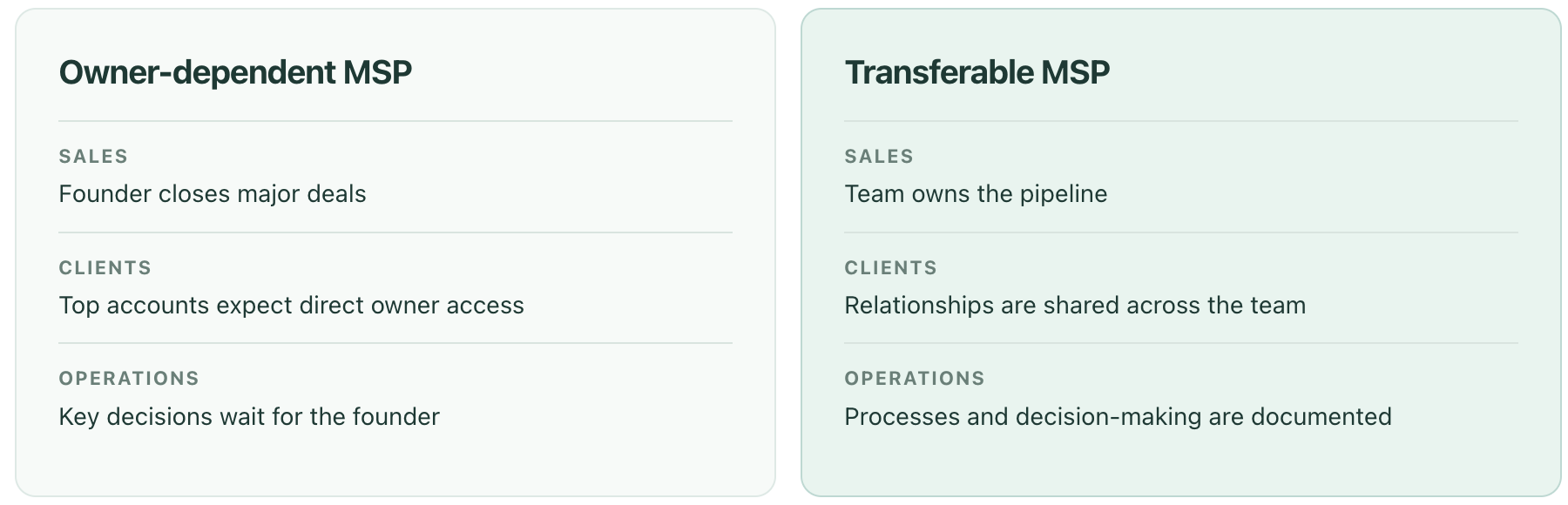
Imagine two MSPs generating similar revenue and profit:
At one, the owner still closes nearly every major deal and personally manages the five largest accounts.
At the other, independent teams manage sales, client relationships, service delivery, and operations.
Both might be successful businesses, but the second is generally easier for a buyer to take over.
That doesn't mean you need to make yourself completely unnecessary before selling. Some acquisitions include an ongoing leadership role for the founder. But you should be able to explain which responsibilities depend on you today and how those responsibilities would transfer.
A good sign of readiness: You could step away for a month without major disruption to revenue, client relationships, or daily operations.
2. Your financials would survive a stranger's scrutiny
You probably understand your MSP's finances better than anyone. You know why a particular month was expensive, which customer payments are running late, and why a certain expense doesn't reflect normal operations.
A buyer doesn't have that context.
When someone evaluates your MSP, they need financial statements that make sense without you sitting beside them explaining every unusual transaction.
Revenue should be recognizable and consistently recorded. Expenses should be categorized correctly. AR should reflect what customers actually owe. And the numbers in your reporting should agree with the underlying records.
This becomes particularly important during a quality of earnings review, when a buyer or financial adviser examines how reliable and sustainable the company's reported earnings really are.
A useful gut check is whether someone unfamiliar with your business could review your profit and loss statement and come away with a reasonably accurate understanding of how the MSP performs.
If the answer is yes, you're in a much stronger position to begin a serious sale conversation.
If the answer is, "Well, I'd have to explain a few things first," it's worth understanding how many of those explanations could be resolved before a buyer gets involved.
That might mean cleaning up historical transactions, reconciling accounts more consistently, separating personal expenses from business expenses, or documenting unusual costs that won't continue under new ownership.
The earlier you address those issues, the less likely they are to slow down diligence or raise questions about your asking price. For a practical starting point, see the most common mistakes MSPs make with their books.
A good sign of readiness: Your financial statements are current, reconciled, and understandable without weeks of cleanup.
3. Your DSO and payment follow-up run without daily oversight
An MSP can have healthy revenue, strong margins, and a growing customer base while still struggling to get invoices paid on time.
That becomes particularly important during a sale because buyers aren't just interested in what you've billed. They want to understand how reliably that revenue turns into cash.
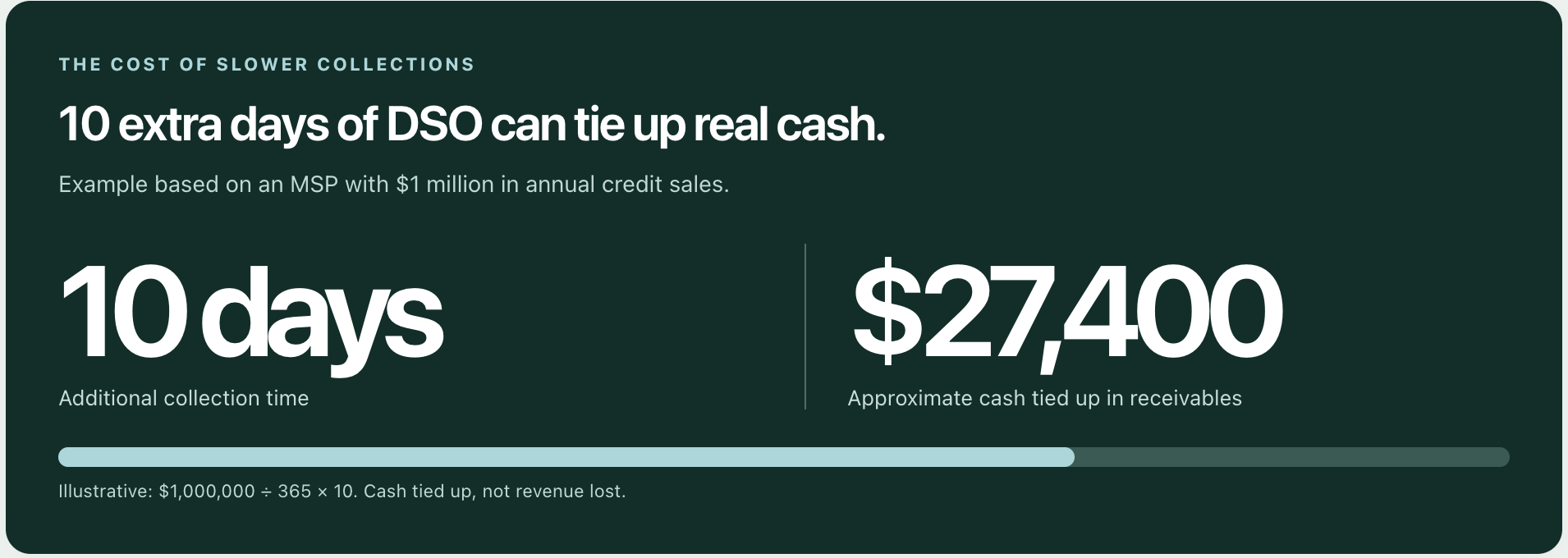
Days sales outstanding (DSO) measures how long, on average, it takes your business to collect payment after a sale. A consistently high DSO can indicate that too much working capital is tied up in receivables, while an unpredictable DSO can make cash flow harder to forecast.
Consider a business generating $1 million in annual revenue. That's roughly $2,740 in average daily revenue. Each additional day of DSO represents approximately that much more cash tied up in receivables, assuming revenue and payment patterns remain relatively consistent.
Now think about what happens to your payment process when you're unavailable.
Do reminders still go out? Are failed payments flagged and followed up on? Does someone know which accounts need attention? Can your team see which invoices are overdue without piecing together information from multiple systems?
A mature AR process shouldn't depend on the owner remembering to ask about outstanding balances every Friday.
AutoPay, consistent payment reminders, clear account ownership, and automated account monitoring can help reduce that dependence. FlexPoint's AR Agents, for example, can monitor accounts and handle past-due follow-up autonomously based on the rules an MSP sets, reducing the recurring work that would otherwise fall to the team.
You can run the numbers on your own DSO with our calculator to see how much working capital may be tied up in outstanding invoices.
A good sign of readiness: Your payment process continues working consistently without you checking overdue accounts or chasing individual invoices.
4. You've stopped reinvesting in growth
Not every sign that you're ready to sell shows up in a financial report. Sometimes it shows up in the decisions you've stopped making.
Maybe you've been talking about hiring another technician for six months but haven't moved forward. Maybe you've identified a promising new service line but don't feel particularly motivated to launch it.
Neither of those decisions necessarily indicate something is wrong. There are perfectly good reasons to hold back spending, particularly when growth is uncertain or cash needs to be preserved.
But there's a difference between being financially disciplined and quietly losing interest in the next stage of the business.
MSP owners spend years thinking about what comes next. The next hire, the next customer segment, the next acquisition, the next revenue milestone. When that forward-looking mindset starts to disappear, it's worth asking why.
You may be satisfied with the size of the company you've built. You may want to take some financial risk off the table. Or you may simply be ready for someone else to provide the capital and energy required for the next phase.
There's nothing inherently wrong with any of those answers.
The important distinction is whether you're intentionally preparing for an exit or allowing the business to stagnate while you avoid deciding what comes next.
Deferred investments can eventually affect service quality, growth, employee retention, and the company's attractiveness to buyers.
A good sign of readiness: You recognize that the next phase of growth may be better led or funded by someone else, and you're making deliberate decisions about the transition.
5. A competitor or platform company has already approached you
For you, the first serious thought about selling may have come from an unexpected call or email.
That could look like: a regional MSP wants to talk about combining businesses, a private equity-backed platform company is expanding into your market, or an acquisition adviser reaching out on behalf of a buyer looking for companies with your customer profile or service specialization.
Even if you weren't planning to sell, that interest is useful information.
It suggests that someone sees potential value in what you've built, whether that's your recurring revenue, geographic presence, customer relationships, technical capabilities, or team.
But inbound interest isn't the same thing as being ready to sell.
A buyer approaching you doesn't necessarily mean they're prepared to pay an attractive price, and an initial expression of interest isn't a substitute for understanding what your MSP is worth.
It's also worth remembering that buyers often evaluate multiple businesses at once, so an unsolicited conversation may simply be exploratory.
If you receive an approach, use it as an opportunity to learn what buyers are looking for and how they view businesses like yours.
Just make sure you're doing your own preparation before giving an interested buyer too much influence over the process. Knowing what buyers will check once you're in diligence can help you identify issues before they become negotiating points.
A good sign of readiness: You're receiving credible interest and have enough information about your own business to evaluate it without feeling rushed.
6. You know your numbers cold
There's a difference between knowing that your MSP is profitable and knowing how a buyer is likely to value it.
If a buyer asked about your EBITDA, margins, recurring revenue percentage, or customer concentration, could you give them a reasonably accurate answer without opening a spreadsheet?
You don't need to memorize every line of your financial statements. But you should understand the numbers that explain how your business performs, where its risks are, and what makes its revenue valuable.
EBITDA is a common starting point for MSP valuations because it helps buyers evaluate earnings before interest, taxes, depreciation, and amortization. But buyers may also examine adjusted EBITDA to account for certain one-time or owner-specific expenses.
Margins matter because two MSPs generating the same revenue can produce very different profits. And recurring revenue matters because buyers generally place more value on predictable income than on one-time projects or break-fix work.
For context, Craig Fulton of Evergreen reported at GTIA ChannelCon 2026 that average North American MSP valuations were around 6–8 times EBITDA, while 70–75% recurring revenue represented a strong revenue mix. Those are useful reference points, not guaranteed sale prices or universal requirements.
The actual value of your MSP depends on its size, profitability, growth, customer retention, contract quality, and how much risk a buyer would inherit.
For example, an MSP with $3 million in revenue, healthy margins, and a diversified base of long-term managed services contracts may look very different to a buyer than one with the same revenue but heavy project work and a handful of dominant clients.
Knowing your numbers also means understanding where they might raise questions.
If one customer represents a large share of revenue, you should know that. If margins have declined over the past year, you should be able to explain why. If cash collection has slowed, you should understand what's driving it.
A buyer will eventually ask these questions, so knowing the answers before the conversation begins gives you more control over how your business is evaluated.
A good sign of readiness: You understand your MSP's earnings, margins, recurring revenue, and major financial risks well enough to discuss them confidently with a potential buyer.
7. You're mentally done building and ready to hand it off
This one can be harder to recognize than the financial signs.
You've spent years building your MSP. You've probably handled everything from difficult client conversations to late-night emergencies, hiring decisions, payroll worries, and the occasional problem nobody else knew how to solve.
Over time, that work becomes part of your identity.
You're not just someone who owns a business, you're the person who built this particular business, with these employees, these customers, and all the history that comes with it.
So deciding to sell can feel surprisingly complicated, even when the financial case makes sense.
You might still enjoy the people and the work but feel less interested in leading another major growth phase. You might want more time with family, an opportunity to start something different, or simply a life where every major business decision doesn't eventually land on your desk.
Many owners don't want to stop working. They just don't want to keep carrying the full responsibility of ownership. So selling to a larger MSP or platform company may give them the opportunity to continue leading their team while gaining access to more resources and support.
Some want a clean break.
But knowing what you personally want from an exit can help you avoid accepting a deal that looks attractive financially but leaves you in a role or situation you never wanted.
It's also possible to be emotionally ready before the business is financially ready, or the other way around. That's why the personal side of exit planning deserves just as much attention as the numbers.
A good sign of readiness: You can picture what comes after ownership, and the idea of handing the business to someone else feels more appealing than continuing to build it yourself.
What to do next if most of these sound like you
You don't need to check every box to begin preparing to sell your MSP. In fact, very few businesses reach a point where every "i" is dotted and every "t" is crossed.
But if four or more of these seven signs sound familiar, it's probably worth taking a more serious look at your exit readiness.
Start by identifying which signs describe your business today and which still need work.
You may find that your finances are in good shape but too many customer relationships depend on you. Or perhaps the company runs well without your involvement, but you've never thought carefully about the type of buyer or transaction you'd actually want.
Those gaps are easier to address when you have time to make changes on your own terms.
The MSP Exit Readiness Guide includes a Readiness Checklist and Attractiveness Scorecard you can use to assess where your business stands. The worksheets help you evaluate the financial, operational, and strategic factors that can affect a sale, rather than relying on a vague sense that the business is doing well.
And remember, preparing to sell doesn't mean committing to sell.
Cleaner financials, reliable cash collection, documented processes, and a stronger management team will make your MSP easier to run today. They're worthwhile improvements even if you decide to remain the owner for another five years.
You may ultimately decide that now isn't the right time.
The goal is to reach a point where selling is a choice you can make with confidence, rather than a decision you have to rush because an opportunity appeared before you were ready.