


Finding an MSP that might be available for acquisition is one thing. Determining whether it's worth pursuing is another.
Two managed service providers can have similar revenue, customer counts, and service offerings but present very different acquisition opportunities. One might have predictable recurring revenue, a capable leadership team, and well-documented operations. The other might rely heavily on its owner, struggle with customer retention, or have financial processes that are difficult to integrate.
For buyers, the goal isn't simply to find an MSP that's willing to sell. It's to identify a business that fits your acquisition strategy and has the potential to perform well after the transaction.
Here's what to look for when qualifying an MSP acquisition target.
1. Look beyond revenue to understand its quality
Revenue is often one of the first numbers buyers consider, but the amount alone doesn't reveal how dependable that revenue is.
An analysis from Aventis Advisors identifies recurring revenue, profitability, growth, customer concentration, and churn altogether the factors that influence MSP valuations.
An MSP generating $5 million annually through recurring managed services contracts may have a very different financial profile from one generating the same amount through hardware resale and irregular project work.
When evaluating a potential acquisition, consider:
- Recurring revenue: How much comes from ongoing managed services agreements versus one-time work?
- Customer retention: How consistently does the MSP retain customers and renew contracts?
- Customer concentration: How much revenue depends on a handful of major accounts?
- Profitability: Are margins sustainable, and what adjustments are needed to understand normalized earnings?
- Revenue growth: Is growth coming from new customers, expanded services, price increases, or acquisitions?
A qualified target doesn't necessarily need exceptional performance in every category. But buyers should understand what's driving its financial results and whether those results are likely to continue under new ownership.
2. Understand how dependent the business is on its owner
Many MSPs begin as founder-led businesses, with owners maintaining close relationships with customers and overseeing important operational decisions.
That involvement can be a strength. It can also create transition risks if too much of the business depends on one person.
Consider what would happen if the owner stepped away six months after the acquisition.
Would the leadership team be able to manage day-to-day operations? Are customer relationships distributed across account managers? Are technical procedures and financial responsibilities documented?
An MSP with an established management team and repeatable processes may be easier to integrate than one where the founder personally handles every major customer issue, billing exception, or financial decision.
The important question is whether the business can continue operating effectively through an ownership transition.
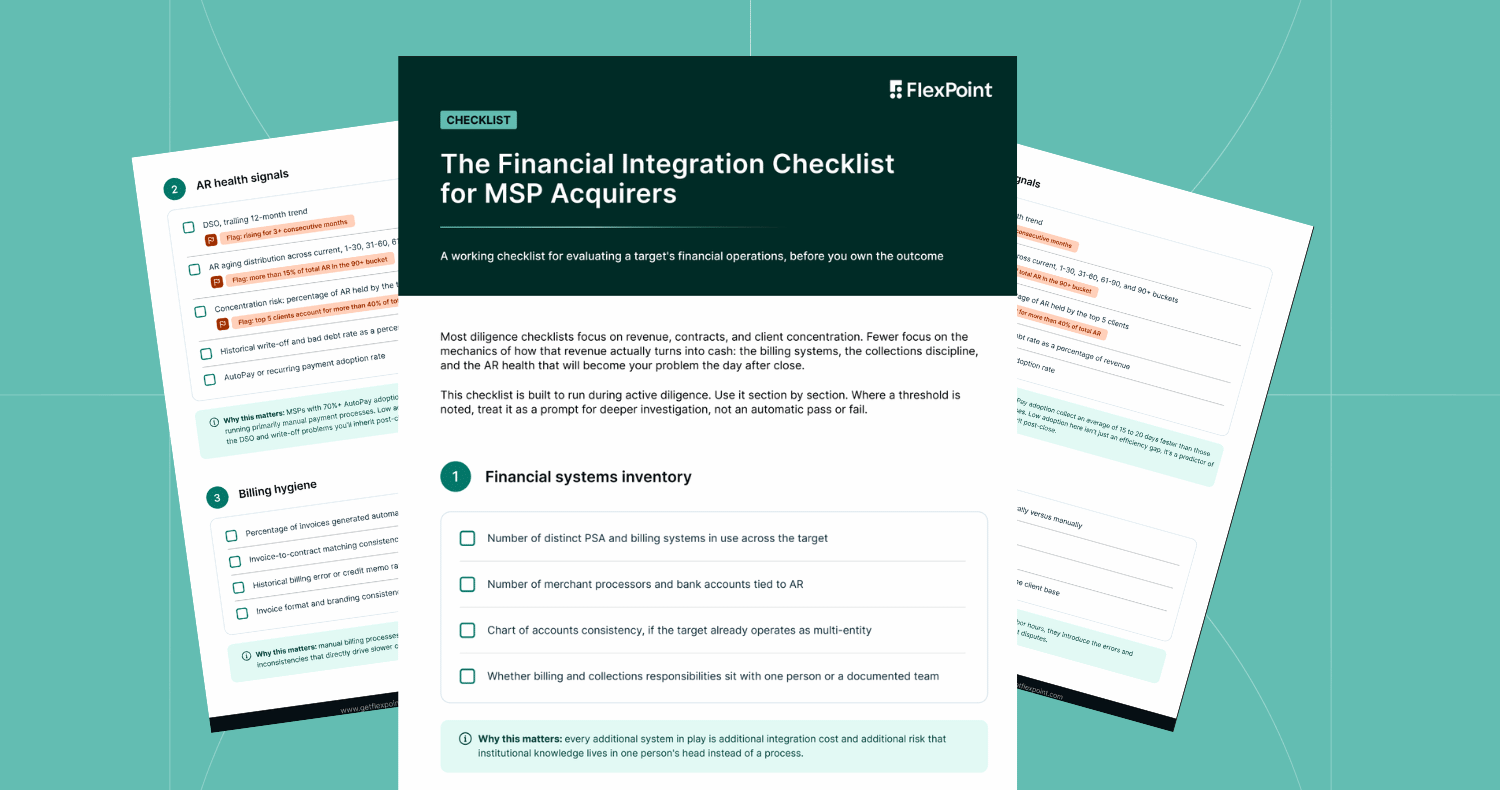
3. Examine the financial operations behind the business
An MSP can report healthy revenue and profitability while still having significant problems with billing, payments, or accounts receivable.
These issues aren't always visible in a high-level financial summary, but they can affect cash flow and create additional work after an acquisition.
During preliminary conversations, try to understand:
- Which PSA and accounting platforms does the MSP use?
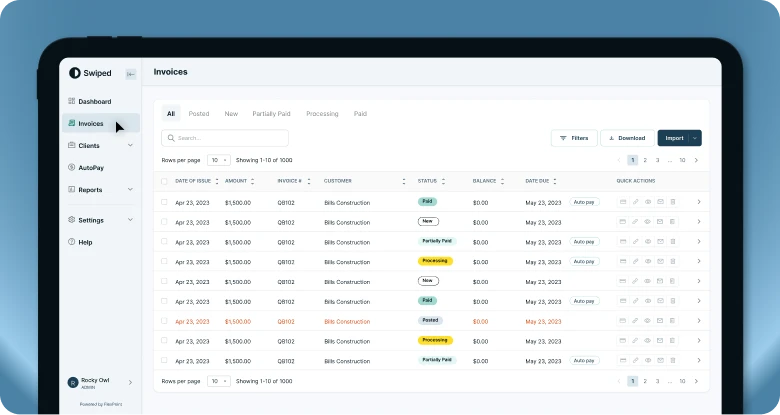
- How are recurring invoices generated and delivered?
- How much of the payment process is automated?
- Are overdue invoices followed up on consistently?
- How are payments matched to invoices and bank deposits?
- Are billing and reconciliation processes documented?
For example, an MSP with strong recurring revenue but a large balance of overdue invoices may require additional attention to working capital and payment processes.
Similarly, a business that relies on manual reconciliation may introduce operational complexity when its financial activity needs to be incorporated into a larger portfolio.
Neither issue automatically disqualifies a target. But both should influence the buyer's assessment of integration requirements and the resources needed after close.
Related: How to Prepare for Financial Integration After an MSP Acquisition
4. Identify the risks that could change the deal
Some acquisition risks are relatively straightforward to address. Others can materially change a target's attractiveness or the terms a buyer is willing to offer.
A few warning signs deserve particular attention:
These are reasons to investigate, not automatic deal-breakers.
A buyer may still pursue an MSP with operational weaknesses if the purchase price, integration plan, and expected benefits justify the additional work.
The goal is to identify material risks early enough to make an informed decision about whether to proceed.
5. Consider what happens after the acquisition
A qualified MSP acquisition target needs to make sense beyond the transaction itself.
Before advancing an opportunity, consider how the business would operate within your existing organization.
If your strategy involves acquiring multiple MSPs, for example, you may want to preserve individual brands and customer relationships while introducing more consistent financial processes across the portfolio.
That raises practical questions:
- Can the acquired MSP continue using its existing PSA?
- Will its accounting and reporting systems need to change?
- Can payment and AR workflows be standardized?
- What operational responsibilities will move to a centralized team?
- How much implementation work will be required?
These decisions can affect acquisition costs, customer continuity, and the time needed to realize operational benefits.
For MSP acquirers, financial integration is particularly important. Standardizing supported billing, payment, and reconciliation workflows can help reduce the amount of manual work introduced with each acquisition, even when businesses continue operating on different PSA systems.
The better you understand those requirements before close, the easier it is to plan for them.
How do you know when an MSP is worth pursuing?
A qualified acquisition target isn't necessarily the largest, fastest-growing, or most profitable MSP on your list.
It's a business that meets your strategic requirements, demonstrates financial potential, and presents risks your organization can reasonably manage.
At the initial evaluation stage, you should be able to answer three questions:
- Why does this MSP fit our acquisition strategy? Identify the specific capabilities, customers, market presence, or financial characteristics that make the opportunity attractive.
- What needs further investigation? Document uncertainties around financial performance, customer retention, leadership, and operations.
- Can we realistically integrate and support this business? Consider the systems, people, processes, and resources required after the acquisition.
If those answers support moving forward, the next step is a more detailed evaluation and financial due diligence.
For a framework to organize and compare potential opportunities, see our guide to building an MSP acquisition target list, including a downloadable acquisition scorecard.
Build a stronger foundation for your next MSP acquisition
Finding a qualified MSP acquisition target requires looking beyond the initial numbers.
Recurring revenue, customer relationships, leadership stability, financial operations, and integration requirements all influence whether a business is likely to be a good fit.
At FlexPoint, we help MSPs simplify supported billing, payment, and reconciliation workflows, including across major PSA platforms. For acquirers managing multiple businesses, more consistent financial processes can make it easier to support growth without adding unnecessary manual work.
Related articles