

For most of the last two decades, improving service delivery was largely a matter of adding capacity.
More clients meant more technicians; more tickets meant more documentation.
Better service came from hiring good people, refining your processes, and finding ways to squeeze a little more efficiency out of every hour.
That hasn't changed entirely.
But what has changed is where many of those hours are being spent.
MSPs are no longer only asking how quickly a technician can resolve a ticket. They are asking how much work had to happen before that ticket reached the right person, how much context had to be gathered, how many updates had to be written, how much documentation had to be created, and whether the issue could have been prevented in the first place.
AI is beginning to reshape service delivery in two ways. It's changing how support is delivered to clients, and it's changing the operational work that happens behind every ticket, conversation, and invoice.
According to Kaseya’s 2026 State of the MSP Report, 48% of MSPs say AI and automation will be the top IT or service need for their clients in 2026. At the same time, 71% say acquiring new customers is their biggest challenge.
In other words, MSPs are being asked to deliver more value, prove that value faster, and operate more efficiently while competition gets harder.
For MSPs, that raises a better question than whether AI will replace service teams.
If AI takes over more of the repetitive work around service delivery, what becomes possible for the people who used to do it?
If AI changes how work gets done, it changes what great service delivery actually looks like.
Here's where that shift is already happening, and why it matters for MSPs.
Service Delivery Has Always Been About Trust
Ask an MSP owner what they sell and you will probably hear words like security, responsiveness, expertise, or reliability.
Clients often experience it more simply.
They remember whether your business is easy to work with.
That impression is built through hundreds of small moments:
A ticket gets acknowledged quickly. A technician gives a clear update. Documentation is accurate enough that the next person does not have to start over. An issue is escalated before it becomes painful. A billing question gets answered without three back-and-forth emails.
None of those moments is especially dramatic on its own.
Together, they become your reputation and the entire basis of your relationship with your client.
That is also why service delivery has never belonged only to the help desk. Your technicians, dispatchers, account managers, finance team, and client success team all shape the same client experience.
Clients do not experience those departments separately, they experience one company.
As AI becomes part of more of those day-to-day interactions, the question is not whether it belongs in service delivery.
It is whether it helps your business become more consistent, more responsive, and easier to work with.
That idea becomes even more important as AI begins handling more client interactions. We explored that shift further in our guide to What Happens to Client Relationships When AI Handles Your AR?
The Bottleneck Is No Longer Just Ticket Volume
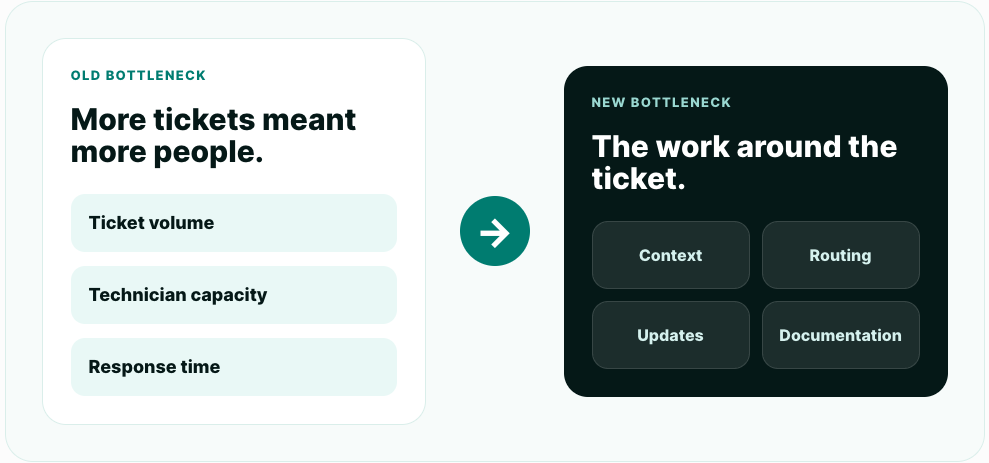
For years, ticket volume was the obvious service delivery bottleneck.
More tickets meant more pressure on technicians, more scheduling efforts, documentation, etc...
Eventually, the answer was usually to hire another person or ask the same team to handle more work.
AI does not remove the need for good people.
But it does change where the bottleneck lives.
A surprising amount of service delivery time is not spent solving the hardest technical problem of the day. It is spent gathering context before solving it, summarizing what happened after solving it, routing work to the right person, writing updates, documenting the fix, and making sure the client understands what changed.
None of that work is unnecessary.
The question is whether your highest-skilled employees should still be the ones doing all of it.
Fixify’s 2026 IT Help Desk Benchmark shows why this matters. Tickets with AI automation had a median resolution time of 4.4 hours, compared with 71 hours when a human performed most of the work. The first response time was similar, but the difference showed up in everything that happened after the ticket was acknowledged.
That is the real service delivery shift.
Overall, AI is both helping MSPs respond faster while it is also helping work move faster after the response too.
That matters because the expectations placed on MSPs have changed.
Clients no longer judge service delivery solely by how quickly a ticket gets closed. They notice how quickly someone understands the problem, whether they have to repeat themselves, whether updates arrive proactively, and whether the issue stays resolved after the ticket is closed.
In other words, clients increasingly judge the experience of receiving support, not just the technical outcome.
Ten years ago, improving service often meant reducing response times or hiring enough technicians to keep up with ticket volume. Today, it also means reducing the administrative work surrounding every ticket.
That's why many of today's AI investments are focused on reducing the friction between the moment a ticket is submitted and the moment meaningful work actually begins.
AI Is Changing the Service Desk First
The most obvious place AI is changing MSP service delivery is the service desk.
Ticket triage is a good example.
A technician may be perfectly capable of reading a ticket, identifying the issue, assigning priority, routing it to the right person, and finding the relevant documentation.
But when that process happens hundreds of times a week, the work becomes expensive.
AI can classify tickets, summarize client requests, suggest priority, recommend next steps, and surface related documentation before a technician ever opens the ticket.
Several PSA and service management platforms are already moving in this direction.
ConnectWise Sidekick uses generative AI to summarize tickets, recommend responses, and assist technicians as they work. HaloPSA has introduced AI integrations and supports third-party AI tools for ticket summarization, workflow assistance, and knowledge retrieval. (One that keeps coming up on Reddit is Runbooks.) Meanwhile Microsoft Copilot is increasingly being used alongside Microsoft 365 to surface documentation, summarize conversations, and prepare technicians before client interactions.
Purpose-built AI platforms are beginning to take that one step further by operating directly inside service workflows instead of simply responding to prompts. Rather than helping someone complete a task, they're helping determine what work should happen next.
That puts each technician in a better place by the time they get their hands to solving the problem.
Instead of spending the first several minutes figuring out what the client is asking, what device is involved, what has already been tried, and who should own the issue, the technician can begin with that context already assembled.
For technicians, that means less time hunting for information and more time applying their expertise where it creates the most value.
Documentation Is Becoming Part of the Workflow
Most MSPs know documentation matters.
They also know how easily it gets neglected.
Technicians are busy. Tickets pile up. The fix gets completed, the client is satisfied, and the documentation becomes tomorrow’s problem.
Until tomorrow arrives.
Then another technician has to troubleshoot the same issue without the full story or an account manager prepares for a client conversation without clean notes. Or a recurring issue looks like a new problem because the past work was never documented clearly.
AI is beginning to make documentation less dependent on memory and discipline.
Tools like Microsoft Copilot, ChatGPT, and PSA-integrated AI features can summarize ticket notes, clean up technician updates, draft knowledge base articles, and turn long internal conversations into usable documentation. N-able’s AI governance guidance also notes that AI tools are already being used to summarize tickets, draft communications, analyze telemetry, and increasingly automate actions across IT environments.
General AI tools each solve different problems. If you're evaluating where they fit into an MSP's workflow, we've compared some of the best AI tools currently available for MSPs and what they're best suited for.
That matters because documentation is not just an internal housekeeping task.
It is part of service quality.
Better documentation means better handoffs, fewer repeated questions, cleaner escalations, and faster resolution the next time the issue appears.
It also means new technicians ramp up faster because the knowledge isn't locked inside someone else's memory.
Proactive Service Is Becoming More Realistic
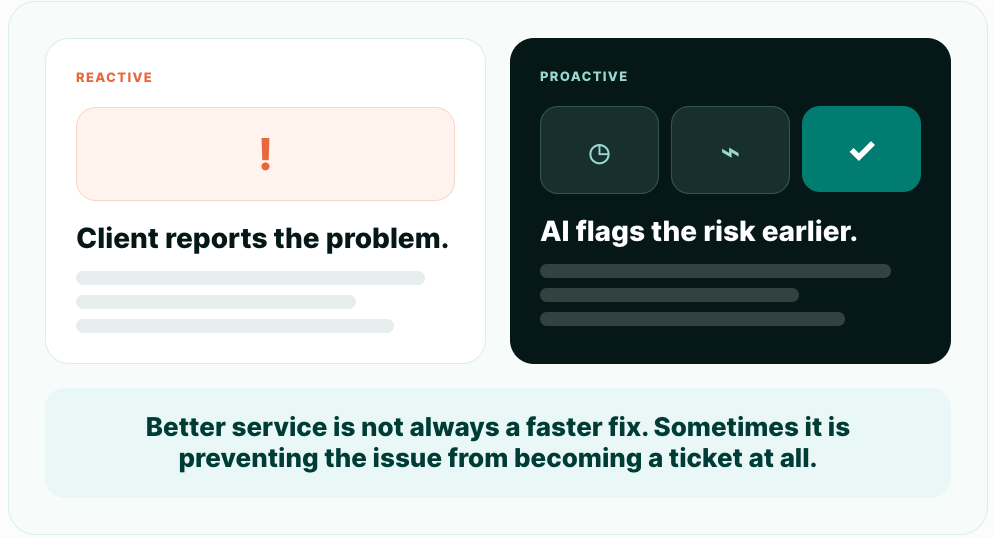
MSPs have talked about being proactive for years.
The challenge is that proactive service still requires someone to notice the signal, understand the risk, prioritize the action, and communicate what is happening.
That is difficult when teams are already stretched thin.
AI makes proactive service more realistic because it can monitor patterns, identify anomalies, and surface risks earlier than a human team reviewing dashboards manually. That might mean detecting recurring endpoint issues, spotting backup failures, identifying tickets that are likely to escalate, or noticing that a client’s environment is drifting away from standard configuration.
This shift is already showing up across the MSP ecosystem. Microsoft Intune uses AI to identify device health trends before they become widespread issues. CrowdStrike Charlotte AI helps security teams investigate threats faster by surfacing relevant telemetry and recommending next actions. NinjaOne, N-able, and several RMM vendors are also investing heavily in AI-powered monitoring, anomaly detection, and intelligent alerting that helps technicians focus on the issues most likely to impact clients.
The common thread for all of these isn't simply automation for automation's sake.
It's helping technicians identify meaningful problems earlier so they can spend more time preventing issues than reacting to them.
That's ultimately where most MSPs want to be. Clients rarely celebrate a fast response to a problem they never wanted to have in the first place.
That is also why unified data matters. Kaseya has pointed out that AI cannot accurately prioritize tickets or suggest remediation when data is incomplete or structured differently across disconnected systems. AI needs consistent workflows and reliable inputs to be useful.
That is an important reminder for MSPs.
AI is not magic layered on top of messy operations.
It only really works when the underlying service delivery process is already operating within connected systems and clean data.
Client Communication Is Becoming More Consistent
One of the biggest service delivery problems is not technical ability.
It is inconsistency.
A technician forgets to send an update. A ticket sits longer than expected. A client asks for status and gets a vague answer. An account manager enters a QBR without the full picture. A billing question goes unanswered because it landed outside the help desk.
None of those moments alone ruins a client relationship.
Together, they make the MSP feel harder to work with.
AI helps here because much of client communication follows patterns. Ticket updates need to be clear. Escalations need context. Billing questions need accurate answers. Follow-ups need to happen when they were promised.
The work is not always complex, it just has to happen consistently.
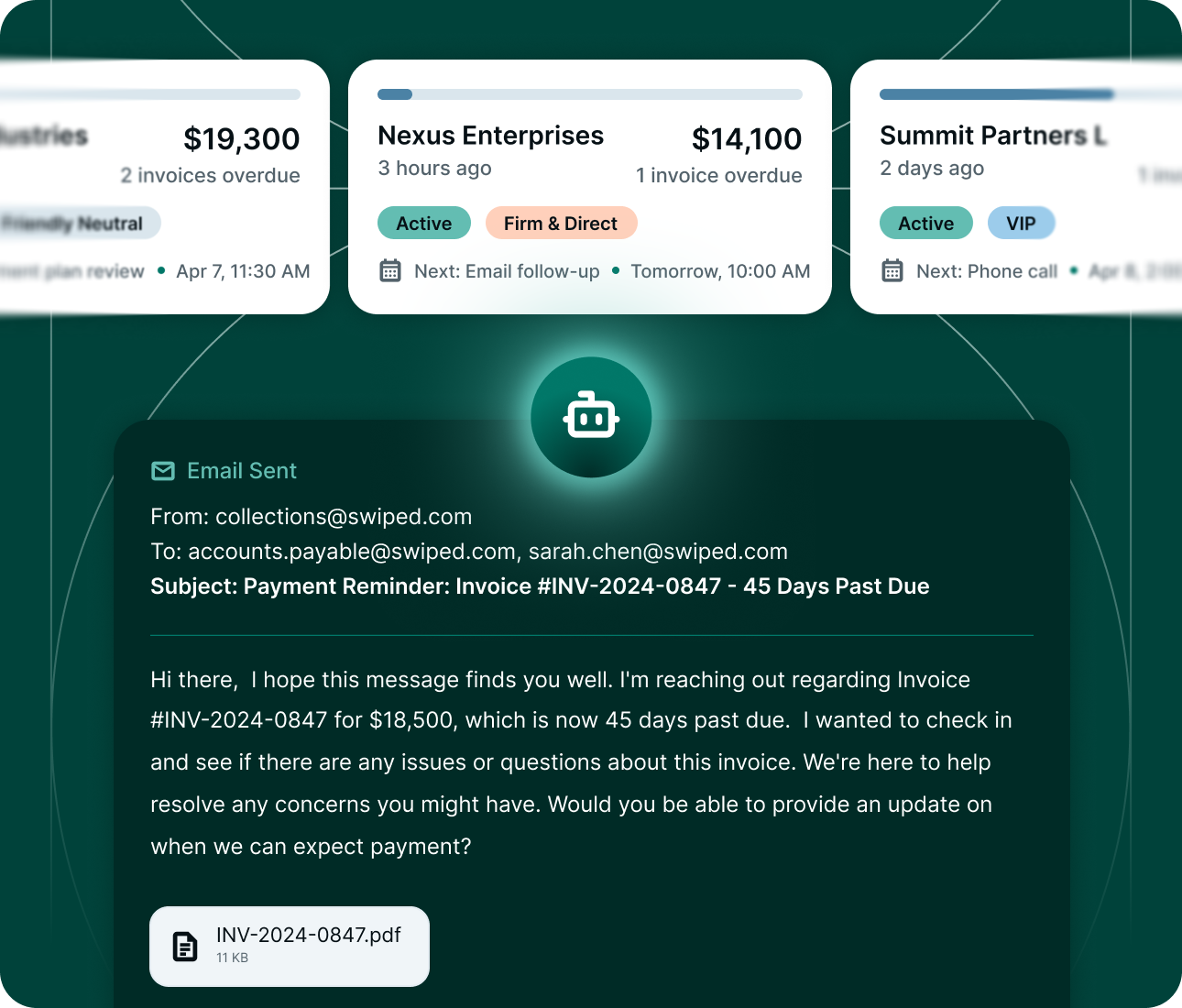
This is where back-office AI becomes part of service delivery, not separate from it. A client asking about an invoice is still having a service experience. A client trying to pay is still interacting with your company. A client waiting for a follow-up after a billing dispute is still judging whether your business is organized.
That is why tools like FlexPoint AR Agents belong in the service delivery conversation. AR Agents help reduce the friction that often sits outside the ticket queue but still affects the client relationship.
If you'd like to see how purpose-built AI agents differ from traditional AI assistants, our guide to AI Agents for Payments & Billing explains why they're becoming the next evolution of operational software.
Service delivery is not just what happens when something breaks.
It is every operational moment where the client needs your business to be clear, responsive, and easy to work with.
For a deeper look at how AI is changing finance operations specifically, read our guide to Back Office AI for MSPs.
MSPs Are Moving Toward Decision Intelligence
The more AI handles repetitive work, the more valuable human judgment becomes.
That may sound counterintuitive, but it is the direction the MSP market appears to be moving.
At Pax8 Beyond 2026, the company framed AI as a way to create capacity at friction points throughout service delivery. The goal is not simply more automation for its own sake. It is freeing teams to focus on strategic client guidance, outcome delivery, and trusted advisor relationships.
That is a useful way to think about the shift.
MSPs are not becoming less service-oriented; they are becoming less task-oriented.
The value is moving from “we handled the ticket” to “we helped the client understand what matters, what to do next, and how to reduce risk.” That is real leadership.
AI can summarize a ticket, draft an update, surface account history, or recommend the next step.
But someone still has to decide what matters, explain it in the context of the client’s business, and build trust over time.
That is where MSPs will continue to differentiate.
The Future of Service Delivery Is Not Less Human
It is easy to assume AI makes service delivery less personal.
In practice, the opposite may be true.
When technicians spend less time gathering context, they have more time to solve meaningful problems. When account managers spend less time assembling reports, they have more time to advise clients. When finance teams spend less time chasing routine payments, they have more time to resolve exceptions. When documentation happens as part of the workflow, fewer people have to waste time recreating history.
Clients rarely remember whether AI helped route the ticket.
They remember whether the issue was handled clearly, whether someone followed through, whether the experience felt organized, and whether your MSP made their day easier or harder.
That is ultimately what service delivery has always been about.
The most successful MSPs in the next few years won't necessarily have the most technicians or the biggest service desk.
They'll be the ones that remove as much friction as possible from the work surrounding their people. Because when repetitive work becomes faster, expertise becomes more visible.
And that's what clients are paying for.
Explore FlexPoint AR Agents to see how MSPs are using AI to reduce repetitive collections work while keeping people in control of every important decision.



.png)