


Every month, you send payment reminders, follow up on overdue invoices, answer billing questions, and spend time chasing balances.
Despite being typically unpleasant, those interactions are central touch points to your relationship with your clients.
And according to PwC, 73% of consumers say customer experience is an important factor in their purchasing decisions, yet less than half believe companies consistently deliver a good experience.
That creates an understandable tension around AI-powered accounts receivable. If software starts handling collections, billing questions, and payment follow-up, what happens to the relationship?
Will clients feel ignored?
Will communication become less personal?
Or does the opposite happen?
Why Collections Conversations Can Feel So Personal
Few conversations are more uncomfortable than asking someone for money.
Even when the invoices are always accurate and you've had a good long-standing relationship... that strain never fully goes away.
For MSPs, that tension is amplified because most relationships are long-term. You're not sending a single invoice and moving on. You're supporting the same clients month after month, often for years.
It's easy to worry that every reminder email can chip away at goodwill—it can seem like an assumption that they are no longer reliable.
On top of that, following up too aggressively could create friction where none existed before.
As a result, many teams delay collections activity longer than they should.
That hesitation is common. Research from Xero found that many small business owners experience anxiety around chasing overdue invoices, with payment collection consistently ranking among the least enjoyable parts of running a business.
The irony is that avoiding the conversation often creates more relationship damage than having it.
A client who receives a clear reminder on Day 3 rarely feels frustrated.
But a client who receives no communication for six weeks and then suddenly gets an escalation call often does.
The relationship problem isn't usually the reminder.
It's how the reminder is handled.
What Clients Actually Want From Billing
Most clients don't wake up hoping for more interaction with your accounting department.
Just as much as you don't want to place additional emails or calls, they don't want to receive them.
They want questions answered quickly, to understand what they owe, and for it to be easy to pay.
According to Salesforce's State of the Connected Customer report, 88% of customers say the experience a company provides is as important as its products or services.
Nobody says:
"I love having to call accounting!"
What matters is the process does not overburden anyone and the outcome (finalized payment) is easy to achieve.
The Relationship Is Not the Reminder
It's easy to confuse the relationship one has with a client with the mechanism uses to manage the relationship.
After all, asking for payment is a part of your relationship.
But the reminder email is not central to your relationship and neither is the payment portal.
What is central to your relationship is mutually shared trust (more importantly the trust that they have in you as the provider).
That trust is built through consistency: communicating early and clearly, following through, making interactions easy... and overall prioritizing their ease of living.
The specific tool being used matters far less than whether the experience feels predictable and professional.
The Real Problem: Inconsistent Human Follow-Up
When MSP owners think about collections, they often imagine a choice between human communication and automated communication.
In reality, the biggest source of frustration is usually inconsistent communication.
Consider a few common situations: a client pays an invoice but still receives a reminder, a billing question sits unanswered for three days, an owner escalates an account after weeks of silence, five reminders arrive at once because someone finally reviewed the aging report.
None of those experiences are personal (or professional). And ultimately, these occurrences are exactly the kind of thing that erode the trust—and because of that, the relationship—that your clients have with you.
Relationship damage in collections comes from friction in the process itself, not automation.
Besides, consistency is often the difference between a small delay and an invoice that becomes a much larger collections problem.
How AI Can Improve the Client Experience
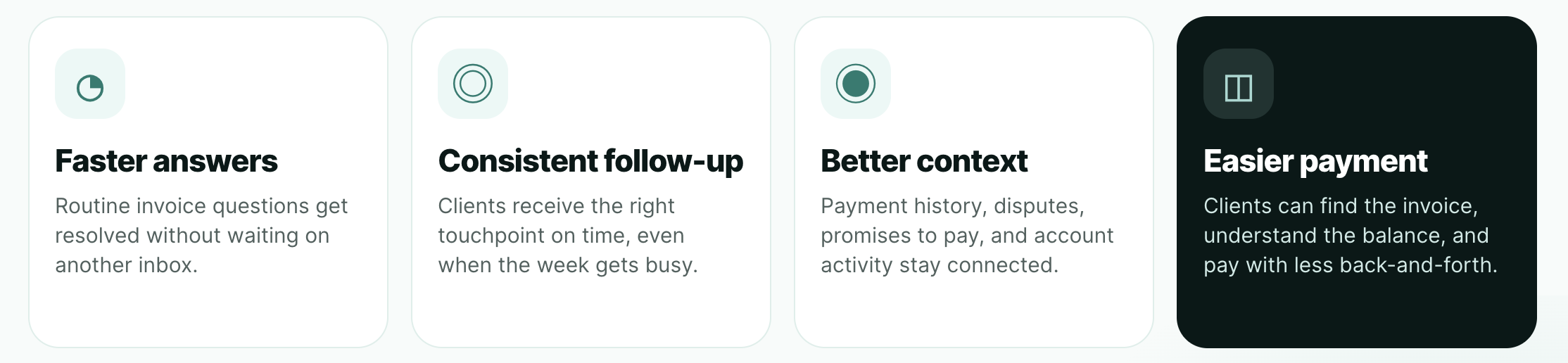
The biggest gains for clients with the application of AI usually show up in four areas:
1. Faster Answers
Invoice-related questions are often repetitive: When was this invoice sent? What payment methods do you accept? Has the payment been received? What is this balance for?
AI can answer routine questions immediately instead of requiring a client to wait for someone to return an email.
HubSpot research found that 90% of customers rate an immediate response as important when they have a service question.
For clients, faster answers feel like better service.
And that's ultimately because they are.
2. More Consistent Communication
One of the biggest challenges in collections is simply making sure follow-up happens.
Across hundreds of invoices at different stages and with your own front-of-office work, it's easy for clients to slip through the cracks. Balances become overdue quickly when there are so many spinning plates.
This is often simply the nature of things for an MSP. People get busy.
AI doesn't have that problem.
With the right application, your clients receive communication at the appropriate time, regardless of how busy the week becomes.
3. Better Context
A surprising amount of collections work involves gathering information before taking action.
It leads to another slurry of questions someone on your team has to answer before reaching out: Has the client paid recently? Did they promise to pay next week? Was there a dispute? Have they historically paid on time?
Humans need to pull information from multiple systems before deciding what to do and how to do it.
AI can evaluate that context instantly.
That leads to more appropriate communication, not less personal communication.
You could be concerned here that this is where the human and interpersonal element is lost. But what's important to reiterate is that their cousin's friend's wedding coming up is not the content of a payment reminder.
When it comes to payments (especially late ones), the clearer and less muddled the content of the touchpoint with the client, the better.
What is appropriate in a follow-up is the details of the payment and their billing history alone. A client who has paid on time for three years should not be treated the same way as a client who has been sixty days overdue for the last six months.
Context matters.
4. Easier Payment Experiences
Overdue invoices are rarely caused by unwillingness to pay. Those clients you usually discover right off the bat from their first payment.
When it's not the result of liquidity issues, overdue invoices are often caused caused by payment friction.
E.g. the invoice is difficult to find, the payment process is confusing, or the client needs to ask a question before submitting payment.
Reducing friction improves the client experience.
The right AI tool for accounts receivable at this level smooths out all of those moving pieces for your client.
And improving the client experience often improves payment speed at the same time.
Human Relationships Are Still the Priority
It's important to establish that "AI collections" or "AR Agents" does not mean a robot replacing a person.
It actually means reserving your employees for more complex tasks and situations where they create the most value.
Billing disputes still require human judgment.
Frustrated clients still require empathy.
Strategic accounts still deserve personal attention.
Complex exceptions still benefit from conversation.
AI handles repetition and the things that most require consistency. But ultimately, AI is not best suited to handle exceptions, but your expert back-office employees are.
Humans handle the actual aspects of your client relationships. That division is important because it reflects how most MSPs already operate.
The goal is not to automate trust.
The goal is to automate the administrative work surrounding trust.
Read more here: "Is AI Coming for Back Office Jobs?"
The Best AR Systems Don't Replace Humans
The most effective model is not Human or AI.
It's Human + AI.
AI handles the repetitive work:
- Routine follow-up
- Payment reminders
- Invoice questions
- Collections prioritization
- Documentation
Humans handle the situations where judgment and empathy matter most.
This is the approach FlexPoint takes with AR Agents.
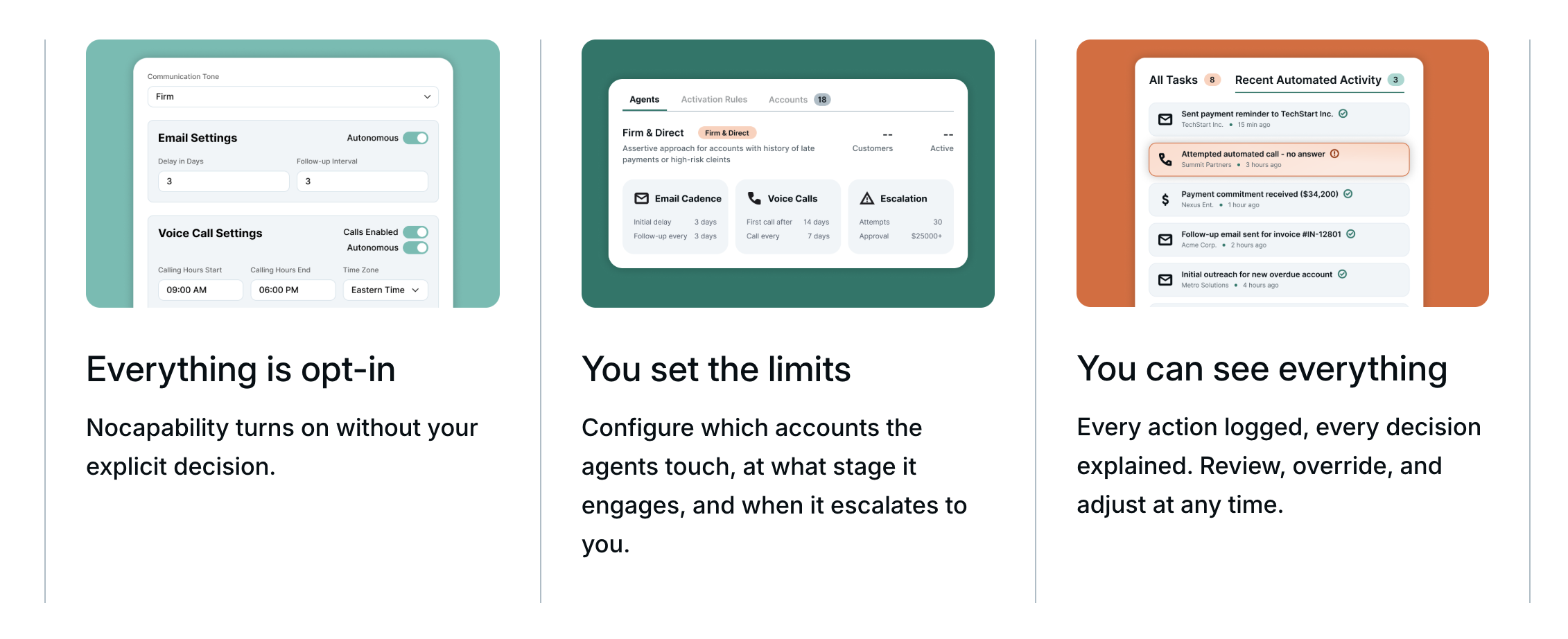
Teams can choose between autonomous workflows and copilot workflows depending on how much control they want to maintain.
Agents can identify accounts requiring attention, recommend next actions, answer routine questions through email or an intelligent voice call, and organize collections activity across the entire workflow.
Meanwhile, humans remain fully in control of escalation paths, communication strategy, client relationships, and final decisions.
The result is more visibility for your teams and better cash flow.
For many MSP teams, the biggest benefit isn't the automation itself, but finally having all of the information needed to make good decisions in one place.
For a deeper look at how this model compares to traditional automation, see our guide on AI vs. Automation vs. Manual Payment Collection.
What MSP Clients Will Actually Notice
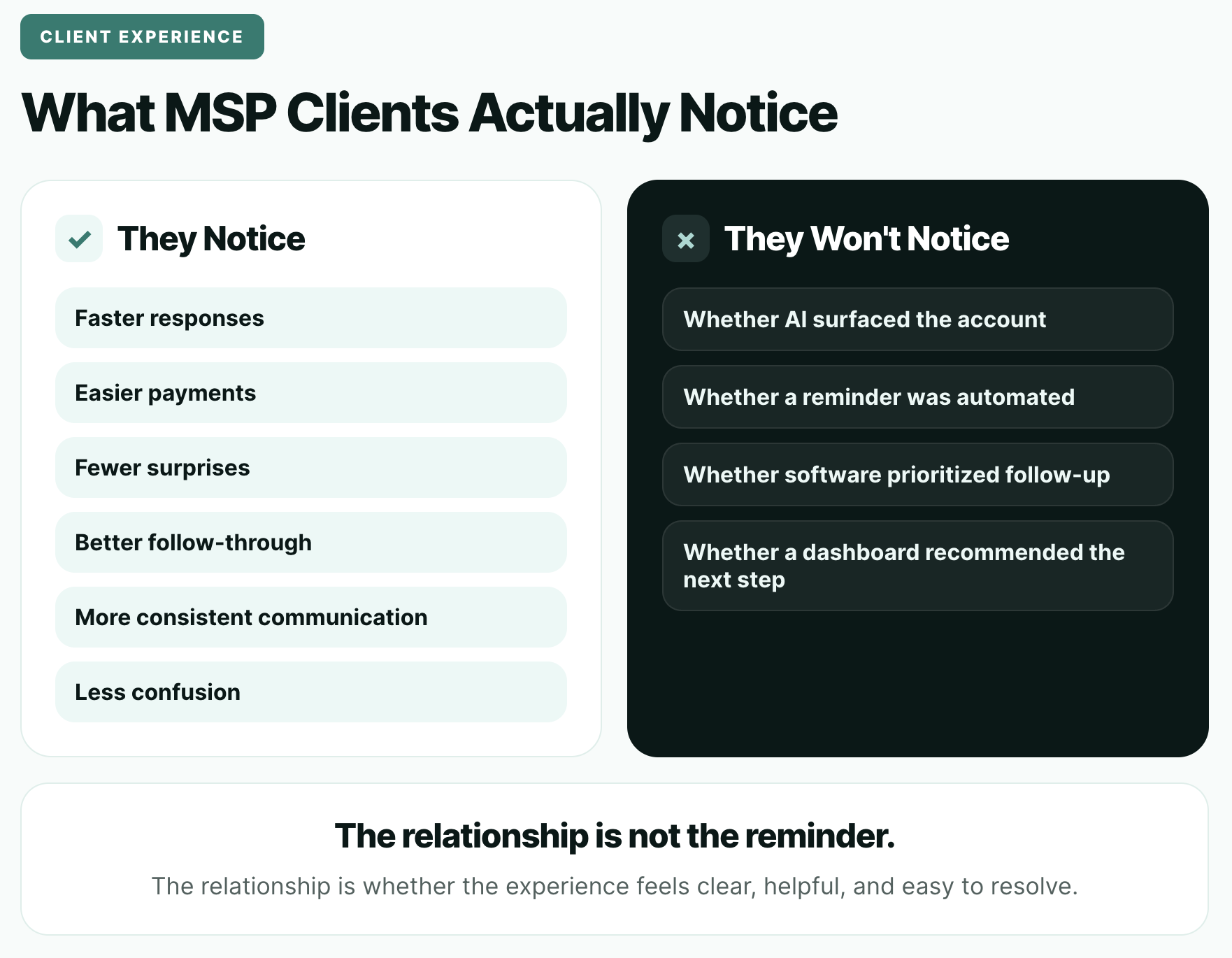
Most clients judge billing experiences the same way they judge every other service interaction:
Was it easy?
Was it clear?
Did it get resolved?
If the answer is yes, the technology behind it becomes a pro to working with you (even if it's an otherwise invisible one).
The Future of MSP Accounts Receivable
It's easy to assume that AI would make client relationships less human.
In practice, the opposite may be true.
The more repetitive collections work AI handles, the more time your team has for conversations that actually require their empathy, judgment, and trust.
Clients rarely remember who sent the reminder. They will remember whether they got an answer, whether the process was easy, and whether your company followed through. Those are the moments that shape trust.
That is what strong client relationships are built on.
And that is why the future of accounts receivable is not about removing people from the process.
It's about giving them more time to focus on the parts of the relationship that only people can provide.
Learn more about FlexPoint and what the AR Agents could do for your collections here.




.png)