


Over the last year, nearly every major payment provider, accounting platform, and accounts receivable vendor has announced some form of AI agent.
The common theme is simple: AI is moving from helping finance teams make decisions to helping them do the work.
For businesses struggling with late payments, manual invoicing, and growing accounts receivable workloads, that development creates an exciting opportunity.
Tasks that once required hours of follow-up, organization, and coordination can increasingly be handled with far less manual effort.
But before we dive in to the top AI agents for payments and billing, it's worth noting that that can mean many different things.
Some agents focus on accounts receivable and collections. Others help automate accounting and financial workflows. A newer category is emerging around agent-driven payments, where AI can securely initiate or complete transactions on behalf of users.
For the purposes of this guide, we'll cover all three categories so you can understand what tools may be best for you, where the market is today, and where it's heading next.
Why AI Agents Are Moving Into Finance
According to the 2025 PYMNTS Intelligence Growth Corporates Working Capital Index, nearly half of middle-market firms reported that late payments negatively impacted their ability to grow.
Cash flow remains one of the most persistent operational challenges for businesses of every size.
At the same time, many finance teams still spend 20+ hours a month following up on overdue invoices, answering payment questions, escalating disputes, and updating collection notes.
These are repetitive tasks that require judgment but not necessarily deep strategic decision-making... which makes them ideal candidates for AI.
As Victor Lopez, CEO of FlexPoint, noted during Pax8 Beyond 2026, many MSPs have already adopted AI across service delivery.
Yet despite the fact that the biggest opportunity for AI is in the back office, it currently remains one of the least automated parts of the business.
What Makes an AI Agent Billing Different?
Not every AI tool qualifies as an agent.
Many finance platforms now include AI-generated insights or chatbot interfaces. Those capabilities can help teams work more efficiently, but they still rely on a human to decide what happens next.
But an agent can take action on its own within rules and guardrails defined by the business.
A true billing or payments agent can:
- Monitor invoices, payment activity, and customer interactions continuously
- Identify accounts that need attention
- Decide when follow-up is appropriate
- Send collection emails or payment reminders
- Answer common billing questions
- Escalate disputes or exceptions to a human team member
- Learn from outcomes and adjust future actions
For example, a conventional accounts receivable platform might flag an invoice as overdue and recommend outreach. An AI billing agent can recognize the overdue invoice, draft or send the follow-up, answer a customer's payment question, and escalate the conversation if additional attention is needed.
It's the shift from insight to action that makes AI agents one of the most talked-about developments in the MSP space (and finance space, more broadly)!
AI Agents for Accounts Receivable & Collections
The first category focuses on helping businesses get paid faster.
These agents are designed to automate invoice follow-up, collections workflows, payment communication, and accounts receivable management. While approaches vary, the goal is generally the same: reduce manual effort and improve cash flow visibility.
FlexPoint
Best for: MSP Accounts Receivable All-Around
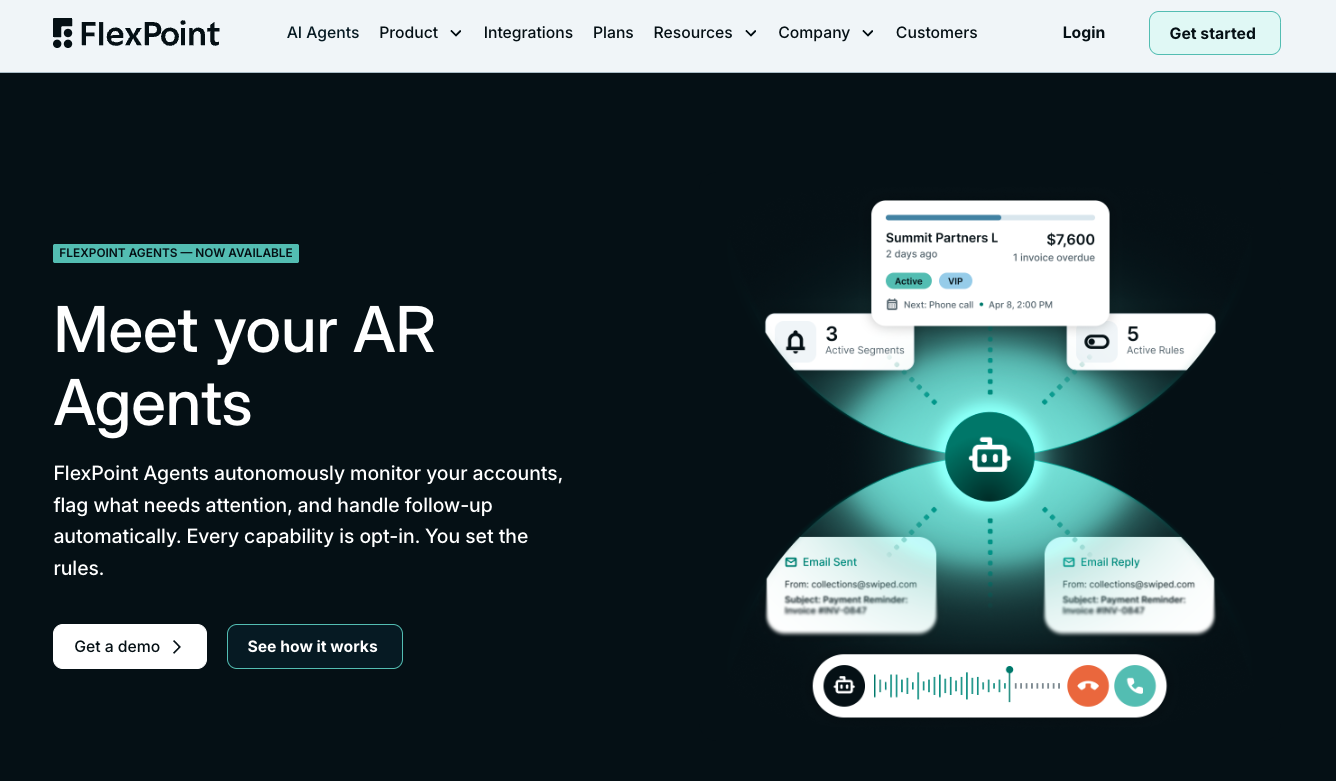
FlexPoint's AR Agents are designed specifically for managed service providers.
Unlike many AI tools entering the market, FlexPoint's agents are built directly into its MSP billing and payments platform. That gives them visibility into invoices, payment activity, collections history, and client communications.
The agents themselves can send follow-up emails, place conversational collection calls with tone based on the account's delinquency, adapt outreach based on account activity, and surface accounts that need attention.
Teams can monitor everything through the Agent Command Center, which provides visibility into agent activity, pending approvals, and collections progress.
There you can also decide if the Agents act autonomously or in a co-pilot mode that requires your approval on every action.
According to FlexPoint, customers have achieved up to a 55% reduction in DSO and 5x faster payments while reducing time spent on manual collections work.
So instead of adding another standalone tool, businesses can manage billing, payments, and collections in one place with the Agents adding a significant layer of value to an already great platform.
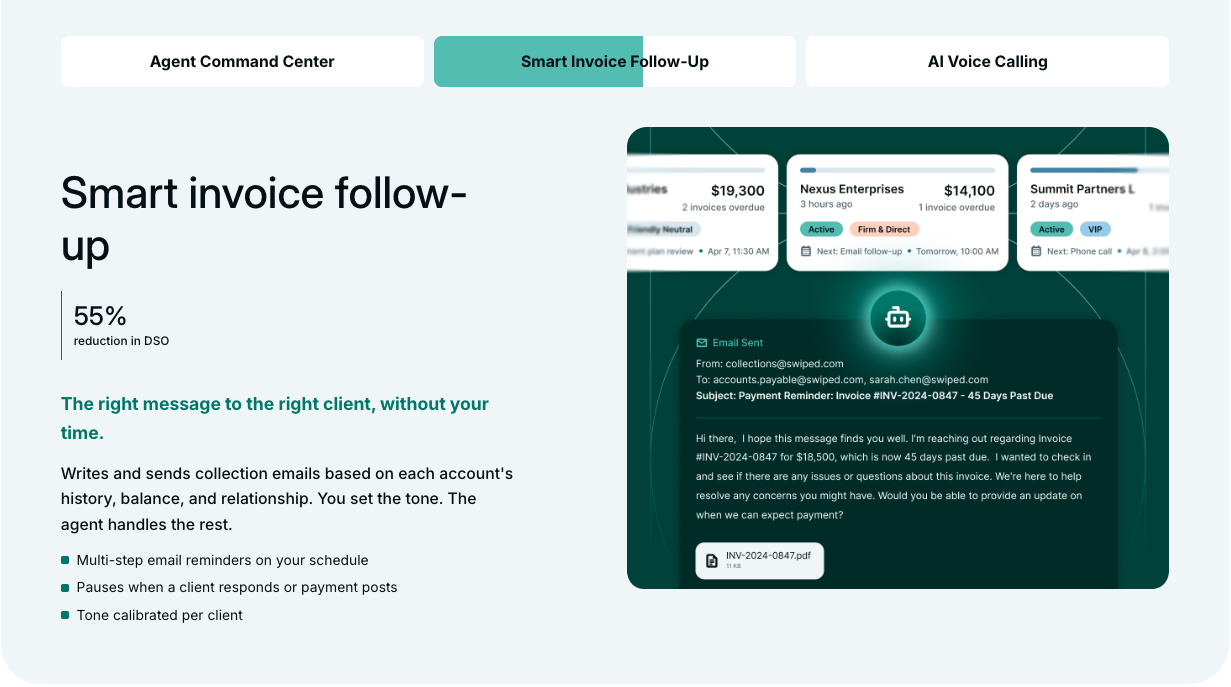
The interconnectedness and the fact it is the first of its kind with voice calling and multiple modes is what makes FlexPoint Agents stand out.
Paraglide

Best for: Billing conversations
Paraglide's platform focuses on the communication layer of accounts receivable. The company's premise is that collections challenges are often about the conversations around the invoices.
Customers have questions, finance teams answer them, responses get delayed, which ultimately causes payments to be delayed.
Paraglide's AI agents are designed to manage the back-and-forth that often follows.
That includes responding to billing questions, handling invoice inquiries, managing collections conversations, routing disputes, and following up on payment commitments directly from the finance inbox.
The company positions this as a way to automate both outbound collections and inbound billing communication in one workflow.
Paraglide reports that customers have reduced DSO by an average of 34% by using AI agents to handle these high-volume conversations.
Beam
Best for: Collections management
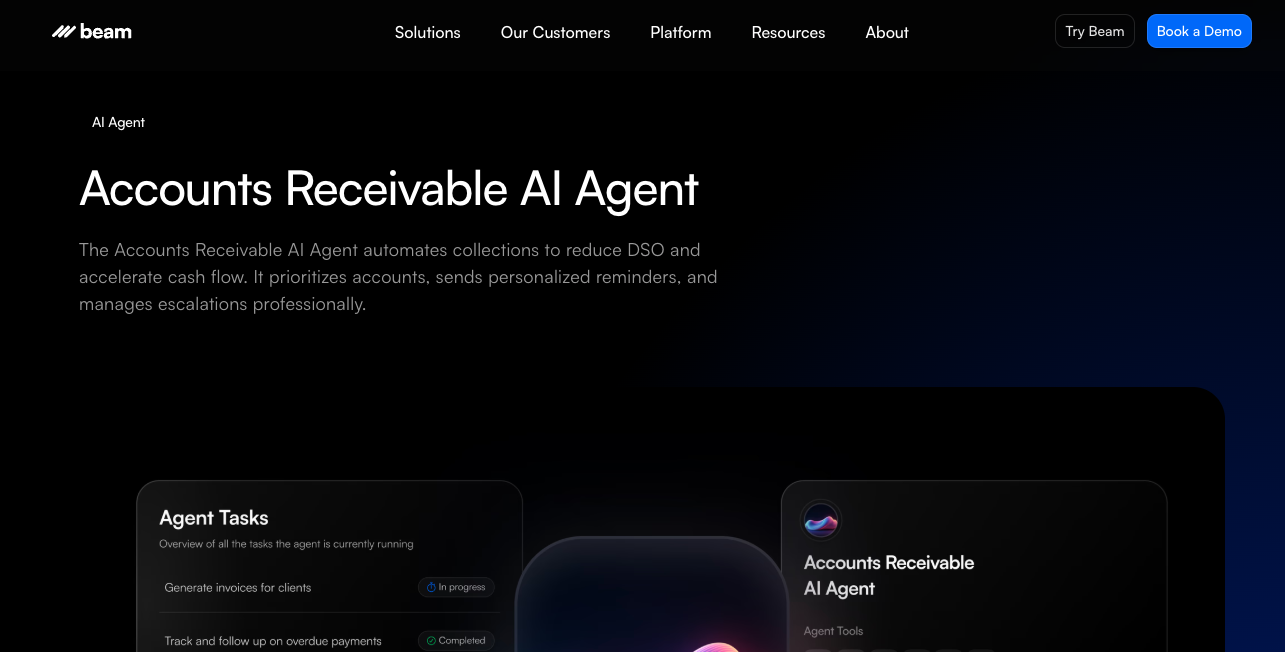
Beam's Accounts Receivable Agent is designed to help finance teams spend less time figuring out where to focus their efforts.
The platform uses AI to identify which accounts need attention and help teams stay on top of outstanding invoices.
According to Beam, customers have achieved up to a 25% reduction in DSO and a 40% improvement in collections efficiency through its AI-powered workflows.
What makes Beam interesting is its focus on helping teams prioritize their work.
Instead of sorting through aging reports and spreadsheets, teams get a clearer picture of which accounts should be addressed first and where follow-up efforts are likely to have the biggest impact.
That matters because most finance teams are not trying to outsource every decision to an AI agent.
AI Agents for Accounting & Financial Operations
Not every finance agent is focused on collections.
Some are designed to help businesses manage broader accounting and financial workflows, from bookkeeping and invoice processing to cash flow analysis and operational reporting.
Intuit AI Agents
Best for: SMB Accounting
Intuit has integrated AI agents across QuickBooks to help businesses manage bookkeeping, cash flow, invoicing, payments, and day-to-day financial operations.
The company's goal is to move beyond AI as a simple assistant and toward AI that can actually help complete work.
Depending on the task, Intuit's agents can help generate invoices, track payments, identify cash flow issues, surface important financial insights, and automate parts of the accounting process that would normally require manual effort.
What makes Intuit's tool interesting is its scale.
QuickBooks is already one of the most widely used accounting platforms among small businesses, giving Intuit a unique opportunity to bring AI directly into financial workflows that millions of businesses already use every day.
For organizations already operating inside the QuickBooks ecosystem, Intuit's AI agents offer a glimpse into what accounting software may look like in the future: less data entry, fewer repetitive tasks, and more time spent acting on financial information instead of organizing it.
BILL AI Agents
Best for: Financial operations automation
BILL has expanded its AI capabilities to help businesses manage accounts payable, accounts receivable, spending, approvals, and other financial workflows.
The platform uses AI to assist with tasks like invoice processing, expense management, payment workflows, and cash flow visibility. BILL has also introduced AI-powered assistants that can help teams find information, answer questions, and complete common finance tasks more quickly.
What makes BILL interesting is that it sits at the center of a large volume of business payments. The company processes billions of dollars in transactions each year, giving it deep insight into how businesses manage money and financial operations.
For organizations looking to reduce manual work across AP processes, BILL is one of the more established players bringing AI into day-to-day finance workflows.
Rather than focusing on a single task, its approach is centered on helping finance teams spend less time on administrative work and more time managing the business.
AI Agents for Payments & Transactions
A third category is beginning to emerge around agent-driven payments.
These platforms are building the infrastructure that allows AI agents to securely authorize, initiate, and complete transactions.
While many of these tools are still early, they offer a glimpse into how autonomous payments may function in the future.
Stripe Agentic Commerce

Best for: AI-powered transactions
Stripe may not offer a traditional billing agent, but it is helping build the infrastructure that many future AI agents will rely on.
With Agentic Commerce, Stripe is focused on enabling AI agents to securely browse, make decisions, and complete purchases on behalf of users while maintaining controls around payment authorization and security.
The platform includes tools like secure payment credentials, merchant authentication, spending controls, and approval workflows that allow AI agents to transact without exposing sensitive payment information.
What makes Stripe's approach interesting is that it is focused on the payment itself rather than the workflow around it. While many AI agents are helping businesses manage invoices, collections, or accounting tasks, Stripe is working on the technology that allows AI agents to actually move money and complete transactions.
For businesses watching where payments are headed, Agentic Commerce offers an early look at what agent-driven purchasing and commerce could look like in the years ahead.
Mastercard Agent Pay

Best for: Enterprise agent transactions
Mastercard's Agent Pay initiative is designed to help AI agents securely make purchases and complete transactions on behalf of users and businesses similar to Stripe.
The platform uses tokenized payment credentials, authentication controls, and spending limits to ensure AI-driven transactions remain secure and authorized.
Agent Pay is also positioned as a way to complete purchases autonomously when permission is granted.
What makes Agent Pay notable is that it comes from one of the world's largest payment networks.
The technology is still in its early stages, but Agent Pay offers a glimpse into how AI may eventually participate directly in the payment process rather than simply assisting around it.
Visa Intelligent Commerce
Best for: Agent-assisted purchasing and payment authorization
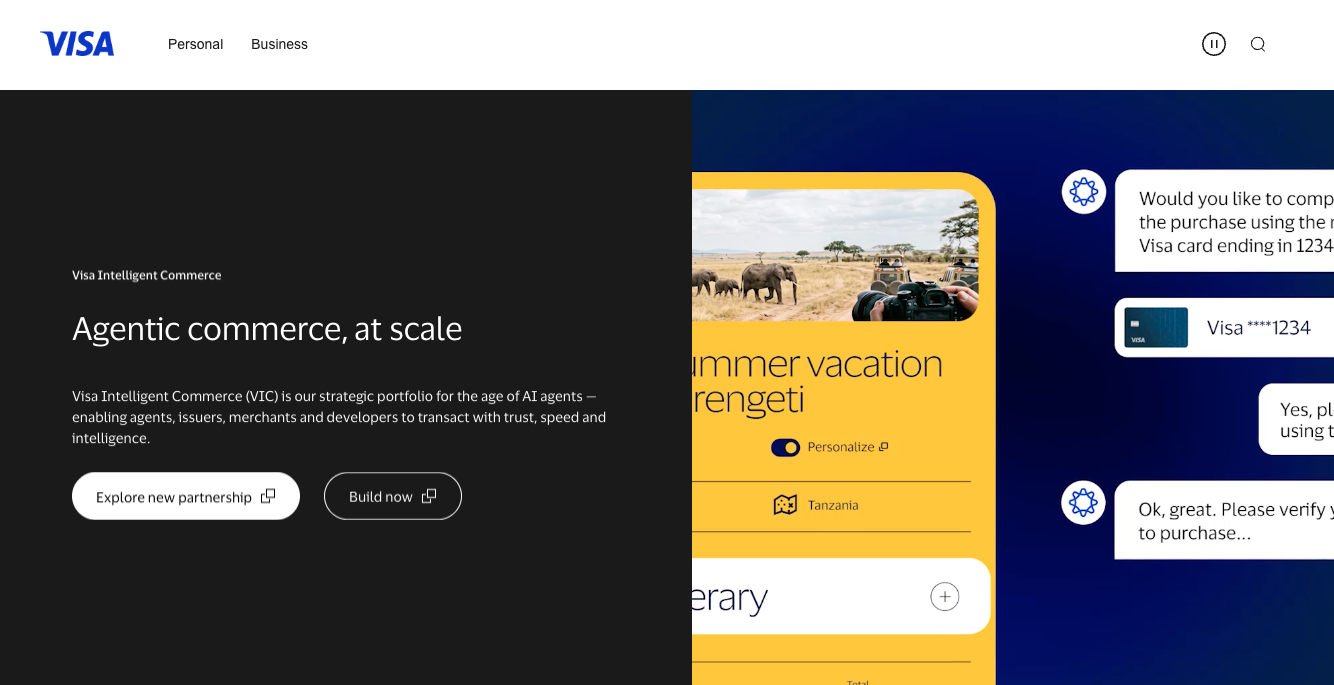
Announced in 2025, Visa's Intelligent Commerce connects directly with Visa's payment network while maintaining controls around authentication, spending limits, and transaction approvals.
The goal is to make it possible for AI agents to assist with shopping, sourcing products, and completing purchases without compromising security.
Visa has partnered with several major AI companies as part of the initiative, reflecting a broader belief that agent-driven commerce will become increasingly common over the next few years.
Some of the largest players in the payments industry are actively preparing for a world where AI completes actions on its own.
Stripe, Visa, and Mastercard have all developed very similar initiatives around agent-driven commerce.
While these technologies offer an interesting look at where payments may be headed, most MSPs will likely see more immediate value from AI tools that help automate billing, collections, and back-office operations today.
Which AI Agents Matter Most for MSPs?
The AI agents we've covered are solving very specific problems.
Some focus on collections and others focus on accounting workflows. Some are helping build the infrastructure for a future where AI agents can make purchases and move money autonomously.
Those developments are important, but most MSPs are not looking for another standalone tool.
They're looking for fewer systems, fewer handoffs, and fewer places where billing and payment information can get lost.
That is where FlexPoint takes a different approach.
While AR Agents are a major new part of the platform, they sit as an opt-in feature inside a larger system built specifically for MSP financial operations.
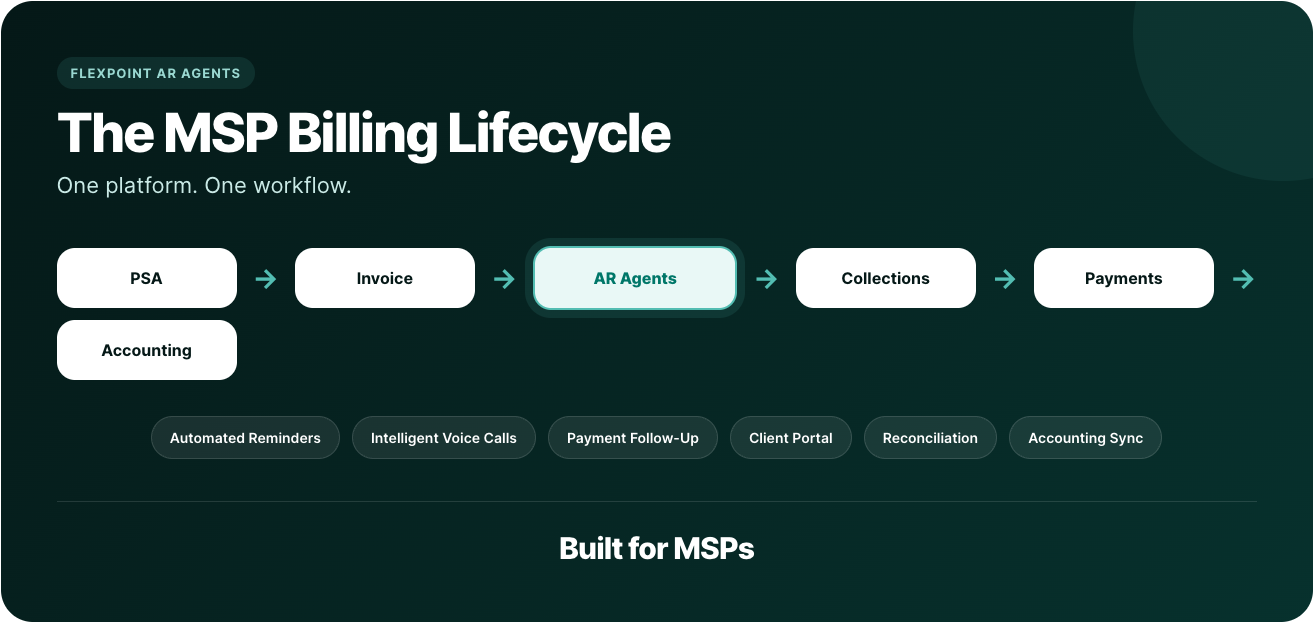
FlexPoint connects PSA data, invoicing, payment processing, collections, client payment experiences, accounting integrations, and reconciliation into a single workflow rather than requiring teams to stitch together multiple point solutions.
The result is that invoices, payments, payment status, collections activity, and financial records stay connected throughout the entire billing lifecycle. Teams spend less time moving information between systems and more time focusing on clients and operations.
The value isn't just the intelligence of the agent itself. It's how well that agent fits into the systems your team already uses every day.
Disjointed, single-use AI tools are not effective. They end up becoming tack-ons to an already complicated process that will inevitably gunk up your workflow.
Find your first agent below:
The Future of Billing Is Becoming Autonomous
The most interesting part of this market isn't which company has the best AI agent today.
It's how quickly the category is evolving.
Five years ago, finance automation mostly meant workflow rules and reminders.
Today, AI agents can draft collection emails, answer payment questions, prioritize invoices, analyze payment risk, and initiate actions without waiting for human prompts.
Tomorrow, those same systems may be able to manage significant portions of the billing lifecycle end-to-end.
The companies leading this transition are approaching the problem from different angles. Some are focused on accounts receivable. Others are building payment infrastructure. Some are embedding agents inside existing accounting software.
Together, they're creating something that didn't really exist a few years ago: software that both supports financial operations and also actively participates in them.
Curious what AI-powered collections could look like inside your MSP? Learn how FlexPoint AR Agents help automate invoice follow-up, place dynamic conversational collections calls, and give your team a clear view of everything happening across accounts receivable all while keeping people in control of the decisions that matter.