


If an AI agent can send payment reminders, handle objections, reconcile deposits, and flag delinquent accounts without a human touching any of it...what exactly is the billing coordinator doing?
That's an uncomfortable question. And most companies building back-office AI tend to sidestep it. The easy answer involves words like "augment," "assist," and "free up your team for higher-value work." That framing isn't wrong. But it isn't complete, either.
The reality is much more specific. Some back-office tasks are being automated out of existence. Some roles are changing fundamentally. And a few functions are becoming more important, not less, precisely because AI is handling the volume work that used to crowd them out.
We need to stop asking "is AI coming for back-office jobs?" because it's not a self-fulfilling prophecy. We need to look at which tasks are being automated, which roles are being redefined, and what does a smart MSP operator do about it right now?
The reality of what back-office AI can do today
Before the broader debate, it's worth grounding this in specifics, because most of the anxiety around AI and jobs is driven by vague projections rather than what's actually shipping.

Here's what AI agents are doing in MSP back-office finance today, not theoretically:
- Sending, scheduling, and personalizing payment reminder sequences across channels like email and phone
- Triaging invoice disputes and routing edge cases to humans
- Flagging accounts showing behavioral patterns associated with late payment and adjusting communication appropriately
- Generating AR aging reports and surfacing collection priorities without manual input
- Processing ACH and card payments and logging them accurately
That list is not a roadmap. Those are live capabilities in production, used by MSPs to run AR functions that previously required dedicated human hours every week.
Here's what AI still can't reliably do in back-office finance:
- Navigate disputes involving contract interpretation
- Build or repair a client relationship after a payment conflict
- Make judgment calls about whether to waive a fee, offer a payment plan, or escalate to a third-party collector
- Understand context that lives outside the system: a client's business is struggling, an owner is dealing with a personal crisis, a relationship has a complicated history
AI handles repeatable, process-driven, high-volume work well. The judgment-intensive, relationship-sensitive, contextual work still requires people. That distinction matters more than almost anything else in this conversation.
What the research is saying
The analyst community has been sounding alarms about automation and jobs for years. But the specific numbers tell a more precise story than the headlines suggest.
McKinsey Global Institute estimates that 60–70% of employee time across industries involves tasks that could be automated with current or near-term AI. That number gets cited constantly. What gets cited less: "could be automated" is not the same as "will be eliminated." The task can be automated. The role may not be.
Within finance specifically, McKinsey's research flags routine transaction processing, data collection, and standard reporting as among the highest-automation-potential functions, with up to 70% of those activities technically automatable. Finance and accounting rank near the top of that list across industries.
The World Economic Forum's Future of Jobs Report 2025 projects significant displacement from automation, but also projects that the roles being created by AI-driven productivity gains outnumber the ones being lost. The challenge: the new roles require meaningfully different skills than the displaced ones. The gap between what's being lost and what's being created isn't a headcount problem. It's a skills problem.
Gartner predicts that by 2026, 80% of finance functions will have deployed AI-driven automation in at least one area. For MSPs, that clock is moving faster than most realize. The vendors they buy from, the distributors they work through, and the platforms they use to run their business are all already building AI into their finance workflows.
On the cost side, the numbers are hard to ignore. Research from PYMNTS and American Express found that manual AR processes cost businesses an average of $10–15 per invoice to process. AI-assisted AR brings that figure below $2. That delta isn't a trend piece. It's a business case, and MSP operators are starting to do that math.
The takeaway from the research is not "billing manager jobs are being automated."
It is that the sub-tasks within those jobs, sending reminders, matching payments, generating reports, are being automated. The role often survives. The work within it changes dramatically. Those are two very different outcomes, and conflating them is what makes this conversation harder than it needs to be.
What's happening to back-office roles in MSPs
Research gives you the macro picture. What's happening in real MSP back offices right now gives you the ground-level one. Three patterns show up consistently.
The role doesn't disappear, but the job description does change.
MSPs that deploy AR agents aren't terminating their billing coordinators. They're redirecting them. The coordinator who spent 60% of their week executing follow-up calls and sending reminder emails is now spending that time on exception handling, client escalations, and vendor relationship management. The work is genuinely different, and for most people, more interesting. But it requires different capabilities: judgment, communication, contextual thinking, not just process execution.
Smaller MSPs are doing more with fewer people.
A 10-person MSP that previously couldn't justify a dedicated billing role can now run a full AR function with an AI agent handling the collection sequence and a part-time ops person reviewing exceptions and managing edge cases. This isn't displacement in the traditional sense. It's capacity expansion that compresses the headcount required to scale. The job that "goes away" is often one that never existed yet.
For example, look at the manual processes around overdue payment followup via email and phone. Time-consuming tasks that no one wants to do are a prime example of tasks to readily handover to AI.
Headcount pressure shows up at hiring time, not at layoff time.
Very few MSPs are eliminating billing staff because they deployed an AR agent. What's changing is the next hire. When a billing coordinator moves on, the MSP owner faces a different question than they did three years ago: do I replace this role as-is, or does the AI agent absorb the volume work while someone more senior handles the strategic piece? That's where the quiet displacement happens, in attrition rather than in reductions in force. It's gradual, and it's already underway.
The back-office tasks most at risk, and the ones that aren't
So, specificity matters here. "Back-office jobs" is not a monolith!
Higher automation risk — i.e., tasks AI agents handle now or will soon:
- Manual invoice generation and delivery
- Payment reminder execution: sending, logging, and following up across channels
- Payment matching and deposit reconciliation
- Standard AR aging report generation
- Data entry between PSA, billing platform, and accounting system
- Routine payment status updates to clients
Lower automation risk — i.e., functions that still require human judgment:
- Collections strategy and escalation decisions
- Vendor and distributor relationship management
- Client financial dispute resolution
- Cash flow forecasting and financial planning
- Contract negotiation and billing structure design
- Interpreting why a pattern is happening, not just that it is
The pattern is consistent: tasks that are sequential, rule-based, and self-contained within a system are highly automatable. Tasks requiring institutional knowledge, relational judgment, or strategic thinking are not, at least not yet.
The harder truth is that most back-office roles involve both. A billing coordinator's job isn't purely process execution or purely judgment-driven relationship work. It's a mix, and AI is systematically taking on one side of that mix. Operators who recognize this and actively reshape the remaining role will keep their teams intact and doing better work. The ones who assume the whole role stays the same because part of it still requires people are going to end up with expensive mismatches between headcount and actual need.
What the MSPs handling this well are actually doing
They audit time before making any decisions.
Before deploying AI in the back office, the best operators map where their team's hours actually go. Most are surprised: 50–70% of a billing coordinator's week is spent on tasks that are already automatable. That audit reframes the conversation from "should we automate?" to "what should we automate first, and what do we do with the recovered capacity?"
They're being direct with their teams.
The worst version of this transition is the one where leadership deploys AI quietly, tells the team nothing's changing, and then changes everything over 18 months without acknowledgment. The MSPs navigating this well are having direct conversations: here's what the AR agent handles, here's what we need you to focus on instead, here's how your role is going to evolve. That conversation is uncomfortable once. The alternative, a team that figures it out on their own, is uncomfortable indefinitely.
They treat AI output as a starting point, not a final answer.
The MSPs getting the most from AI agents for payment collection aren't the ones who flip them to fully autonomous on day one. They run them with human review on exceptions, refine the logic based on what gets escalated, and increase autonomy as confidence builds. The technology earns the trust; the trust expands the scope. That's a transition, not a switch.
They change what they measure.
Pre-AI back-office metrics tend to be activity measures: calls made, emails sent, invoices processed. Post-AI metrics are outcome measures: DSO, collection rate, percentage of receivables current, time-to-resolution on disputes. That shift in measurement is itself a signal of what the human role is actually for now. If you're still measuring your team by how many reminders they sent, you're measuring the wrong thing.
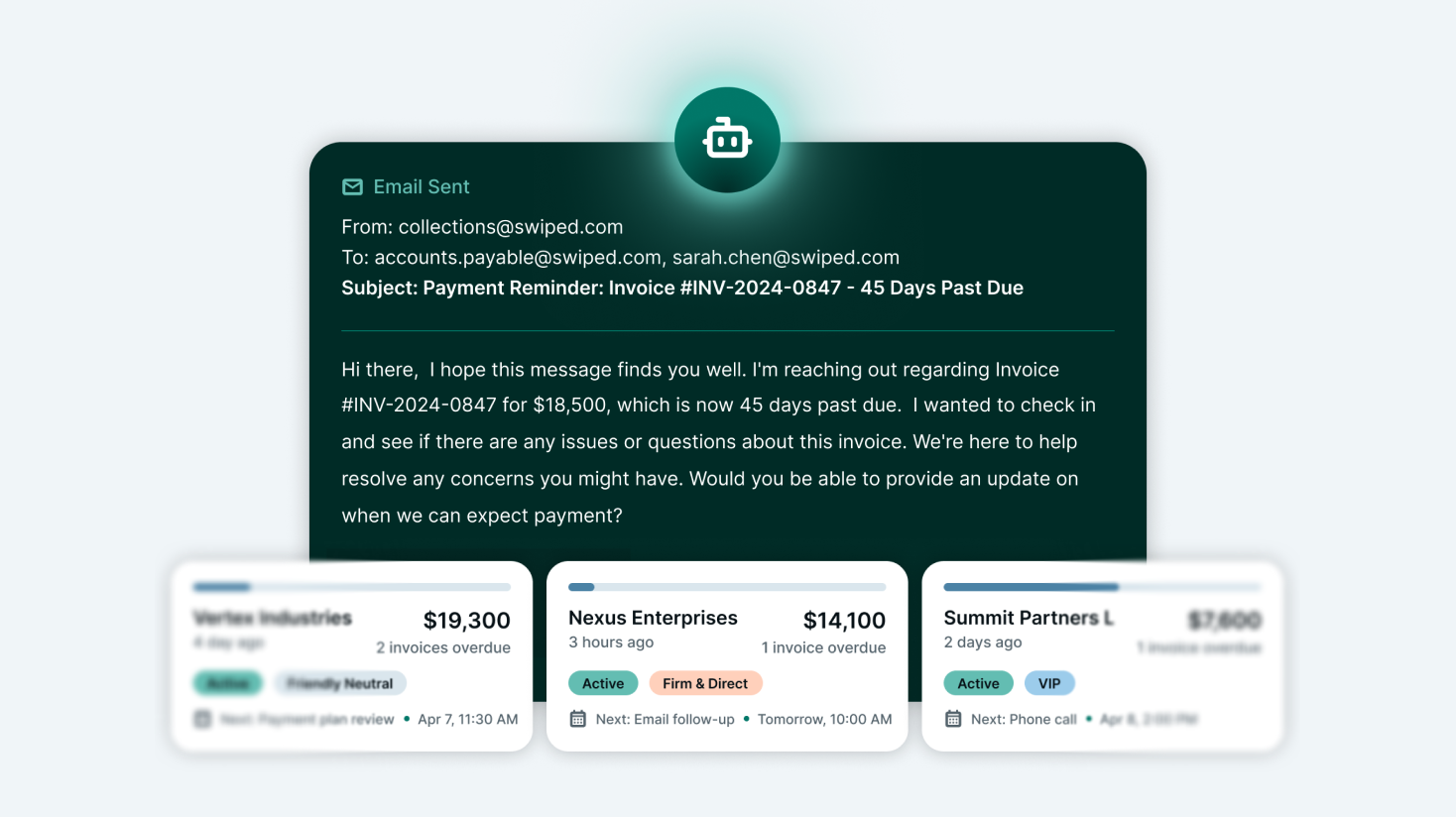
Take autonomous late payment communication, for instance. When repetitive, time-consuming work can be handed off to an AI agent, you and your team gain time back and immediate performance improvements.
So, is AI coming for back-office jobs?
Yes. And no. And it depends on which part of the job you're talking about.
The tasks that back-office roles have historically spent the most time on, the repeatable, process-driven, high-volume work, are being automated. That's happening now, not in five years. AR agents for payment collection are already handling work that used to take meaningful human hours every week at MSPs of every size.
But the job is more than its tasks. The roles that survive this shift, and in some cases become more valuable, are the ones where the human brings what AI can't: judgment under ambiguity, institutional memory, client relationships, and the ability to interpret context that lives outside the system.
The displacement risk is real, but it isn't uniform. A billing coordinator who spends their day executing reminder sequences and reconciling payments is in a fundamentally different position than one who manages vendor relationships, resolves escalated disputes, and advises ownership on cash flow strategy. Same job title. Very different exposure.
The MSP back office isn't going to be AI-only. It's going to be AI-first. AI agents handle the volume; people handle the judgment. The operator's job is to make sure that split is intentional, not something that happens to them by accident.
The question MSP operators should actually be asking
"Is AI coming for back-office jobs?" is the wrong frame. It's too abstract to act on.
The question worth sitting with: what does my back office need to look like in two years, and am I building toward that or drifting toward it?
MSPs that are deliberate about this, that audit their back office, deploy AI where the ROI is clearest, and actively reposition their team toward higher-judgment work, will come out of this with leaner operations, lower DSO, and teams doing more meaningful work than they were doing before.
The ones that don't will find themselves either overstaffed on tasks that AI agents handle for a fraction of the cost, or under-automated and steadily losing margin to competitors who moved faster.
The transition is already underway. The only question is whether you're steering it.




.png)