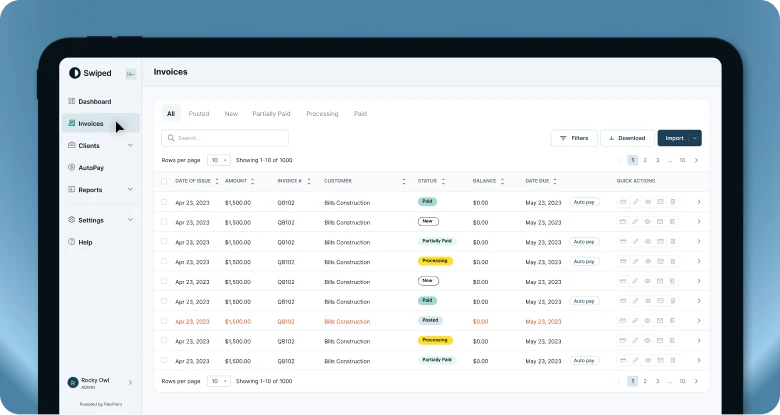


Getting paid is simple.
Getting paid consistently, on time, and without constant follow-up is much harder.
It can be easy to point fingers at your clients, but a bad process is the more likely culprit for cramped cash flow.
Invoices get missed. Reminders get delayed. Questions sit unanswered. Collections become another recurring task that someone on the team has to manage.
For years, businesses have relied on manual processes and automation to keep accounts receivable moving. Now AI is introducing a third option.
According to Service Leadership Index, labor typically represents 50-60% of an MSP's total cost structure.
Which is why even small improvements in administrative efficiency can have an massive impact on profitability.
This guide breaks down the differences between manual collections, automated collections, and AI-powered collections so you can understand where each approach fits and where the biggest opportunities for improvement exist.
Manual Payment Collection: The Default MSPs Get Stuck In
Manual collections is where almost every MSP starts, and where a lot of them stay longer than they should.
It looks like this: a spreadsheet with AR aging, calendar reminders to follow up with specific clients, reminder emails drafted one at a time, and phone calls made by whoever has bandwidth that week. It feels manageable because the setup cost is zero and the control feels high.
There is no software to configure, nothing to integrate, and you know exactly what happened because you did it yourself.
According to Chaser's 2026 Accounts Receivable Report, 76% of businesses spend at least three hours per week managing accounts receivable, and 40% spend more than six hours per week. Much of that time is consumed by manual follow-up, reconciliation, and administrative work that pulls people away from higher-value responsibilities.
The actual cost of manual collections is real.
And owners often absorb the most visible portion.
An hour a week on collections calls is an hour not spent on business development, client relationships, or operational decisions. But the more consistent hidden cost sits with bookkeepers, office managers, and whoever ends up owning the AR inbox. These are people who were hired to do specific jobs, and a disproportionate share of their time ends up going toward chasing the same invoices month after month, answering the same questions, and cleaning up after a follow-up sequence that nobody officially owns.
The operational consequences are predictable.
Follow-up happens inconsistently because it depends on whoever has bandwidth. Invoices age past the point where collection is comfortable because nobody escalated in time. AR visibility is limited to whatever the spreadsheet captured last.
And because everything is manual, there is no audit trail, no documentation, and no reliable way to see which accounts are trending toward a problem before the problem is obvious.
What Payment Automation Actually Does (and Where It Stops)
Rules-based automation solves the consistency problem.
How Rules-Based Payment Automation Works
Automation handles the repetitive mechanical work of payment follow-up without requiring a human to initiate each step.
Scheduled reminder emails go out at Day 3, Day 7, and Day 14 without anyone having to remember to send them, AutoPay charges recurring invoices automatically, and dunning sequences escalate in tone on a calendar rather than relying on someone deciding it is time to be more direct.
The pay-off for automation is significant. According to PYMNTS research, businesses using automated accounts receivable processes report getting paid twice as fast as those relying primarily on manual workflows. On top of that, the same study also shows a reduction of DSO by 20-30%.
Because of that, staff time is freed for higher value tasks.
For MSPs moving from pure manual processes, automation typically produces a measurable improvement in DSO and a meaningful reduction in the hours spent on routine follow-up.
The Limits of Automation

Automation follows rules, but it does not read context.
When a reminder email fires at Day 7 for a client who called yesterday and said payment is coming Friday, the automation does not know that.
When a long-term client with a clean history misses their first invoice, the automation sends the same escalating tone it sends to the client who has been 45 days late three months in a row.
When a client emails back asking a question about a line item, the automated follow-up email has no answer. The message lands in a human inbox and waits.
This is the ceiling of rules-based automation: it handles the predictable cases well and stalls on everything else.
Every exception, every dispute, every routine invoice question, and every account where the standard sequence is not the right sequence creates a manual task.
Which means bookkeepers and office managers are still involved, just now they are managing the exceptions that automation produced rather than doing the full process themselves.
The diagram is simple. Automation reaches a decision point, an account that has not paid after four reminder emails, a client who disputed a charge, a situation where the next step requires judgment, and the path stops.
AI Payment Collection: Judgment at Scale
How AI Differs from Automation
AI is not necessary an extension of automation, it is a different kind of automation.
Automation says: if this condition is true, do this action. Every time, for every account, regardless of context.
AI says: given everything I know about this account, this client's history, this situation, and this stage of the collections process, what is the right action?
There may be the same trigger but there will be a different response.
A client who has paid on time for 18 months and is two weeks late for the first time gets a different follow-up than a client who has been inconsistent for the last six months. An account with a disputed invoice gets a different response than an account where the invoice was clearly received and simply not paid.
AI reads the context and acts accordingly. Automation cannot.
This matters because a significant portion of the work in a real collections process is not the manual execution. It is judgment: which accounts need attention right now, what tone is appropriate given this client's history, whether to escalate or stay patient, and what the right next step is for a situation that does not fit the standard sequence.
Automation offloads the mechanical layer but AI offloads the judgment layer.
What Agentic AI Means for Accounts Receivable
Agentic AI is software that takes action toward a goal rather than simply executing a predefined step when a condition is met.
The distinction is important.
A standard automation workflow executes steps. An AI agent pursues outcomes.
It does not wait to be told "send a reminder to this account." It assesses which accounts need attention, determines what kind of attention is appropriate, takes the action, monitors the result, and decides what to do next.
The goal is getting the invoice paid.
Applied to accounts receivable, this means an AR agent can chase the right accounts the right way without being configured for every possible scenario.
It handles routine invoice questions without routing them to a human inbox. It adjusts outreach timing based on what it knows about each client. It escalates when escalation is appropriate and holds when a softer approach is more likely to work. And it surfaces the accounts that genuinely need human attention so the humans involved are spending their time on situations that actually require them.
The flow for automation is: trigger, fixed action. But for an AR Agent it is: trigger, assess, adapt, then act.
Meet AR Agents: Accounts Receivable Agents Built for MSPs
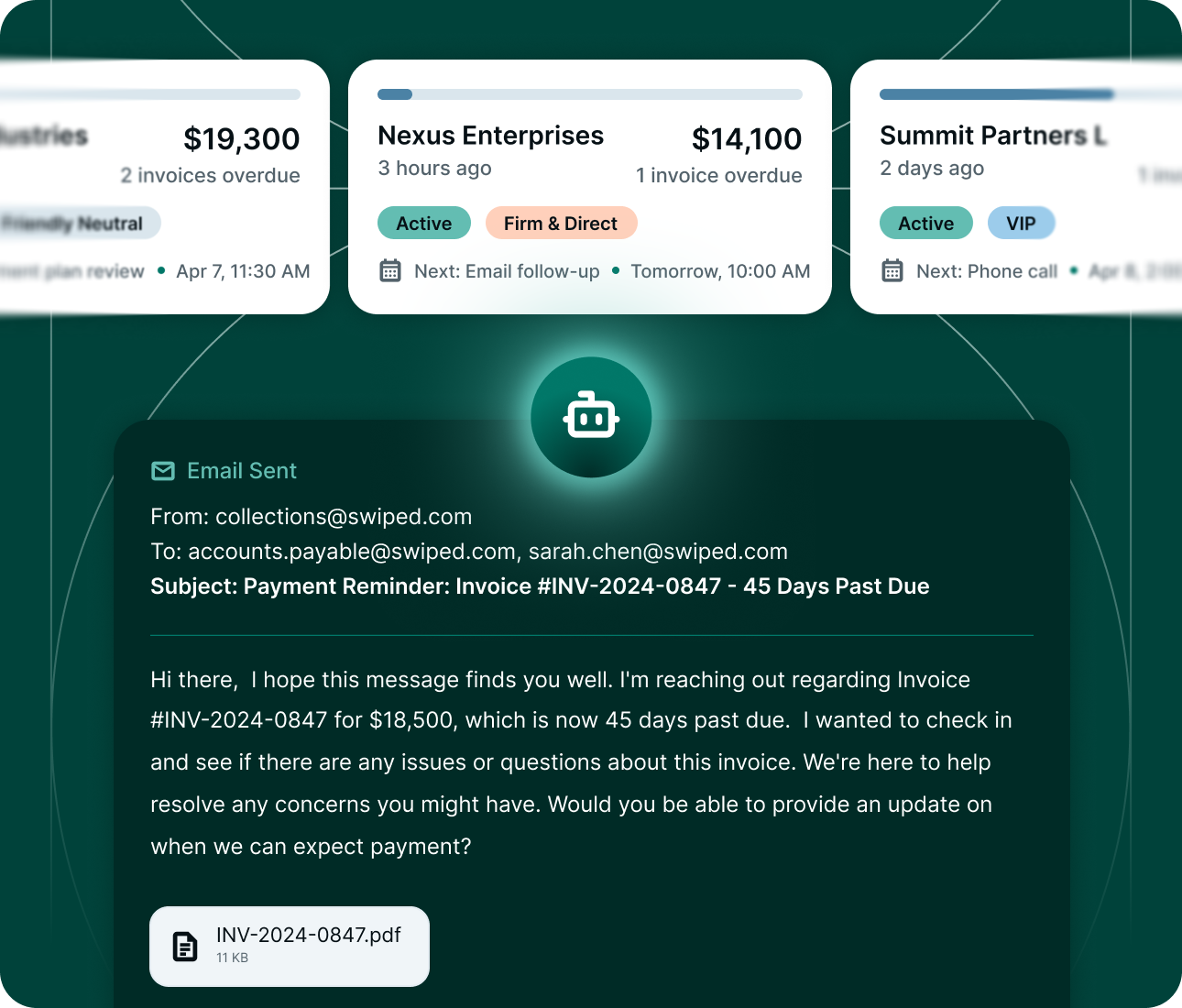
FlexPoint's AR Agents are the practical application of agentic AI to MSP accounts receivable.
They handle late payment collection autonomously: sending follow-up reminders, placing AI voice calls to overdue accounts, adapting outreach based on payment history and account behavior, managing escalation sequences, answering routine invoice questions, and logging every interaction automatically.
The outcomes translate directly: lower DSO, reduced write-offs, and time returned to the people who were absorbing the manual work of collections.
Owners stop spending Friday afternoons on collections calls. Bookkeepers stop chasing the same accounts every month. Office managers stop fielding the same questions.
AR Agents are not trying to remove humans from collections entirely.
They are removing humans from the parts of collections that do not require them.
Meanwhile, disputes, payment plan negotiations, service limitation decisions, and strategic client conversations still involve people. Those are the situations where human judgment is genuinely necessary.
Everything else runs seamlessly.
Manual vs Automation vs AI: Side-by-Side Comparison
Which Approach Is Right for Your MSP?
The honest answer is that most MSPs use some combination of all three, and the right balance depends on where you are operationally.
If you have fewer than 20 recurring clients and a stable team member who owns AR: manual processes are probably sufficient. The cost of inconsistency is manageable at this scale, and automation may add complexity without proportionate value.
If you have 20 to 50 clients and find your team spending meaningful time on routine collections follow-up: automation is almost certainly worth implementing. The consistency gains alone will improve DSO and reduce the manual overhead on whoever currently owns that work.
If you have 50 or more clients, or if collections follow-up is already consuming more team capacity than it should: AI is where the ceiling moves. Not because automation stops working, but because the exception volume grows with the client base and the judgment calls multiply faster than rules-based systems can accommodate them.
One important thing to be clear about: AI does not make the process fully autonomous.
AR Agents loop in humans when situations require it and if you prefer it. FlexPoint's AR Agents can, depending on your preferences, operate autonomously or work in a co-pilot mode that still requires your approval.
What Happens When Collections Can Run Itself
The goal is to get paid faster without creating more work for your team.
Manual collections work until the volume becomes difficult to manage. Automation improves consistency, but it still depends on rules and often breaks down when clients don't follow the expected path. That's where AI begins to change the equation.
Instead of simply automating tasks, AI can help manage the decisions, conversations, and follow-up work that traditionally required human attention.
For most MSPs, the future won't be manual collections, automation, or AI alone. It will be a combination of all three: AutoPay for recurring payments, automation for routine reminders, and AI agents for the accounts that require more context, persistence, and personalization.
The real question isn't whether AI belongs in collections. It's where your current process creates the most friction and what it would mean to remove it.
Curious what AI-powered collections could look like inside your MSP? See how FlexPoint AR Agents help teams stay ahead of overdue invoices with intelligent follow-up, conversational voice collections, and complete visibility into collections activity.
See how FlexPoint AR Agents handle late payment collection for MSPs. Book an on-demand demo.
FAQs
What is the difference between AI and automation in payment collection?
Automation follows predefined rules: send a reminder at Day 7, escalate at Day 14, charge AutoPay on the 1st. It executes consistently but cannot adapt to context. AI assesses each account's history, situation, and stage of the collections process and determines the appropriate action. Same trigger, different response based on what actually makes sense.
Do AI agents reduce DSO?
Yes, and for a straightforward reason: consistent, timely follow-up is the single strongest predictor of how quickly invoices get paid. AI agents follow up consistently across every account without depending on anyone's bandwidth. The accounts that would have been forgotten in a manual process get the same attention as the ones that were being actively managed.
What is agentic AI in accounts receivable?
Agentic AI is software that takes action toward a goal rather than executing a fixed step when a condition is met. In accounts receivable, that means the system is not waiting to be told what to do with each account. It is assessing which accounts need attention, determining the right approach, acting, monitoring the result, and deciding what comes next. The goal is collecting the invoice, not executing the sequence.
Can AI replace manual collections entirely?
No, and it should not try to. Disputes, payment plan negotiations, service limitation decisions, and relationship-sensitive conversations still require human judgment. What AI replaces is the repetitive operational layer: the routine reminders, the standard follow-up, the routine invoice questions, and the escalation sequencing that currently consumes team time without requiring expertise. The humans stay in the process. They just show up where they are actually needed.



.png)