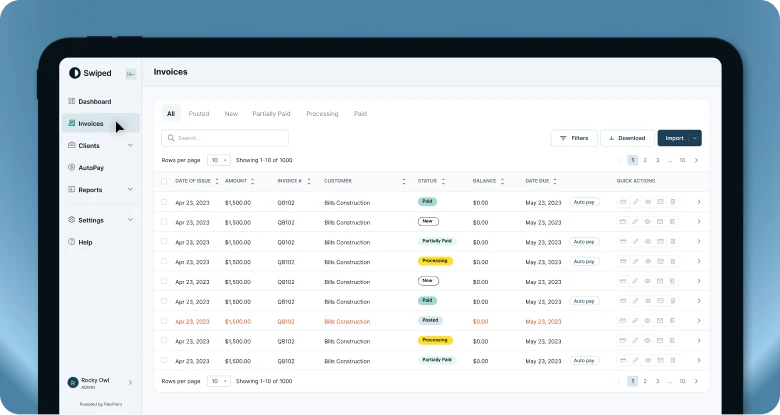



A $5,000 invoice that gets paid 45 days late doesn't cost your MSP $5,000.
You already know that intuitively, though.
Most MSP owners know late payments are frustrating and costly.
They're also incredibly common. According to a 2025 QuickBooks survey, 56% of small businesses reported being owed money from unpaid invoices, with nearly half reporting invoices that were more than 30 days overdue.
The cash flow impact is obvious. An invoice that should have been paid in 15 days gets paid in 45. And money that should be available for payroll, hiring, marketing, or growth remains tied up in accounts receivable.
But cash flow is only part of the cost of late payments.
We’ll talk about the real cost, both monetarily and in terms of opportunity, work, and other places late payments are costing you and tell you how to get that money back.
The Real Cost of One Late Invoice
It's relatively easy to know how much an overdue invoice is worth in terms of money.
But it's not always clear how much it actually costs to collect.
Imagine a $5,000 invoice that should have been paid in 15 days but instead arrives 45 days late.
The most obvious cost is the delayed cash flow.
If your MSP invoices $100,000 per month, every additional day of DSO effectively keeps roughly $3,300 of revenue from reaching your bank account. Extend payment timing by thirty days across multiple clients and suddenly tens of thousands of dollars are sitting in accounts receivable rather than being used to hire, invest, market, or simply provide breathing room.
This is why DSO matters.
It measures how quickly your MSP turns completed work into cash. A business with a DSO of 25 days operates very differently than one with a DSO of 55 days, even if both generate the same revenue.
In fact, accounts receivable is often the largest working capital asset on a company's balance sheet. Credit professionals estimate that roughly 60% of working capital is tied up in receivables for many organizations.
Want to see how delayed payments are affecting your cash flow? Use our DSO Calculator to estimate the impact of your current Days Sales Outstanding and identify opportunities to get paid faster.
But the cash delay is only part of the story.
The Labor Cost
Now imagine what happens during those additional thirty days: the invoice receives three reminder emails, a collection call gets made (and may or may not get answered), the client asks a question about the balance or disputes it, the bookkeeper updates notes, someone checks the aging report, and then the owner gets looped in because the account is important.
(And that depends on everyone remembering, manually doing said task, marking that it is done, handing it off, and having easy access to all this relevant data.)
Individually, none of those activities feel expensive.
Collectively, they create substantial labor.
Using a conservative estimate:
If the fully-loaded cost of the employee performing those tasks is $35 per hour, that single late invoice generated roughly $40 in collection labor.
That still doesn't sound like much.
Now imagine twenty overdue invoices requiring similar attention.
Suddenly the business is spending roughly 23 hours and over $800 in labor simply managing collections just to recover the revenue that you have already earned.
Research into late payment collection found small businesses collectively spend millions of hours every year chasing overdue invoices.
The old adage rings true here... time really is money.
The Opportunity Cost
Late payments create a ripple effect throughout a business. One that was already mentioned briefly above but is worth emphasizing.
Yes, the invoice needs to get paid.
But every hour spent reviewing aging reports, chasing balances, answering payment questions, and managing collection activity is an hour that cannot be spent on client relationships, sales, service delivery, process improvement, or growth.
The challenge is that collections work shows up in small pieces throughout the week.
Collectively, those collection tasks pull attention away from work that moves the business forward.
That is why the true cost of late payments is larger than the delayed cash itself and even the amount of work it takes to collect it.
Because both of those cause a third problem: you no longer have the time or the liquidity to pursue actual steady growth. You're forced to become a reactive business that is reliant on how forthcoming your clients are instead of a business that is able to continue building.
For owners, that often means less time spent on strategy and growth. For finance and operations teams, it means more time managing collections instead of improving processes and supporting the business.
This cost never appears on an invoice, yet it is often the largest one.
Delayed Payments Are an Operational Problem
It can be easy to blame your clients if you're feeling the pain of overdue invoices.
Sometimes that can be the case. But more often, late payments are the result of friction you or your clients are experiencing with manual processes or outdated tools.
For example, how can a client pay on time if the reminder doesn't go out on time? Or if a payment question sits unanswered in someone's inbox. A client says they'll pay Friday, but nobody follows up the following week. An account slowly ages because everyone assumes someone else is handling it.
None of those situations are unusual.
They're exactly what most MSPs deal with every month.
The problem is that collections is often spread across multiple systems and people:
- Payment history lives in the accounting platform
- Client communication lives in email
- Notes live in the PSA
- Aging reports live in spreadsheets
So by the time someone sits down to review an overdue account, they're piecing together information from three or four different places just to understand what happened.
That delay matters.
According to research from the Credit Research Foundation, an invoice that reaches 90 days past due has only a 69.6% probability of being collected. At six months past due, that probability drops to just 52.1%.
The challenge is that timing is difficult to manage manually. A bookkeeper can remember to follow up on ten overdue invoices. Fifty becomes harder. One hundred becomes nearly impossible without a system. As invoice volume grows, consistency usually declines right alongside it.
This is where many MSPs get stuck.
Most teams already know they should send reminders, answer payment questions quickly, follow up on promises to pay, and escalate overdue balances when necessary.
The problem is doing all of those things consistently, across every account, every month, even as the business scales.
Late payments often look like a collections problem.
More often, they're a visibility and process problem first.
Consistency Is What Gets Paid
Most MSPs relying on manual processes actually have more of a consistency problem than a "late payments" problem.
The reality is that almost everyone knows what good collections looks like.
None of that is particularly difficult.
The challenge is that collections work never really ends.
And because collections is rarely the most urgent thing happening in an MSP, it often gets pushed behind service tickets, projects, client requests, and everything else competing for attention.
That is where overdue invoices start to accumulate.
Not because the team doesn't know what to do. Because the process depends on people remembering to do the same things over and over again, month after month, across dozens or even hundreds of accounts.
According to the U.S. Small Business Administration, cash flow challenges remain one of the biggest reasons small businesses struggle. Late payments only make those challenges harder to manage.
The irony is that most collections work does not require deep expertise, it simply requires consistency.
Yes. Invoices need reminders. Questions need answers. Payment plans need follow-up. Calls need to happen when emails stop working.
The work is straightforward; the repetition at scale is what creates the burden.
That is why adopting tools like AutoPay, payment portals, automated reminders, and AI-powered collections workflows is becoming necessary for scaling businesses.
The goal is not to remove people from the process. The goal is to make sure the right things happen at the right time without requiring someone to constantly manage every step manually.
How MSPs Reduce the Cost of Late Payments
The best collections strategy is not chasing payments harder.
It's removing friction before invoices become overdue.
That starts with making payment easy.
Fort Point IT, a FlexPoint customer, saw the majority of its clients adopt AutoPay after implementation. The result was fewer overdue invoices and more than 80 hours per month returned to their bookkeeper's schedule.
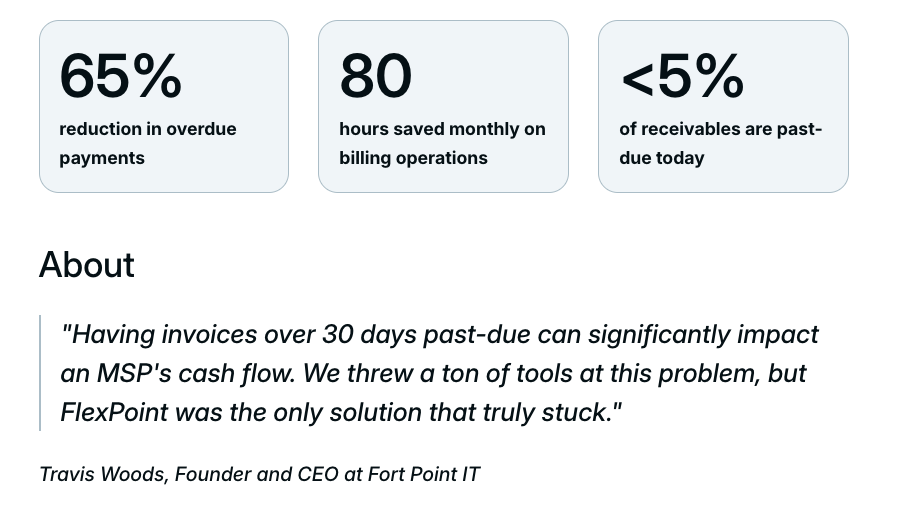
That's a meaningful operational win.
Every invoice that pays automatically is one less invoice requiring reminders, phone calls, status updates, and follow-up.
The next step is consistency.
Clients should not receive different collection experiences because one employee was busy and another happened to remember to follow up. Automated reminders help ensure every account receives the right communication at the right time.
But even automation has limits.
A rule can send an email after seven days, but a rule cannot determine whether that email is the right response.
A client who has paid on time for three years should probably receive different treatment than a client who is ninety days overdue.
That is where AI is beginning to change collections.
Instead of simply executing a sequence, AI can evaluate payment history, invoice age, prior communication, and account activity before deciding what action makes the most sense.
Why FlexPoint Approaches This Differently
If you've made it this far, you've probably noticed something.
The biggest cost of late payments is rarely the invoice itself.
It's the work surrounding the invoice.
The reminders. The follow-up. The payment questions. The collection calls. The status checks. The time spent figuring out what happened, what should happen next, and who is responsible for making it happen.
Most tools help solve one piece of that problem.
FlexPoint was built to connect the entire workflow.
Invoices, payment portals, AutoPay, reminders, collections activity, payment processing, accounting sync, reporting, and AR Agents all operate within the same platform.
That means your team is not jumping between systems, hunting through email threads, updating spreadsheets, or piecing together account history before deciding what to do next.
More importantly, it means the collections process becomes consistent.
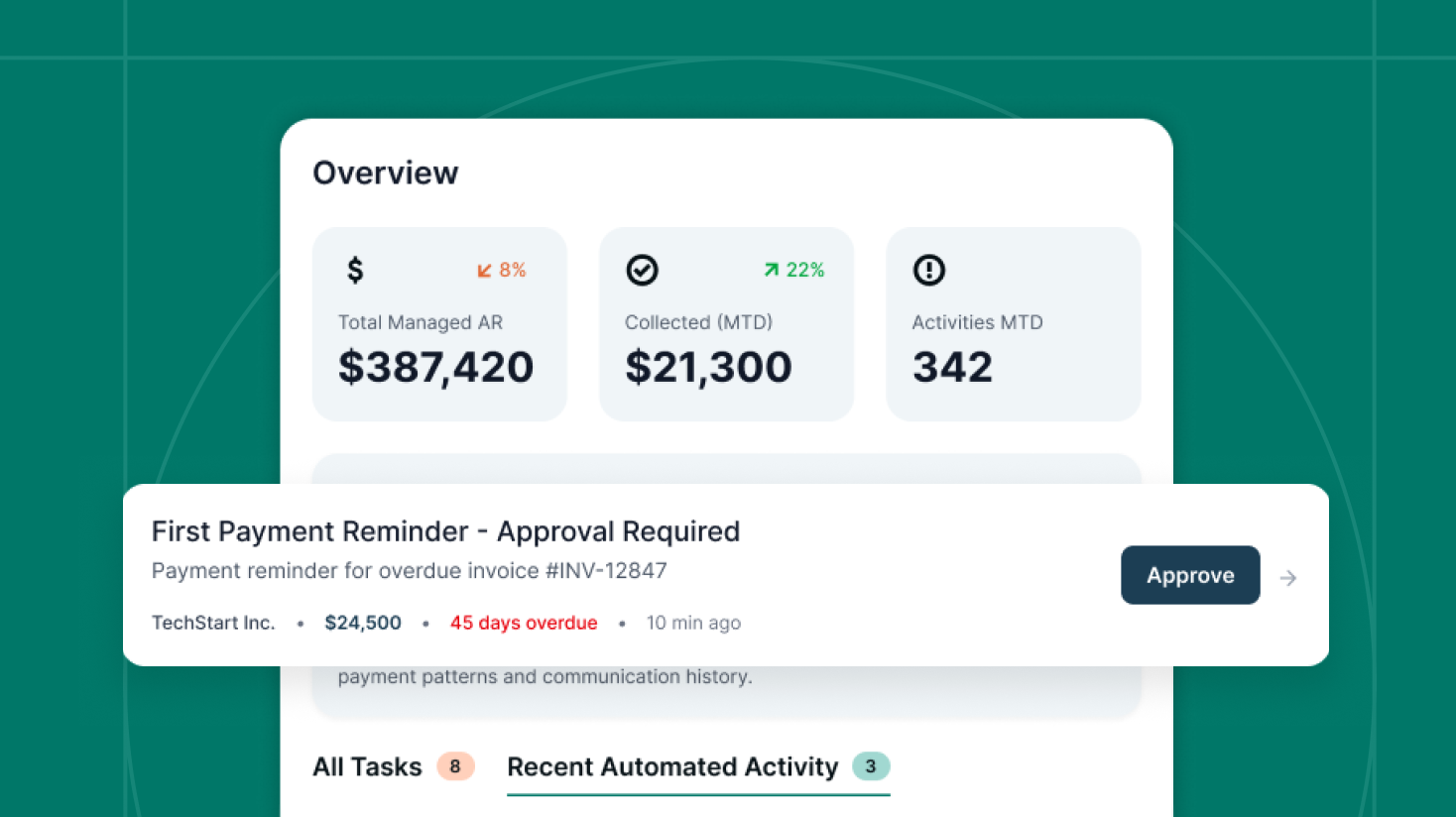
FlexPoint's AR Agents can see the same information your team sees: invoice status, payment history, prior communication, collection activity, and client behavior but consolidate it all for you in the dashboard.
They can prioritize overdue accounts, send intelligent follow-up emails, place collections calls on your behalf, answer any payment questions, track activity across every account, and surface exceptions that actually require human attention.
From there, you decide how much control you want to keep. Run the agents autonomously or use them in a copilot model where your team reviews recommendations and approvals.
Either way, the goal is the same.
Make it easier for clients to pay. Make it easier for your team to stay organized. Make sure the right follow-up happens at the right time.
And make sure important information never disappears into spreadsheets, inboxes, or disconnected systems.
Because reducing late payments is really about creating a process that makes getting paid easier for everyone involved.
The Cost Is Bigger Than the Invoice
A late invoice is easy to see. The work around it is much harder to measure.
That is why late payments can quietly become so expensive for MSPs.
The delayed cash flow matters, but so does the time spent chasing the payment.
A better collections process does not just help you get paid faster. It helps you spend less time managing the work around getting paid.
That is where FlexPoint is built differently.
By connecting everything in one platform, FlexPoint gives MSPs the context they need to keep collections moving without forcing the team to chase every account manually.
Chasing late payments shouldn't need to be your MSP back office's second job, they already have enough to manage.
See how FlexPoint helps MSPs reduce overdue invoices, automate follow-up, and spend less time chasing payments.
FAQs
How much do late payments cost an MSP?
Late payments cost MSPs more than the value of the invoice itself. In addition to delayed cash flow, overdue invoices create collection labor, increase Days Sales Outstanding (DSO), consume administrative time, and prevent teams from focusing on higher-value work. Even a single invoice can require multiple reminders, phone calls, status checks, and internal discussions before payment is received.
What is a good DSO for an MSP?
While DSO varies by business model and client base, many MSPs aim to keep DSO below 30 days. A lower DSO generally indicates that invoices are being paid quickly and cash is moving through the business efficiently. A higher DSO often signals collection challenges, billing friction, or inconsistent payment processes.
Why do MSP invoices get paid late?
Most late payments are not caused by clients refusing to pay. Common causes include missed follow-up, invoice approval delays, billing questions, manual collection processes, and a lack of visibility into account status. As MSPs grow, these issues often become more difficult to manage consistently without automation.
How can MSPs reduce overdue invoices?
MSPs can reduce overdue invoices by implementing AutoPay, simplifying the client payment experience, automating payment reminders, improving invoice visibility, and maintaining consistent follow-up processes. Many MSPs also use AI-powered collections tools to identify at-risk accounts and prioritize outreach.
What is the fastest way to improve cash flow in an MSP?
One of the fastest ways to improve cash flow is reducing the time between invoice delivery and payment collection. Strategies such as AutoPay enrollment, online payment portals, automated reminders, and proactive collections workflows can significantly shorten payment cycles and improve DSO.
How much time do MSPs spend chasing overdue invoices?
The exact amount varies, but many MSPs spend hours every week reviewing aging reports, sending reminders, answering payment questions, making collection calls, and documenting activity. As the number of overdue invoices increases, collection work can become a significant operational burden across finance, operations, and leadership teams.
What is the biggest hidden cost of late payments?
The biggest hidden cost is often opportunity cost. Every hour spent chasing overdue invoices is an hour that cannot be spent on client service, sales, business development, process improvement, or growth initiatives. While the cash flow impact is easy to measure, the lost productivity created by manual collections is often much larger over time.




.png)