

Late payments are not unusual for MSPs.
In fact, MSP Insight found that 81% of MSPs report not being paid on time.
And according to Allianz Trade, North American businesses wait more than 50 days on average to get paid.
DSO is what measures the average number of days it takes to collect payment after an invoice is issued.
At first glance, it seems like a finance metric.
In reality, it measures the health of every aspect of your business: cash flow, collections, and—often—your back-office processes.
A high DSO means revenue has been earned but has not yet reached your bank account. A low DSO means your business is converting completed work into cash quickly and consistently.
For MSPs trying to grow, hire, invest in new services, or simply improve financial predictability, few metrics are as important as DSO.
In this guide, we'll explain what DSO is, what a healthy DSO looks like for MSPs, why DSO increases, and the practical steps MSPs can take to reduce it.
What Is Days Sales Outstanding (DSO)?
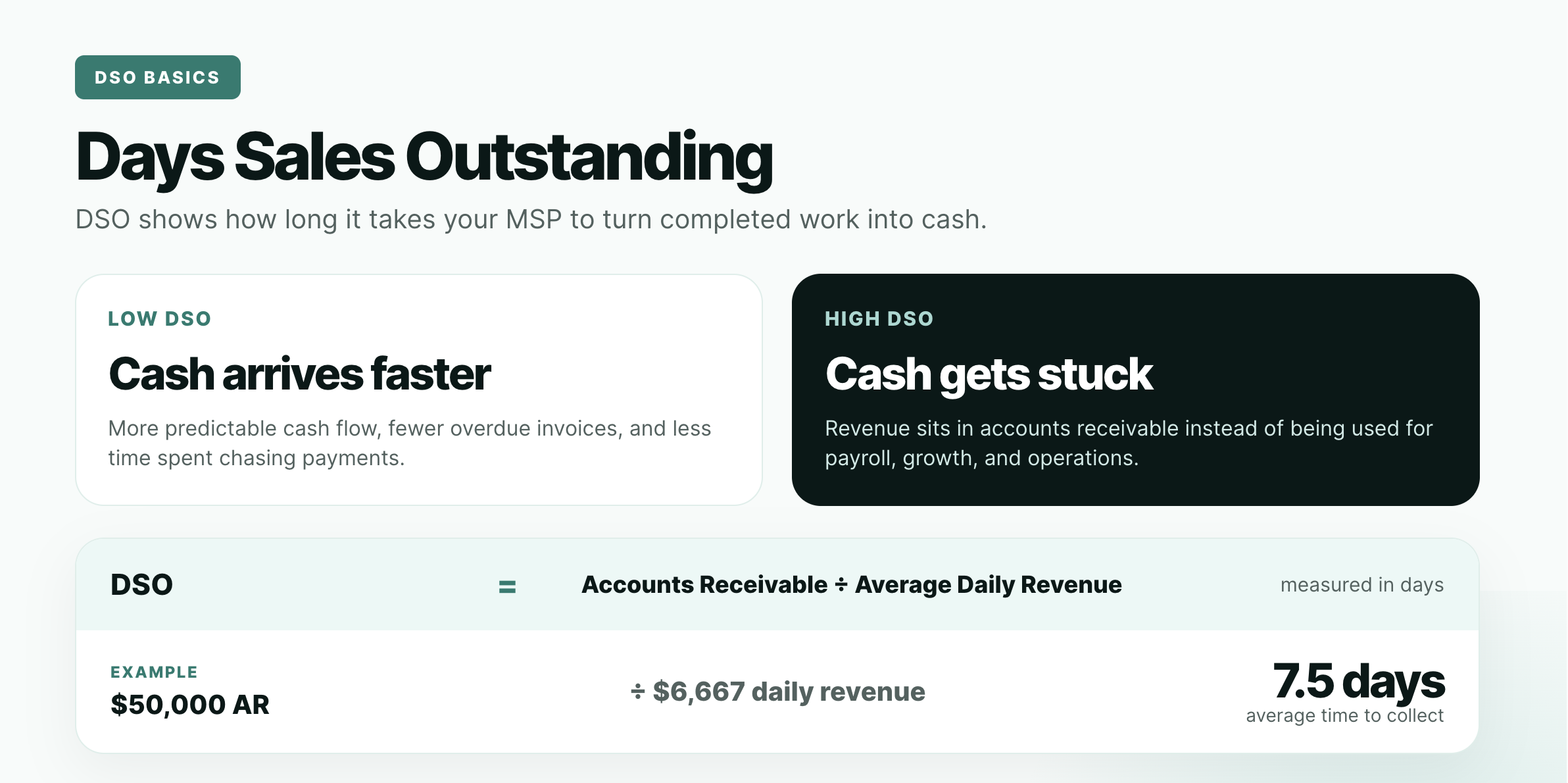
Days Sales Outstanding measures the average number of days it takes your business to collect payment after a sale.
The formula is:
DSO = Accounts Receivable ÷ Average Daily Revenue
For example:
- Accounts Receivable: $50,000
- Monthly Revenue: $200,000
- Average Daily Revenue: $6,667
DSO = 7.5 days
This means it takes an average of 7.5 days to collect payment after invoicing.
Lower DSO generally indicates faster collections and healthier cash flow.
Higher DSO often signals delayed payments, collection bottlenecks, or friction somewhere in the billing process.
Want to calculate your own DSO? Use our DSO Calculator to see how quickly your MSP is turning invoices into cash.
What Is a Good DSO for an MSP?
There is no universal DSO benchmark because payment terms vary between MSPs.
However, these ranges provide a useful framework:
Payment terms matter.
An MSP operating on Net 15 terms should generally expect a lower DSO than one operating on Net 30 terms.
The goal is not achieving the lowest DSO possible (after all, the stat is only one thing). The real goal is collecting invoices consistently and predictably to the point where you don't have to even worry about your DSO.
Why MSPs Should Care About DSO (Days Sales Outstanding)
Cash Flow
Cash flow is the most obvious reason to pay attention to DSO, but it's also the easiest one to underestimate.
For MSPs the 50 days on average wait time means work completed today may not turn into usable cash for nearly two months.
The challenge is that your expenses do not wait.
Payroll still runs every two weeks, software vendors still charge monthly, and contractors still need to be paid. On top of everything else, growth choices like new hires still need equipment and onboarding.
Revenue sitting in accounts receivable may look good on a profit and loss statement, but it cannot pay bills until it reaches your bank account.
(In fact, accounts receivable is often one of the largest working-capital assets on a company's balance sheet. Many finance teams estimate that receivables represent roughly 40-60% of working capital, making collections one of the fastest ways to improve liquidity without generating additional sales.)
Despite the work being done and the client being happy, your revenue is not real or usable until it has been collected.
Client Risk
DSO is also one of the earliest indicators that something may be changing with a client.
A single late payment is usually not a cause for concern, but pattern of increasingly late payments often is.
Unless something catastrophic has happened, clients rarely wake up one day and stop paying entirely. More often, payment behavior changes gradually.
Invoices that were once paid in ten days begin taking twenty. Twenty becomes thirty. Thirty becomes forty-five... etc.
Tracking DSO helps MSPs spot those trends early enough to have productive conversations before overdue balances become collection problems or write-offs.
In that sense, DSO is not just a collections metric. It is also a significant relationship health metric.
In situations like these with clients who have previously been consistent, it's important to approach them with the benefit of the doubt. Try calling them to see how they are doing before your messaging gets accusatory.
Curious about the optimal tone, timing, and communication method when invoices become overdue? Check out our guide on Email vs. Phone Calls for Overdue Invoices.
Growth Planning
Every business decision becomes easier when cash flow is predictable.
When you know generally when revenue will arrive, you can make hiring decisions with greater confidence. You can invest in new tools, expand service offerings, and build reserves for future opportunities.
The opposite is also true.
When payment timing becomes unpredictable, growth can slow to a halt. You can become a reactive MSP instead of one looking toward the future. And strategic decisions start revolving around cash availability rather than business opportunity.
Lower DSO creates flexibility because it shortens the distance between earning revenue and actually having access to it.
Operational Efficiency
Perhaps the most overlooked thing DSO measures is process quality.
Many MSPs assume a high DSO means clients are paying slowly. And sometimes that's very true.
The more valuable question though is why are clients paying slowly? This is the point which you can actually make changes to improve your DSO because you can't ultimately change your clients' behavior.
If invoices go out late, reminder emails depend on memory and are forgotten, questions are unanswered, data on your end is disconnected and no one has a complete picture of what is happening with an account... those are all things that can result in late payments that are on your end.
You can't exactly blame a client for paying late if they weren't reminded or don't have ease of access to pay. (After all, they have a lot going on in their lives too.)
That is why DSO is often one of the first metrics to reveal operational inefficiencies long before they show up elsewhere in the business.
Luckily, according to Ardent Partners, organizations that automate invoice processes reduce processing time by as much as 81%, freeing teams to focus on exceptions rather than repetitive administrative work.
Why MSP DSO Gets Too High
If friction exists somewhere between sending an invoice and receiving payment, your DSO will be higher than you may want.
A high DSO is usually the result of lots of little frictions which are predominantly solvable.
Manual Collections
Manual collections work surprisingly well when an MSP is small.
A bookkeeper remembers which accounts need attention. The owner follows up with important clients. Outstanding invoices can be reviewed in a single spreadsheet.
But when your business grows and twenty clients become fifty+ and every follow-up depends on someone remembering what happened last week and what needs to happen next, clients (and their invoices) will fall through the cracks.
The process itself does not break.
The consistency does because repetition scales faster than people do.
Payment Friction
Clients are far more likely to pay quickly when payment is simple.
Unfortunately, many invoicing processes unintentionally create obstacles.
For example:
- An invoice is buried in an inbox
- Payment instructions are unclear (or a payment link is not included)
- The client has asked questions that haven't been answered or asked for a copy of the invoice
- The payment portal is unavailable or difficult to access
- Their account manager or someone else is OOO
(And hundreds of other mundane occurrences.)
None of these issues are major individually.
Collectively, they add days or weeks to the payment cycle which makes it so important to ensure the things you can control are absolutely nailed down.
Lack of AutoPay
Recurring services create recurring invoices.
Without AutoPay, every recurring invoice becomes another opportunity for delay.
Someone has to open the invoice, review it, approve it, submit payment, and remember to do it again next month.
AutoPay removes that decision point entirely.
Every invoice paid automatically is one less invoice that can be forgotten, delayed for approval, or lost in someone's inbox.
That is why many MSPs see meaningful reductions in overdue invoices simply by increasing client adoption of automated payment methods.
Limited Visibility
One of the most common causes of delayed collections is not knowing what happened last billing cycle. You may know exactly how much you are out from last billing period, but do you remember what was said?
Have they expressed the state of their finances and asked for a payment period? More importantly, do you have to hunt for all this context?
Payment history lives in the accounting platform. Client communication lives in email. Service notes live inside the PSA. Collection activity lives in spreadsheets.
So by the time someone fully investigates an overdue invoice, they often spend more time gathering information than actually resolving the issue.
The longer it takes to understand a situation, the longer it usually takes to get paid.
5 Ways MSPs Reduce DSO
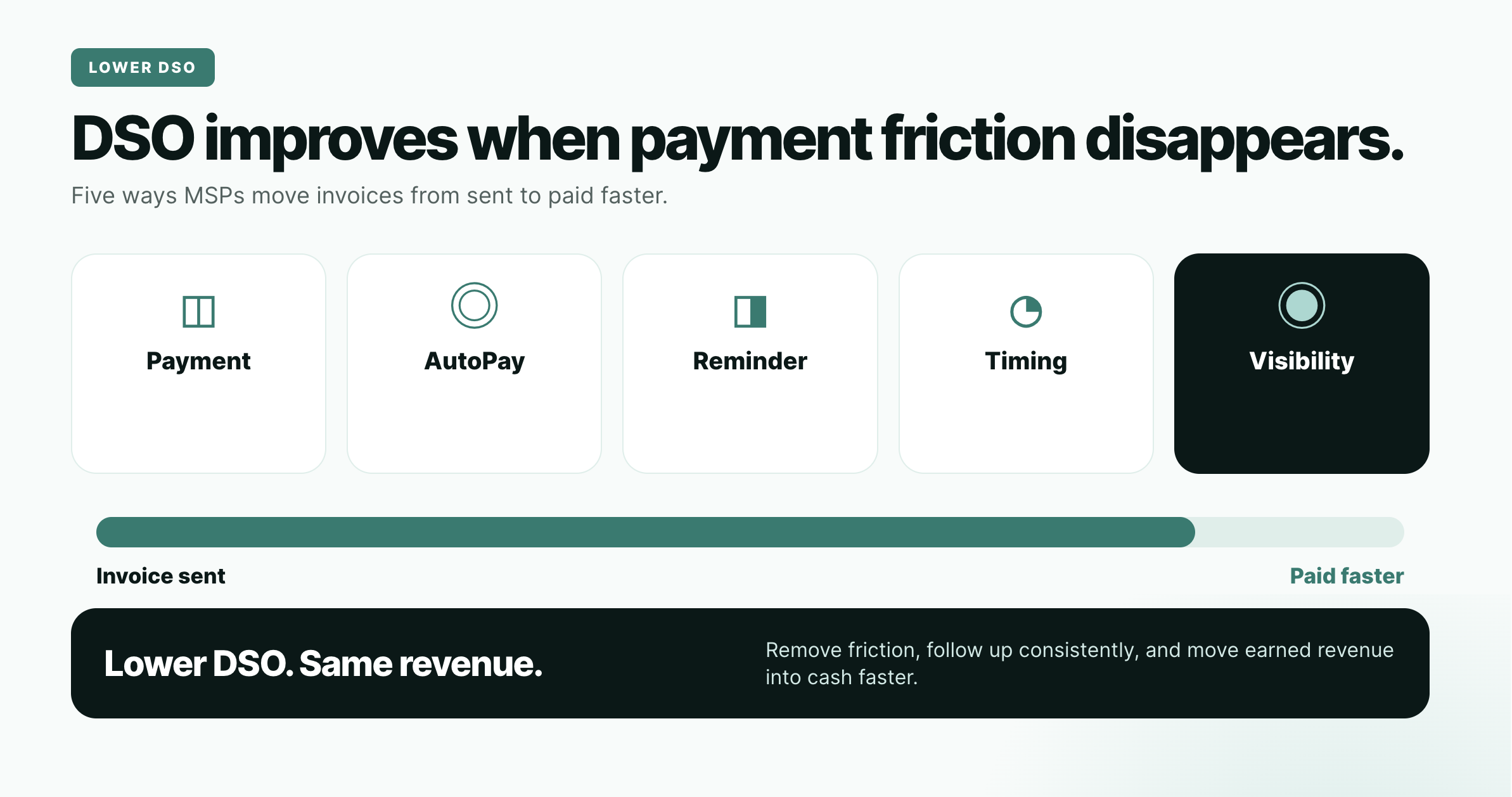
By now you likely have a few ideas where clients and invoices may be dropping off in your own MSP. But if you need some concrete steps to improve your cash flow, feel free to review the ones below.
1. Make Payment Easier
The easiest invoice to collect is the one that never requires a follow-up.
Clients should be able to view invoices, understand what they owe, and submit payment in a few clicks.
That sounds obvious, but many billing processes still create unnecessary friction.
You can make payment easier for your clients with client payment portals (and an easy "pay here" link in your reminder emails), ACH options, saved payment methods, and clear invoice formatting.
2. Increase AutoPay Adoption
Few initiatives reduce collection workload faster than AutoPay.
Every invoice paid automatically is one less invoice requiring reminders, collection calls, status updates, and follow-up.
Fort Point IT experienced this firsthand. After implementing FlexPoint, the majority of clients adopted AutoPay, helping reduce overdue invoices by 65% and returning more than 80 hours per month to their bookkeeper's schedule.
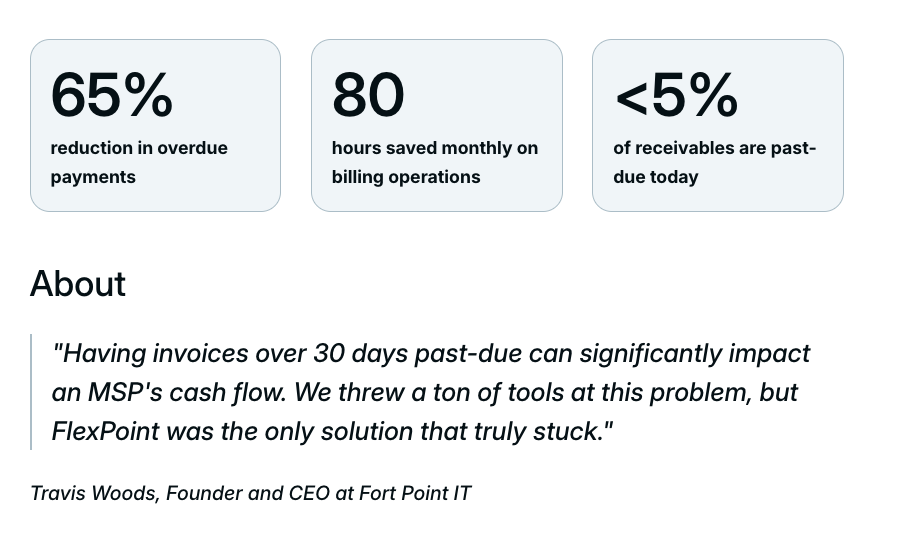
The result was not simply faster payment for the client.
It was less administrative work surrounding payment.
3. Automate Invoice Reminders
Overdue invoices don't suddenly become 30 days late.
They become 3 days late. Then 7. Then 15...etc.
At the risk of being over-repetitive, the problem is that manual follow-up rarely scales as cleanly as invoice volume does. As the number of clients grows, reminders become easier to miss, harder to track, and more inconsistent from one account to the next.
Automated reminders solve that problem by making follow-up predictable.
Every client receives the right communication at the right time without requiring someone on your team to remember, monitor, or manually send it. FlexPoint's automated reminders work alongside payment portals and AutoPay to reduce the number of invoices that ever require collections in the first place.
Because the easiest overdue invoice to collect is the one that never becomes seriously overdue.
4. Follow Up Earlier
According to research from the Credit Research Foundation, an invoice that reaches 90 days past due has only a 69.6% probability of being collected. At six months past due, that probability falls to 52.1%.
That makes early intervention important.
A simple reminder a few days after a missed due date is usually more effective than a frustrated escalation thirty days later.
The goal is not to pressure clients.
The goal is to identify issues while they are still small and easy to resolve.
Most overdue invoices become harder to collect simply because too much time passes before someone takes action.
5. Improve Collections Visibility
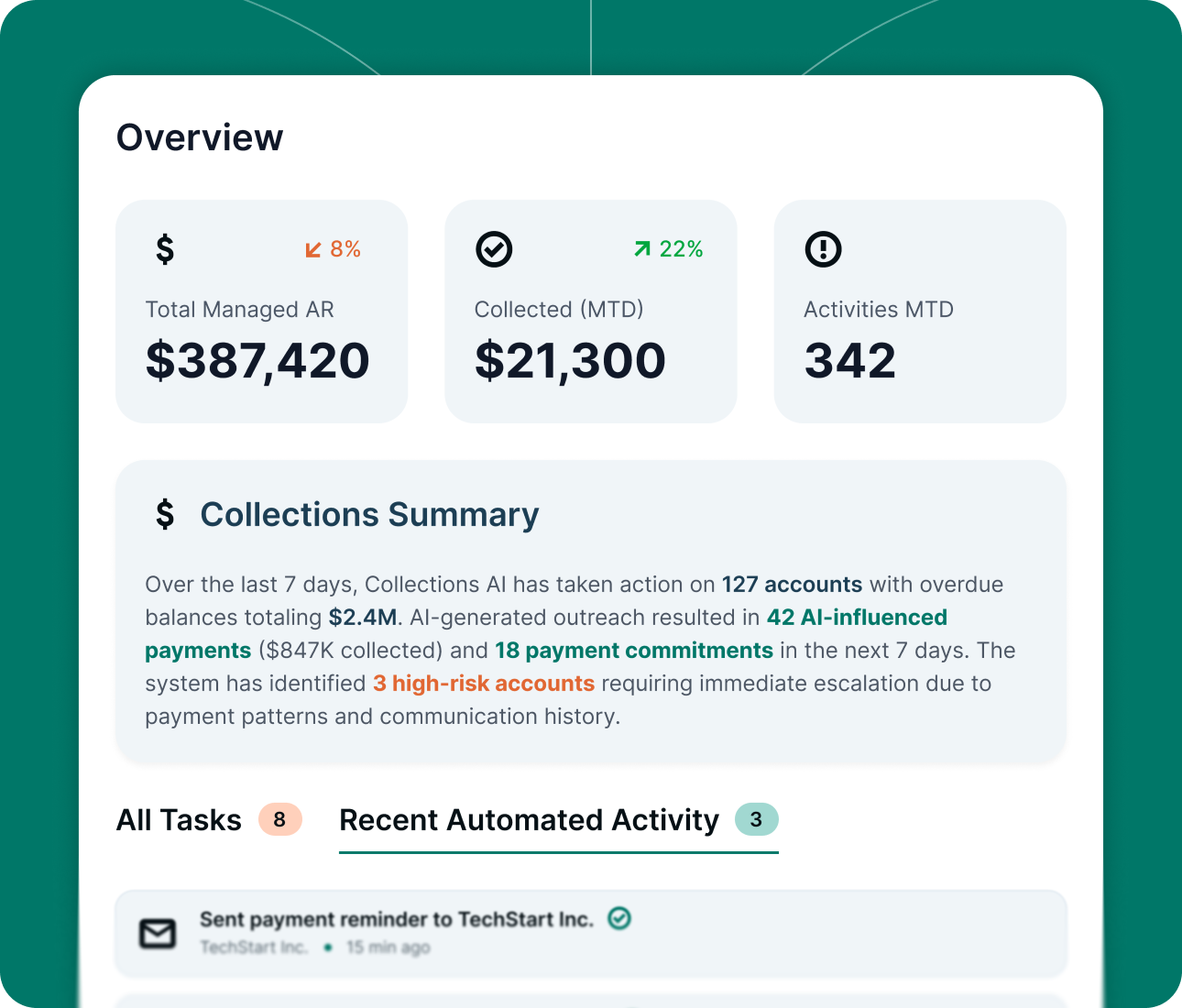
The biggest challenge for many MSPs is knowing which accounts require attention today (and what kind of attention they require).
Most collections delays begin with uncertainty: Who followed up last? Did the client respond? Was there a dispute? Did they promise to pay next week?
The faster your team can answer those questions, the faster they can move the account forward.
Most overdue invoices simply require context. Knowing what happened last, who was contacted, what was promised, and what should happen next.
This is why centralized visibility has become increasingly important. When invoice history, payment activity, communication records, and collection actions are available in one place, teams spend less time investigating accounts and more time resolving them.
That visibility is also where AI-powered collections workflows are beginning to create real value, helping teams identify which accounts need attention before they become serious collection problems.
FlexPoint's AR Agents bring that information together inside the AR Agent Dashboard, giving teams a real-time view of overdue invoices, payment history, collection activity, client responses, promises to pay, and recommended next actions. Instead of digging through your PSA, accounting platform, inbox, and spreadsheets to understand what's happening, the context is already there.
And if you'd rather not manage every step yourself, AR Agents can take action as well, sending follow-ups, answering routine invoice questions, placing intelligent collections calls, and surfacing only the accounts that genuinely require human attention.
How Much Could Lowering DSO Improve Cash Flow?
Imagine an MSP generating $100,000 per month.
With a DSO of 50 days, approximately $166,000 is tied up in accounts receivable at any given time.
Reducing DSO to 35 days would release roughly $50,000 back into the business.
No additional sales required.
That's why it's hard to overstate the importance of improving your DSO.
Curious just how much late payments are costing you overall? Read How Much Do Late Payments Cost Your MSP?
Common DSO Mistakes MSPs Make
If your DSO has increased for three consecutive months, it is usually a sign that either payment behavior or collections processes have changed. Both deserve investigation.
- Waiting until invoices are severely overdue before following up: waiting too long makes these conversations even more awkward. A friendly reminder a few days after a missed due date is usually much easier than trying to collect an invoice that has been sitting for sixty or ninety days.
- Treating every client the same regardless of payment history: A client who has paid on time for three years probably deserves a different approach than a client who consistently pays late. Payment history provides valuable context, and the best collections processes use that context instead of applying the same sequence to every account.
- Relying entirely on manual collections: As client counts grow, follow-ups become harder to track, communication becomes less consistent, and overdue invoices become easier to miss. What feels manageable with twenty clients often becomes unsustainable with one hundred.
- Failing to offer AutoPay: Without AutoPay, every invoice requires another manual payment decision from the client. Even clients with good intentions can forget, delay approval, or simply get distracted. AutoPay removes that friction entirely.
- Reviewing aging reports only once per month: Aging reports provide the most value when they help teams identify problems early. Waiting until the end of the month often means opportunities for early intervention have already been missed.
- Measuring DSO without taking action to improve it: Many businesses monitor the metric but never address the underlying causes. If DSO is rising, it is usually a signal that something in the billing, payment, or collections process deserves attention.
Most DSO problems are not caused by a lack of knowledge.
They are caused by inconsistent execution.
Improving DSO Is Really About Consistency
You already know what good collections should look (or feel) like.
Invoices go out on time, clients receive timely reminders, payment questions receive prompt answers, follow-ups and escalations happen exactly when they should.
None of that is particularly complicated.
What is complicated is maintaining those activities across dozens or hundreds of accounts while simultaneously running the rest of the business.
That is why improved DSO is most often the result consistency.
The MSPs with the healthiest DSO are not necessarily the ones sending the most reminders or making the most collection calls. They are the ones that have removed friction from the payment process and built systems that ensure the basics happen every time.
When payment is easy, follow-up is consistent, and account information is readily available, invoices get paid faster.
FlexPoint helps MSPs create that consistency through client payment portals, AutoPay, automated reminders, integrated payment processing, real-time collections visibility, and AI-powered AR Agents that help teams prioritize the accounts that need attention most.
Because the goal is not simply tracking DSO.
The goal is getting paid faster, with less effort and fewer overdue invoices along the way.
Streamline your MSP's financial operations with FlexPoint's advanced DSO management tools.
Visit our website or contact us today to learn more about our capabilities and schedule a demo.
FAQs
What Is DSO?
Days Sales Outstanding (DSO) measures the average number of days it takes a business to collect payment after issuing an invoice. For MSPs, DSO is a key accounts receivable metric because it directly impacts cash flow, collections performance, and financial planning.
What Is a Good DSO for an MSP?
A good DSO for most MSPs falls between 20 and 30 days. A DSO below 20 days typically indicates excellent collections performance, while a DSO above 45 days may signal issues with invoicing, payment processes, or follow-up consistency.
How Do You Calculate DSO?
The standard DSO formula is:
DSO = Accounts Receivable ÷ Average Daily Revenue
For example, if an MSP has $50,000 in accounts receivable and generates $5,000 in revenue per day, its DSO would be 10 days.
Why Is DSO Important for MSPs?
DSO helps MSPs understand how quickly completed work turns into cash. Lower DSO improves cash flow, reduces collection workload, supports growth initiatives, and provides greater financial flexibility. Higher DSO can create cash flow pressure and increase the risk of overdue invoices becoming uncollectible.
What Causes DSO to Increase?
Common causes of rising DSO include:
- Late invoice delivery
- Inconsistent collections follow-up
- Limited payment options
- Low AutoPay adoption
- Poor visibility into overdue accounts
- Manual billing and collections processes
Many MSPs discover that rising DSO is often a process issue rather than a client issue.
How Can MSPs Reduce DSO?
MSPs can reduce DSO by:
- Making payment easier through client payment portals
- Increasing AutoPay adoption
- Automating invoice reminders
- Following up on overdue invoices sooner
- Improving visibility into collections activity
- Using AI-powered collections tools to prioritize accounts requiring attention
The goal is not necessarily to collect more aggressively, but to remove friction from the payment process.