


There's nothing particularly uncomfortable about invoice reminder emails.
But things get uncomfortable quickly when the payment still hasn't arrived and someone has to actually pick up the phone.
Calling a client about money can feel like a loaded conversation, especially when the relationship isn't particularly strong or the account is strategically important.
But in practice, overdue invoice calls are rarely as tense as they feel in anticipation. Especially if you keep in mind that your clients are most likely not avoiding you.
They are busy, or the invoice is stuck somewhere in their approval process, or they genuinely forgot.
So it's important to keep in mind that the goal of an overdue invoice call is not to apply pressure.
At least, at first.
It is to understand what is blocking payment, confirm next steps, and keep the process moving. Think of it as a simple status check with a specific outcome in mind.
This guide covers when to call, how to sound, the most common mistakes, and eight scripts you can use across the most common overdue scenarios no matter how uncomfortable it may feel.
Why Phone Calls Matter for MSPs
Chances are good that you already know it's important to have that personal connection of getting your clients on the phone. But if you don't, or would rather not call, here are a few central reasons why it is so important:
1. Email eventually stops working: Inboxes are noisy, reminder emails get overlooked, forwarded without action, or buried under everything else the client has going on. After a few unanswered emails, the dynamic has shifted. The client has had the option to respond and has not. A phone call changes the interaction from passive to active. It signals that the situation has moved to a different stage and it is being taken seriously by you.
2. Calls surface information faster: A single two-minute call often produces more clarity than three emails. You find out the invoice went to the wrong person. You learn there is a dispute over a specific line item. You discover the client is waiting for internal approval. That information is what unlocks payment, and you would not have had it without calling.
3. MSP relationships are ongoing: A one-time transaction between strangers can withstand a slurry of emails. But a managed services relationship that you want to continue for the next three years cannot. Tone matters more for MSPs than for most businesses precisely because you are not just collecting a payment. You are managing a relationship that will have many more billing cycles after just one (ideally).
When MSPs Should Call About an Overdue Invoice
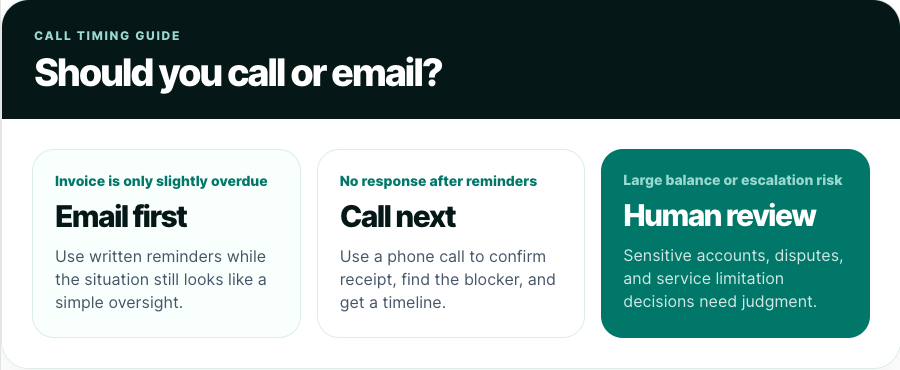
Call when:
- The invoice is 7 to 14 days overdue and email reminders have gone unanswered
- The balance is large enough that personal contact is warranted
- The account is strategically important and a human touch matters
- There are signs of confusion or a potential dispute
- A payment was promised but never arrived
- Service limitation is approaching and you want to give the client a final personal heads-up
Stick with email when:
- The invoice is in the pre-due or early overdue stage and email has not had a real chance yet
- The conversation needs to be heavily documented for legal or escalation purposes
- The client reliably responds to email and there is no indication something is wrong
For the full sequencing logic: Email First or Call First? The Right Sequence for Chasing Late MSP Payments
The Biggest Mistakes MSPs Make on Collections Calls
1. Sounding emotional. If you are frustrated when you make the call, the client can hear it. Frustration triggers defensiveness. Defensiveness slows payment down. If you are not in the right headspace for a calm, operational conversation, wait until you are.
2. Talking too much: The purpose of the call is to surface information and confirm a next step. It is not to explain the entire billing situation or fill silence with justification. Ask, listen, and confirm. That is the whole call.
3. Sounding vague: "I'm just checking in about your account" is the phone equivalent of a subject line that says "following up." It gives the client almost nothing to work with. "I'm calling about invoice #4821 for $3,200, which was due on June 5" is specific, immediate, and easy to respond to.
4. Calling without context: Before you dial, know the invoice number, balance, due date, what reminders have already gone out, whether a payment was ever promised, and where the account stands relative to your service agreement thresholds. A collections call where you have to look things up mid-conversation loses credibility fast.
5. Escalating too early: Strong language has diminishing returns if it is used before the situation warrants it. Save service limitation references and formal notice language for the stages where those things are actually happening or about to happen.
It's important to stay calm, direct, and operational in your tone for calls about invoices (overdue or not).
If you have ever called a pharmacy to ask about a prescription or followed up on a shipping delay, you know what this sounds like. You are not angry, confused, or apologetic. You are simply checking on something that should have happened and has not yet.
The register should come across as neutral confidence. Assuming positive intent without assuming infinite patience.
And most importantly, the call should feel easy to resolve because you have made it easy to resolve.
Overdue Invoice Call Scripts for MSPs
Script 1: First Follow-Up Call (7 to 14 Days Past Due)
Goal: Confirm receipt and understand what is delaying payment.
"Hi [Name], this is [Your Name] from [MSP]. I'm calling about invoice #[number] for $[amount], which was due on [date]. I just wanted to confirm you received it and see if there's anything holding payment up on your side."
This script works because it does not assume the client is ignoring you.
It leaves room for the most common real explanation (the invoice got buried, forwarded to the wrong person, or flagged for internal review) and invites the client to explain rather than defend.
Script 2: Client Says They Will "Check on It"
Goal: Turn a vague response into an actual commitment.
"Absolutely. When would be a good time to follow back up if you aren't able to confirm payment today?"
Never end a collections call without a timeline. "I'll look into it" is not a next step.
But a specific date for follow-up is. This script is short on purpose, ask the question then wait.
Script 3: Payment Was Promised But Never Arrived
Goal: Professional accountability without creating conflict.
"Last week we discussed payment by Friday, and I wanted to follow up since we haven't seen that come through yet. Is there anything that changed on your side?"
This script acknowledges the prior conversation without sounding accusatory.
"Is there anything that changed" gives the client a face-saving way to explain a delay rather than having to admit they simply did not follow through.
Script 4: Invoice Was Sent to the Wrong Person
Goal: Get routing clarity and prevent the same delay next month.
"Thanks for letting me know. Who is the best contact for invoice approvals so we can make sure future reminders reach the right person directly?"
Fix the process in the same call. This prevents the same situation from repeating and positions you as helpful rather than just persistent.
Script 5: Large Balance Follow-Up
Goal: Increase seriousness while staying calm.
"I wanted to reach out directly because the outstanding balance has grown to $[amount], and we want to make sure we align on timing before it becomes a larger issue operationally."
"Operationally" is doing useful work in that sentence. It keeps the framing practical rather than financial, which reduces defensiveness. The call is about making sure things stay on track instead of focusing on the money itself.
Script 6: Service Limitation Approaching
Goal: Document seriousness without sounding threatening.
"I wanted to make sure you were aware that the account is approaching the threshold in our service agreement where service limitations may apply if the balance isn't resolved."
Reference the policy, not the punishment. The client agreed to these terms.
This script treats that like a fact, not a threat, which is exactly what it is.
Script 7: Payment Plan Conversation
Goal: Open a collaborative path forward.
"If paying the full balance right now is difficult, we're open to discussing a structured payment plan so we can keep things moving."
Only use this when you have already decided a payment plan is appropriate for this client.
For guidance on when that decision makes sense: Should You Offer a Payment Plan to a Late-Paying Client?
Script 8: Leaving a Voicemail
Goal: Prompt a callback without giving too much away.
"Hi [Name], this is [Your Name] from [MSP]. I'm following up on invoice #[number] for $[amount] that was due on [date]. Please give me a call back at [number] or you can pay directly at [payment link]. Thanks."
Keep voicemails under 30 seconds. The goal is a callback or a payment, not a full update.
For complete voicemail guidance: How to Leave a Voicemail for an Unpaid Invoice (Without Sounding Aggressive)
How Long Should an Overdue Invoice Call Be?
Ultimately that depends on what the situation is but going over five minutes for a call about an invoice (especially compounded by dozens or hundreds of clients) means significantly lost time.
A well-run collections call has three parts: identify the invoice, surface the blocker, confirm the next step.
If the call is running long, it is usually because the ask was unclear, a dispute has emerged, the conversation became emotional (or you just have one of those clients who likes chatting!).
Good collections calls are short because they are focused.
What to Do After the Call?
Send a follow-up email immediately. Recap the invoice number, the balance, what was agreed, and the timeline for payment. This is not a formality. It is a documented record of what was discussed. If the client later claims they were never told something, the email exists. If you offer a client payment portal make sure the link is present so they can resolve the overdue invoice immediately.
Log the interaction. Date, time, what was said, what was committed, any concerns raised, and where the account stands relative to escalation thresholds. If the situation eventually reaches collections or service limitation, that log is your paper trail.
For more on documentation requirements as part of a formal collections process: Creating a Collections Policy for Your MSP
What if Someone Could Call For You?
Despite all this information, calling is still uncomfortable. Especially after that third or fourth touch point when they've usually been responsive.
Even the best intending AR manager in an MSP will get exhausted by this process when they're also juggling five other tasks.
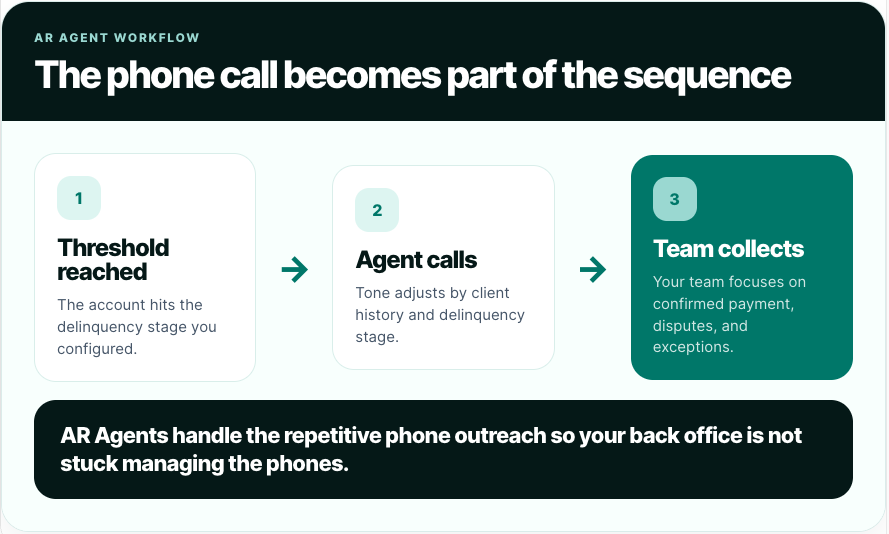
With FlexPoint's AR Agents, the calls can be done for you.
You can manage whether or not they are on for a client (maybe that one who likes to chat about their summer plans), what tone is used depending on billing delinquency and account history, and how often the calls are made.
The agents can confirm whether payment has already been sent, identify potential disputes or delays, log every interaction automatically, and surface the accounts that actually require human attention. Your team spends less time managing phones and repetitive follow-up, and more time resolving exceptions, handling sensitive conversations, and actually collecting payments.
No need for scripts to be sitting in front of you or one of your most valuable employee's time being monopolized by a touch-and-go client.
Without autonomous agents, the rhythm of collections becomes consistent and so does your cash flow.
When a Call Becomes an Escalation Issue
Some situations move past what a call can resolve on its own: repeated broken promises, no response after multiple contact attempts, disputes that have stalled without progress, or balances that have grown to the point where service limitation is no longer avoidable.
When that happens, the collections call becomes part of a documented escalation sequence rather than a standalone touchpoint.
Related guides:
A Better Collections Operation
Cash flow problems for MSPs usually stem from the process depending too heavily on manual effort.
Emails going out late, calls happening inconsistently, and escalation stages blurring together is the result of overburdened back-office employees lacking the tools they need.
The result is that finance teams spend an enormous amount of time managing the workflow around collections instead of actually resolving overdue accounts.
That is where automation and AR Agents create leverage.
Routine outreach happens automatically, emails and calls go out at the right stage, and payment activity updates in real time with documentation for everyone.
Clients receive communication that matches the account context and delinquency level and the accounts that genuinely require human judgment rise to the surface instead of getting buried beneath repetitive follow-up work.
The outcome is not a collections process without people. It is a collections process where your team spends less time chasing routine payments and more time handling the conversations, decisions, and client relationships that actually matter.
Learn how FlexPoint help MSPs with smart invoice follow-up, autonomous phone outreach, escalation workflows, and payment tracking while keeping humans in control of sensitive collections decisions.





.png)