


"We never received the invoice."
You've probably heard that more than once.
Maybe you've already sent two reminder emails. Maybe the invoice is already two weeks overdue. Your accounting software shows it was emailed successfully, yet the client insists they never saw it.
Now you're left wondering whether there was a genuine delivery issue or whether they're simply buying more time.
Either way, the conversation puts payment on hold.
For MSPs, that matters. According to MSP Insight, 81% of MSPs report not being paid on time, with invoices delayed by an average of 60 days. Late payments aren't just frustrating. They create unnecessary pressure on cash flow, especially for businesses built around recurring revenue.
The good news is that "we never received the invoice" is typically just the symptom of a problem which is solvable. (Whether that's outdated billing contacts, crowded inboxes, inconsistent invoicing processes, or simple human error.)
Understanding what happened and responding the right way can often turn an overdue invoice into a quick resolution while helping prevent the same issue from happening again.
"I never received the invoice" doesn't always mean what you think
When clients say they never received an invoice, most people immediately think about email delivery.
But that's usually only part of the story.
Receiving an invoice and seeing an invoice are two very different things.
An invoice might arrive successfully in someone's inbox and still never be opened. It could be filtered into spam, buried beneath hundreds of other emails, forwarded to someone who no longer works at the company, or sitting in a shared accounts payable mailbox that only gets reviewed once a week.
In larger organizations, invoices often pass through several people before they're ever approved for payment. Procurement, department managers, finance teams, and accounts payable may all touch the same invoice before money actually leaves the bank account. Somewhere along that chain, communication breaks down surprisingly often.
That's why arguing over whether your accounting platform says the invoice was "sent" rarely helps.
From your perspective, the invoice was delivered. From your client's perspective, they never had the information they needed to pay.
Those can both be true.
Approaching the conversation with that mindset usually produces a much better outcome than assuming bad intent.
Instead of responding with:
"We definitely sent it."
The conversation becomes:
"Thanks for letting us know. Let's figure out what happened and get you another copy."
Instead of creating a disagreement over what happened, you're working together toward the same goal: getting the invoice in front of the right person so payment can move forward.
That doesn't mean every client is always being truthful.
It means you don't need to answer that question first.
Most email systems can confirm whether an invoice was successfully sent, but they can't tell you whether the right person actually opened it, understood it, or had everything they needed to approve payment.
Before you resend the invoice, verify what actually happened
But before you simply resend the invoice and move on, it's worth taking a minute to verify a few details.
For example, if the invoice was sent to an employee who left the company three months ago, resending it to the same address doesn't accomplish anything.
Likewise, if the invoice has already been partially paid, disputed internally, or replaced by a corrected version, sending another copy may only create more confusion.
Before responding, take a quick look at the account.
- Confirm the invoice was generated correctly
- Verify the billing contact
- Check whether reminder emails were sent
- Review any recent notes from your finance team or account manager
- Gather context on the last point of contact
This can take some time but it often prevents awkward conversations that could have been avoided.
When payment history, previous conversations, invoice status, and client notes all live in different systems, even a simple follow-up requires detective work.
As your MSP grows, that detective work becomes one of the biggest hidden costs of your AR process.
Respond first. Investigate second.
The temptation for anyone handling overdue invoices to defend your process before solving the problem.
Most of the time, that's backwards.
Whether the invoice landed in spam, went to the wrong contact, or simply got buried in a busy finance inbox doesn't really change what needs to happen next.
The client still needs an invoice they can review and pay.
A simple response like this is usually enough:
"Thanks for letting us know. I've just resent the invoice. If it still doesn't come through, let me know and we'll make sure we get it to the right person."
If the client calls instead of emailing, you can even stay on the phone while they confirm they've received the resent invoice. It turns another follow-up into an immediate resolution.
It's important to notice what's missing in that message—accusation, debate, or proving who is right.
Ironically, that's often the fastest way to find out whether the invoice truly wasn't received. Clients who genuinely had a delivery issue usually appreciate the quick response and move straight into the payment process. If the invoice still isn't paid after it's been resent and confirmed, then you have much better information to guide your next conversation.
The goal of your first response from a client who says they haven't received the invoice and is late on payment isn't to settle a disagreement. It's to get the payment process moving again.
Now, how do you keep this from happening in the first place?
Update your billing contacts before it happens again
If a client genuinely never received an invoice, it's worth asking one more question before moving on:
Did the invoice go to the right person?
Billing contacts change more often than most businesses realize. According to Gartner, employee turnover remains elevated across many industries. Employees leave, finance teams reorganize, companies merge, and someone who approved invoices six months ago may no longer be responsible for payments today.
That's why "I never received it" can actually be a helpful signal.
Instead of treating it as a one-off problem, use it as an opportunity to verify the client's billing information. Confirm the accounts payable contact, make sure the invoice is going to the correct email address, and ask whether anyone else should receive a copy moving forward.
Many MSPs only update billing contacts when something goes wrong.
A better approach is to make it part of your regular client reviews or onboarding process. Spending two minutes confirming payment contacts today can save hours of follow-up conversations later.
More importantly, it reduces the chances of another invoice quietly disappearing into the wrong inbox.
Should you extend the due date?
One question that often comes up after resending an invoice is whether the due date should change.
There isn't a universal answer because every situation is different.
If the invoice genuinely never reached the client's finance team because of an outdated billing contact or an email delivery issue, extending the due date would be perfectly reasonable. After all, it's difficult to expect someone to pay an invoice they never had an opportunity to review.
But that's very different from a client who received the invoice, ignored multiple reminders, and only claimed they never saw it after you followed up.
The important thing is having an internal approach before these situations happen.
Without one, every overdue invoice becomes a judgment call. One employee extends the due date. Another immediately applies a late fee. Someone else decides to waive it entirely.
That inconsistency creates confusion for both your team and your clients.
Instead, decide ahead of time how situations like these will be handled. You don't need a rigid rule for every possible scenario, but you should have a process that leaves room for judgment without making every exception feel arbitrary.
Clients appreciate consistency just as much as they appreciate flexibility.
Another option is creating a payment plan. Read more here: Should You Offer a Payment Plan to a Late-Paying Client? A Guide for MSPs
Whatever decision you make, document why it was made. The next person who reviews the account should understand why an exception was made without having to reconstruct the conversation.
When does a late fee make sense?
If your agreement includes late fees, don't assume every "I never received the invoice" conversation automatically means the fee should disappear.
Instead, look at the bigger picture:
- Was there a legitimate delivery problem?
- Has this client consistently paid on time for years?
- Did they respond immediately once the invoice was resent?
- Or is this simply the latest explanation in a pattern of delayed payments?
Those questions usually tell you far more than the phrase "I never received it."
Late fees work only when they're part of a clearly communicated payment policy. If you've explained your payment terms during onboarding, included them in your service agreement, and referenced them on every invoice, clients already know what to expect.
That doesn't mean you can't choose to waive a fee occasionally.
It means the exception should be intentional rather than becoming the expectation.
If you're still developing your policy, our guide to Maximum Late Invoice Fee Laws by State walks through the legal considerations for commercial invoices across the U.S.
Your standard process should handle most situations automatically. Judgment is reserved for the exceptions, not every overdue invoice.
The real cost
One client saying they never received an invoice isn't usually a serious problem.
Twenty clients saying it every month is.
According to Versapay, 74% of finance leaders say their teams spend a moderate or significant amount of time every week chasing late payments.
Think about everything that has to happen after someone says they didn't receive the invoice.
Someone has to: verify the billing contact, review payment history, check whether reminder emails were sent, resend the invoice, document the conversation, decide whether the due date changes or a payment plan is offered, determine whether a late fee still applies, and schedule another follow-up if payment still doesn't arrive.
None of those tasks is particularly difficult.
They're simply repetitive.
And as your client list grows, so does the amount of time your team spends piecing together information before they can even begin the actual collections conversation.
That hidden administrative work is often far more expensive than the occasional overdue invoice itself.
Read more about How Much Do Late Payments Cost Your MSP?
Make it easier for clients to pay
One of the simplest ways to reduce "I never received the invoice" conversations is to stop relying on a single email.
If the only way a client can access an invoice is by finding one message in a crowded inbox, payment depends on that email being delivered, opened, and acted on.
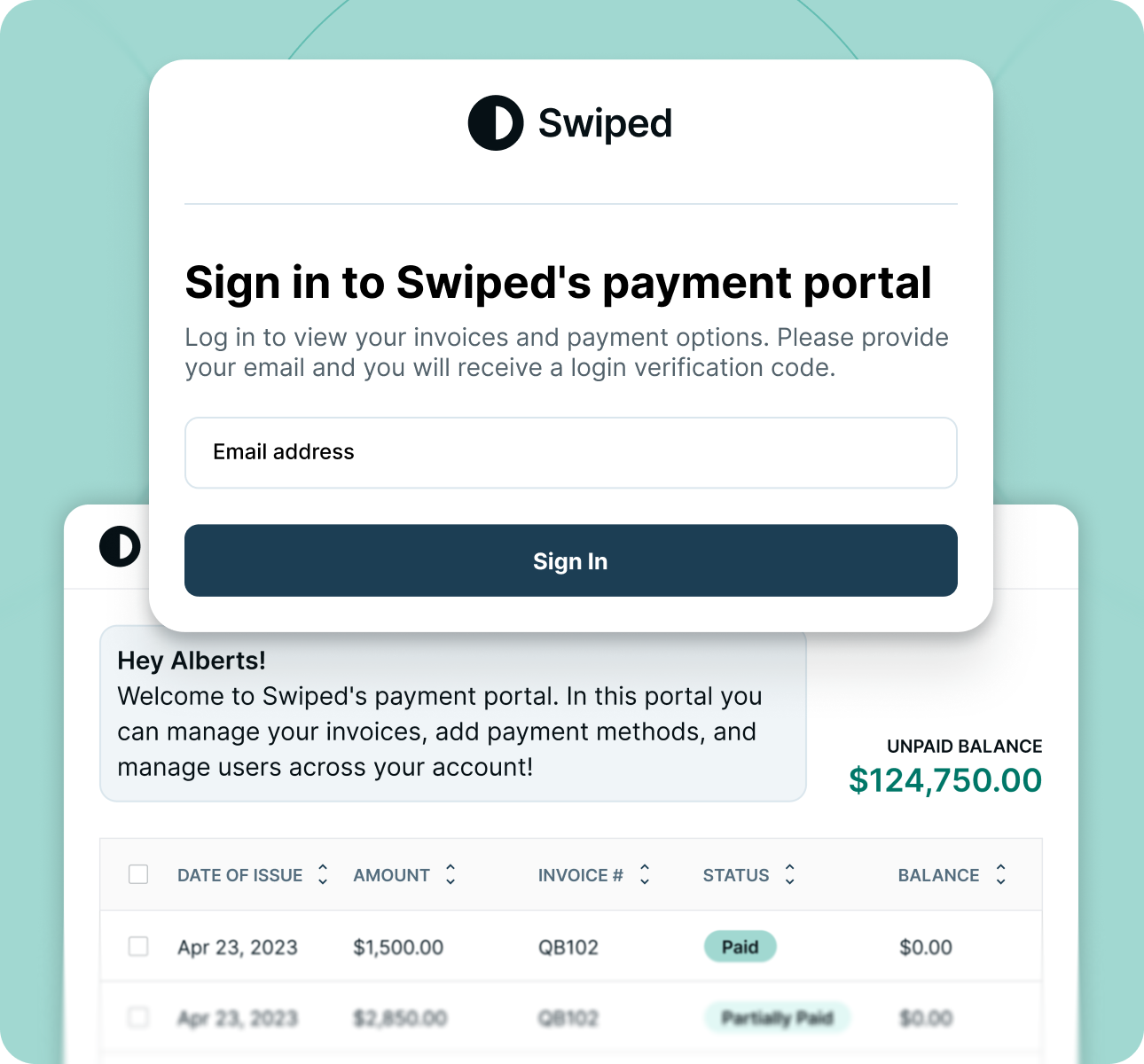
Modern payment portals do help your finance team, but they also remove friction for clients. If someone can't find the original email, they can still log in, review outstanding invoices, and pay without waiting for another copy to be sent.
The original email becomes a notification rather than the only place the invoice exists.
Prevention is better when it comes to most things but especially late payments. Since there are many tools available, it's best to make use of them.
Overall, it reduces the number of payment-related questions your team has to answer in the first place.
As your MSP grows, consistency matters more than speed
Early on, it's easy to manage accounts receivable from memory or an Excel sheet.
You know which clients always pay a few days late, you remember who asked for an extension last month, and you know who prefers a phone call instead of an email.
That becomes much harder once you're managing dozens—or hundreds—of client relationships.
At that point, consistency matters more than individual effort.
The strongest collections processes aren't built on systems that ensure every client receives the appropriate level of communication, every invoice follows the same process, and every exception is documented along the way.
That's one reason more MSPs are moving toward purpose-built payment platforms that combine automation with AI.
With FlexPoint's platform + AR Agents, toutine reminders can be scheduled automatically, invoice history stays connected to client conversations, and AI can surface payment history, recommend next actions, answer routine invoice questions, and help prioritize overdue accounts before anyone on your team has to step in.
The technology is reducing the exhaustive administrative work surrounding overdue invoices while making your clients interaction with your business more reliable and sustainable.
And that way, your team spends less time hunting for context and more time resolving the situations that genuinely require experience and judgment.
How to Use AI in Your MSP Back Office
Preventing missing invoices starts with better tools
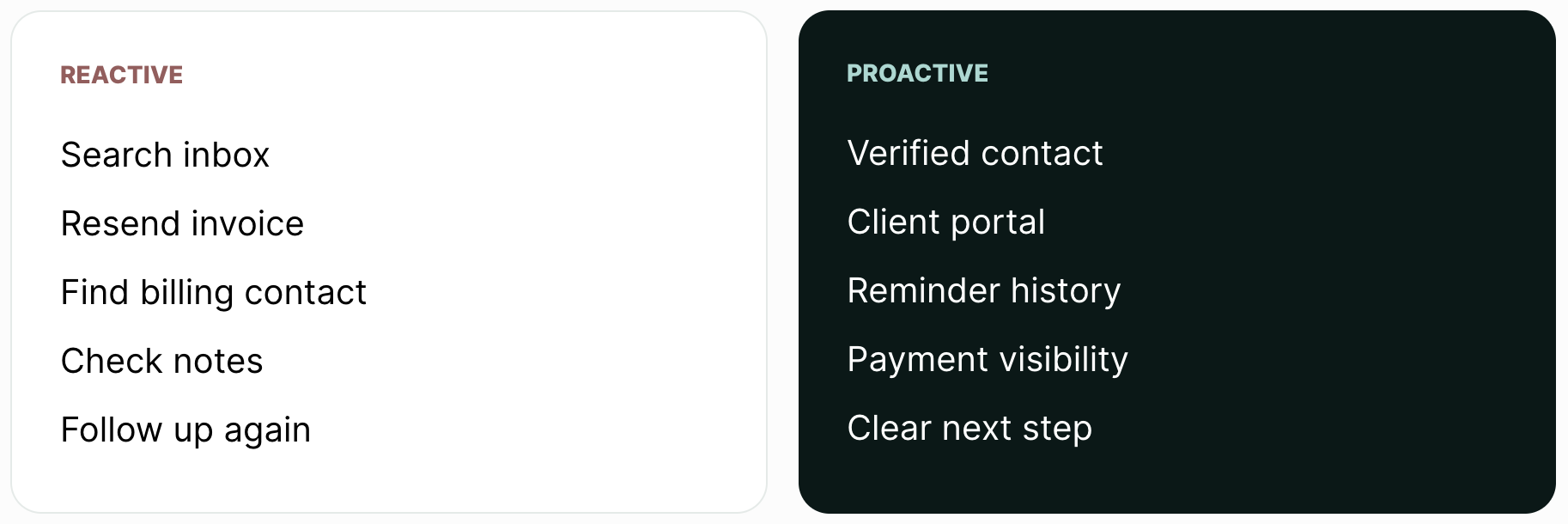
When a client says they never received an invoice, it's tempting to focus on proving whether they're right.
Most of the time, that's the wrong question.
The better question is what's preventing payment today, and how do we remove that obstacle?
Sometimes the invoice genuinely wasn't received. Sometimes it was.
But either way, the conversation usually points to something that can be improved.
The best MSPs don't build accounts receivable processes that depend on perfect memory or constant manual effort. They build processes that make paying easy, communicate expectations clearly, and stay consistent as the business grows.
Clients rarely remember how many reminder emails you sent. But they will remember whether paying your business felt straightforward.
And the easier you make that experience, the easier it becomes to get paid on time.