


Few conversations are more uncomfortable than an invoice dispute.
After all, you somehow have to balance two things that both matter: protecting your revenue and protecting the relationship.
Maybe a client questions billable hours. Maybe they assumed the work was included in their agreement. Maybe they're surprised by an after-hours charge.
By the time the invoice arrives, it looks like a billing problem even if it isn’t.
But invoice disputes actually begin long before the invoice: a scope change wasn't documented, expectations drifted, or someone interpreted the agreement differently.
If you treat every dispute like a collections issue, clients become defensive. But if you treat it like a communication problem first, you're much more likely to preserve both the payment and the relationship.
Research from AltLINE found that 98% of businesses experience invoice disputes, making them one of the most common causes of delayed payment.
The good news is that most invoice disputes follow recognizable patterns. Once you understand what's actually causing them, they're much easier to resolve and far less likely to happen again.
Most invoice disputes aren't about money
When clients push back on an invoice, it can be tempting to assume they're trying to avoid paying.
Sometimes that's true. More often, they're trying to understand something they weren't expecting.
You likely hear the same questions all the time:
"I thought this was included."
"Why was this billed separately?"
"Can you explain this charge?"
Notice what's not often being said: "We're refusing to pay."
More often than not, your clients want context.
That aligns with what businesses report more broadly. QuickBooks identifies unclear invoices, billing errors, unexpected charges, and misunderstandings around project scope as some of the most common reasons invoices are disputed.
Those problems can only be solved by helping the client understand how the invoice reflects the work that was performed.
An invoice dispute isn't always a payment dispute.
Clients often dispute understanding before they dispute paying. Identifying which one you're dealing with changes the entire conversation.
Understand the concern before you respond
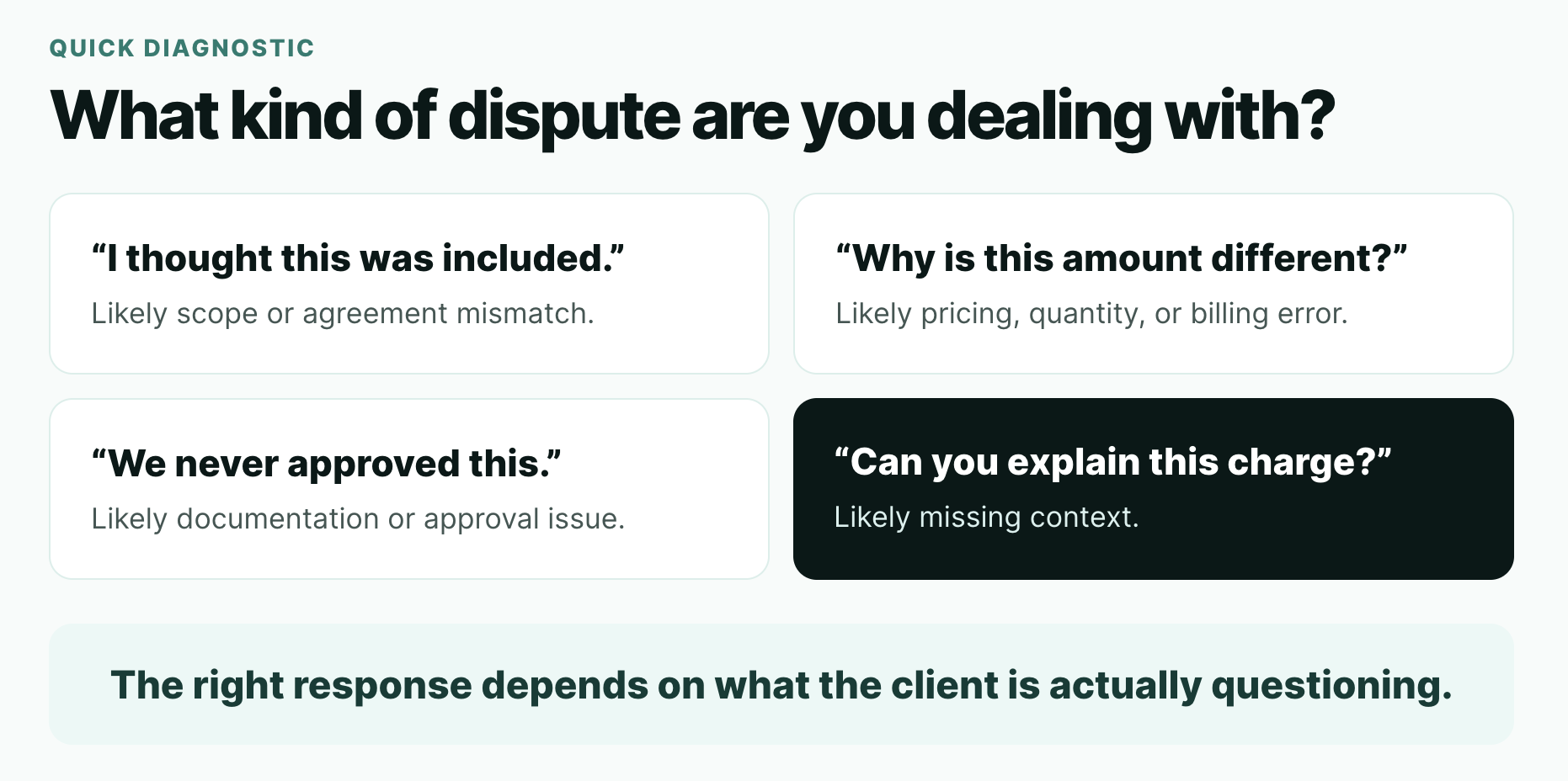
Not all invoice disputes are the same.
A client questioning billable hours requires a different conversation than someone disputing project scope. Similarly, a duplicate hardware charge isn't the same as a client who simply wants more detail before approving payment.
Before explaining anything, identify what they're actually questioning.
Is it:
- pricing?
- scope?
- a billing error?
- missing context?
Each leads to a different conversation.
Once you've identified the concern, resist the urge to answer from memory.
Go back to the documentation.
Review the statement of work, technician notes, ticket history, email approvals, and any documented scope changes.
Sometimes you'll confirm the invoice is exactly right.
Other times, you'll discover the client's confusion is completely understandable. Maybe additional work was approved verbally but never documented. Maybe the scope expanded gradually without anyone formally updating the agreement. Maybe the invoice is accurate but the description simply isn't clear.
Those aren't billing problems, but they are evidence of communication problems.
Only after you've gathered the full picture should you respond.
Instead of immediately defending the invoice, ask questions like:
- "Can you help me understand which charge stood out?"
- "What were you expecting to see instead?"
- "Can you walk me through how your team understood the project?"
Those questions shift the conversation from proving you're right to understanding the disagreement.
Clients are not likely to become defensive because you asked questions, but they will if they feel like nobody listened.
If you made a mistake, own it quickly
Invoicing mistakes can happen. And when it does, the fastest way to rebuild trust is the simplest one: acknowledge the mistake.
Correct it, send the updated invoice, and move on.
Trying to defend an obvious billing error will cost more than the mistake itself.
And as uncomfortable as it can be to admit wrongdoing, admitting it quickly will build more trust than trying to explain why it happened.
What to do when the client is wrong
Of course, sometimes the invoice is accurate, and your client is mistaken.
Many businesses make the mistake of responding with contract language.
"Per Section 4.2 of the agreement..."
Technically, that may be true, but it rarely helps.
Instead, walk the client through the story behind the invoice.
Best practices include:
- Showing the original proposal
- Pointing to the approved scope change
- Sharing the technician notes or email where additional work was requested
- Helping them understand how the invoice connects to the work completed
It’s important not to overwhelm them with documentation. But you can help them see the same timeline your team sees.
That said, not every dispute needs a winner.
If a longtime client questions a relatively small charge after years of paying on time, a one-time credit or partial adjustment may be worth far more than continuing the disagreement.
On the other hand, if disputes become routine, repeatedly making exceptions teaches clients that your payment policy is negotiable.
What to do if the dispute isn't resolved
There also comes a point where continuing the conversation stops being productive.
If you've carefully reviewed the documentation, explained how the invoice relates to the agreed-upon work, corrected any mistakes on your end, and offered reasonable flexibility where appropriate, you've done your part.
At that stage, continuing to negotiate often creates more uncertainty rather than more understanding.
Depending on the situation, that may mean setting a firm payment deadline, offering a structured payment plan if cash flow is the real issue, or explaining that work will pause until the outstanding balance is resolved in accordance with your service agreement.
If the relationship has broken down entirely and the client refuses to honor a legitimate invoice despite clear documentation, formal collections or legal action may eventually become necessary.
Those steps should be rare and a last resort.
By the time you're considering them, the goal is to protect the financial health of your business while remaining professional throughout the process.
Most invoice disputes never reach that point.
The vast majority are resolved through clear communication, good documentation, and a willingness from both sides to understand what actually happened before deciding what should happen next.
A successful invoice dispute resolves when the client understands the outcome and still wants to keep working with you.
Prevent invoice disputes before they start
Avoiding the invoice disputes in the first place is better than having to manage the complication of a dispute arising. While it’s not possible to completely prevent invoice disputes, there are many notable ways to lessen their volume.
After all, invoice disputes start before the invoice is actually sent.
For example, a scope change happening during a phone call but never making it into the PSA.
So that by the time the invoice arrives, both sides genuinely believe they're right. In other words, most disputes begin with a transparency problem, not a collections problem.
That's why the best dispute resolution strategy is better communication, clearer documentation, itemized invoices, consistent project updates. All things you already know are central to operating a well-functioning MSP.
Small conversations throughout the project instead of one difficult conversation afterward.
When expectations stay aligned, invoices become much easier to approve because there are fewer surprises left to explain.
Better systems make better conversations
Even with excellent communication, disputes will still happen.
The question is how quickly your team can understand what happened.
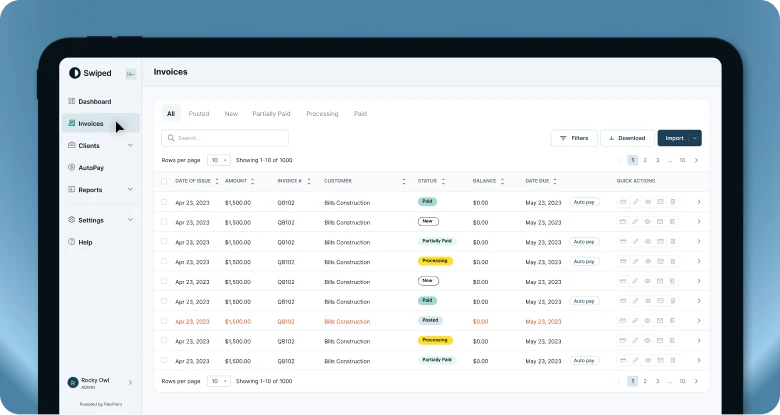
Resolving a dispute often means jumping between your PSA, accounting platform, email, ticket history, and internal conversations before anyone can answer the client's question.
The work isn't difficult, but it is fragmented.
Versapay found that 51% of finance leaders say tracking invoice status and customer communication is one of the biggest sources of friction in accounts receivable.
When information is scattered across multiple systems, even straightforward questions take longer to answer, and those delays often become part of the client's experience.
This is exactly why more MSPs are rethinking how they manage AR.
When someone disputes an invoice, the biggest challenge is gathering the information you need before you can say anything with confidence.
That's where purpose-built platforms like FlexPoint make a difference.
Instead of piecing together invoice history, payment activity, reminder emails, and supporting documentation across multiple systems, your team can access that context in one place. The conversation shifts from "Give me a few minutes while I investigate" to "Here's what happened, and here's how we can resolve it."
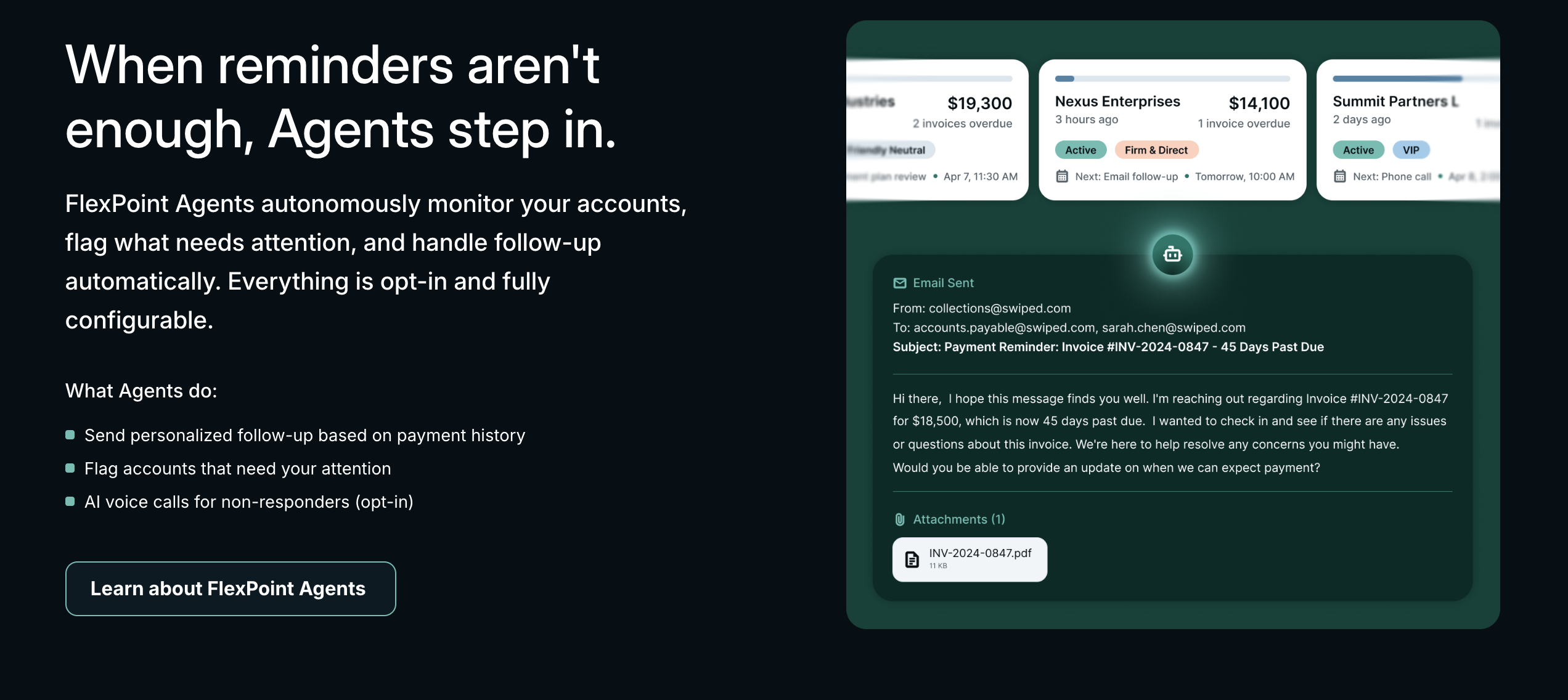
FlexPoint's AR Agents take that a step further.
Before anyone reaches out to the client, the dashboard shows all previous conversations, and if discussed with the voice agent, a script is maintained. They can also explain why an invoice is outstanding, answer routine invoice questions, recommend the next best action for you, and highlight the account history that matters most.
Your team still makes the decisions. They simply begin the conversation with far more context than they otherwise would.
Clients are more likely to remember how you handled it
Invoice disputes are never enjoyable, but they don't have to damage your relationship.
In fact, the way you handle a dispute can leave a stronger impression than the dispute itself.
Clients are most likely to remember if they felt heard, whether the explanation made sense, and whether your team handled the conversation professionally.
Most invoice disputes aren't really about the invoice.
They're the result of bad communication. That's why the most effective dispute resolution strategy is to create clear expectations, document changes as projects evolve, and give your team the context they need to answer questions confidently.
When you do that consistently, invoice disputes become exactly what they should be: a temporary conversation, not a permanent source of friction.
Handle fewer disputes. Resolve the ones that do happen faster.
The best invoice disputes are the ones your clients never have to raise. FlexPoint helps MSPs create a smoother payment experience with clearer invoices, automated reminders, complete account history, and AI-powered AR Agents that give your team the context they need before every collections conversation.
See how FlexPoint helps MSPs simplify accounts receivable.