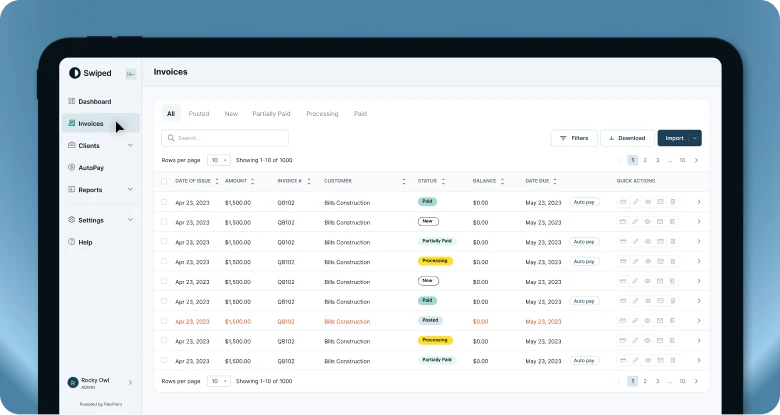



There's a pattern showing up in how MSPs approach AI investment, and it's not what most people expected.
The early assumption was that AI would hit the service desk first: ticket triage, automated responses, self-service portals. And it has, to a degree. But the MSPs that see the clearest return on their AI investments don't stop there. They're looking beyond the helpdesk and to the back office (specifically in accounts receivable and payment collection). And the gap between those forward-looking MSPs and operators who haven't made that move yet continues to grow.
This isn't a coincidence. It's a direct reflection of where the friction lives in your MSP's financials, and which problems AI is genuinely well-suited to solve right now.
The service desk gets the attention. The back office carries the cost.
MSP leaders spend a lot of time thinking about service delivery. That's where client relationships are built (or broken), where SLAs are met or missed, where technicians spend their days. It makes sense that AI investment conversations start there.
But service delivery problems tend to be visible. A ticket backlog shows up on a dashboard. A missed SLA triggers an alert. Client escalations land in inboxes. The problems are hard to ignore.
Back-office problems are quieter. Invoices go unpaid for 45, 60, 90 days without triggering a single alarm. Cash sits in outstanding receivables while the MSP draws on a credit line to cover payroll. A billing coordinator spends three hours a week sending manual follow-up emails that get a 20% response rate. None of that shows up on a service delivery dashboard. It just shows up in the cash flow statement, eventually, and usually at the worst possible time.
The most profitable MSPs have figured out something important: the back office isn't simply an administrative function. It should be viewed as a financial performance function. And it's been chronically underinvested in relative to the drain it creates.
What "profitable" looks like in an MSP context
Before getting into where AI fits, it's worth being specific about what separates high-margin MSPs from average ones, because it isn't always what people assume.
Revenue growth matters, but margin is what actually determines whether an MSP is building equity or just turnover. And margin in a managed services business is determined less by what you charge than by how efficiently you collect what you're owed and how much overhead you carry to do it.
CompTIA's IT Industry Outlook 2026 report finds that just over half (51%) of MSPs expect to exceed annual revenue and profitability this year. What's fueling expected growth for these MSPs? The differentiators aren't always on the service side. They show up in billing efficiency, collection rates, and the ratio of back-office overhead to revenue.
A few numbers that illustrate the gap:
- MSPs with high AutoPay adoption rates (70%+) collect an average of 15–20 days faster than those running primarily manual payment processes
- Every additional day of DSO on a $1M ARR business represents roughly $2,700 in cash that isn't in the bank yet
- According to PYMNTS, MSPs using automated AR processes report 2x faster payments cycles than manual counterparts.
Those numbers compound. An MSP running 200 invoices a month at $12 average processing cost is spending $2,400 a month, $28,800 a year, on the mechanics of getting paid. That's before accounting for the carrying cost of slow collections or the time a human being spends chasing payments instead of doing something that actually grows the business.
Why the back office is where AI ROI is clearest right now
AI investment decisions should follow the same logic as any other capital allocation: put the money where the return is most certain and most measurable.
Back-office finance functions clear that bar for three reasons.
The work is well-defined.
AI performs best on tasks with clear inputs, clear rules, and clear outputs. Sending a payment reminder when an invoice hits 7 days past due is a clear task. Reconciling an incoming ACH payment against an open invoice is a clear task. Flagging an account that has gone from net-30 average to net-55 average over the past quarter is a clear task. The back office is full of them.
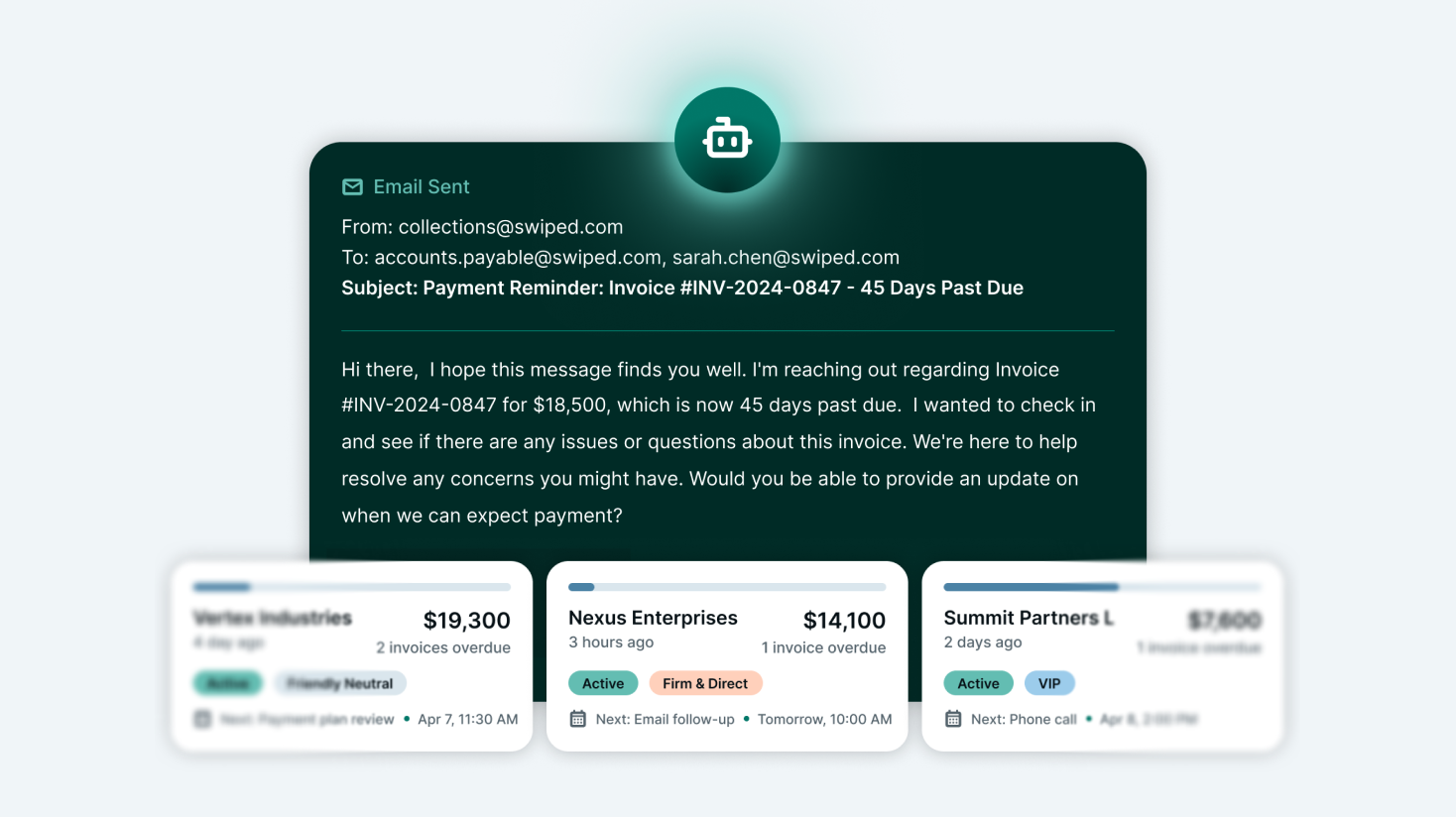
Compare that to service desk AI, where the inputs are messier (unstructured ticket descriptions, client frustration, ambiguous scope), the rules are harder to define (what's a P1 vs. a P2 in this client's context?), and the cost of a wrong answer is higher (a misrouted critical ticket is a client relationship problem). The back office is a better starting point precisely because it's more structured.
The outcomes are directly measurable.
Measuring the ROI of a service desk AI investment requires tracking ticket resolution time, technician utilization, client satisfaction scores, and a handful of other proxies. It's doable, but it takes time to accumulate meaningful data and it's easy to attribute improvements to the wrong variable.

Measuring the ROI of back-office AI is more direct. DSO goes up or down. Collection rate goes up or down. Cost per invoice processed goes up or down. Time spent on manual follow-up goes up or down. These are clean metrics that change quickly after deployment and leave little ambiguity about whether the investment is working.
The volume is high enough to matter.
AI investments pay off at scale. A tool that saves two minutes per task only generates real value if there are thousands of instances of that task. Back-office finance functions clear that bar easily: invoices go out every month, reminders need to go out on a cadence, payments need to be reconciled, aging reports need to be generated.
What back-office AI is doing for high-performing MSP operations
It's worth being specific about what "back-office AI investment" actually means in practice, because the term gets used loosely.
The clearest application is AI agents for accounts receivable and payment collection. In high-performing MSPs, these agents handle the full collection sequence without human intervention on standard cases: sending post-due reminders, executing follow-up sequences across email and phone calls, triaging responses, flagging disputed invoices for human review, and logging all activity back to the system of record.

The result is a collection process that runs at a consistency and cadence that no human team can match, not because humans aren't capable, but because humans have 40 other things to do and invoice follow-up is the easiest thing to deprioritize when the day gets busy.
Beyond AR, back-office automation in high-performing MSPs shows up in payment reconciliation (matching incoming payments to open invoices automatically), reporting (generating aging reports and surfacing collection priorities without manual effort), and increasingly in payment method management (nudging clients toward auto-pay enrollment, flagging expired card on file before a payment fails).
None of this is experimental. These are production capabilities deployed by MSPs running real revenue on them today.
The compounding effect most operators underestimate
Back-office AI improvements compound in ways that service desk improvements often don't.
When an AI agent reduces average DSO from 45 days to 28 days, the cash freed up doesn't sit in a bank account. It reduces credit line utilization, which reduces interest expense. It improves the MSP's financial profile, which improves access to capital at better rates. It reduces the owner's cognitive load around cash management, which frees up attention for growth decisions. It makes the business more attractive to acquirers or investors if that's ever relevant, because clean AR is one of the first things a buyer examines.
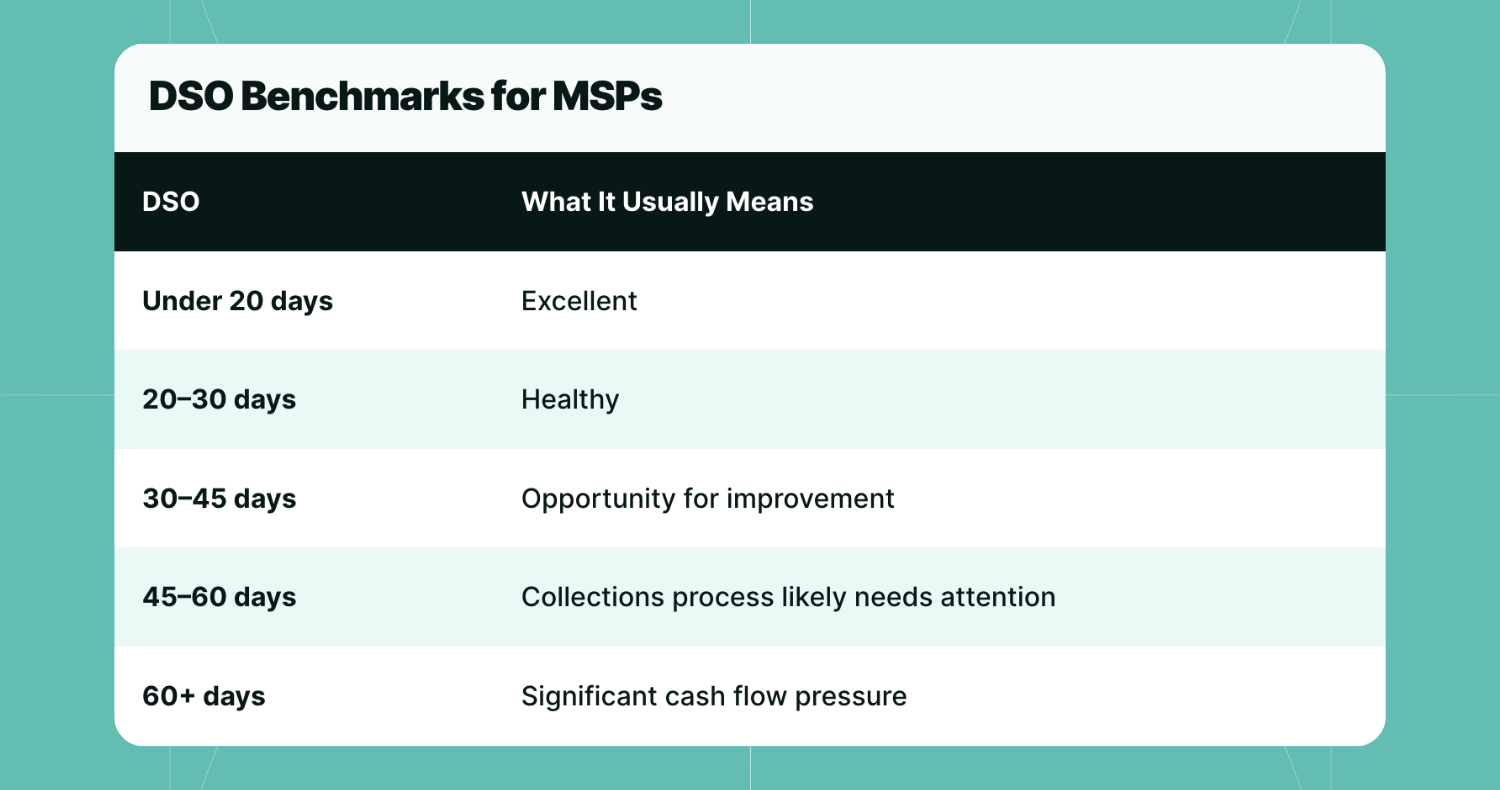
A 17-day DSO improvement on a $2M ARR business is roughly $93,000 in additional cash availability at any given time. That's not revenue. That's working capital efficiency, and it has a real effect on what the business can do.
The service desk improvements that most MSPs are chasing with AI, faster ticket resolution, fewer escalations, higher technician utilization, are valuable. But their financial effects are mostly felt in client retention and technician capacity. Important, but less direct than the cash flow and margin effects of back-office AI done well.
The owners who are waiting are making a choice (even if it doesn't feel like one)
There's a version of this conversation that treats AI investment as a future consideration: something to evaluate once the technology matures, once there's more data, once the business is in a better position to absorb the change.
That framing has a cost that's easy to miss. Every month of delayed back-office AI deployment is another month of manual collection processes, another month of DSO that's higher than it needs to be, another month of back-office overhead that AI would eliminate.
Gartner's research on AI in finance projects that 90% of finance functions will have deployed AI-driven automation in at least one area in 2026. The MSPs competing for the same clients, the same talent, and the same partner relationships are not all waiting. Some of them have already moved.
The back office isn't glamorous. It doesn't generate press releases or win awards. But it's where margin is made or lost, where cash flow is protected or eroded, and where the operational gap between high-performing MSPs and average ones quietly widens every quarter.
The most profitable MSPs figured that out first. The window to close the gap is still open. It won't be indefinitely.





.png)