

According to Paystand, traditional B2B payment methods like checks face fraud 74% of the time, while credit card transactions are vulnerable only 3% of the time.
According to Finextra, 82% of companies used digital payments for B2B transactions in 2023. This indicates the increasing adoption of digital payment methods and the higher chances of fraud, unauthorized access, or data breaches.
For MSPs, payment security is essential due to recurring high-value client transactions. Compared to consumer transactions, the large amount of money and sensitive business data make them prime targets for fraud.
As a trusted technology partner for your clients, you must offer the most convenient payment methods while maintaining data security.
According to Kaseya, 78% of MSPs see cybersecurity as their biggest challenge, while Bloomberg says 84% of US companies face B2B payment fraud attacks.
Thus, MSPs must take proactive measures such as encrypting transaction data, implementing multi-factor authentication (MFA), and regularly updating security protocols. You must use secure payment gateways to protect your clients and your own financial information.
Robust compliance is critical, as a security breach can severely impact your MSP's financial operations and damage your reputation. You may face hefty monthly fines ranging from $5,000 to $100,000, legal repercussions, and customer churn.
This article will discuss current MSP payment security challenges and best practices to secure payment processes effectively.
10 Current Security Challenges in MSP Payments

According to McKinsey, payment card fraud can lead to losses of up to $400 billion over the next ten years. US credit agency Equifax paid over $1 billion in penalties after the 2017 data breach, which affected 150 million consumers.
MSPs receive recurring card payments from several clients every month. Fraudulent transactions and illegitimate chargebacks significantly impact their profitability.
According to the IMF, extreme losses have quadrupled since 2017 to $2.5 billion, with indirect losses like reputational damage or security upgrades even higher.
The complications arising from payment security threats result in MSPs losing their customers due to trust issues, disruption of operations due to non-compliance, and massive fines by regulatory bodies.
MSP payment security challenges include malware attacks, insider threats, phishing, and ransomware. Cybercriminals target MSP payment systems because huge amounts of money are transacted through them.
By infiltrating networks and compromising payment solutions, they gain unauthorized access to sensitive client information or banking credentials.
MSPs must have robust payment security solutions and compliance policies to protect themselves.
Here are the current security challenges in MSP payments you must prepare for:
1. Increasing Cyber Attacks:

According to the IMF, cyber-attack incidents targeting the financial sector are constantly rising. Creditsafe survey shows that 53% of companies have suffered up to six fraud cases this year by September, and they tend to lose more than 30% of their total revenue to fraudulent activities each year.
MSPs are targeted by hackers as they get quick monetary gains from large transaction amounts and highly sensitive information of multiple companies.
Considering the rising frequency and increasing impact of cyber attacks, MSPs must take necessary precautions, such as threat intelligence platforms, encryption technologies, regular security audits, and ongoing employee training, to mitigate cyber risks.
2. Phishing Scams:
Phishing attacks have evolved past simple, deceptive emails. Attackers now use advanced tactics like business email compromise (BEC) by impersonating executives or trusted vendors to trick employees into making fraudulent transactions.
Cybercriminals can create email addresses that closely resemble your MSP’s to trick your clients. They can extract client login credentials directly or lead them to fake websites that capture sensitive information. Once attackers can access the MSP’s email, they can send fraudulent invoices or payment requests to clients, leading to losses of up to $17,700 every minute.
The method bypasses traditional security measures since attackers impersonate well-known brands or trusted contacts.
In 2023, 51.7% of phishing attacks involved impersonating top global brands like Microsoft, MasterCard, Apple, and Google to add credibility to their schemes. Once your clients mistake the attackers for being trusted employees of your MSP, they may easily share sensitive data and compromise their security.
For instance, the Austrian aerospace manufacturer FACC lost $61 million to a BEC scam. A phisher posed as the CEO and instructed an accounting department employee to send funds to a fraudulent account.
3. Insider Threats:
MSP payment systems are at risk of insiders misusing access to sensitive data and payment systems for financial gains. Malicious insiders may alter system configurations or delete critical data, disrupting operations for your MSP and clients.
According to ACFE, 80% of insider attacks involve disgruntled employees, and they sabotage systems or leak data in retaliation. Sometimes, employees may be bribed or coerced into sharing company or client data with competitors.
MSPs must monitor employees' digital behaviors and flag large file transfers, multiple failed login attempts, or access during odd hours.
Compromised client data can have significant legal and financial consequences for your MSP, as the average annual cost of an insider threat is $11.5 million.
Additionally, clients may churn as they lose confidence in your MSP's ability to protect sensitive information, and even new clients may be suspicious due to your bad reputation.
For instance, in 2023, a high-profile insider threat incident struck Tesla, exposing the risks even prominent brands face. Two former employees leaked Tesla's sensitive personal and proprietary data to a foreign media outlet. They revealed the personal details of over 75,000 current and former employees, including names, addresses, phone numbers, employment records, and Social Security numbers.
Despite legal action against the former employees, Tesla's security reputation suffered, highlighting the lasting damage insider threats can cause.
4. Outdated Software:
Outdated payment systems lack essential security updates that protect against known vulnerabilities, making them attractive targets for cybercriminals. They may involve manual processes or slow transaction times, which increases the likelihood of errors.
According to the Ponemon Institute, unpatched known vulnerabilities led to 60% of breaches.
Outdated MSP payment software offers easy access to unauthorized users who may put your transaction data and client banking information. It would also not be PCI-compliant, putting your MSP at risk of non-compliance fees and fines.
For instance, the IT services platform ConnectWise disclosed two vulnerabilities affecting its ScreenConnect tool, impacting MSPs using it on-prem and in the cloud. The company had to release patches within days and even ask partners and customers to shut down on-prem ScreenConnect servers if they could not update to the latest version amid the attacks.
5. Compliance Failures:
Non-compliance with evolving standards like PCI-DSS poses serious security risks for MSPs receiving digital payments from clients. Non-compliant payment systems miss security measures like encryption and MFA, making it easier for hackers to access payment information.
According to Colligo, the average cost of compliance is only $5.47 million, while the average cost of non-compliance is $14.82 million. However, due to evolving regulatory standards, only 27.9% of organizations maintain full PCI-DSS compliance.
Non-compliant MSPs may have weak access controls, allowing unauthorized access to sensitive data. They often lack robust monitoring, delaying breach detection. According to Drata, 87% of companies with low compliance experience disruptions.
Non-compliant MSPs are also impacted by heavy penalties, legal repercussions, damaged reputations, lost business, and high remediation costs.
6. Integration Issues:
According to PYMNTS, 48% of businesses cited payment software issues as the top reason for failed payments.
MSP payment systems must integrate with MSP-centric tools like ConnectWise, QuickBooks Online, QuickBooks Desktop, SuperOps, or Xero for easier reconciliation and accurate accounting.
However, many MSPs struggle with integration issues due to a lack of compatible software and standardized processes.
Security gaps expose sensitive payment information, resulting in unauthorized access or breaches. It also increases administrative burdens and may lead to delays in service delivery.
7. Lack of Encryption:
Encryption protects data in transit during the transaction and at rest after payment processing. Without strong encryption, payment data can be intercepted, stolen, or altered, leading to financial losses, fines, and reputational damage.
Encryption converts sensitive data into unreadable code that only authorized parties can decode. Without strong encryption, hackers can access unprotected data, like payment details and personal identifiers, as it moves between systems or is stored in databases.
Without proper encryption, data is vulnerable to man-in-the-middle (MITM) attacks. If payments are processed over public networks, attackers can intercept and alter information. According to Cofense, MITM attacks have increased by 35% annually.
Unencrypted payment data at rest is also at risk if the database is compromised. Hackers get access to sensitive financial information directly.
According to PYMNTS, point-to-point encryption (P2PE) is essential to safeguard cardholder data. MSPs must ensure their payment systems are adequately encrypted to prevent unauthorized access.
8. Third-party Risks:
According to Trustpair, third-party fraud accounts for 38% of all crimes. Using third-party service providers in MSP payment systems introduces security vulnerabilities that you may be unable to control.
Third-party service providers involved in MSP payment collections may be:
- Payment Initiation Service Provider (PISP)
- Account Information Service Provider (AISP)
- Trusted Party Payment Instrument Issuer (TPPII)
Cybercriminals can gain unauthorized access through unsecured APIs that are not coded or monitored correctly.
Inadequate data encryption and non-compliant software puts MSPs at risk for breaches and compliance penalties. You should only work with trusted party payment instrument issuers (TPPIIs) who follow strict security standards and compliance regulations.
9. Social Engineering Attacks:
According to IBM, social engineering attacks involve tactics like:
- Phishing: Attackers steal sensitive information through email or other communication channels.some text
- Bulk phishing: Generic emails are sent to numerous potential victims.
- Spear phishing: Attacking an individual or organization, using their researched personal details for credibility.
- Whale phishing: An attack targeting high-profile individuals like executives or officials within an organization.
- Vishing (Voice phishing): Phone call attacks using spoofed numbers to extract sensitive information verbally.
- Smishing (SMS phishing): Using text messages to trick recipients into giving personal information or clicking malicious links.
- Search engine phishing: Fraudulent websites rank on search engines to trick users into giving sensitive information.
- Angler phishing: Social media phishing attacks in which scammers pose as customer service reps to steal personal data.
- Baiting: Uses a false promise to lure victims into revealing their information in exchange for freebies or downloads.
- Tailgating: A security breach that occurs when an unauthorized person with malicious intention follows an authorized individual into a secure area without credentials.
- Quid pro quo scams: Attackers offer a service or benefit in exchange for access to confidential information.
- Pretexting: A deceptive practice where attackers create a scenario to trick someone into giving information or access.
- Watering hole attacks: Targets frequently visited websites to infect a specific group of users.
- Scareware: Malicious software that tricks users into believing their system is compromised and urges them to install fake security software.
Cybercriminals can use these tactics to trick MSP staff into authorizing fraudulent transactions. They exploit humans, who are considered the weakest link in cyberattacks.For example, the American technology company Ubiquiti Networks lost $46.7 million when an attacker impersonating the CEO instructed the finance department to transfer funds to fraudulent accounts. It shows how social engineering can cause significant financial losses in B2B transactions.
10. Ransomware Threats:
Ransomware attacks target MSPs' financial operations by locking access to payment systems until a ransom is paid. This can lead to severe operational and financial consequences.
Malicious software encrypts files or locks systems, rendering them inaccessible until a ransom is paid.
Attackers focus on MSP payment systems as the data is sensitive, high-value, and critical for business operations. Cybercriminals can pressure organizations to pay the ransom to restore operations and avoid further losses.
According to Sophos, the average ransom payment has risen by 500%, with organizations paying up to $2 million. Ransomware attacks can also result in significant downtime for MSPs, leading to lost revenue and damaged reputation even after paying the ransom.
For example, Evolve Bank and Trust was attacked by The LockBit ransomware group. They stole 33 terabytes of sensitive data, including Social Security numbers and credit card details. After failed negotiations, a substantial amount of data leaked on the dark web.
10 Best Practices for Enhancing MSP Payments Security
According to LexisNexis® Risk Solutions, 50% of MSPs lose around 2% of customers due to payment issues. Poor payment security can lead to client churn, impacting revenue and business viability.
As cyber threats evolve, MSPs must adopt robust security measures to protect payment processes. A secure payment environment prevents financial losses from breaches and client churn.
According to Checkout.com, businesses with secure payment systems are better positioned to protect data and prevent fraud. Secure client data safeguards your MSP's reputation and enhances customer loyalty.
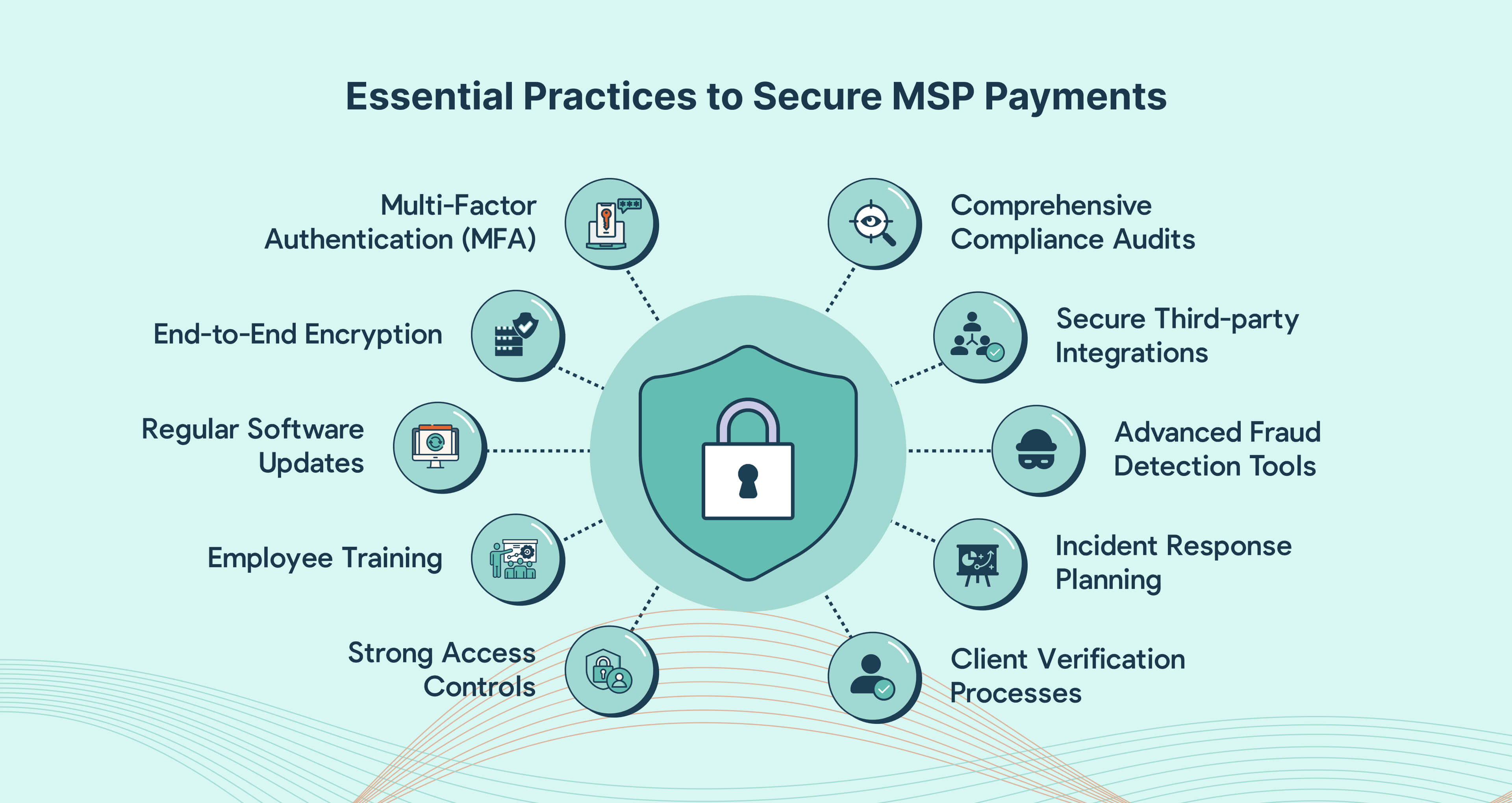
Here are the best practices for enhancing the security of MSP payments:
1. Multi-Factor Authentication (MFA)
Implement MFA on all your payment-related systems. It reduces the risk of unauthorized access as users must provide two or more verification factors to gain access.
MSPs can use it as a security layer to protect sensitive payment data from breaches that exploit weak passwords.
According to Endgrate, MFA blocks 99.9% of automated attacks to prevent unauthorized access. It lowers security expenses and customer service costs related to breaches.MSPs must use MFA for payment requests to block automated attacks and enhance security measures. Adopting MFA practices builds customer trust by safeguarding sensitive information and committing to strong security protocols.
2. End-to-End Encryption
End-to-end encryption (E2EE) encrypts payment data from capture to its final destination. Even if intercepted, the data remains unreadable to unauthorized parties.
Research by Apple found that over 2.6 billion records were compromised in data breaches over two years, highlighting risks that end-to-end encryption can mitigate.
E2EE encrypts transaction data at the source and decrypts it only for the recipient, making it harder for cybercriminals to access sensitive information.
MSPs must implement E2EE to protect client financial information and comply with standards like PCI DSS.
According to Worldpay, implementing end-to-end encryption reduces the risk of data breaches. With E2EE, MSPs can assure clients that their financial information is secure and build trust in their business.
3. Regular Software Updates
Keeping all MSP payment systems and third-party software up to date protects against known vulnerabilities, as 60% of breaches result from an unpatched known vulnerability.
Regular updates help close security gaps that cybercriminals might exploit. You can also reduce the likelihood of attacks, such as ransomware, that exploit outdated software.
MSPs using legacy payment software face risks with end-of-life (EOL) software, which no longer gets security updates. Running EOL software leaves systems vulnerable to attacks and can lead to compliance issues, as many regulations require up-to-date software.
Automate routine patch management to ensure that all systems run the latest security updates and software versions. Regular updates build resilience and protect client trust by minimizing downtime due to security incidents.
4. Employee Training
According to EY, 91% of cybersecurity professionals suggest companies must continuously train employees as cyber threats evolve. Employees must know the latest cybersecurity threats and understand the prevention techniques.
You must educate them on recognizing phishing attempts, identifying suspicious links, using secure payment practices, and following established security protocols.
According to Trustmi, 74% of fraud incidents involve a human element. However, a well-informed team can greatly reduce the risk of human error causing security breaches.
Phishing simulations, visual aids, and interactive sessions can make training more engaging and effective. Encourage employees to report threats and incidents immediately so that you can proactively act on them.
5. Strong Access Controls
According to SISA, 34% of companies suffer from insider threats every year, costing them an average of $8.76 million. Implementing role-based access control (RBAC) ensures that users only have access to the information necessary for their roles, reducing potential vulnerabilities.
According to Varonis, 58% of companies found more than 1,000 folders with inconsistent permissions, and only 5% of a company's folders are protected.
MSPs must regularly review user permissions and restrict access to payment systems based on the principle of least privilege.
Implementing strong access controls restricts access to payment systems and transaction data to only those employees who need it for their job functions. It minimizes potential exposure of sensitive data, as 81% of confirmed breaches were due to stolen, weak, or reused passwords.
Additionally, RBAC ensures compliance with regulatory requirements such as PCI DSS and GDPR.
Regular audits should ensure user permissions are current and suited to their roles. Remove access to former employees or those who have changed positions. MSPs must also watch for unauthorized permission changes that could indicate a breach.
6. Comprehensive Compliance Audits
According to KPMG, only 22% of companies regularly conduct compliance audits with third parties, while 40% audit them only based on triggering events.
MSPs can avoid risks by conducting regular compliance audits, evaluating security protocols, reviewing access controls, monitoring data usage and transfers, and ensuring proper encryption methods.
Regular compliance audits help MSPs ensure their payment systems adhere to industry regulations and standards like PCI-DSS 4.0.
By proactively identifying and addressing gaps in compliance, MSPs can reduce the Mean Time to Resolution (MTTR) if a security incident occurs.
Adopt a zero-trust framework by treating every access request as potentially hostile, regardless of the user's location or past authentication.
According to SecurityIntelligence, organizations using zero-trust can reduce data breach costs by nearly $1 million compared to those without it. MSPs must conduct strict identity checks even when recurring payments are being received.
Compliance audits help MSPs avoid fines, improve data security, and strengthen their credibility. Adopting and maintaining industry-standard practices always enhances customer confidence, especially for clients in regulated sectors.
7. Secure Third-party Integrations
MSPs rely on third-party providers for payment processing, accounting, or data storage. If not carefully managed, these integrations can pose a security risk.
According to the Prevalent Third-Party Risk Management Study, 60% of organizations faced a data breach linked to third-party providers.
Vetting third-party providers' security practices and ensuring contractual obligations helps reduce risk. This includes conducting background checks and ongoing reviews of their security protocols to prevent potential breaches or compromises of sensitive data.
Secure integrations help prevent data leaks from less secure external systems, reducing the chances of reputational damage and financial loss.
Also, MSPs should have contingency plans in place if a third-party provider experiences a security breach. Using AI tools or outsourcing third-party risk management (TPRM) can help MSPs enhance security measures against potential threats.
8. Advanced Fraud Detection Tools
Advanced fraud detection tools enhance MSP payment security, comply with industry standards, and build client trust. AI and machine learning tools analyze behavior and protect endpoints.
By deploying next-generation firewalls (NGFW), intrusion detection systems (IDS), and endpoint detection and response (EDR), MSPs can proactively detect and address fraud, reinforce security, and meet regulatory requirements.
Fraud detection tools using machine learning and behavioral analysis can assess transaction patterns, identify real-time anomalies, and trigger warnings against potential fraud.
For example, if the system detects a high-value transaction outside normal business hours or from an unusual IP address, it can flag this for immediate review.
According to IBM, AI-powered fraud detection systems identified and contained data breaches more quickly, saving about 40% of the average cost compared to those not using AI.
NGFWs manage traffic with strict security rules, monitor for unusual activity, and perform antivirus scanning to block malware from critical systems. IDS adds another layer by detecting and blocking threats that bypass the firewall, like malware from trusted but compromised networks.
MSPs must secure endpoints and email channels to prevent attacks from phishing or malware emails. Email filtering tools and security protocols like DMARC (Domain-based Message Authentication, Reporting, and Conformance), SPF (Sender Policy Framework), and DKIM (DomainKeys Identified Mail) ensure that emails claiming to come from trusted domains are genuine. These protocols and EDR tools guard against BEC and phishing attacks.
Advanced fraud detection and threat management solutions secure MSP payment systems and enhance compliance, client trust, and operational efficiency. MSPs that adopt these tools can stay compliant with regulations like PCI DSS, FFIEC guidelines, and state-specific data protection laws, reinforcing their reliability and commitment to client security.
9. Incident Response Planning
MSPs should create and regularly update an incident response plan. It will guide stakeholders and employees in responding swiftly to security incidents. It must outline specific steps to take during a breach, including communication strategies with affected clients and regulatory bodies, ensuring a swift recovery process.
A well-thought incident response plan minimizes confusion during a breach, accelerates recovery, and reduces damage.
Regularly testing the plan ensures that all employees know their roles and the sequence of actions to be taken during a breach. It strengthens your MSPs' resilience and improves customer confidence in your payment systems security.
10. Client Verification Processes
MSPs must use stringent verification processes to confirm client identity and the legitimacy of payment instructions. Techniques like identity checks, biometric authentication, or OTPs can boost security during transactions, adding extra protection against fraud.
According to Experian, 86% of customers are willing to undergo identity verification for data security. Appropriate client verification helps build trust.
According to Brilliance Security Magazine, biometric data boosts MFA by blocking 99.9% of cyberattacks. MSPs must use unique identifiers like fingerprints or facial recognition to protect transaction data against unauthorized access.
Conclusion: Strengthening Trust and Compliance in MSP Payments

MSP payments security mainly involves protecting their systems from data breaches and fraud.
Cyberthreats increase when payment systems integrate with third-party providers or are accessible to many employees.
Client identity verification, vetting transactions, and monitoring activity on the payment portal help MSPs strengthen payment security.
AI and machine learning-based fraud detection tools help proactively identify anomalies and prevent breaches.
Employee education and awareness help build a culture of prioritizing security and compliance.
MSPs should train employees to use the payment system, set strong passwords, recognize phishing, and report suspicious activity.
Regular payment security audits and vulnerability assessments help identify and fix weaknesses before exploitation. Secure integrations, incident response planning, and strict role-based access reduce security risks.
By anticipating threats, MSPs can greatly reduce the risk of data breaches and fraud. Implementing robust measures like automating software updates, deploying next-gen firewalls, and adopting advanced fraud detection systems ensures protection even against sophisticated threats.
Payment security ensures compliance and builds client trust. A proactive strategy enables MSPs to swiftly identify and neutralize threats while maintaining operational efficiency.
MSPs looking for advanced security features tailored to their complex requirements by integrating with FlexPoint. The payments platform offers robust encryption protocols, comprehensive fraud detection algorithms, and seamless integration capabilities.
FlexPoint automates the entire billing cycle, from invoicing to payment collection and reconciliation. Reducing manual intervention prevents insider threats and data leaks due to phishing attacks.
With FlexPoint, MSPs can offer a client-specific branded portal with passwordless authentication. The platform also implements multi-factor authentication and tokenization to further enhance payment security and protect sensitive client information from potential hacks or breaches.

In addition, the platform offers real-time monitoring and customizable reporting options, allowing MSPs to generate detailed reports on payments and prevent any suspicious activity.
By adopting FlexPoint, you can enjoy peace of mind, knowing your MSP payment systems are safeguarded in compliance with industry regulations. Reliable and safe payment systems also strengthen client relations and improve operations.
Secure your MSP's financial operations with FlexPoint's advanced payment security solutions.
Visit our website to learn more about how we can help you safeguard your transactions and maintain client confidence. Enhance your security posture today.