

Alternative Payments pricing looks straightforward at first: plans start at $199 per month for businesses processing up to $50,000, and standard ACH transactions are advertised at $0.
But $199 represents one specific configuration, not necessarily what your MSP will ultimately pay.
That's why it's important to break down what's included, what's not, and what Alternative Payments could actually cost as your MSP scales.
In this article, we'll break down publicly reported costs as well as private market research about features that cost extra.
Quick answer: Alternative Payments starts at $199 per month for up to $50,000 in monthly processing volume with standard three-day payouts. Published pricing increases based on payment volume and payout speed, reaching $699 per month for businesses processing up to $100,000 that want next-day payouts. Credit card processing, faster payouts beyond the standard tier, full ConnectWise + QuickBooks Online sync, additional processing volume, and data migration are all separate costs.
How much does Alternative Payments cost?
Alternative Payments uses volume-based subscription pricing. In other words, the amount you pay for the platform depends partly on how much money your business processes through it each month.
Published standard pricing breaks down as follows:
What the standard monthly fee includes is:
- Basic billing and accounts receivable functionality
- Customer and invoice payment tools
- Standard three-day payouts
- ACH, credit card, and BNPL payments
While Alternative Payments does not charge a standard per-transaction fee for ACH payments, credit card transactions cost 2.9% + $0.30 for Visa and Mastercard and 3.5% + $0.30 for American Express. We'll go over this more in depth in the next section.
And notably, once your MSP processes more than $100,000 per month, Alternative Payments no longer publishes a fixed monthly subscription price. You'll need custom pricing instead, though private market research gives some sense of what that looks like (more on that below).
Alternative Payments credit card processing fees
As already mentioned briefly above, Alternative Payments' published credit card processing fees are:
- Visa and Mastercard: 2.9% + $0.30 per transaction
- American Express: 3.5% + $0.30 per transaction
And while paying a separate processing fee for credit cards is far from unusual, what stands out is the difference for American Express.
Alternative Payments charges 0.6 percentage points more for Amex than it does for Visa and Mastercard. By comparison, FlexPoint does not charge a markup for Amex, and instead charges a flat 3.0% + $0.30 for all supported credit cards.
Alternative Payments does support passing card processing costs through to customers as a surcharge where legally permitted, but only as a full pass-through of the fee. FlexPoint offers more flexibility here: partners can pass the full 3.0% surcharge to customers, split it 50/50, or absorb it entirely.
Whether your MSP absorbs those costs, splits them, or passes them along in full can substantially change your effective processing expense, particularly if a large percentage of clients pay by card.
What is not included in Alternative Payments plans?
While Alternative Payments' published subscription prices cover basic billing, not every capability your MSP may need is included in that configuration.
The biggest areas to account for are the additional charges for faster payouts, full ConnectWise PSA and QuickBooks Online synchronization capabilities, additional payment volume, and data migration.
Faster payouts
The standard Alternative Payments subscription includes three-day payouts.
But if you want funds sooner, you'll need a higher-priced subscription. Two-day payouts cost more than standard funding, and next-day payouts cost more again.
What stands out is that Alternative Payments' fastest published payout option is next-day rather than true Same-Day ACH. We'll break down exactly what those faster tiers cost below.
Full ConnectWise PSA + QuickBooks Online synchronization
For MSPs looking to fully replace Wise-Sync or Mobius Lite (without an extra tack-on cost), it's important to know that syncing between ConnectWise and QuickBooks Online is not included on any Alternative Payments plan.
The ConnectWise PSA and QuickBooks Online sync capabilities are available as a separate paid add-on, and pricing for the "Sync Tool" isn't publicly disclosed.
It's also worth noting there are limited materials available around this sync tool. Below is a comparison of platforms that offer ConnectWise PSA and QuickBooks Online synchronization.
FlexPoint's GL Connect provides full ConnectWise to QuickBooks Online syncing, and is included on Growth and Plus plans at no additional cost.
Higher payment volume
Processing volume also changes what you'll pay with Alternative Payments.
Its published subscription increases from $199 to $499 as you move from the up-to-$50,000 tier to the up-to-$100,000 tier. Beyond $100,000 per month, Alternative Payments moves to custom pricing, but private market research indicates that additional volume runs approximately $250 for every $50,000 in processing above your plan's cap.
That threshold is worth paying attention to if your MSP is already approaching $100,000 in monthly collections. Don't evaluate the platform solely at today's volume. Ask what the numbers look like at the volume you expect to process a year or two from now.
FlexPoint's plans, by contrast, don't charge an additional fee when an MSP exceeds its included monthly processing volume.
Data migration
Moving your existing billing and payment history onto a new platform is its own cost to plan for. Private market research puts Alternative Payments' data migration fees at around $500. FlexPoint includes data migration at no extra cost on all plans.
How much does Alternative Payments charge for faster payouts?
The standard Alternative Payments subscription uses a three-day payout schedule. MSPs that want faster access to their funds need to upgrade to two-day or next-day payouts.
Here's how the pricing changes:
Put more simply:
- At up to $50,000 in monthly processing, two-day funding adds $50 per month, while next-day funding adds $100 per month.
- At up to $100,000, the difference grows to $100 per month for two-day payouts and $200 per month for next-day payouts.
That means an MSP processing up to $100,000 per month would pay $2,400 more per year for next-day rather than standard three-day payouts.
And since Alternative Payments moves to custom pricing above $100,000 in monthly volume, its published numbers can't tell you what accelerated funding will cost once your MSP crosses that threshold.
ACH transaction cost vs. payout speed
Here's where Alternative Payments' $0 ACH pricing needs a little context.
$0 ACH describes the standard transaction cost, but it doesn't mean same-day access to those funds is free. In fact, same-day access isn't available at any tier.
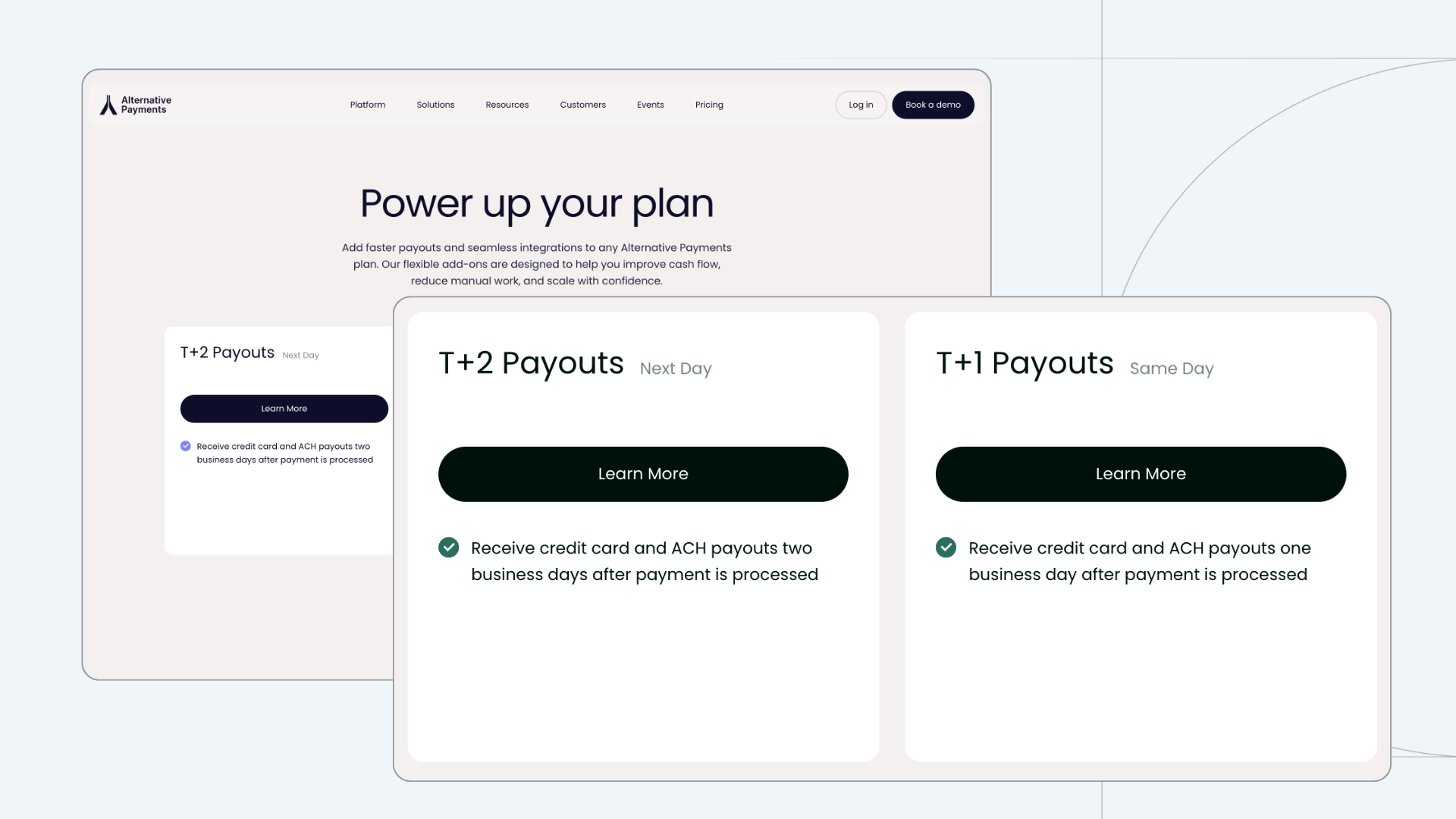
Alternative Payments' funding schedules work like this:
- T+3 Payouts: Funds arrive three business days after processing and are included with the standard subscription.
- T+2 Payouts: Funds arrive two business days after processing and require the applicable faster-payout option.
- T+1 Payouts: Funds arrive the next business day and represent Alternative Payments' fastest published option.
T+1 shouldn't be confused with true Same-Day ACH.
Under a T+1 schedule, for example, a qualifying payment processed Monday would be paid out Tuesday. Nacha-defined Same-Day ACH can settle on the same business day when submitted within the applicable processing windows.
That distinction actually matters because it reshapes the question from just, "What does this ACH transaction cost?" to "When can I actually use my money?"
Revenue sitting in transit isn't yet available for payroll, vendor payments, hardware purchases, or other operating expenses.
FlexPoint includes true Same-Day ACH on every plan, at the same per-transaction rate ($0.25-$1.00, depending on plan) as standard ACH.
What is the full cost of Alternative Payments?
Once you put the pieces together, Alternative Payments' effective monthly cost looks something like this:
Subscription based on payment volume + applicable credit card processing + paid add-ons + applicable conditional/exception fees = effective monthly cost
Payout speed is already incorporated into the subscription tier, so it shouldn't be counted twice.
Consider an MSP processing up to $100,000 per month that wants:
- Next-day payouts
- Full ConnectWise PSA + QuickBooks Online sync
- A mix of ACH and credit card payments
The known costs would start with a $699 monthly subscription for next-day funding.
From there, the MSP would also need to account for applicable credit card processing at 2.9% + $0.30 for Visa/Mastercard or 3.5% + $0.30 for Amex, plus the separately priced ConnectWise + QBO synchronization functionality and any applicable conditional fees.
That's an additional $200 per month, or $2,400 per year, before accounting for the other applicable costs. It's worth noting that FlexPoint includes same-day ACH on every plan at no added cost, so that $200-per-month premium for next-day funding with Alternative Payments doesn't have an equivalent on the FlexPoint side.
What happens above $100K per month?
No one can say for sure, since Alternative Payments doesn't publish pricing past that point.
Published fixed-dollar pricing ends once monthly processing exceeds $100,000. From there, businesses receive custom pricing.
Market and private data reviewed by FlexPoint shows variation in what customers pay as they scale, including one example in which pricing reached approximately $1,300 per month following a volume-based increase, and a general pattern of roughly $250 in added cost for every additional $50,000 in monthly volume.
And payment volume isn't the only thing prone to change as your MSP grows.
Faster access to funds, deeper integrations, and better automation will likely become more important, so factor those needs into your projected costs rather than pricing the platform around what you need today.
Alternative Payments alternatives for MSPs
Alternative Payments can be a fit for MSPs looking for billing, AR, and payment functionality. But if you're comparing it with other platforms, starting subscription prices don't tell you very much on their own.
A more useful comparison considers the complete workflow and total cost required to run it.
For each Alternative Payments competitor, look at monthly platform pricing, how that pricing changes with volume, ACH costs and payout speeds, card processing rates, PSA and accounting integrations, deposit reconciliation, AR automation, financing, paid add-ons, data migration costs, and the manual work your team still has to perform after implementation.
For a broader breakdown, see our guide to the Top Alternative Payments alternatives for MSPs.
How does FlexPoint compare with Alternative Payments?
Unlike Alternative Payments, FlexPoint is purpose-built for MSP billing, payments, and accounts receivable. This means that its functionality is designed around the billing and AR workflows your MSP relies on today, with the scaled version of your MSP also in mind.
So far, we've focused largely on what Alternative Payments charges for the functionality it provides. But cost is only one side of the comparison.
There are also capabilities Alternative Payments doesn't currently offer at all (either within its plans or as a paid add-on) that can make running your MSP's billing and AR operations easier.
Those capabilities include:
- Same-Day ACH included on every plan
- GL Connect for full QBO and ConnectWise PSA synchronization, included on Growth and Plus plans
- Automated deposit reconciliation, not just payment reconciliation
- A suite of AI agents
- FlexLine financing up to 12 months
- Free data migrations to FlexPoint
- Flexible surcharging, including the option to split card fees with customers
- Predictable pricing designed to support MSPs as payment volume grows, with no added fee for additional monthly processing volume
Compare the complete workflow. What will your MSP pay at its actual payment volume? How quickly will you get your money? What costs extra? What happens when you cross $100,000 per month? And, just as importantly, what billing and AR work will your team still be responsible for after you've paid for the platform?
The best value is the platform that gives your MSP the functionality it needs today without requiring you to continually add costs, products, or manual work as you grow.