


You probably came here looking for a straightforward answer to “How much does ConnectBooster cost?”
Unfortunately, there isn’t one.
Public MSP reports show how widely that cost can vary. One r/msp user reported paying a grandfathered $199 monthly fee plus transaction costs, while another shared a price tag of $1,000 per month (at renewal, up from their original $159/month).
These individual reports aren’t official price points, but the gap between them gets to the heart of the confusion: ConnectBooster’s cost depends on far more than any advertised monthly fee.
So let’s break down the fees that make up the total ConnectBooster cost and why some MSPs are now exploring ConnectBooster alternatives.
How much does ConnectBooster cost?
There is no officially listed pricing for ConnectBooster available online. A mix of SaaS fees, transaction fees, processing fees, usage fees, and miscellaneous fees have been reported. A Reddit user, allegedly affiliated with ConnectBooster, referenced a $349 monthly SaaS fee that is waived with the Kaseya 365 Ops bundle, along with transaction fees for ACH and credit card payments.
How much does ConnectBooster cost?
There are two camps when it comes to gauging ConnectBooster pricing:
- Those looking to switch to ConnectBooster, and likely to bundle with Kaseya 365 Ops
- Those already on ConnectBooster, and who are trying to gauge their all-in costs compared to other MSPs
The publicly referenced $349 monthly fee is best viewed as a starting point for those looking to add ConnectBooster. Some MSPs may receive the SaaS platform through Kaseya 365 Ops, while others have standalone, grandfathered, or individually negotiated agreements.
From there, the total cost can include several separate charges:
- Monthly platform fee: The recurring SaaS subscription, unless bundled or waived.
- Gateway fees: Separate charges for routing transactions through the BNG payment gateway virtual terminal.
- Processing fees: The cost of processing credit card and ACH payments.
- Usage-based fees: Additional platform charges tied to payment volume.
- Miscellaneous fees: Costs for items such as PCI compliance, account services, fraud protection, or returned payments.
ConnectBooster’s documentation confirms it bills separately for software, gateway, credit card processing, and ACH processing charges. These costs appear on their own statements or as separate bank-account debits.
How long are ConnectBooster Contracts?
It’s worth mentioning that contract terms can vary too. Three-year agreements are commonly reported, but older and individually negotiated contracts may have very different pricing.
ConnectBooster rates & fees
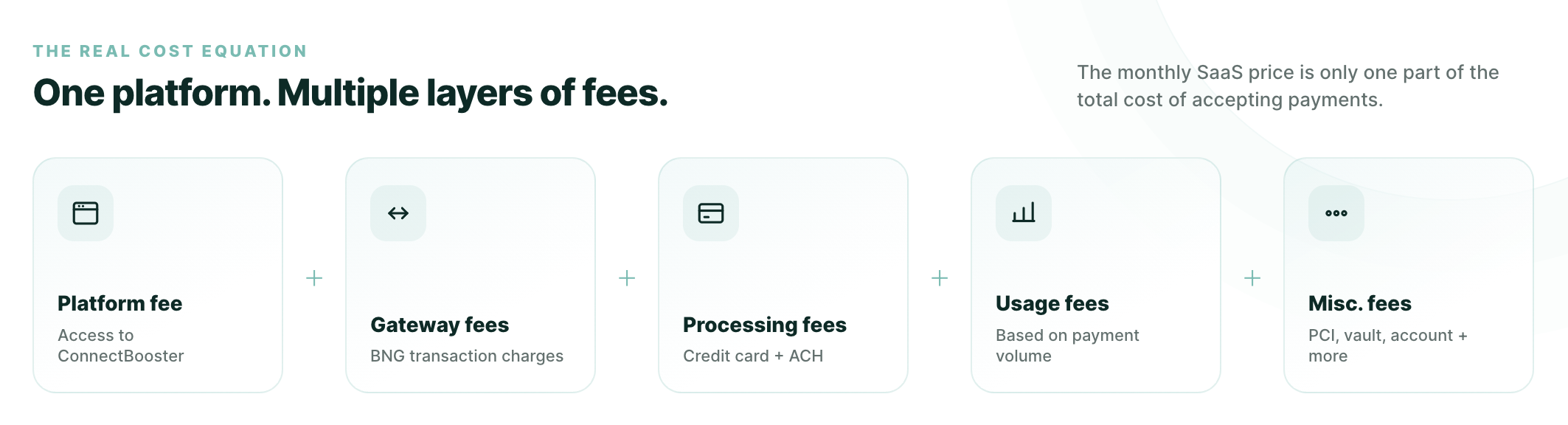
Getting to ConnectBooster’s real price means investigating how the platform, gateway, processing, usage-based, and miscellaneous fees add up.
ConnectBooster monthly SaaS fees
ConnectBooster’s monthly fee pays for access to the platform. It does not cover the full cost of accepting and processing payments.
ConnectBooster has publicly referenced $99-$149/mo with some quotes up to $280. Some MSPs receive the platform through Kaseya 365 Ops and may not pay a separate SaaS fee. However, inclusion in the bundle does not actually eliminate any of the other fees which we will cover like: gateway, processing, usage-based, or miscellaneous charges.
Legacy and negotiated agreements can also look different.
BNG gateway fees
A payment gateway securely sends payment information from ConnectBooster to the company responsible for processing the transaction. Although the gateway and processor work together, they are not the same service.
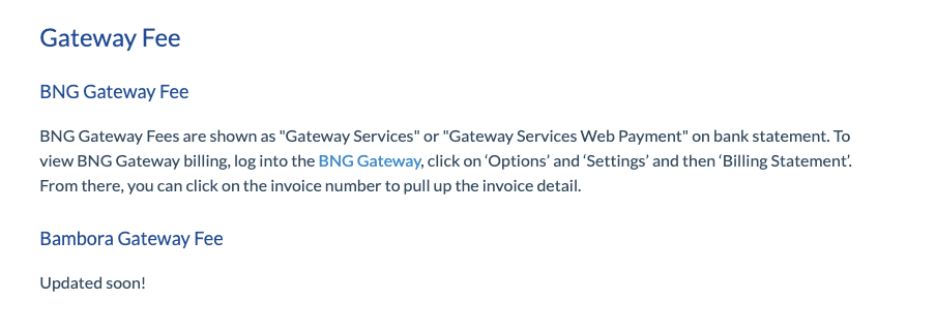
ConnectBooster currently uses the BNG payment gateway virtual terminal, which carries its own per-transaction charge. According to ConnectBooster’s billing documentation, these charges may appear on a bank statement as “Gateway Services” or “Gateway Services Web Payment.”
Payment gateways commonly charge a small amount for each transaction in addition to any monthly account fee.
For example, Authorize.net publicly lists a gateway-only fee of $0.10 per transaction, plus a monthly fee ($25) and daily batch charge. It’s estimated that BNG gateway pricing sits around $0.20+ per transaction (with $10/month account fees reported) in some agreements.
To be clear, a gateway fee is not the same as a processing fee. An MSP could pay both on the same transaction.
Clearant credit card processing fees
In ConnectBooster, credit card processing fees are also billed separately to cover the authorization and settlement of card payments. ConnectBooster partners with Clearant and EPX for credit card processing.
A public r/msp discussion referenced a ConnectBooster rate of 2.99% plus $0.30 per transaction (through BNG). However, that rate should not be treated as universal.
Interchange+ pricing has also been reported, on top of a flat $0.10/transaction fee and $15/month account fee. With interchange plus, you pay the card network’s underlying interchange cost plus an additional processor markup. Because interchange varies by card type, network, and transaction, the effective rate can change from month to month.
That means the full cost of a ConnectBooster card payment commonly includes:
Credit card processing rate + per-transaction processing fee + BNG gateway fee
Express funding is also reportedly available for a 0.03% additional fee.
Many payment platforms let businesses offset credit card costs through surcharging built directly into the payment workflow. ConnectBooster offers credit card surcharging at a flat 3.0% pass-through rate to your clients. However, that 3% does not necessarily cover the full cost of processing rates, transaction fees, and gateway fees. So if there is a 0.5%-1% discrepancy, that leftover cost will be automatically billed via the separate vendor invoices from Kaseya.
ACH fees
ACH payments also carry a separate processing fee. According to a Kaseya representative in the public r/msp pricing discussion, ConnectBooster charges $1.50 plus 0.35% per ACH transaction, capped at $15 per transaction. The representative also cited a one-business-day funding hold.
For example, a $1,000 ACH payment would cost $5, while a $2,000 payment would cost $8.50. Any transaction above approximately $3,857 would reach the $15 cap.
ACH is generally less expensive than accepting a credit card, but it is not free through ConnectBooster. Depending on the MSP’s agreement, the ACH fee may also sit alongside usage-based and other account fees so the total cost can exceed the per-transaction ACH charge alone.
ConnectBooster usage fees
A usage fee is an additional platform charge tied to the dollar amount an MSP processes through ConnectBooster. (It is separate from the fee charged to move each payment.)
Many reports suggest that ConnectBooster agreements include a usage fee, sometimes with a monthly minimum or negotiated cap. Again, the exact structure varies, but a 0.5% usage fee is commonly reported.
Usage fees add up quickly. As your MSP collects more, both your processing costs and the price of using the platform can rise with it.
In effect, usage-based pricing can penalize an MSP for growing.
For example, private market data shows some ConnectBooster usage fees calculated at 0.5% of monthly payment volume, with negotiated caps of $890 -$1,000 per month. At that rate, an MSP processing $200,000 would pay $1000 in usage fees alone. That does not include the monthly SaaS fees, gateway fees, processing fees, and other junk fees.
Other billing platforms, like FlexPoint, do not charge usage fees.
ConnectBooster miscellaneous, hidden, & “junk” fees
The last bucket of fees commonly seen on ConnectBooster statements are multiple misc. fees, often hidden at the bottom and with confusing names.
These fees are separate from the core platform, gateway, processing, and usage costs.
Common junk fees include:
- Fraud fee: $0.01 per transaction
- Customer vault fee: $0.50 per transaction, plus a $15 monthly fee
- Automatic card updater: $1.50 per transaction
- PCI non-compliance fee: $39.95 per month
- DataGuardian fee: $17.95 per month
- Monthly account fee: $10
- Merchant regulatory reporting fee: $79.95
Disclaimer: not every MSP pays every fee, but many have reported paying upwards of $300/month in these hidden fees.
Each one adds up. Many line items, like PCI compliance or automatic card updaters, are already included with other billing platforms. FlexPoint does not charge extra for any of these hidden fees.
How much does ConnectBooster really cost an MSP?
A useful way to estimate your total is:
Platform fee + gateway fees + payment processing + usage fees + miscellaneous fees = effective monthly cost
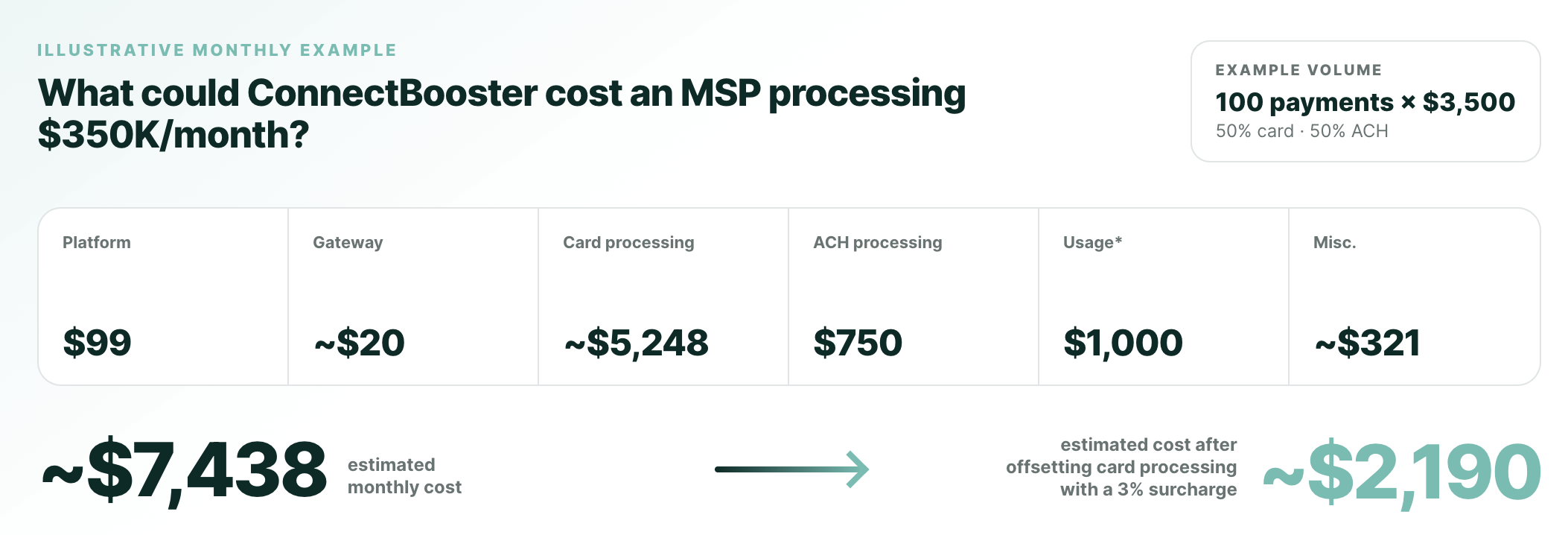
Let’s use the example of a larger MSP processing $350,000 per month. To keep the math simple, we’ll assume 100 monthly payments averaging $3,500 each, split evenly between credit card and ACH:
- 50 credit card payments totaling $175,000
- 50 ACH payments totaling $175,000
Using the publicly reported rates and fees discussed above, the estimated monthly costs would look like this:
- Platform fee = $99 (this is the lowest number referenced)
- Gateway fees = ~$20
- Credit card processing = ~$5,248
- ACH processing = $750
- Usage fee = $1,000, assuming a negotiated monthly cap
- Miscellaneous fees = ~$321
The credit card estimate applies the publicly reported rate of 2.99% plus $0.30 per transaction:
($175,000 × 2.99%) + (50 × $0.30) = $5,247.50
For ACH, the reported pricing is 0.35% plus $1.50 per transaction, capped at $15. A $3,500 ACH payment would exceed that $15 cap, so all 50 ACH transactions in this example are charged at the maximum:
50 × $15 = $750
At a reported 0.5% usage rate, $350,000 in monthly payment volume would otherwise generate a $1,750 usage fee. For this example, we’ll assume the MSP has negotiated a $1,000 monthly cap.
That brings the estimated all-in cost to approximately $7,438 per month.
If the MSP passes a 3% surcharge through to clients on the $175,000 in credit card payments, that would collect approximately $5,250 to offset the modeled card processing costs. The MSP would still be responsible for approximately $2,190 per month in platform, ACH, gateway, usage, and miscellaneous fees under these assumptions.
That’s why ConnectBooster’s SaaS price alone does not provide a complete picture of what the platform may cost an MSP.
It’s also important to distinguish this estimated monthly cost from a single ConnectBooster invoice. ConnectBooster’s documentation states that software, gateway, credit card processing, and ACH processing charges are billed separately and may appear on separate statements or as separate bank-account debits.
Illustrative example based on publicly reported pricing. Actual costs vary by contract, payment mix, processing volume, negotiated terms, and other factors.
What’s included (and missing) in a ConnectBooster subscription?
ConnectBooster provides the core tools MSPs need to accept and manage client payments.
What ConnectBooster Includes
- Credit card and ACH payment acceptance
- AutoPay enrollment
- Saved payment methods
- Invoicing and automated payment reminders
- Payment activity tracking
- Integrations with select PSA and accounting platforms
What ConnectBooster Does Not Include
ConnectBooster’s standard platform does not include several capabilities MSPs may expect from a modern billing platform. Some are unavailable, while others require additional fees or separate products.
- Same-Day ACH
- Autonomous collections management
- Automated deposit reconciliation
- A branded payment portal hosted on the MSP’s own domain
- Automated client onboarding and passwordless access
- Native HaloPSA and SuperOps integrations
- Included PCI compliance and email tracking
- Client financing terms of up to 12 months
- Pricing without percentage-based usage fees
FlexPoint includes these capabilities within its platform, including AR Agents for collections, Same-Day ACH, automated deposit reconciliation, and eligible client financing for up to 12 months through FlexLine.
These differences affect more than a feature checklist. Missing functionality can introduce additional software, paid add-ons, and manual work, all of which increase the real cost and complexity of managing billing.
Compare FlexPoint vs. ConnectBooster
Save thousands by switching from ConnectBooster
By now, the recurring debates about ConnectBooster pricing on r/msp should make a lot more sense.
Two MSPs can compare their bills and appear to be describing entirely different pricing models because (in many cases) they are.
Figuring out what ConnectBooster costs takes some interpretation. The platform fee is only the beginning; gateway charges, processing rates, usage fees, and hidden add-ons are spread across different statements and vary by agreement.
Whether an MSP is choosing its first billing platform or reconsidering its current one, FlexPoint offers a simpler, stronger, and more scalable path forward. New customers can avoid unnecessary complexity from the start, while existing ConnectBooster customers may begin saving as soon as they switch.
See how much your MSP could save by switching from ConnectBooster to FlexPoint.
Explore FlexPoint plans or request a personalized cost comparison.



.png)