Are Payment Processing Fees Tax-Deductible in 2026?



%20(1)%20(1).jpg)
Payment processing fees are the broccoli of your P&L. Not exciting. Not glamorous. Always there anyway.
Every time a client pays an invoice, a small chunk disappears into the payment processing void. Credit cards. ACH. Gateways. Monthly platform fees. Individually, they feel harmless. Collectively, they can take a noticeable bite out of your margins. The good news is that the IRS does not expect you to just smile and accept it. Most of those fees are deductible if you track them correctly.
Now let’s get into the part that actually saves you money.
Are Payment Processing Fees Tax-Deductible for MSPs?
Yes. Payment processing fees are generally tax-deductible for MSPs when they are ordinary and necessary business expenses.
If you accept credit cards or ACH from clients, the fees you pay to process those payments are usually deductible. That is the good news.
The less-good news is that many MSPs miss deductions simply because fees are poorly tracked or buried in reports no one looks at until tax time. As payment volumes increase, those small fees can quietly turn into a meaningful tax opportunity or a missed one.
This article breaks down:
- Which payment processing fees MSPs can deduct
- How IRS rules apply in 2026
- How to track fees the right way
- Why AR automation makes this much easier
Why Payment Processing Fees Hit MSPs Hard
Payment processing fees are easy to overlook. They are not loud. They do not break anything. They just quietly show up on every transaction.
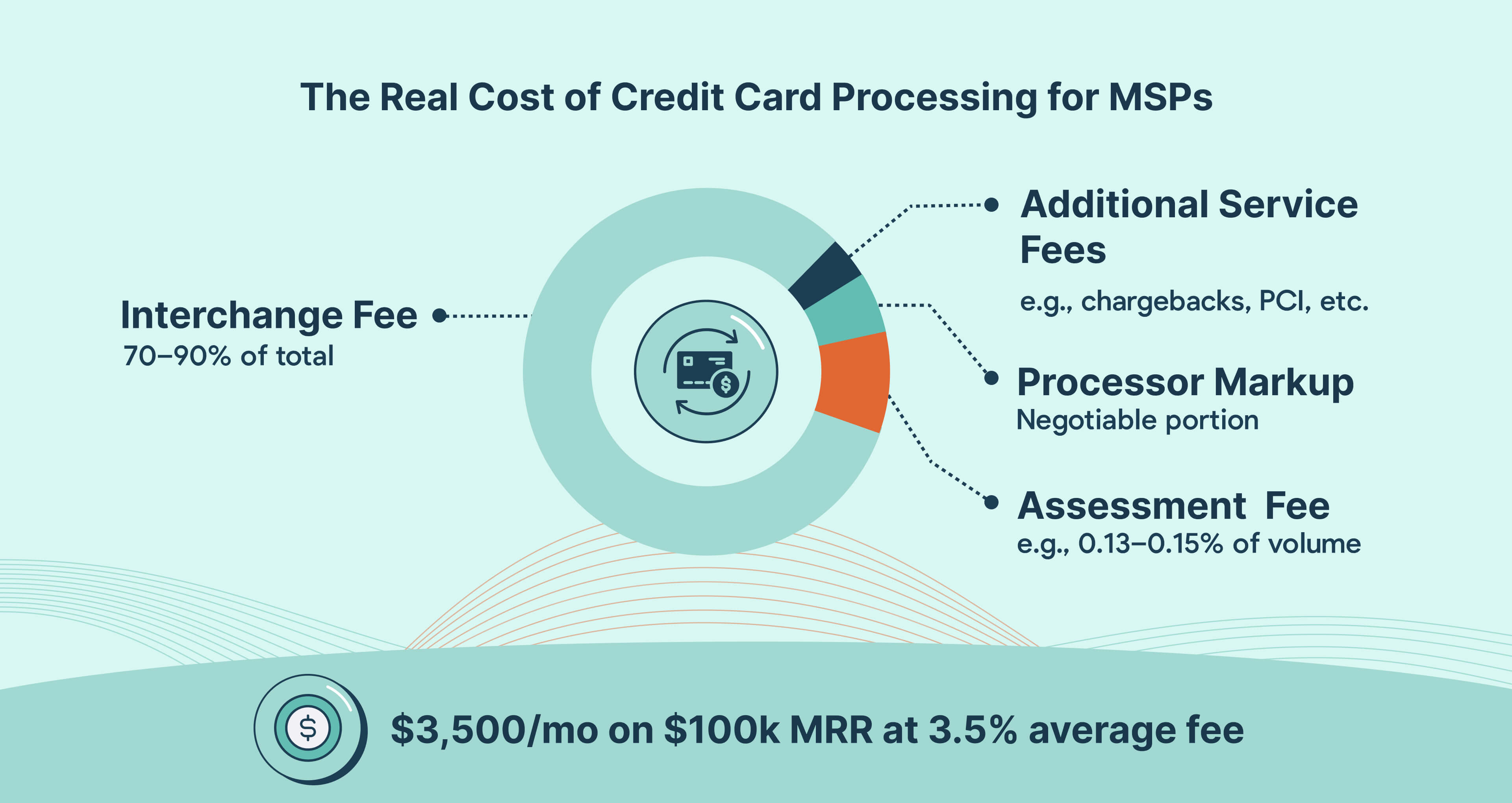
That is a problem for MSPs, because the managed services model is built on:
- Predictable, recurring monthly invoices
- Heavy use of credit cards and ACH
- Automated reminders and collections running in the background
Each payment carries a fee. One fee is forgettable. Hundreds or thousands of them are not.
Over time, those costs directly impact margins, taxable income, and how clearly you can see your cash flow. The more automated your billing is, the easier it is for fees to blend into the background.
If you want to see how this plays out in real dollars, try comparing what you pay in credit card fees versus ACH.
Processing fees do not get smaller when you ignore them. They only get more expensive. Tracking them correctly is how MSPs keep them from quietly eating away at profitability.
What Counts as a Payment Processing Fee?
Payment processing fees include more than just the obvious credit card swipe fee. For most MSPs, deductible payment processing fees typically fall into a few common buckets.
Common deductible payment processing fees include:
- Interchange fees – Fees charged by credit card networks like Visa or Mastercard for processing transactions
- Processor fees – Charges from your payment processor (Stripe, Square, PayPal, FlexPoint, etc.) for handling payments
- Assessment fees – Network or card association fees applied per transaction
- Chargeback and dispute fees – Costs incurred when a client disputes a payment or requests a refund
- Gateway fees – Subscription or per-transaction fees for online payment gateways that facilitate credit card or ACH payments
These fees are all considered ordinary and necessary for running a modern MSP business because they are directly tied to collecting client payments. Documenting and categorizing them properly ensures they are deductible under IRS rules.
IRS Rules: Are Payment Processing Fees Deductible Business Expenses?
To be deductible on your business tax return, the IRS requires that an expense be ordinary and necessary for running your trade or business. That standard comes from IRS Publication 334 (2024), Tax Guide for Small Business:
"To be deductible, a business expense must be both ordinary and necessary."
"An ordinary expense is one that is common and accepted in your field of business."
"A necessary expense is one that is helpful and appropriate for your business."
"An expense does not have to be indispensable to be considered necessary."
Most payment processing fees meet that test for MSPs. Accepting electronic payments using credit cards, ACH, or third-party gateways is a common and widely accepted way to get paid in the modern service economy, including in managed services.
What the IRS Says
- Payment processing fees are generally ordinary and necessary. Documentation used by tax professionals and IRS publication references show that merchant service fees such as credit card and third-party payment processing charges are treated as a cost of doing business and are deductible.
- Bank-related fees tied to business operations are deductible. IRS guidance specifically lists bank fees as deductible business expenses when they are associated with a business account.
What Isn’t Deductible
There’s one big caveat. Personal financial fees aren’t business deductions. The IRS does not allow deductions for personal bank charges or fees unrelated to business activity. If a credit card or bank account is used for both personal and business expenses, only the business portion qualifies for a deduction.
Another example: convenience fees charged for paying personal income taxes by credit card are explicitly not deductible as business expenses.
Simple Rule of Thumb for MSPs
If the fee exists because your MSP is collecting payment from a client or maintaining the financial systems needed to collect client payments, the IRS usually treats it as a legitimate business (ordinary and necessary) expense. As with all deductions, good documentation and proper bookkeeping make it easier to substantiate the expense during tax preparation or audit.
How MSPs Should Categorize and Track Payment Processing Fees
This is where things often go sideways.
Many MSPs net fees against revenue or leave them scattered across statements. That makes reporting messy and deductions harder to defend.
Necessary disclaimer: we are not licensed accounting or tax professionals. Please consult yours before filing your taxes. Looking for an accountant? Here’s our guide and list of recommendations.
Best practices for accurate deductions:
- Use a dedicated expense category for payment processing fees
- Record gross revenue separately from fees
- Track fees consistently across credit cards, ACH, and gateways
- Reconcile processor reports with accounting software every month
Common fee categories at a glance
Clean books make your CPA very happy. They also make audits much less stressful.
Tips to Maximize Deductibility of Payment Processing Fees
A few simple habits go a long way:
- Review processor statements monthly, not just bank totals
- Track all types of fees: interchange fees, processor fees, assessment fees, chargeback fees, and gateway fees
- Keep documentation like gateway reports, invoices, and monthly statements
- Separate recurring fees from one-time charges to avoid confusion
- Work with a CPA familiar with MSPs and service businesses
Waiting until tax season to sort through fees is a surefire way to miss deductions. Small, regular checks prevent big headaches later.
Common Misconceptions About Payment Processing Fees
“Processing fees are not deductible because they are just a cost of doing business.”
False. That is exactly why they are deductible.
“If I pass fees to customers, I lose the deduction.”
Also false. If your business incurs the fee, the deduction stays with you.
“Only credit card fees count.”
Nope. ACH fees, gateway subscriptions, and dispute fees count too.
AR Automation, Payment Platforms, and Tax Benefits for MSPs
Automation is not just about saving time. It also makes tax reporting cleaner.
Modern AR and payment platforms help MSPs by:
- Tracking processing fees automatically and in real time
- Preventing miscategorized or missed deductions
- Syncing accurate data into accounting systems
That means:
- Better cash flow forecasting
- Easier quarterly tax planning
- Less scrambling at year end
Platforms like FlexPoint are built to centralize invoicing, payments, reconciliation, and fee tracking. The result is cleaner data, fewer surprises, and a lot less spreadsheet gymnastics.
Conclusion: Payment Processing Fees Are Deductible if You Track Them Right
Payment processing fees are generally tax-deductible for MSPs in 2026. That part is straightforward.
The real risk is not eligibility. It is poor tracking.
When MSPs:
- Categorize fees properly (interchange, processor, assessment, chargeback, gateway)
- Keep documentation
- Use automation to stay organized
…those everyday processing costs turn into real tax savings.