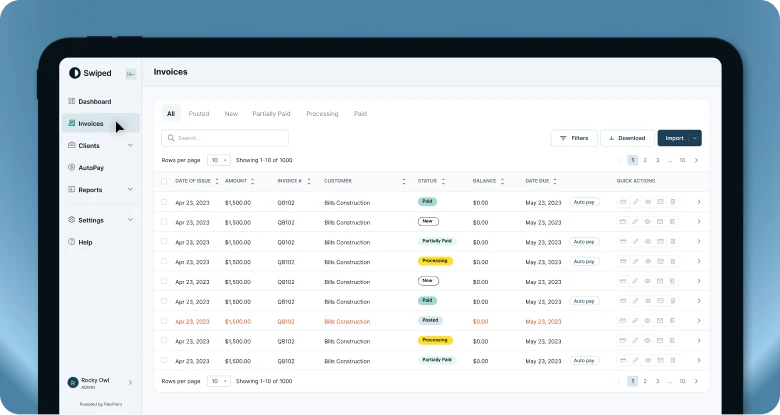



Contrary to popular belief, MSPs don’t run into cash flow issues because they’re bad at business. Chances are, if your MSP is struggling with cash flow and liquidity, it’s because of an inefficient operation or multiple financial systems that are evolving more slowly than your actual growth.
What begins with minor operational mismatches like billing delays, scattered expenses, and underpriced agreements snowballs quietly until something finally breaks. And by the time you feel the pressure in your bank account, the real issues have already been baked into your processes for months.
If you want predictable margins, stable growth, and the ability to reinvest in your team confidently, you need to recognize these cash flow red flags early.
Below are the five most fundamental operations at the base of cash flow problems for MSPs.
Want to see how your MSP's cash flow health stacks up? Jump to the 5-minute diagnostic below or talk to FlexPoint about closing the gap between invoicing and cash.
{{toc}}
1. Misaligned MSP Billing Cycles
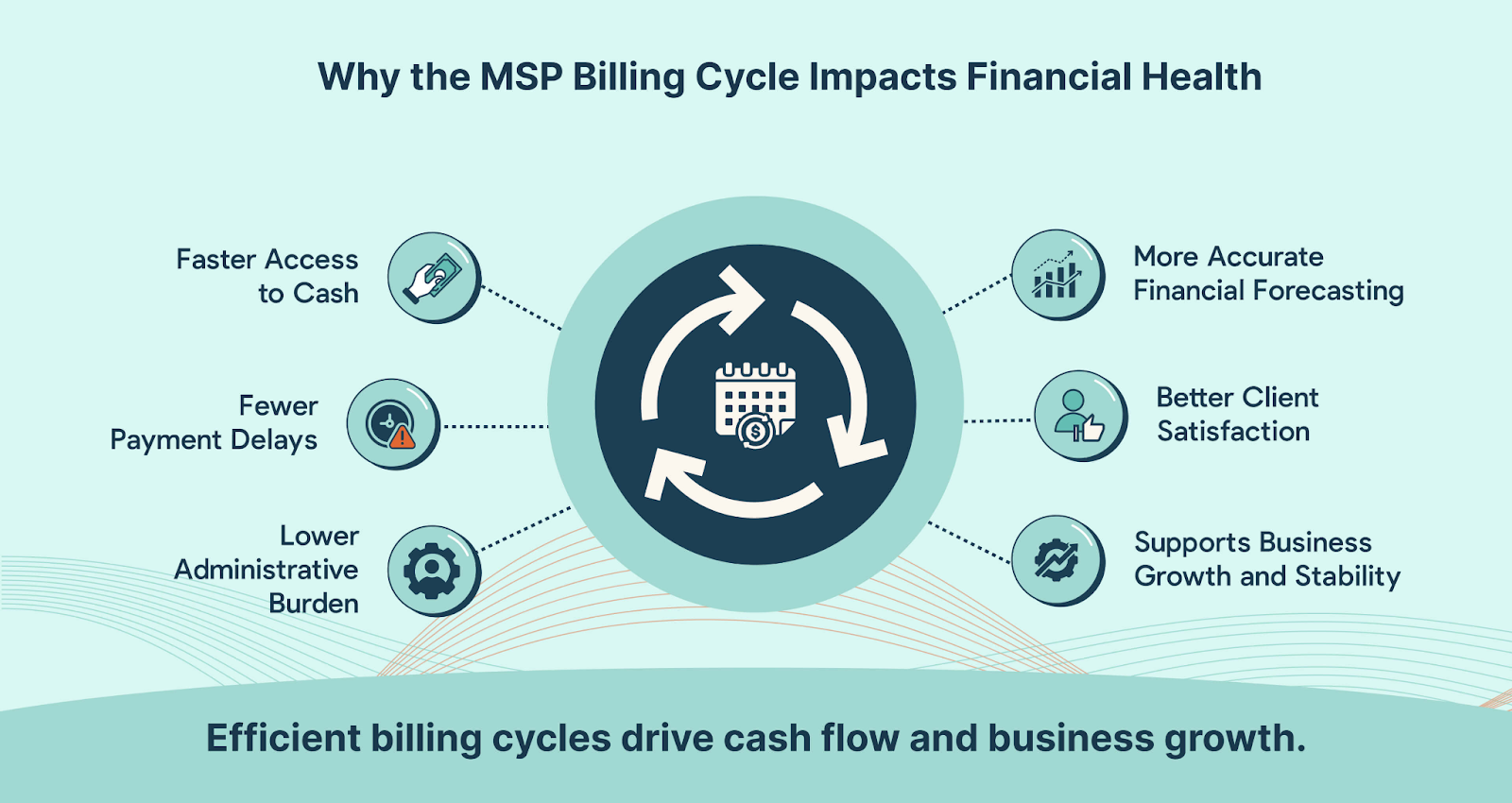
Misaligned billing cycles between invoicing clients and paying vendors are among the most common and preventable cash flow traps.
Most MSPs bill monthly, but engineering work, ticket approvals, licensing charges, and payroll cycles can all operate on their own timelines. You may bill monthly, but do you pay your technicians biweekly? At what frequency are your vendors expecting payment? Do you have annual licenses too?
It may not seem too important at face value, but when your cycles are misaligned, chances are you don’t actually have a good idea of what your bottom line is. You’ll be seeing money come in and go out of your MSP at different intervals, meaning that when you go to “take the temperature” of your finances, it can look better or worse than your reality.
Also related to misaligned billing cycles, MSPs can further confuse their bottom line by back-billing clients. If you’re consistently billing last month’s services this month, you’re already solidly in a cash flow trap. The operational delay creates an artificial gap between the work performed and the money collected, which will widen dramatically as you scale.
The result of this is predictable:
- Tickets get approved late
- Licensing usage is reconciled after invoices go out
- Invoices are delayed
- Cash arrives weeks after services are delivered
High-maturity MSPs tighten both of these loops carefully.
The important takeaway here is to keep debts and credits at the same intervals so that you know the reality of your finances.
The fix: Align your billing and payment schedules. Bill on the 1st for that month's services, not the previous month's. Approve time weekly. The goal is to keep debits and credits on matching intervals so your cash position reflects reality.
2. Underpriced Managed Service Contracts
Underpricing doesn’t always look like "a cheap contract." More often, it’s a contract that was fair, but three years ago. And because there are a lot of opinions around “fair pricing” when it comes to MSPs, it’s easy to let people’s voices, math equations, and even Reddit threads get into your decision-making. But the reality is, nobody knows what you’re worth more than you do. Only you know the margin you need to keep business moving smoothly.
That’s why it is so crucial to both revisit agreements on a somewhat regular basis (based on the services you’re providing) and to adjust your pricing based on your own growth. There’s no reason to be insecure about the service you’re providing your clients. Any competition shouldn’t drive you to lower your prices past what your service is actually worth.
Besides, costs change, vendor licensing changes, clients grow, and your own tech stack expands. So why should you keep your pricing at one too low rate when all these variables are changing?
Ultimately, your client agreements protect your margins on paper, but they can end up eating away at your profitability.
If you:
- Haven’t increased prices in 12–24 months
- Added multiple new tools without adjusting pricing
- Expanded support hours
- Updated per-device/per-user counts
It’s important to revisit your contracts.
This is an under-explored reason why MSPs end up cash-constrained: your expenses increase automatically while your pricing increases manually.
The fix: Review agreements at least every 12 to 18 months. Tie price reviews to vendor renewal cycles so increases don't catch you off guard. And don't let competitive anxiety drive you below what your service is worth. Only you know the margin you need to keep the business healthy.
3. Budgeting That Doesn't Reflect How MSPs Actually Use Cash
Most MSPs track revenue. Far fewer track the operational drivers behind it. And almost none forecast cash in a way that mirrors how their business actually uses cash month-to-month.
Cash flow starts to slip, not because an MSP is bad with numbers, but because MSP financial models are built upside-down. It’s easy to treat revenue like a fixed line item if your client base has stayed the same, but it actually shifts dramatically with ticket volume, contract updates, payroll timing, annual renewals, and licensing changes. That’s why last year’s P&L should not be dictating the coming year’s budget or goals, and last month’s revenue should not determine next month’s investments.
Because when budgeting and forecasting don’t reflect an MSP’s operational realities, financial problems start popping up like unwelcome surprises: next quarter’s cash position sneaks up on you, hiring feels risky because future payroll impact isn’t modeled, annual software renewals land at the wrong moment, and the net effect of churn + new MRR gets misjudged. And while these shocks feel sudden, the truth is that the signals were always there. It's just that you didn’t have a system tying them together, which is what makes the difference between mature MSPs and those who are starting out.
High-maturity MSPs plan what they’ll spend and then ensure the business operates accordingly; newer MSPs discover what they spent after the fact and plan based on data that may be irrelevant.
Without close alignment between financial operations and actual operations, leaders default to defensive decision-making (pausing spending, delaying projects, hesitating on hires…etc) because the picture is too fuzzy to trust.
That’s why budgeting and forecasting accurately is how you stop reacting to your business and start steering it.
The fix: Build a rolling 90-day cash forecast updated at least monthly. Include payroll timing, vendor renewals, and expected collections — not just revenue. If the forecast is a spreadsheet updated "when there's time," it's a guess, not a plan.
4. Expense Categorization That Hides the Real Picture
Expense categories can feel like an accounting chore, like something you can simply “clean up later.” But messy or overly broad categories do far more damage to MSP finances than almost any other bookkeeping mistake. Implementing or expanding categories too far will distort margins and hide bad clients or services.
If you can’t clearly see your true delivery cost per client, your gross margin per agreement, or which tools and licenses are underutilized, you’re operating off instinct instead of data. You also lose visibility into creeping vendor costs, which (as every MSP knows) rarely go down. And when labor spend starts rising faster than revenue (a pattern nearly every scaling MSP encounters), you won’t spot it early enough to correct course.
Imagine for a moment that your MSP treats several software licenses, cloud hosting fees, and third-party vendor costs as general “operations expenses” rather than tagging them to specific clients or service lines. You think Client A generates a 30% margin, but because some of its hidden costs sat in the wrong bucket, the real margin might be 10% or less. Meanwhile, Client B looks profitable on paper, but actually loses money once you allocate the correct expenses.
Mis-categorization leads directly to:
- bad margins
- incorrect pricing
- inaccurate forecasting
- overspending or underspending
- avoidable tax problems
- wrong assumptions about client profitability
When your categories are wrong, so are your conclusions, and you end up fixing the wrong problem. That’s why so many MSPs think they have a “pricing issue” when they might actually have a visibility issue.
If you want a deeper dive into the payment side of the equation, like late payments, failed charges, and client friction, we’ve already broken those down separately in our MSP Payment Challenges guide.
The fix: Audit your expense categories against your service lines and client list. Every cost should be traceable to either a client, a service line, or a true overhead category. If your bookkeeper can't tell you the gross margin per agreement, the categorization needs work.
5. Manual Billing Operations
And at the end of the day, if you aren’t collecting consistently, then your cash flow can never flow. That’s why it’s obvious but important to reiterate that the most basic of cash flow problems stem from inconsistent, manual, or siloed workflows. Even if your services are well priced, and your contracts are clean, and expenses are categorized correctly, relying on humans for billing is a silent cash leak.
According to the Institute of Finance & Management (IOFM), 12.5% of manual invoices contain 100-400 errors per 5,000 entries. That error rate alone translates into underbilled hours, missing license fees, misclassified tickets, and forgotten out-of-scope work, which can all essentially remain invisible until someone digs into the books.
When you depend on spreadsheets or manual processes, these problems multiply:
- Tickets get resolved but never billed
- Hours or services are misclassified under the wrong client or project
- Device or user counts stay outdated
- Licensing mismatches or overages go unnoticed
- Out-of-scope work gets swallowed into general support and never invoiced
- Time approvals pile up and get rushed at the month’s end, increasing mistakes
Delayed invoices, inconsistent MRR, revenue leakage, and disputes that slow down cash flow even more.
Automation changes the game. AR platforms like FlexPoint eliminate the reliance on memory and human error. Instead, it uses structured workflows that pull time logs, service tickets, licenses, and contract data into invoices based on pre-set rules consistently and defensibly. Which means more money, happier technicians and back-of-house employees, and (most importantly) happier clients.
For MSPs trying to avoid cash flow traps, automating billing is one of the highest-ROI operational upgrades you can make.

If you’re curious about how to address other billing challenges head-on, make sure to read Overcoming MSP Billing Challenges.
The fix: Automate your billing workflow. AR platforms like FlexPoint pull time logs, service tickets, licenses, and contract data into invoices based on pre-set rules: consistently and without relying on anyone to remember. Invoices go out on time, amounts are accurate, and reconciliation happens automatically.
For MSPs trying to stabilize cash flow, billing automation is one of the highest-return operational changes available.
How to Diagnose Your MSP's Cash Flow Health in 5 Minutes
If clients are still paying by paper check, that alone adds 7 to 10 days of transit time before clearance even begins. Read: How to Transition Your Clients Away from Paper Checks
How MSPs Can Fix Cash Flow Problems Fast
It’s important to reiterate that MSP cash flow problems rarely start with dramatic failures.
They usually begin with small operational mismatches that quietly snowball until the pressure shows up everywhere in your operations.
That’s why you shouldn’t be waiting to feel the pressure of low cash reserves. But the good news is that these issues are predictable, follow consistent patterns, and are fixable far faster than most owners expect.
Once you understand the core operational red flags we explored (misaligned billing cycles, underpriced agreements, inaccurate forecasting, messy expense categories, and manual billing workflows), you can correct them with targeted changes that immediately stabilize cash flow.
High-maturity MSPs operate differently because they’ve built systems that keep revenue, expenses, and delivery aligned. They rely on consistent billing rhythms, automated validation rules, clear expense visibility, and forecasting models that remove the surprises that create cash flow instability. They’re also not afraid to make out-of-the-box changes (like asking vendor relationships to change on their terms) when they know it will benefit them in the long run.
When all these pieces work together, MSPs unlock what every owner wants: dependable cash flow even during rapid growth or seasons of slower business.
If you want a deeper walkthrough of how to address these issues, watch our webinar, Common Financial Challenges for MSPs. It breaks down exactly what to fix first, what matters most, and how to build a financial operation that grows as fast as your MSP.
FAQs
Why do MSPs struggle with cash flow even when revenue is growing?
Because cash flow depends on timing, and most MSPs bill too slowly, forecast too little, or get hit by expenses they didn’t anticipate.
What is the biggest cash flow problem for MSPs?
Manual and inconsistent billing operations cause the most leakage, often cutting 5–12% of monthly revenue before anyone notices.
How can I tell if my MSP is underpricing?
If your costs have increased but your agreements haven’t been updated in 12–24 months, you are almost certainly underpriced.
How do misaligned billing cycles affect cash flow?
When payroll, invoicing, time approval, and client billing run on different schedules, cash moves out faster than it comes in.
Why is forecasting so hard for MSPs?
Most MSPs track revenue but not revenue drivers, timing, or renewals, which makes future cash positions nearly impossible to predict.
Why do improper expense categories hurt MSP cash flow?
Bad categorization hides rising costs, distorts client profitability, and leads to poor pricing decisions.
Does automating billing actually improve cash flow?
Yes, automated billing closes revenue gaps, reduces disputes, and keeps invoices aligned with real work delivered.
What’s the fastest way to correct these red flags?
Align your billing cycles, clean up your agreements, categorize expenses consistently, and automate your billing workflow.





.png)