

%2520(1).jpeg)
It's the 15th of the month. Three invoices are sitting at 10 days past due. You know you need to follow up. You also have a ticket queue backed up, a new client onboarding this week, and approximately zero desire to spend your afternoon drafting polite-but-firm payment reminder emails.
So the invoices sit. Another week passes. Now they're 17 days out.
While it feels like a discipline problem, it's not. It's a capacity problem. Manual AR follow-up is repetitive, time-sensitive, and requires just enough judgment that it never gets delegated cleanly. For most MSPs, it either falls on the owner or it falls through the cracks.
That's the problem an accounts receivable AI agent is built to solve. This post explains what one actually is, how it works in practice, and what to look for if you're considering adding one to your billing stack.
Quick refresher: what is an AI Agent?
Before getting into accounts receivable specifically, it helps to understand what an AI agent is in the first place, because the term gets thrown around loosely.
An AI agent is a tool (either à la carte or part of a comprehensive solution) that monitors a defined set of conditions, makes decisions based on rules you configure, and takes action autonomously. It doesn't need to wait for a human to trigger it each step of the way.
That's different from basic automation. A scheduled invoice reminder is automation: it goes out at a fixed time regardless of what's happening on the account. An AI agent reads the account — balance, age, client history, prior contact — decides what to do next, does it, waits for a signal, and adjusts accordingly.
If you run an MSP, you already work with this logic every day. Your RMM monitors endpoints and acts when something needs attention. You set the rules once; the platform handles the volume. An AR agent does the same thing for your invoices and collections workflow.
Ok, so what is an accounts receivable AI agent?
An accounts receivable AI agent, or AR Agent for short, is software that autonomously monitors unpaid invoices, sends follow-up communications, and escalates overdue accounts based on rules you configure, without requiring manual input each time.
It's not a chatbot. It's also not an automated email. It's an active system that watches your AR, makes decisions, and works accounts through a follow-up sequence until they're resolved.
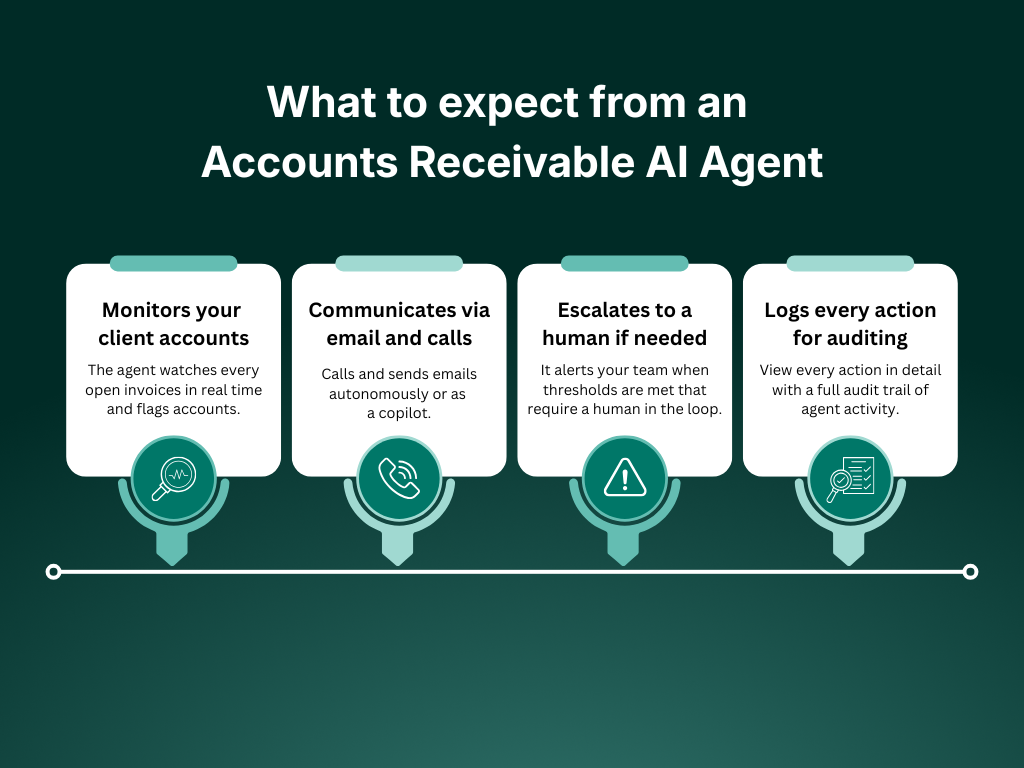
Here's what it actually does:
Monitors: The agent watches every open invoice in real time — balance, days outstanding, payment history, prior outreach — and flags accounts that meet your follow-up criteria.
Communicates: It writes and sends (or drafts for you to send) collection emails calibrated to the client relationship and escalation stage. A long-term client who's never been late gets a different message than a newer account that's 30 days overdue. The agent reads the context and adjusts. When a client responds or payment posts, the sequence pauses automatically.
Escalates: It moves accounts through your defined workflows at thresholds you control. It can autonomously send reminders, formal follow-up, make voice calls, and then escalate to human handoff as needed.
Logs everything: You cearly see every action, every decision, with context on why it was triggered. Full audit trail. Reviewable and overridable at any time.
What it doesn't do: replace your judgment on complicated situations. It handles routine volume so your judgment is reserved for the accounts that actually need it. And it doesn't act outside the rules you set. Every capability is opt-in.
Why AR Agents matter specifically for MSPs
Generic billing automation exists. So does basic accounting software with payment reminders. Neither was built for the way MSPs actually operate.

Recurring revenue creates recurring AR problems.
Monthly contracts mean invoices go out on a predictable cycle. That also opens the door for repeat late payments. At 10 clients, manual follow-up is manageable. As your business scales, it becomes a full-time job nobody budgeted for.
You can't afford to damage client relationships chasing money.
Long-term contracts mean the relationship has real value. A client who's been with you for five years and missed a payment once shouldn't get the same follow-up as an account that's chronically 45 days out. An AR agent calibrates tone per client, per situation. That's something a generic reminder sequence can't do.
The back office isn't resourced for this at scale.
Many growing MSPs don't have a dedicated AR person. Follow-up lands on the owner or an admin juggling six other priorities. The AR agent fills that gap without adding headcount.
Getting paid on time is a growth lever, not just housekeeping.
Consistent cash flow affects what you can invest in, such as people, tooling, new client acquisition. According to a 2025 Atradius report, 43% of B2B invoices in North America are paid late. For MSPs running on tight margins, that's not an abstract stat.
How a payment collection AI agent works in practice
Here's a concrete example. An MSP has a client — five-year relationship, generally reliable — whose $3,200 invoice is now seven days past due.
Day 7: The agent flags the invoice. It reads the account: long-term client, clean payment history, no prior collection activity. It sends a friendly reminder email under the MSP's brand. Tone is professional, not aggressive. The action is logged.
Day 14: No response, no payment. The agent sends a follow-up. The language is more direct — it references the original due date and the outstanding balance, and includes a direct payment link. Still professional and on-brand (and logged).
Day 21: Still nothing. The agent triggers a voice call. It identifies itself as calling on behalf of [MSP name], delivers a clear message, and gives the client a direct path to resolve the balance. The call is logged with a full summary.
Day 22: Client pays. The sequence closes. No further action. No human intervention required at any step.
Meanwhile, the MSP owner has a live dashboard showing exactly what the agent did, when it did it, and what's queued next. They can override, pause, or adjust at any point. Nothing happens outside their visibility.
That's it's job. It provides consistent, calibrated follow-up that would have otherwise required a handful of awkward, time-consuming manual conversations.
What to look for in an AR AI agent for your MSP
Not all AR automation is the same. If you're evaluating options, here's what actually matters:
Built into your billing platform, not bolted on. An agent that reads live invoice and payment data from the same system it acts on is more accurate and more reliable than one pulling from a third-party sync. Data lag creates errors. Native is better.
Full opt-in control. No capability should activate without your explicit configuration. If a vendor can't tell you exactly what's on by default and what you have to enable manually, that's worth pushing on before you buy.
Client segmentation. Uniform follow-up is the failure mode of basic automation. The system should read relationship context and adjust accordingly, not just blast a sequence at every overdue account.
Multi-channel communication. Email is where most follow-up starts, but not where it always ends. Some clients don't respond to email. A voice call as a defined escalation step — with proper identification and full logging — meaningfully improves collection rates.
A complete audit trail. Every action logged, every decision explained. You need to answer "why did that go out?" for any account, at any time. If the system can't show you that, you don't have trust visibility. You're blindly trusting automation.
The TL;DR on AR Agents
An AR AI agent monitors your invoices, runs follow-up on the rules you set, and escalates to you only when it needs a human call. For MSPs managing recurring revenue across dozens of clients, it's what makes consistent collections possible without a dedicated AR hire or an owner buried in payment emails.
If you want to see what this looks like inside a platform built specifically for MSP billing, book a demo with FlexPoint. Thirty minutes, no pressure.