

According to the 2022 AFP Payments Cost Benchmarking Survey, nearly 75% of businesses are transitioning their B2B payments from paper checks to electronic payments.
A 2024 article from EMARKETER reported that ACH payments will “represent almost half (47.9 %) of B2B transaction value in 2024.” This represents the anticipated growth of 7.8% for B2B ACH transaction value from the previous year.
ACH payments are expected to total $17.140 trillion of the $35.783 trillion forecasted B2B payment transaction value for 2024. The popularity of B2B ACH payments is evidence of a transition in B2B payment methods.
Accepting ACH payments from your MSP clients will allow you to meet their changing demands and payment preferences.
This article will explain how ACH payments can enhance operational efficiency and security for MSPs. You will learn practical strategies to implement ACH payments effectively to improve financial operations and client satisfaction.
What are ACH Payments?
ACH (Automated Clearing House) payments are a type of electronic funds transfer (EFT). These transactions can also be called “direct deposit,” “eChecks,” and “direct debit.”
Nacha (formerly NACHA), the National Automated Clearing House Association, manages the ACH Network.
The ACH network connects U.S. banks, allowing money to move through them, including MSP ACH payments.
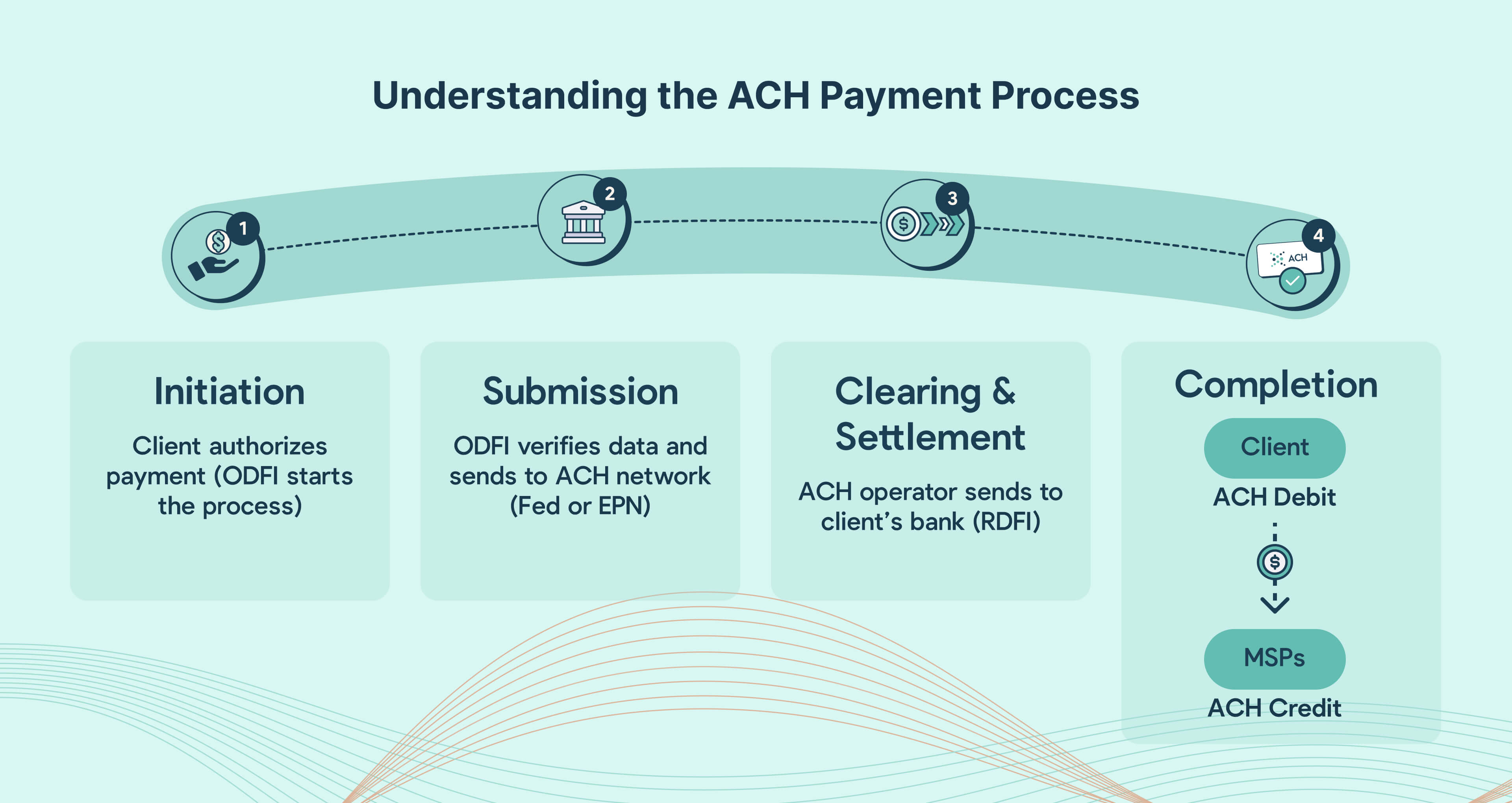
ACH Payment Process: 4 Steps
When ACH payments are processed, payment data must be sent from the originator’s bank to the clearing house.
The money is then sent to the recipient’s bank to credit the payment to that account.
Here is a closer look at each part of this process.
1. Initiation
A payer originates an ACH transaction – a direct deposit or payment from their bank.
For MSPs, this may include recurring services where the billing is automatic and the client authorizes these payments.
With ACH payments, the initiating bank is the Originating Depository Financial Institution or ODFI.
2. Submission
The ODFI collects the payment files, verifies the information is correct, and ensures all the required fields are entered in a format that ACH will accept.
The files are sent to one of two national ACH operators: the Federal Reserve or The Clearing House’s Electronic Payments Network (EPN). These two operators can also communicate with one another.
3. ACH Clearing and Settlement
Upon receiving the payment entries, the ACH operator sends them to the appropriate recipient’s bank. This is the receiving depository financial institution or RDFI.
As per Nacha guidelines, this is typically done within one business day.
4. Completion: Debit vs. Credit ACH Payments
When a client pays you via ACH, you receive an ACH credit.
For your client, this payment is an ACH debit.
For example, your client signs up for a recurring monthly ACH payment for your MSP services.
Once the ACH debit payment is authorized, your bank account will receive the ACH credit, and the process will be complete.
8 Key Benefits of ACH Payments for MSP Operations

MSPs receiving payments this way can get paid on time, stabilize their cash flow, and have more financial predictability.
A 2023 study from Atradius found that 55% of all B2B invoiced sales are overdue.
Further, QuickBooks research found that “89% of business leaders believe late payments are preventing their business’ growth.”
Because of their convenience and security, ACH payments are becoming increasingly common for payroll, vendor payments, and consumer bills.
MSPs can maximize the benefits of ACH transactions, which we will explain next, to reduce accounting burdens and simplify accounting operations.
The many benefits of these transactions explain the popularity of ACH payments.
The following section will overview MSPs' key advantages, from reducing administrative burden and payment processing fees to increasing cash flow predictability and client satisfaction.
1. Reduced Transaction Costs
ACH payments typically incur lower fees than credit card transactions.
The average credit card processing fee for major payment networks (including Visa , Mastercard, and American Express) is between 1.0% and 4% of the transaction value.
Nacha does not determine the costs for ACH processing; this is left to the organization that makes the transaction. The organization can choose to charge a flat fee or a percentage.
According to data from GoCardless, those who use a flat fee generally pay between $0.20 and $1.50 per transaction.
If they opt for a percentage-based fee, this is usually between 0.5% and 1.5% of the transaction amount.
AFP's Payments Cost Survey shows that the median per-transaction cost for ACH payments ranges from $0.26 to $0.50.
We will use a $5,000 transaction to demonstrate the total cost of credit card transaction fees and ACH processing fees.
We will compare the total transaction costs using FlexPoint’s ACH fee of $0.25 per transaction or a 3.5% credit card transaction fee.
If we apply these numbers to a single transaction and to 100 transactions, the total transaction fees for each method and structure would be:
2. Faster and Reliable Alternative to Check Payments
Despite the rise of digital payment methods, checks remain widely used in business transactions.
According to a 2022 Association for Financial Professionals (AFP) report, over 33% of businesses still rely on checks for making and receiving payments. This continued reliance on checks can significantly impact cash flow, as checks typically take 7 to 10 business days to clear, factoring in mailing and processing times.
The slow processing times associated with checks can delay business operations, payroll, and growth investments, making cash flow management more challenging for Managed Service Providers (MSPs).
In contrast, ACH transfers offer a faster alternative. ACH payments generally take two to five business days to complete, a marked improvement over the extended checks timeline.

While ACH is not instantaneous, it provides a more predictable and quicker payment management method.
Typically, MSPs can expect funds to settle within two to five business days when using ACH, which still offers a significant advantage over the lengthy check-clearing process.
Understanding these timelines is crucial for MSPs aiming to maintain consistent cash flow.
By transitioning from checks to ACH, MSPs can reduce delays and improve financial predictability, although managing client expectations around payment timelines is essential.
3. Decreased Payment Errors
A study published by PYMNTS revealed that 45% of small businesses say manually reviewing and approving accounts receivable (A/R) and accounts payable (A/P) is their biggest B2B payment challenge.
Manual payments are more error-prone than automated payments. In a 2008 study of human error, researchers found that the average accuracy rate was about 95%, even for simple data entry tasks.
A study published by The Institute of Finance and Management found that 39% of invoices contained errors, including incorrect billing addresses or duplicate payments.
Despite this high error rate, B2B Digital Payments Tracker 2022 data still found that 28% of B2B payments are processed manually.
Automated payment processes have significantly lower error rates. According to statistics from DocuClipper, automated data entry has a near-perfect average accuracy rate of 99.959% to 99.99%.
For this example, we assume that correcting each payment error costs you $50. This includes time spent identifying and fixing errors, potential late fees, and customer dissatisfaction.
Manual Payments: 95% Accuracy
- Number of errors per 1,000 invoices: 50
- Cost per error: $50
- Total cost of errors: $50 x 50 = $2,500
Automated Payments: 99.959% to 99.99%
- Number of errors per 1,000 invoices: Between 0.1 and 0.41
- Cost per error: $50
- Total cost of errors: $50 x 0.1 = $5 (best case)
- Total cost of errors: $50 x 0.41 = $20.5 (worst case)
When we apply these statistics to manual and automated MSP transactions, the seemingly small difference becomes much more significant.
4. Improved Security
ACH payments have lower fraud rates than checks, credit cards, and wire transfers.
In the 2023 AFP® Payments Fraud and Control Report, 30% of organizations reported incidents of fraud with ACH debits and credits.
For other popular payment methods, the percentage of organizations that experienced fraud was:
- Checks: 63%
- Credit cards (commercial/corporate): 36%
- Wire transfers: 31%
Lower incidences of fraud for ACH payments can be attributed to the strict regulations of the clearinghouses they pass through.
Nacha governs the ACH Network, and The Nacha Operating Rules regulate and define the roles and responsibilities of financial institutions and network participants.
Many of these rules apply to risk management, fraud prevention, and protecting sensitive financial information.
For example, Nacha enforces rules for authorization and authentication processes.
This involves verifying users' identities before authorizing transactions. It can include multi-factor authentication, where a user must provide two or more forms of identification.
More secure payments mean fewer fraud-related financial losses for your MSP.
Data published in US Companies and B2B Payment Fraud Report by TrustPair and Giact, 2023 found that 24% of companies that experienced fraud lost more than $100,000, and more than 5% lost more than $1 million.
5.Consistent and Predictable Payment Processing
ACH payments are especially favorable for recurring revenue models and automatic bill payments that are common in the MSP industry.
With ACH payments and automatic billing, ACH payments facilitate a consistent payment schedule. This creates a steady inflow of funds to support better financial planning and resource allocation.
This predictability is particularly useful for smaller MSPs, which may have limited resources to cover unexpected expenses.
For example, an MSP has 50 clients, and 35 of them use automated payment functionality to initiate ACH payments automatically or process credit cards that clients have saved on file.
However, if the other 15 clients pay manually by check, the MSP may experience a cash flow gap.
An MSP's payment process takes an average of 60 days. If its clients don’t use automatic billing, the MSP risks having to chase down payments for overdue invoices.
6. Increased Customer Satisfaction and Customer Base
A 2023 PYMNTS Intelligence research study reported that businesses offering several instant payment methods earn higher customer satisfaction scores.
Using a payment system built for MSPs that offers all primary payment methods makes it easier for clients to pay. This removes friction from the payment process and speeds up the payment cycle.
It’s important that your clients have secure, reliable, and convenient payment methods to choose from.
A Federal Reserve study found that “80% of Americans are interested in leveraging faster payments to pay businesses.”
The study also reports that almost 70% of respondents think enhanced faster payment capabilities (including ACH payments) are an important satisfaction driver.
Credit card payments can be instantaneous. However, like ACH transfers, it takes an average of one to three days for the settlement to post and the transaction to be complete.
However, as explained earlier, ACH payments under $1 million dollars are eligible for same-day processing, which can significantly speed up the payment cycle.
Clients can also authorize automatic monthly payments to be withdrawn on a certain day of each month to pay for their MSP services.
If they do not have to manually make this payment, it requires less work and less time.
Allowing your clients to pay in their preferred way, including ACH, credit cards, and debit payments, gives you access to a broader client base and improves client satisfaction rates.
7. Integration with Financial Software
ACH payments can easily integrate into your existing MSP financial systems or accounting software (such as QuickBooks Desktop, QuickBooks Online, and Xero) . This streamlined integration reduces administrative burden and enhances overall operational efficiency.
For example, integrating ACH payments with your existing MSP payment automation software can automate reconciliation processes. This reduces the time and effort required to match payments with invoices and ensures accurate financial records.
SkyCamp, a Columbus, Ohio-based MSP, came to FlexPoint when the ACH credit service through their credit card invoicing platform was incredibly time-consuming.
Their next option was QuickBooks ACH, but it lacked full integration with their payment platform. This meant SkyCamp had to process ACH payments manually.
SkyCamp needed a total billing operations overhaul.
When FlexPoint consolidated SkyCamp Technologies' ACH payment processing to a single, fully integrated platform, this move saved them eight hours of work per month, led to a 20% increase in AutoPay, and resulted in 30% faster payments.
8. Reduce Administrative Burden
Automating your payment process with ACH payments can save your business significant time and money.
A study from Goldman Sachs found that switching from manual to automated processes reduces the payment processing time by 70-80%.
Along with saving time in the payment process, automation also saves money.
The Institute of Finance and Management reports it costs an average of $8.78 for a business to process one invoice manually.
Conversely, an automated payment process costs an average of $1.77.
This is a nearly 80% decrease in processing costs. Payment automation also significantly shortens the process compared to manual processing.
Implementing ACH Payments: Best Practices for MSPs
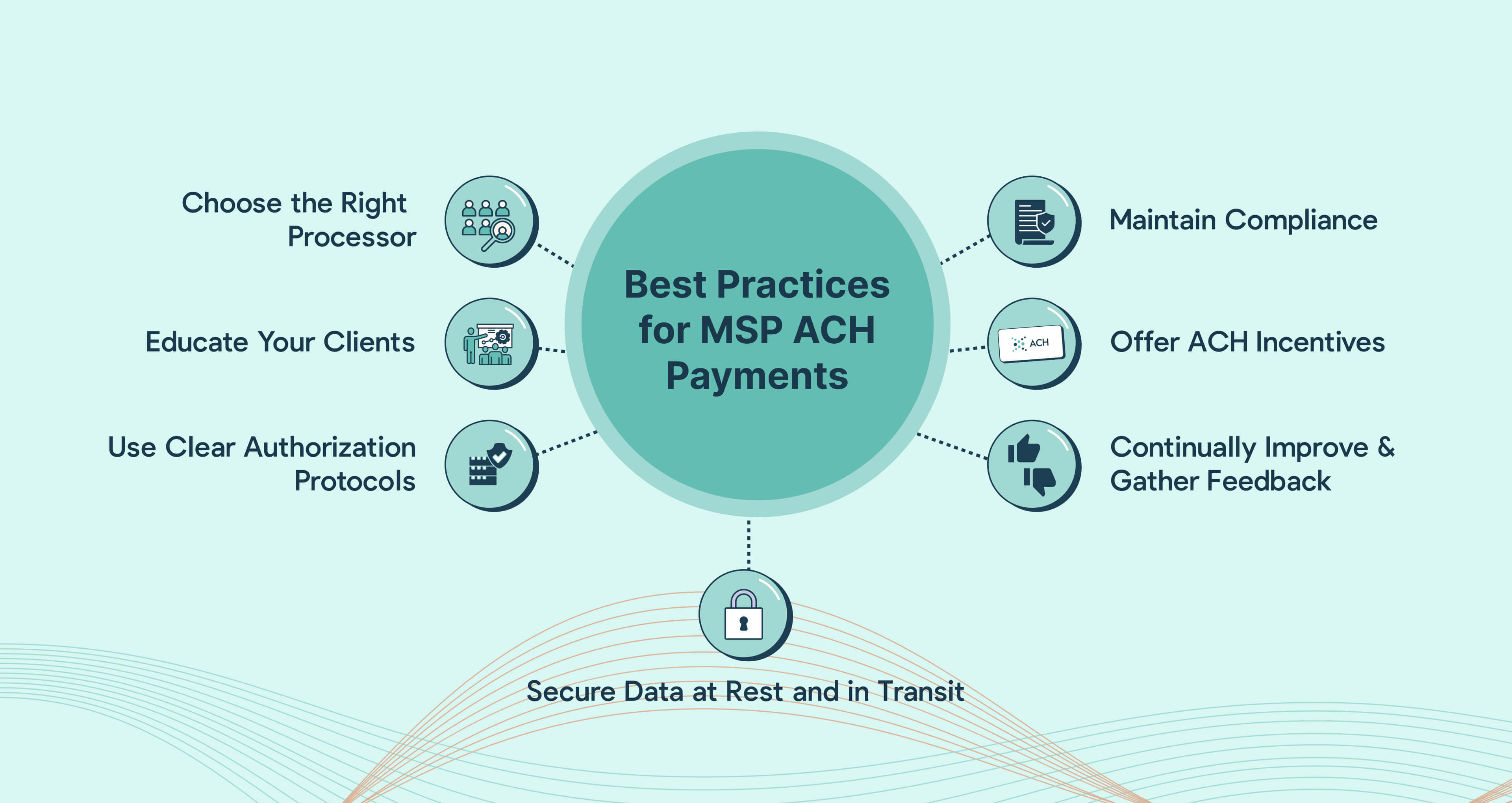
Managed service providers should follow certain best practices to take advantage of ACH payments' benefits. These best practices involve technical considerations and compliance execution.
Below, you’ll find practical tips to optimize the ACH payment process for your MSP.
1. Processor Selection
Choose a reputable MSP ACH payment processor that complies with applicable financial regulations, consumer protection laws, and security standards. This includes PCI Payment Card Industry Data Security Standard (PCI-DSS) compliance.
We will explain the importance of PCI compliance as it relates to ACH payments in a moment.
First, we will consider the customer service aspect of choosing an ACH vendor that provides excellent customer service.
Before deciding on a specific payment processor, consider its customer service practices. You can read about its policies on its website and search online for client reviews and customer service ratings.
Make note of how much support they offer and whether it is included in your plan or if you will need to pay more. Watch for problem-resolution information as well, including clients sharing their experiences.
You will also want to ensure your chosen ACH processor offers client training and technical support to minimize downtime and operational disruptions.
A user-friendly interface is also important. This can significantly reduce the learning curve during onboarding. This is helpful for your clients as it means they can more easily start using the platform.
It also benefits you because less time and money will need to go into training clients to use the platform.
2. Educate Your Clients
ACH payment volume is growing steadily.
In 2014, Nacha reported that the total dollar value of ACH debit and credit payments for B2B payments was $26.66 trillion.
By 2023, this value had more than doubled, reaching $54.2 trillion.
This payment method is becoming more popular, and 63% of B2B companies use ACH payments. However, a significant portion of businesses are either unaware of the benefits of MSP ACH payments or have chosen not to adopt them.
Nacha offers payments education virtually, in-person, and by creating industry resources and accreditation events.
To encourage adoption, prioritize raising client awareness about the benefits of ACH payments. You can do this by offering information to read or watch, providing training and education sessions, or connecting your clients with Nacha resources.
If your clients are aware of ACH payments but aren’t convinced of the benefits, there are numerous statistics and case studies to show them to provide the proof they want to see.
3.Clear Authorization Protocols
Establish and maintain clear protocols for obtaining and storing client authorization for ACH debits. This helps prevent unauthorized or fraudulent payments and ensures your clients feel confident using ACH for their payments.
Nacha has a set of requirements for ACH authorizations.
Importantly, Nacha explains that while certain information must be included in authorizations, the rules do not require that the authorization is in a specific format or that they contain specific language.