

.png)
For MSPs, choosing the right financial software is about more than sending invoices or processing payments. It is about building a system that supports efficiency, compliance, and long-term growth. Two popular platforms often compared are Bill.com and QuickBooks Online.
Bill.com is known for its focus on accounts payable (AP) and accounts receivable (AR) automation. It simplifies invoice approvals, vendor payments, and digital transactions.
QuickBooks Online, on the other hand, is a full-featured accounting platform. It covers invoicing, expense tracking, financial reporting, and tax support for small businesses, including MSPs.
For MSPs managing recurring contracts and various industry-specific billing models, the choice depends on whether the priority is streamlined payments or a complete accounting suite.
In this article, we will compare Bill.com and QuickBooks Online side by side. We will look at features, pricing, integrations, and use cases. We will also show how pairing QuickBooks Online with FlexPoint adds MSP-specific billing automation.
{{toc}}
Bill.com vs QuickBooks Online: Why MSPs Are Comparing These Platforms
MSPs are evaluating both Bill.com and QuickBooks Online (QBO) to improve financial efficiency and reduce manual work. Each platform offers distinct strengths while serving different purposes.
Bill.com is built for AP/AR automation. It minimizes manual data entry, accelerates invoice approvals, and helps MSPs optimize cash flow.
QuickBooks Online is a full accounting platform. It supports invoicing, expense tracking, reporting, and tax management. For MSPs, this means having a single platform to manage day-to-day accounting while offering visibility into overall financial health.
Choosing the right platform ultimately comes down to priorities.
MSPs that need a robust accounting suite tend to lean toward QuickBooks Online. Those who want advanced AP/AR automation may prefer Bill.com.
Understanding these differences is essential for selecting the right platform.
Features Comparison: Bill.com vs QuickBooks Online for MSPs
When MSPs evaluate financial platforms, they need to consider how each one handles invoicing, billing, AP/AR, reporting, and integrations.
Below is a detailed comparison of Bill.com and QuickBooks Online across key functions.
Invoicing and Billing
Bill.com: Simplifies invoice approvals and payment scheduling. It supports digital payment processing, reducing manual effort and improving cash flow.
QuickBooks Online: Offers stronger invoicing features. It also supports recurring billing and automated reminders. These features directly integrate with comprehensive accounting workflows for enhanced financial visibility.
Accounts Payable/Receivable Automation
Bill.com: Focuses on automating vendor payments, customer invoicing, and multi-step approval chains. It is built for AP/AR efficiency.
QuickBooks Online: Manages AP and AR within its broader accounting suite, providing basic automation. However, it lacks the depth of workflow customization compared to Bill.com.
Reporting and Analytics
Bill.com: Provides AP/AR-focused reporting with real-time cash flow visibility. It is best for tracking payments and outstanding invoices.
QuickBooks Online: Delivers comprehensive financial reporting capabilities, dashboards, and customizable analytics. It gives MSPs insights across all areas of accounting and business performance.
Integrations and Ecosystem
Bill.com: Integrates seamlessly with leading accounting software, including QuickBooks Online, Xero, and Oracle NetSuite. It also connects with major banks and payment providers.
QuickBooks Online: Offers an extensive app marketplace and strong integration with PSA tools. It also integrates with FlexPoint, allowing MSPs to automate billing and financial workflows.
User Access and Permissions
Bill.com: Offers role-based financial workflows explicitly designed for AP/AR processes. These workflows ensure approval chains and payment responsibilities are clearly defined across finance teams.
QuickBooks Online: Supports multi-user access with role management for all accounting functions. This allows broader control over financial operations.
Automation and Workflow Tools
Bill.com: As previously discussed, it provides advanced AP/AR workflow automation. This includes payment scheduling, reminders, and approval routing.
QuickBooks Online: Offers workflow automations for accounting, invoicing, and expense management. It covers more functions, but with less depth, specifically for AP/AR.
Summary Table: Bill.com vs QuickBooks Online
Pricing & Value: What MSPs Get With Each Platform
When comparing financial platforms, MSPs need to look beyond subscription fees. The total cost of ownership depends on features, add-ons, and how each system fits into existing workflows.
Let’s review the pricing differences between Bill.com and QuickBooks Online.
Bill.com Pricing
QuickBooks Online (QBO) Pricing
Trials and Promotions
- Bill.com: Offers a 30-day free trial with no credit card required.
- QuickBooks Online: Provides a 30-day free trial. In some cases, they offer promotional discounts, such as 50% off for the first three months, to new users.
Value for MSPs
- Bill.com: Ideal for MSPs focused on AP/AR automation and improving cash flow management. Its modular pricing allows businesses to scale according to their specific needs.
- QuickBooks Online: Suitable for MSPs that want an all-in-one accounting suite. It includes a comprehensive accounting solution with features such as invoicing, payroll, and reporting, all in one system, all within a single platform. Suitable for MSPs seeking an all-in-one accounting suite. However, additional costs may arise from add-ons and integrations.
Summary: Bill.com provides specialized AP/AR automation with user-based pricing. QuickBooks Online offers a broader accounting suite with tiered plans for growing businesses.
The best value depends on whether you need targeted payment automation or complete financial management.
Usability, Integrations, and Support: Choosing the Best Fit
The day-to-day experience of financial software plays a major role in adoption and efficiency. MSPs should evaluate how easy the platform is to use, how well it integrates with other tools, and the level of support available.
Let’s review how both these platforms (Bill.com and QuickBooks Online) compare on usability and support.
User Experience
Bill.com: Provides a simple interface. It is built around AP/AR workflows, making invoice approvals, vendor payments, and cash flow tracking straightforward.
QuickBooks Online: Provides a broader dashboard with more accounting features. It offers more profound insights, but it may take teams longer to learn.
Onboarding and Training
Bill.com: Provides setup guides, tutorials, and onboarding resources focused on AP/AR workflows. Live chat, phone, and email support are available for users who need help.
QuickBooks Online: Offers a broader range of training materials. This includes step-by-step guides, webinars, and an extensive knowledge base. It also has support channels, including chat, phone, and community forums.
For MSPs, the quality of support and availability of resources can influence adoption. Teams with less accounting experience may find QuickBooks’ resources more comprehensive, while Bill.com offers a lighter, simpler learning curve.
Integrations with PSA and Billing Tools
Bill.com: Integrates with QuickBooks Online, Xero, NetSuite, and a limited set of business platforms. This makes it effective for AP/AR automation but less flexible for broader MSP needs.
QuickBooks Online: Supports a wide app marketplace. It integrates with many PSA platforms (such as ConnectWise PSA, HaloPSA, SuperOps, Autotask). It also works directly with billing platforms like FlexPoint, which automates MSP billing and collections across accounting and service operations.
Real-World MSP Feedback
Bill.com: Praised for its simplicity and ease of adoption for payment workflows. However, MSPs note that it falls short as a complete accounting solution.
QuickBooks Online: Valued for its robust feature set and broad ecosystem. Some MSPs mention that setup can be more complex compared to lighter tools.
MSPs emphasize the importance of weighing these trade-offs carefully before choosing a platform.
Summary: Bill.com is best for simplicity in AP/AR management. QuickBooks Online offers broader functionality and deeper integrations, including FlexPoint for MSP billing automation.
FlexPoint + QuickBooks Online: Streamlined Billing for Modern MSPs
FlexPoint enhances QuickBooks Online by automating billing workflows explicitly designed for MSPs.
Together, they create a unified solution that reduces manual effort, ensures accuracy, and improves cash flow management.
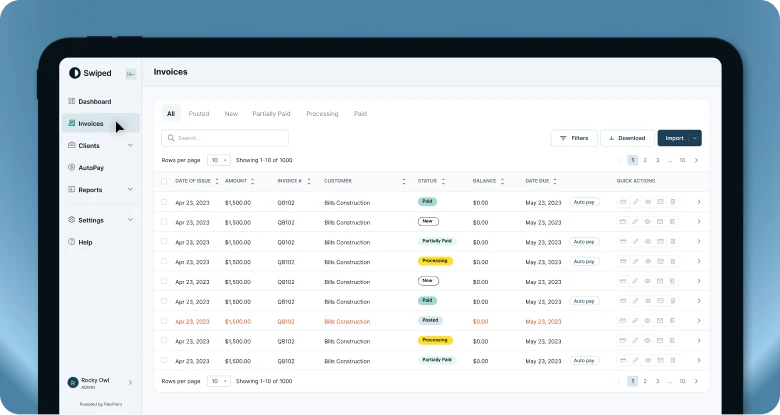
- Purpose-Built Integration: FlexPoint integrates directly with QuickBooks Online to automate billing, collections, and payments. This creates a seamless link between your PSA, accounting, and billing systems.
- Automated Deposit Reconciliation: FlexPoint automatically reconciles deposits in QuickBooks Online. Payments collected through the client portal are matched to invoices and synced in real time, saving hours of manual work and ensuring accurate records.
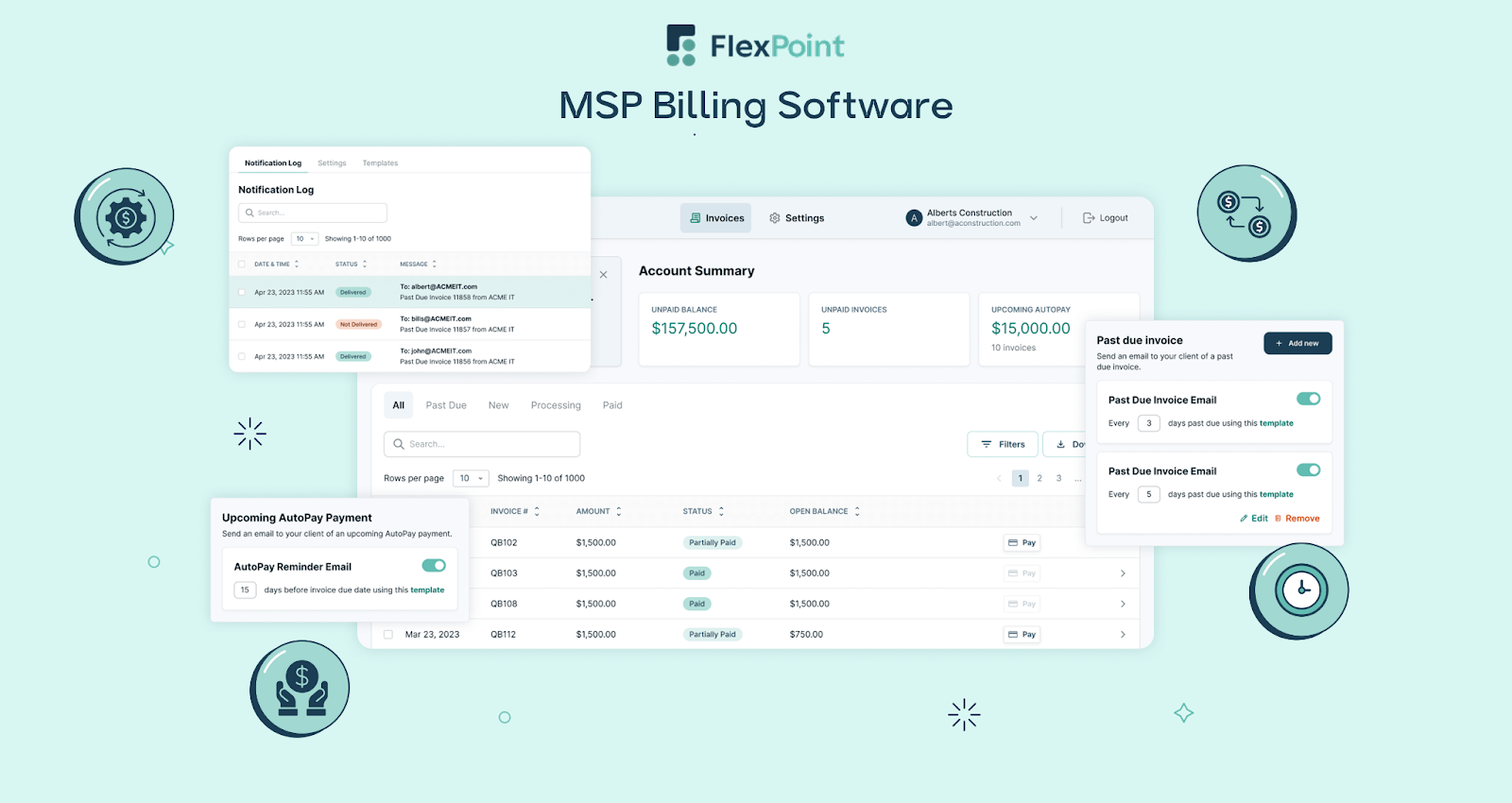
- Branded Client Portal: FlexPoint provides a fully white-labeled client portal, hosted on the MSP’s domain. Clients can view invoices, store payment methods, and schedule payments, creating a professional and seamless payment experience.
- Streamlined Billing: MSPs can manage recurring, usage-based, and custom billing models. All billing data syncs to QuickBooks Online in real-time, ensuring invoices remain accurate and up-to-date.
- Integration with PSA Tools: FlexPoint connects QBO with leading PSA platforms (such as ConnectWise PSA, HaloPSA, SuperOps, Autotask) and MSP-specific tools (such as Quoter, Rewst). This eliminates duplicate data entry, reduces billing errors, and unifies service delivery with financial operations.
- Business Continuity: By combining FlexPoint with QuickBooks Online, MSPs benefit from faster billing cycles, fewer errors, and stronger cash flow. The result is improved efficiency and more predictable revenue.
Note: FlexPoint currently does not integrate with Bill.com. MSPs that want full automation across billing and accounting will get the most value from QuickBooks Online paired with FlexPoint.
Conclusion: Find the Right Financial Platform for Your MSP
Choosing between Bill.com and QuickBooks Online comes down to your MSP’s priorities. Bill.com is a strong option if your primary focus is AP/AR automation and streamlined payments. QuickBooks Online is better suited if you need a comprehensive accounting suite that includes invoicing, reporting, and tax management.
For MSPs seeking the best workflow automation and efficiency, QuickBooks Online, paired with FlexPoint, offers the strongest foundation. This combination integrates PSA, billing, and accounting into one workflow. It reduces manual work, improves accuracy, and accelerates cash flow.
The right choice is a strategic investment in your financial operations. With the right platform in place, your MSP can improve efficiency, strengthen client trust, and build for long-term growth.
FlexPoint seamlessly integrates with QuickBooks Online, along with other leading accounting and PSA tools. It automates invoicing, payment reconciliation, and financial tracking.
This significantly reduces manual data entry, minimizes errors, and saves valuable administrative time.
SkyCamp Technologies, an Ohio-based MSP, struggled with a clunky ACH service and no integration between billing and invoicing. Dan Illausky, President, had to process payments manually each month, which cost time and slowed cash flow.
FlexPoint solved the problem by auto-syncing and reconciling directly with QuickBooks Online.
The result for SkyCamp Technologies after using FlexPoint and QuickBooks Online:
- 8 hours saved each month on admin work
- 30% faster payments from late-paying clients

SkyCamp isn’t alone. MSPs across the country are streamlining billing, speeding up payments, and freeing up hours each month with FlexPoint.
Ready to modernize your MSP’s billing and accounting?
FlexPoint integrates with QuickBooks Online for seamless automation and reporting.
Schedule a demo to see how FlexPoint supports your MSP’s growth.
Additional FAQs: Bill.com vs QuickBooks Online for MSPs
{{faq-section}}