

If you run a managed service provider business, you already know that cash flow can be one of your biggest headaches. You're delivering services month after month, your team is working, your tools are running, but clients are paying on net 30, net 60, or even longer. But the bills aren’t waiting.
That tension between when you earn money and when you actually receive it is the core challenge B2B financing is designed to solve. But financing isn't just a lifeline for when you're struggling or a drip to keep the water on. Used strategically, it's an actual growth tool: one that lets you take on bigger clients, invest in your team, and stop letting cash timing decisions dictate your business strategy.
This guide breaks down the B2B financing landscape specifically for MSPs: what your options actually are, how each one works, when to use them, and how platforms like FlexPoint fit into the picture.
According to industry research, 60% of SMBs struggle with cash flow issues and the root cause is almost always the gap between service delivery and payment collection.
{{toc}}
Why MSPs Face Unique Financing Challenges
Not all B2B businesses are created equal when it comes to cash flow. MSPs operate in a particularly challenging financial environment for a few structural reasons.
You deliver before you get paid
In most MSP models, you're paying for labor, software licenses, vendor costs, and overhead every single month and then waiting for clients to pay their invoices. Even net 30 terms mean you're floating a month of costs. Net 60 or net 90? Now you're running a small bank for your clients, just without the interest income.
Your revenue is recurring, but your costs are immediate
Monthly recurring revenue (MRR) is the holy grail of the MSP model: predictable, stable, scalable. But there's a catch. Those recurring invoices still have to be collected, and the moment you add a new client, onboard a new piece of hardware, or hire an additional technician, you're taking on costs that your MRR won't cover for weeks or months.
Growth requires capital you may not have in liquid form
Want to land a 200-seat enterprise client? You'll need to invest in tooling, bandwidth, and potentially staff before the contract revenue kicks in. That's a capital problem, not a revenue problem, and it's one of the most common reasons MSPs turn down growth opportunities they're fully qualified to deliver.
Among small businesses that applied for financing in the past year, 41% reported being limited in their ability to take on new business as a result, according to Goldman Sachs' 2025 10,000 Small Businesses Voices survey.
The numbers back this up
Industry data consistently shows that 55% of all B2B invoices are paid late, and MSPs with aging accounts receivable find themselves making conservative decisions (holding off on hiring, delaying tool upgrades, or passing on projects) not because the business isn't healthy, but because the cash isn't in the account yet.
Before we get into your options, it helps to know exactly what you are working with. Plug in your numbers below to see how much of your own earned revenue is sitting unpaid right now, and how your DSO score compares to other MSPs.
Want a more detailed breakdown of your DSO and what it means for your business? FlexPoint's full DSO Calculator goes deeper. Check it out here.
And if that number surprised you, you are not alone. Here is what you can do about it.
The Core B2B Financing Options for MSPs
There are more options than most MSPs realize, and the right one depends entirely on what problem you're solving. Here are the primary financing mechanisms available to MSPs, what each one actually means, and where each one makes sense.
1. Working Capital Loans
A working capital loan gives your MSP a lump sum of cash, typically unsecured or lightly secured, that you repay over a set period with interest. Banks offer these, as do alternative online lenders and, increasingly, fintech platforms built specifically for the tech services industry.
Best for: Covering a short-term cash gap, funding a hiring push, or bridging the gap while waiting on a large invoice to clear. FlexPoint offers working capital solutions built specifically for MSPs, with underwriting based on your recurring revenue rather than a lengthy bank application. Learn more about FlexPoint Working Capital.
Watch out for: Interest rates from traditional banks can be steep if you don't have a long credit history, and approval timelines at banks can be painfully slow. Alternative lenders are faster but may charge higher rates.
2. Invoice Financing (Accounts Receivable Financing)
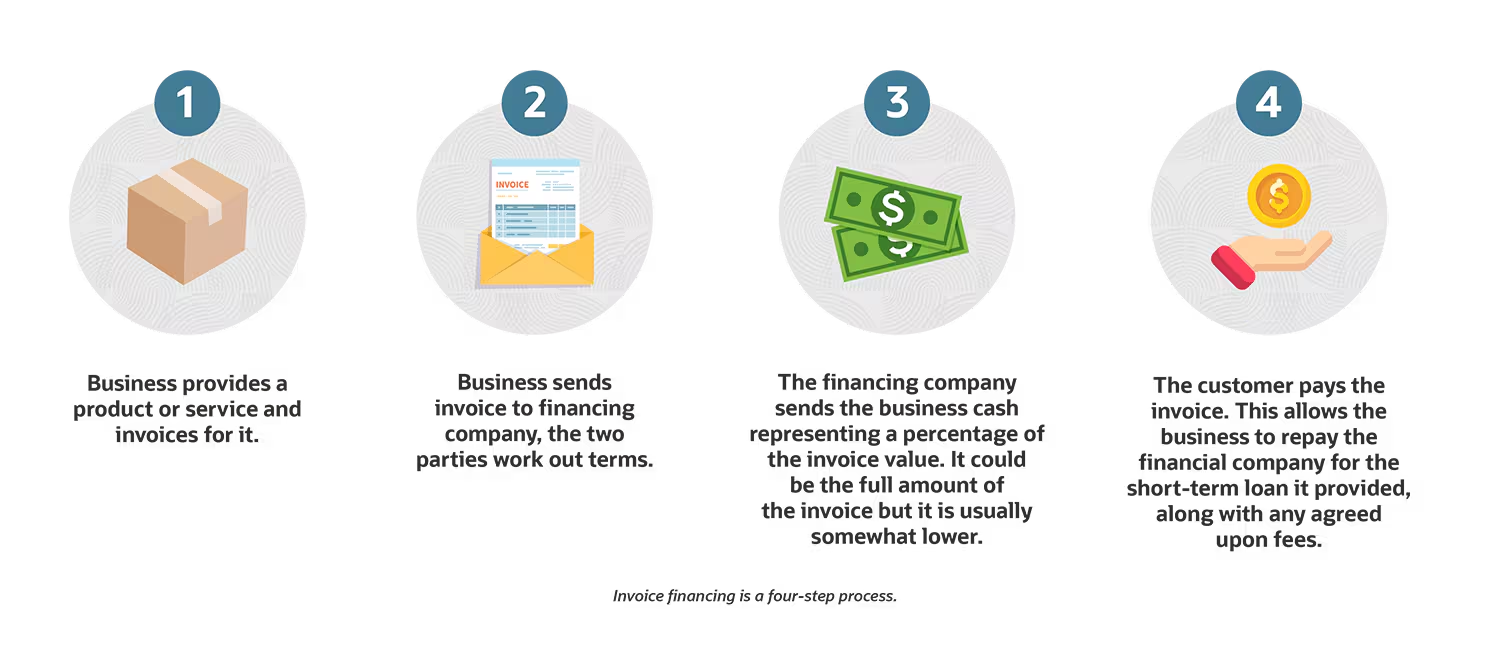
Invoice financing lets you convert outstanding invoices into immediate cash. Instead of waiting 30, 60, or 90 days for a client to pay, you can access a percentage of that invoice value right away (typically 80–95%) from a lender or platform. When the client pays, you receive the remainder minus fees.
There are two main varieties: invoice factoring (where the lender takes over collections from the client directly) and invoice financing or discounting (where you retain control of collections and the arrangement remains invisible to your client).
Best for: MSPs with healthy pipelines but slow-paying clients. If you have the contracts but not the cash, this closes the gap quickly.
Watch out for: Factoring can often feel very uncomfortable; your clients may receive contact from a third party. Maintaining trust in the security of your business and clarity with your clients is crucial, making discounting a cleaner option than invoice financing from a client relationship standpoint.
3. Client-Facing Financing (Point-of-Sale Financing)
This is one of the most underutilized tools in the MSP arsenal and one of the most powerful. Rather than asking clients to pay a large project invoice upfront, you offer them the ability to finance the purchase, spreading payments over time while you get paid.
Think about how consumer financing works when someone buys something expensive like a laptop: they don't pay $1,200 upfront; they pay $50/month. The same logic applies to B2B tech services. A client who baulks at a $20,000 infrastructure upgrade might say yes immediately if they can pay $1,800/month instead. The project gets approved; you win the deal.
Best for: Closing larger deals, reducing sticker shock on project invoices, and improving client win rates without taking on credit risk yourself.
FlexLine is FlexPoint's built-in client financing feature. Here's how it actually works:
- Available on any invoice of $10,000 or more automatically, with no setup required on your end
- Clients can choose to repay over 1 to 12 months, directly inside their payment portal
- Approval typically takes around 1 business day, with a soft credit check on the client's business
- As the MSP, you control whether you absorb some or all of the interest cost, or pass it through to the client (1.5% per month on the financed amount)
- There's no hard cap on how much a client can finance; approval depends on the client's financial profile
As the MSP, you have control over how interest is handled. You can absorb a portion, cover it entirely as an incentive on strategic deals, or pass the full cost through to the client. That flexibility lets you adapt the terms to fit your business strategy and the specific client relationship.
Key insight: Client-facing financing is both a cash flow and a sales tool. With FlexLine, a $25,000 infrastructure project that a client's CFO would have deferred to next quarter becomes a deal you can close this month. Offering flexible payment options removes price as an objection and positions your MSP as a sophisticated, client-friendly partner.
4. Lines of Credit
A business line of credit is a revolving credit facility typically through your bank; you draw down what you need, repay it, and draw again. Unlike a term loan, you're not committed to a fixed amount; you're simply accessing credit on demand up to a set limit.
Best for: Ongoing working capital needs, seasonal cash flow fluctuations, or bridge financing between large projects. A line of credit is particularly valuable for MSPs with variable project pipelines.
Watch out for: Variable interest rates and the temptation to over-rely on credit for operational expenses that should be covered by revenue. Credit is a tool, not a substitute for healthy cash flow.
5. Equipment and Hardware Financing
If you're deploying infrastructure for clients (servers, networking equipment, endpoint devices), you don't necessarily have to front that capital yourself. Equipment financing lets you purchase (or lease) hardware with the equipment itself serving as collateral.
More than 8 in 10 U.S. companies use some form of financing when acquiring equipment, according to the Equipment Leasing and Finance Foundation, which means paying cash upfront for hardware is actually the exception, not the rule. For MSPs who are regularly procuring equipment as part of project delivery, treating hardware as a cash expense is one of the most common and unnecessary drains on working capital.
Best for: Project-heavy MSPs who regularly procure hardware as part of service delivery, or those who need to build out their own infrastructure without depleting working capital.
Did you know many of your tools now qualify for 100% Bonus Depreciation under the Big Beautiful Bill?
6. Revenue-Based Financing
A newer model popular in the tech and SaaS world, revenue-based financing advances you capital in exchange for a percentage of future revenue until a fixed total is repaid. No fixed monthly payment, repayments flex up and down with your actual revenue.
Say you take a $50,000 advance to fund a hiring push ahead of a major client onboard. Rather than paying back a fixed $2,000 per month regardless of what comes in, you repay 8% of your monthly revenue. In a strong month where you collect $80,000, you pay back $6,400. In a slower month where you collect $40,000, you pay $3,200. The obligation adjusts to reality, which makes it significantly less risky during growth phases where revenue can be uneven.
Best for: MSPs with strong, predictable MRR who want capital without the rigidity of a fixed payment schedule.
The Two Sides of MSP Financing: Your Business vs. Your Clients
One of the most important distinctions to understand is that B2B financing for MSPs works in two directions and most providers only talk about one.
Financing for your MSP business
This is what most people think of when they hear "business financing": working capital, lines of credit, term loans. The goal is to give your business operational liquidity (cash to hire, to invest in tools, to take on new projects, to weather slow months). FlexPoint's Working Capital Solutions were built specifically for MSPs, meaning the underwriting is designed around how MSP businesses actually operate, not the criteria a traditional bank uses to evaluate a general small business. Learn more about FlexPoint Working Capital.
Financing for your clients
Offering your clients the ability to finance their IT purchases changes the economics of your deals fundamentally. Instead of your client asking "can we afford this?" they start asking, "how would we like to structure this?" which is altogether a different conversation.
Client-facing financing improves win rates, increases average deal size, and removes cash as a constraint on your clients' technology decisions. For MSPs targeting SMBs (who often have real needs but tight capital budgets), this is a genuine competitive differentiator.
How to Evaluate a Financing Option
Not every financing product is created equal, and the wrong choice can cost you more than it saves. Here's a framework for evaluating your options:
Total cost of capital: What's the effective APR, including all fees and charges? A 3% factor rate sounds low until you annualize it.
Speed of access: How quickly can you draw funds? For working capital needs, a 6-week bank approval process isn't useful.
Visibility to clients: Does the arrangement stay between you and the lender, or does your client get pulled into it? Client relationships matter.
Flexibility: Can you draw when you need to and repay when you're able, or are you locked into a fixed structure?
Integration with your operations: Does the financing option connect with how you already invoice and manage payments, or does it add another disconnected process?
Underwriting requirements: What does the lender need from you? Some require years of financial history; others work from your recurring revenue data.
Financing Red Flags to Watch For
The financing market for SMBs and MSPs has grown enormously in recent years, and not all providers are operating with your interests in mind. The most serious thing to watch for is a confession of judgment clause, which is a provision that allows a lender to collect from you without prior court action, effectively bypassing your legal protections.
Closely related is the question of personal guarantees: on some working capital products, you are signing away personal liability, and many borrowers do not realize this until it is too late. Beyond the contract terms themselves, pay close attention to fee structures.
If a lender cannot clearly explain your total cost of capital in plain language, that opacity is intentional. On the operational side, watch for automatic renewal terms that roll your agreement over at the end of the period with new fees attached, and be especially cautious of stacking, where a lender approves you for a new advance on top of an outstanding one. That practice can look like flexibility but it is one of the most common paths into a debt spiral for otherwise healthy businesses.
The safest approach is to work with financing partners who are transparent about pricing, purpose-built for your industry, and aligned with your recurring revenue model. If they evade your questions or minimize something, it’s possible they are trying to trap you instead of freeing you.
Before You Finance: What Good Cash Flow Management Looks Like for an MSP
Financing is a tool, but it works best when paired with sound underlying financial operations. Here's what the most financially healthy MSPs do consistently:
They automate billing and collections
Manual invoicing is expensive, error-prone, and slow. Research from the Institute of Finance & Management found that the average manual invoice costs $16 to process and is significantly more likely to contain errors. Automated invoicing cuts that cost to around $3 and accelerates your collections cycle substantially.
They shorten payment cycles

Net 60 terms aren't a courtesy; they're a subsidy. Renegotiating to net 15 or net 30, implementing Auto-Pay, and charging late fees consistently are all high-leverage moves that improve cash position without touching a financing product.
They forecast, not just report
Most MSPs track revenue well. Far fewer build accurate 90-day cash flow forecasts. The difference between "what came in last month" and "what will be available to spend in 8 weeks" is where financial decisions actually get made.
They use financing proactively, not reactively
Applying for a working capital facility when you're already in a cash crunch is the worst time to do it. The MSPs who use financing most effectively establish it before they need it and treat it as an available reserve rather than an emergency measure.
They offer clients payment options that remove friction
Every time a client delays a decision because of budget concerns or phases a project over three quarters instead of one, your growth is being constrained by their cash flow rather than your capabilities. Embedding client financing into your sales and invoicing process is one of the highest-leverage changes an MSP can make.
And a payment experience that is branded, intuitive, and frictionless directly drives the client adoption that makes your cash flow tools actually work.
Get more actionable insights from experts Dean Trempelas at Empath and Matt Zaroff from Visionary360 with our webinar about Common Financial Challenges for MSPs & How to Avoid Them.
MSSPs and MSPs that maintain working capital sufficient to cover 3–6 months of operating expenses are significantly more likely to survive economic downturns and take on growth opportunities without hesitation.
Where FlexPoint Fits In
FlexPoint was built specifically for MSPs, not adapted from a generic payments platform, but purpose-designed for the recurring revenue, multi-client, integration-heavy reality of running an IT services business.
On the working capital side, FlexPoint's working capital solutions give MSPs access to capital tied directly to their recurring revenue. Explore working capital for MSPs.
On the client financing side, FlexLine is built directly into your client payment portal; there's nothing to enable, no third-party redirect, no separate application process. When a client receives an invoice of $10,000 or more, they simply select the financing option, connect their bank account, and choose their repayment term (1 to 12 months). Approval typically comes within one business day. As the MSP, you can choose how to structure the interest (pass it through, absorb it entirely, or split it) depending on the deal. You get paid; your client gets the project started on a schedule that works for their budget.
Beyond financing, FlexPoint connects your entire payments infrastructure: AR automation, branded client portals, ACH and credit card processing, same-day payments, and deep integrations with the PSA and accounting tools you're already running, like ConnectWise, Autotask, HaloPSA, QuickBooks, Xero, and more.
The result is less time chasing invoices, healthier cash flow, better client experiences, and access to capital when you need it without having to stitch together five different tools to get there.
Before you look at outside financing, make sure you're using your own money to the best of its ability, you may have more sitting in your business than you realize. The key is unlocking it with the right tool.
Book a demo and we'll show you exactly where to start.




%2520(1).jpeg)