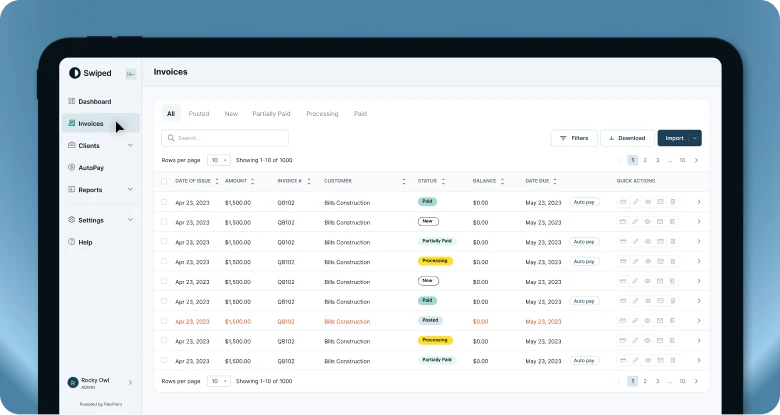


%2520(1)%2520(1).jpeg)
Your MRR is growing, headcount feels “about right,” and cash is there when payroll hits. That’s usually the moment an MSP starts feeling confident enough to make bigger financial moves, like planning hires, investing in new tools, or finally thinking a few quarters ahead instead of just collecting the next invoice.
Sales and staffing get you off the ground. Forecasting is what takes an MSP to the next level.
But forecasting only works when the numbers behind it are solid. This is the point where getting it wrong becomes expensive. If you head into Q2 with bad assumptions or an underestimated budget, the rest of the year is spent reacting instead of executing.
That’s why MSP forecasting must be rooted in reality, not optimism. Numbers based on hope are a quiet killer for SMBs, and MSPs are no exception. But hope isn’t the only thing that trips forecasts up. Most forecasting failures come from deeper technical and structural issues that don’t reveal themselves until something shifts.
And something always shifts.
For example, a vendor raises prices, or the project labor runs longer than planned. On paper, everything still looks fine, until cash tightens, margins feel thinner than they should, and leadership starts asking the same uncomfortable question: “Why didn’t we see this coming?”
That’s what this article is about: where MSP forecasting breaks down, why it happens so consistently, and how to fix it before it costs you real money or opportunities. We’ll go over revenue, expense, and cash flow forecasting specifically.
Why Forecasting Is Harder for MSPs Than Other Businesses
Forecasting works best when revenue and costs behave predictably and show up on a clean, regular schedule. But MSPs don’t get that luxury. Most operate in an environment where very little behaves the same way month to month.
Recurring revenue grows steadily, but project revenue arrives in spikes. Licensing costs scale with seats. Labor costs lag behind workload. Tooling creeps up quietly. The scope expands faster than the contracts get updated. None of this is unusual.
And that complexity isn’t a management failure. It’s simply the nature of the MSP model. Some pain can be reduced with better billing and automation, but the variability itself doesn’t go away.
The real problem starts when an MSP tries to forecast like a traditional SMB. When everything is modeled as if revenue, labor, and costs move together, forecasts look stable on paper while risk expands under the surface.
According to Service Leadership’s MSP benchmarks, recurring managed services revenue behaves fundamentally differently from project and resale revenue, both in margin and predictability, which is why top-quartile MSPs segment financial data aggressively before forecasting anything meaningful.
What to Evaluate Before You Start Financial Planning
Before we get into some of the deeper reasons why your forecasting may be failing, it’s important to acknowledge that your plans are only as good as your foundation.
If these two things aren’t in place, no plan will give you reliable answers, no matter how much time you spend refining it:
Revisit your Chart of Accounts
Your financial plan doesn’t fail in a vacuum. It fails quietly, upstream, and inside the chart of accounts.
Your P&L report can only report what your chart of accounts (COA) allows it to see. And your forecast can only model what your P&L makes visible. So when revenue is collapsed into generic buckets, labor is blended across roles, or specific expenses are buried in overhead, your forecast cannot be successful.
That’s why forecasting meetings at MSPs so often turn into debates instead of decisions. Leadership senses that something is off, but no one can prove it with numbers, because the numbers themselves are built on a distorted structure.
If you want to know how to improve your chart of accounts, read about that here.
Or discover more financial best practices to avoid a distorted relationship with your finances and forecasting with our Common Financial Challenges for MSPs webinar with MSP finance experts Matt Zaroff and Dean Trempelas.
Perfect Your Budgeting
A forecast is a forward-looking comparison against an expected baseline. Without a budget, there is no baseline, only momentum. That’s why so many MSP forecasts quietly normalize poor performance instead of surfacing it; shrinking margins in a budget becomes a norm in the industry instead of a sign of something greater being wrong.
MSP-focused advisory firms consistently emphasize that high-maturity providers treat budgets as operational guardrails, not accounting formalities. Service Leadership and Bering McKinley both point out that the most predictable MSPs build budgets around fully burdened labor costs, target utilization, and delivery cost per client, then forecast deviations from that plan rather than guessing at future outcomes.
A forecast built on clear budget plans for future growth while also exposing where the business is drifting off course, giving you enough time to correct it. If you don’t have a strong budget set firmly in reality, you won’t be able to do this.
The Steps to Running an Effective MSP Forecasting Review
Step 1: Model MSP Revenue by Behavior, Not Totals
Forecasting total revenue works in businesses where all revenue behaves the same way. As already mentioned, MSPs are not one of those businesses.
Managed recurring revenue grows slowly and compounds, while project revenue is episodic and unpredictable. The ins and outs of your revenue are battling each other in different capacities. So when these are forecasted together, supposed volatility disappears while risk quietly accumulates underneath.
Service Leadership benchmark data consistently shows that top-quartile MSPs maintain 50%+ gross margins on managed services, while project margins fluctuate dramatically month to month, often swinging by 20 percentage points or more depending on scope control and utilization. Blending these revenue types into a single forecast creates a false sense of stability that masks margin exposure.
This is why MSPs often experience “surprise” margin drops during periods of growth. Your MRR did not suddenly drop off, but your plan misunderstood what kind of revenue it was modeling.
Effective forecasting starts by respecting MSP’s revenue behavior:
- MRR should be modeled for churn, expansion, and compounding growth
- Projects should be forecasted conservatively and treated as opportunistic upside
- Hardware and licensing should be modeled for cash and margin impact separately
Step 2: Forecast IT Labor Costs Based on Utilization and Hiring Lag
Labor is often the largest expense in an MSP and also the least accurately forecasted.
The reason is timing. Labor costs rarely rise at the same moment the workload increases. Utilization creeps up first, but then ticket queues lengthen. Projects start overrunning, and engineers stretch themselves to meet bigger demands. Only then does hiring begin, and even then, new hires take months to reach full productivity.
Forecasts that assume labor scales evenly with revenue consistently wildly understate future costs. For example, an MSP may add three new managed clients in a quarter and see utilization jump from 78% to 90%, but payroll doesn’t increase until months later when ticket backlogs and project overruns force a hire; by the time the new engineer is onboarded and productive, margin has already been compressed for an entire quarter.
There’s no catastrophic failure, just a slow and steady disconnect between work performed and labor added to support it.
Accurate labor forecasting accounts for:
- Utilization thresholds that trigger hiring decisions
- Hiring delays of 30–90 days
- Onboarding inefficiencies before new hires reach billable capacity
Step 3: Treat MSP Tooling Costs as Variable, Not Fixed
Tooling costs feel predictable…until growth exposes how variable they really are.
Most MSP delivery tools scale directly with endpoints, users, or consumption, so that as clients grow, security stacks expand, backup footprints widen, cloud usage spikes, and vendors inevitably reprice contracts.
Industry research from SaaS Capital and Vendr shows that SaaS vendors have increased prices by an average of 8–12% annually over the past several years, driven by bundling, contract restructuring, and usage-based pricing models. MSPs that forecast tooling as flat overhead rarely see margin compression coming until after it’s already happened.
This is why revenue growth so often fails to translate into profit growth. The forecast never modeled delivery infrastructure scaling alongside the business. Make sure to account for your own growth and tooling needs with the natural increase in prices.
More accurate forecasts treat tooling as a variable input:
- Cost per endpoint or user
- Expected client growth
- Annual vendor price inflation assumptions
Step 4: Forecast Cash Flow Timing Separately From Revenue
Many MSP forecasts appear solid until the bank account tells a different story.
That disconnect almost always comes down to timing. (Maybe you’ve noticed a pattern by now.) Revenue recognition doesn’t equal cash collection. Delayed invoicing, milestone-based projects, postpaid licensing, and stretched receivables all distort cash flow, even when revenue forecasts look strong.
MSPs often find themselves profitable on paper while still feeling constant cash pressure because the forecast never accounted for when money actually hits the bank.
Reliable forecasting incorporates:
- Days-to-invoice assumptions
- Days-to-collect trends
- Prepaid versus postpaid revenue mix
FlexPoint is built to eliminate those timing gaps by automating invoicing, collections, and payment workflows for MSPs, turning fragmented billing processes into predictable cash flow as the business scales.
In one example, Excellent Networks cut average days-to-payment from 25 to 5 by automating billing and collections. When cash timing becomes predictable, forecasts stop breaking down at the bank account.
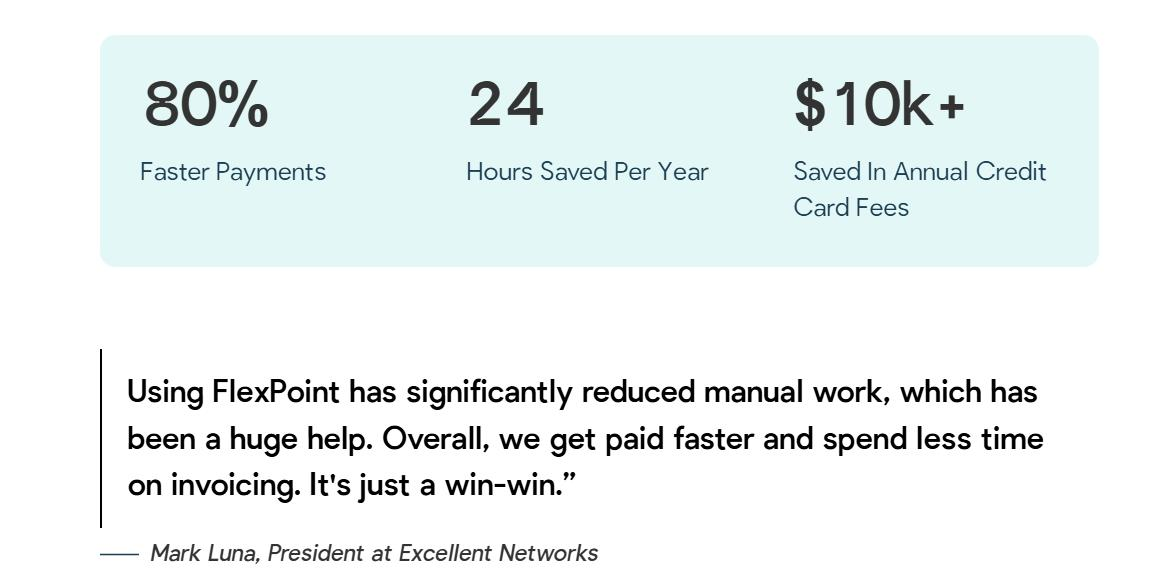
When cash mechanics are forecast alongside revenue, financial surprises stop being surprises.
Step 5: Plan From Operational Drivers, Not a Historic Number
If you start with a single revenue number, your forecast is already wrong.
MSP revenue changes because something operational changed, like endpoint counts, ticket volume, utilization, pricing, or project flow. But driver-based forecasting models take those inputs directly instead of spreading last year’s revenue across future months. This is why MSP finance platforms consistently recommend forecasting managed services, projects, hourly work, and resale separately: each behaves differently and carries different margin risk.
If your forecast can’t explain why a number changed, it can’t support a decision.
Step 6: Tighten the Connection Between Your PSA and Financials
If your PSA and chart of accounts don’t line up, your forecast will never reconcile to reality.
Service items, time entries, and billing rules in the PSA need to map cleanly to financial categories in the GL. When they don’t, forecasts drift, variances become noise, and problems surface too late. High-maturity MSPs design their financial structure so operational data flows straight into reporting without translation.
Forecasts only work when delivery data and financial data speak the same language.
How to implement: create a one-to-one mapping table between PSA service SKUs and GL accounts and automate exports (or use an integration) so month-to-month comparisons are consistent.
How to Fix MSP Forecasting? Align Inputs With Operations
When MSP forecasting breaks down, it’s rarely because leaders aren’t paying attention or aren’t “good with numbers.” It breaks down because the forecast is built on inputs that don’t reflect how MSPs actually operate.
As we mentioned above, a few forecast killers are: Revenue is blended instead of behavior-based, Labor is modeled too early or too simply, tooling is treated like overhead instead of delivery infrastructure, and cash timing is assumed instead of measured.
Put all of that into a spreadsheet, and the math will still work, but the story it tells will be wrong.
The good news is that MSP forecasting doesn’t require more complexity. It requires a better structure. When your PSA, COA, budget, and operational drivers line up, forecasting stops feeling like educated guessing. It becomes a planning tool you can trust completely.
If your forecasts have ever looked right on paper but felt wrong in practice, that’s not intuition; it’s a warning sign. And it’s usually pointing upstream.
If you want to go deeper into the real-world financial challenges MSPs run into (and how experienced MSP finance leaders actually address them), watch the Common Financial Challenges for MSPs webinar with Matt Zaroff and Dean Trempelas. They break down where MSP numbers most often lie, why forecasting fails quietly, and what to fix first before it costs you margin, cash, or control.
Because forecasting shouldn’t be something you hope is right, it should be something you know is grounded in reality.
FAQs
Why is MSP forecasting harder than forecasting for other businesses?
MSPs have multiple revenue types, lagging labor costs, variable tooling expenses, and inconsistent billing timing that make traditional forecasting models unreliable.
What are the most common mistakes MSPs make when forecasting?
MSPs most often forecast total revenue instead of revenue types, underestimate labor lag, treat tooling as fixed overhead, and ignore cash collection timing.
How should MSPs forecast labor costs?
Labor should be forecast using utilization thresholds, hiring lead times, and productivity ramp-up rather than as a fixed percentage of revenue.
Should MSP tooling and licensing be forecast as COGS or overhead?
Tools and licensing required to deliver services should be forecast as variable COGS, so margin compression is visible as the business grows.
Why do MSPs feel profitable but still struggle with cash?
Because revenue recognition does not reflect when cash is collected, delayed billing and collections often break cash predictability.
What is driver-based forecasting for MSPs?
Driver-based forecasting models the operational inputs—like endpoints, tickets, utilization, and tool cost per client—that actually cause financial outcomes.
How often should MSPs update their forecasts?
High-maturity MSPs use rolling forecasts updated monthly or quarterly instead of relying on static annual models.