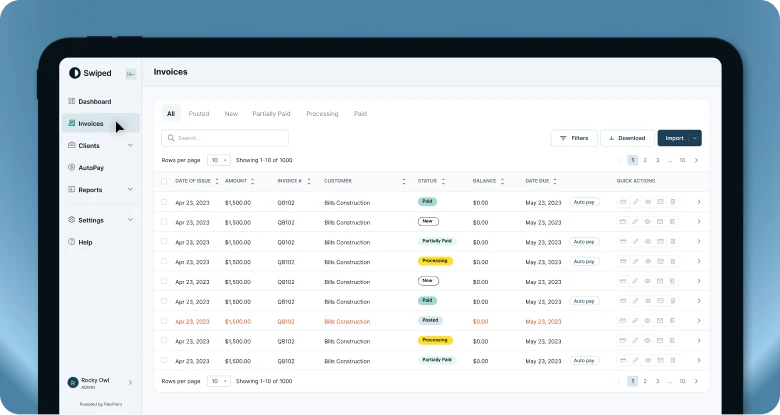



According to statistics from UserGuiding, 63% of customers consider the onboarding period when deciding to subscribe to a service or purchase a product.
A 2022 McKinsey study also found poor customer onboarding, engagement, and customer service are the top reasons customers churn.
For MSPs, client onboarding is a vital point of contact. It shapes the basis for mutual success and sets the tone for long-term client relationships. They depend on a flawless, disciplined onboarding process to ensure client happiness, minimize turnover, and optimize operational efficiency.
From service activation to payment integration and beyond, effective onboarding guarantees clients completely grasp and interact with your services.
With simplified yet powerful payment systems, MSPs may eliminate common onboarding friction points, improve financial transparency, and create lifelong client relationships.
This article will discuss the critical components of a successful client onboarding program, common challenges and strategies to overcome them, and the transformative power of integrated payment systems.
10 Common Payment-Related Challenges During Client Onboarding
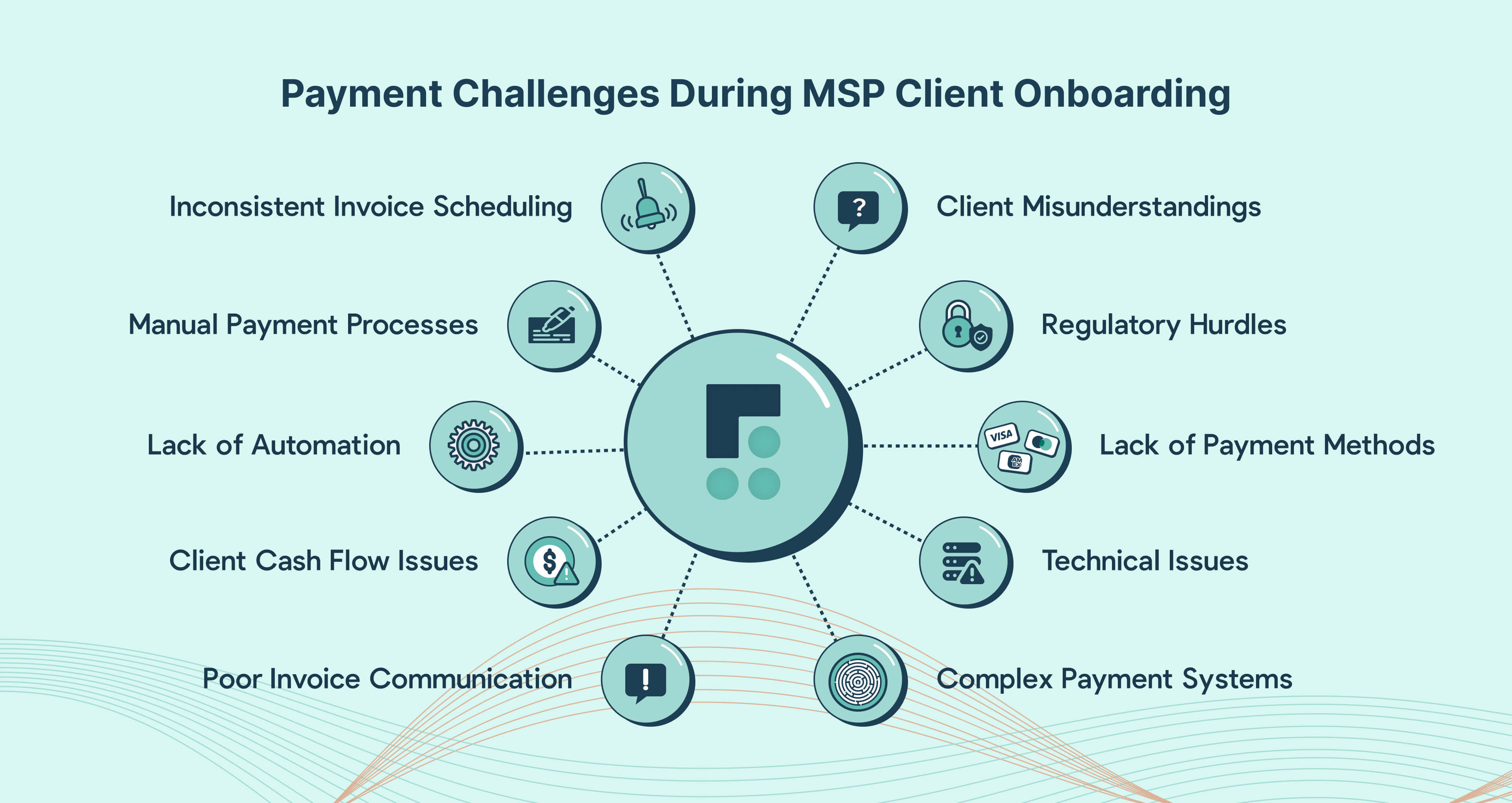
Implementing a more efficient onboarding process that includes comprehensive details about automated invoicing and proactive cash flow management can set the tone for a positive client-MSP relationship.
Examining what successful onboarding practices have in common can help demonstrate the importance of a smooth onboarding process for new clients.
Specific components of onboarding processes are integral to their success. Each part ensures clients have a smooth transition, can optimize your services, and strengthens the relationship.
Addressing challenges during onboarding directly impacts client experience and retention.
Here are the ten most common payment-related challenges to address during client onboarding.
1. Inconsistent Invoice Scheduling:
Inconsistent invoice scheduling presents a challenge during onboarding. It can cause misunderstandings, damage client relationships, and result in late payments and cash flow problems.
Like you, clients depend on regular billing cycles to control their spending and cash flow.
Disruptions to this routine can erode confidence by disrupting their budgeting and planning. This problem frequently results from human payment error, manual billing procedures, or inadequate client-MSP communication.
2. Manual Payment Processes:
Manual payment processes could hold your business back in terms of time and financial resources.
Manual systems necessitate increased administrative effort, potentially hindering the onboarding process for both the MSP and the client. Manually tracking and processing payments can take up valuable time that could be better utilized in engaging with clients and fostering solid relationships.
A study from PYMNTS and American Express shows that businesses using manual payment processes take 30% longer to follow up on overdue payments than those using automated options.
Additionally, research from Ardent Partners found that invoice automation can be up to 80% faster than manually processing invoices.
Manual processes risk establishing an unfavorable precedent for future interactions, indicating an absence of efficiency or modern solutions.
Furthermore, as clients begin their journey with your services, manual processes may convey a sense of antiquated operations. This could diminish their confidence in your capacity to address their needs effectively.
The challenge intensifies as the business expands.
Overseeing a growing client base with manual payment processes becomes increasingly complex, which can result in missed deadlines, errors, and increased expenses.
3. Lack of Automation:
A lack of automation during onboarding can also challenge other MSP operations beyond payments.
Without automation, tasks like data entry, system monitoring, ticketing, and client support become manual procedures prone to inefficiencies and mistakes.
This might result in delays in addressing client concerns, irregularities in service provision, and higher operating expenses.
For example, manually handling client inquiries or IT system changes during onboarding might cause slow response times and lower overall satisfaction.
Furthermore, monitoring essential financial indicators, conducting thorough reporting, and effectively scaling services as clientele expands will be challenging without automation.
4. Client Cash Flow Issues:
Clients may have cash flow issues affecting their ability to pay on time. This is especially prevalent in startups or small businesses with little funding.
These cash flow issues can present a significant challenge during onboarding because client cash flow issues hinder a smooth start to the service relationship and your cash flow.
Balancing the aim to foster client growth with the need to sustain consistent revenue demands careful consideration and may entail extra administrative efforts, further complicating the onboarding process.
The initial financial challenge may affect client satisfaction as well as the long-term viability of the relationship.
5. Poor Invoice Communication
Ineffective invoice communication during the crucial onboarding phase can render the entire experience disorganized and challenging.
According to an Oracle report, 87% of customers receiving poor customer service choose to do business with a competitor. This highlights the significance of communication and clarity in retaining clients.
Poor invoice communication is a challenge during onboarding because it can lead to misunderstandings, delayed payments, and a shaky start to the client relationship.
When clients have difficulty accessing billing information, have unanswered questions, or receive unclear payment instructions, it undermines their trust in your capability to address their needs.
Clients might also view this as an indication of disorganization, which could raise concerns regarding the overall quality of service.
This challenge is further complicated by the importance of billing and payment clarity in sustaining a solid relationship — any lapses can significantly impact the partnership.
Establishing clear and reliable communication from the outset is essential for setting the appropriate tone; neglecting this can lead to diminished trust and potential client attrition.
6. Complex Payment Systems:
Complex payment systems pose a noteworthy challenge during onboarding because they can create friction, confusion, and frustration for clients just as they begin their relationship with your services.
Simplifying payment procedures early on ensures a smooth transition and minimizes potential points of payment friction for new clients.
Salesforce research found that 74% of people are likelier to take their business elsewhere if the purchasing process is too complex.
A streamlined payment system should offer a simple, user-friendly interface, multiple payment options, and a straightforward process for completing transactions.
Complex or burdensome payment systems create payment friction for clients, slowing down the payment cycle and disrupting cash flow.
Requiring clients to navigate multiple platforms, complete extensive forms, or follow complicated steps to process payments may inadvertently deter timely transactions.
If your MSP implements a straightforward, intuitive checkout system, you reduce friction and increase the likelihood of clients completing their payments without hesitation.
7. Technical Issues:
A lack of proactive troubleshooting and fast resolution of technical difficulties hinders the onboarding process. This may leave clients feeling neglected and uncertain about the service they are engaging with.
MSPs will struggle to perform frequent system testing and offer responsive technical help throughout onboarding without dependable technology solutions.
Under these circumstances, establishing a positive client relationship becomes increasingly challenging, which may affect long-term satisfaction and retention.
According to Salesforce data, 80% of consumers report that fast replies from customer service influence their loyalty, underlining the necessity of effective support.
8. Lack of Payment Methods:
Clients expect a smooth and accommodating onboarding experience, and payment flexibility is pivotal. Clients may feel underserved when payment options are limited or not presented, increasing the risk of delayed payments or even client attrition.
A 2023 TreviPay survey reports that 72% of B2B buyers are more loyal to a business that offers their preferred payment method.
Offering limited payment methods can make it difficult for clients to meet their financial responsibilities. Alternatively, providing several payment methods allows clients to select the option that best meets their needs.
Without multiple payment options, such as credit cards, ACH transfers, and digital wallets, it is impossible to cater to diverse client preferences and make payments convenient.
If you do not stay current on industry standards and payment trends, offering clients the payment methods they want will be even more challenging.
For example, there is an increasing demand for ACH payments. In 2019, they made up 32.2% of the B2B transaction value; by 2024, this value had grown to 47.9%.
If your MSP doesn’t offer this payment method, you risk losing clients to businesses that do.
9. Regulatory Hurdles:
Compliance with industry regulations, including data security and privacy standards like the Payment Card Industry Data Security Standard (PCI DSS), can complicate payment processing and slow client onboarding.
PCI DSS is a set of security standards formed by the Payment Card Industry Security Standards Council (PCI SSC). They apply to companies that accept, store, process, or transmit credit card information.
These standards ensure that these companies maintain a secure environment for cardholder information to prevent threats such as identity theft and fraud.
PCI DSS compliance is essential not only for security but also to avoid potential penalties.
These can be as high as $500,000 per violation of PCI standards. Security and compliance are also important to clients and help build trust with those prioritizing data safety.
The onboarding process is an excellent opportunity to discuss how your payment platform supports PCI compliance. This can give clients a sense of security and confidence in your services.
FlexPoint offers a secure payment portal, and leverages validated third-party providers to handle sensitive cardholder data, significantly reducing your compliance burden.
Take the time during onboarding to educate clients on your commitment to strong compliance practices—such as data encryption, secure authentication protocols, and regular security audits.
Clients will appreciate knowing their sensitive data is handled with the utmost care and that their MSP is taking every precaution to safeguard it.
10. Client Misunderstandings:
Misunderstandings regarding invoices, service inclusions, or payment terms during onboarding might result in disagreements and delays.
When clients are unclear about invoices, service inclusions, or payment terms, it undermines the initial trust needed for a successful partnership.
For example, a client might assume that all IT support services are covered by their plan, only to be presented with a separate bill for further work.
These misconceptions can damage confidence and cause conflict between the MSP and the client.
According to data from Wyzowl, 86% of consumers report that they would be more likely to stay loyal to a business that invests in onboarding content to welcome and educate them after purchasing.
This emphasizes the importance of education and transparency to prevent client misunderstandings and establish trust.
9 Proven Ways to Enhance Client Onboarding With a Streamlined Payment System
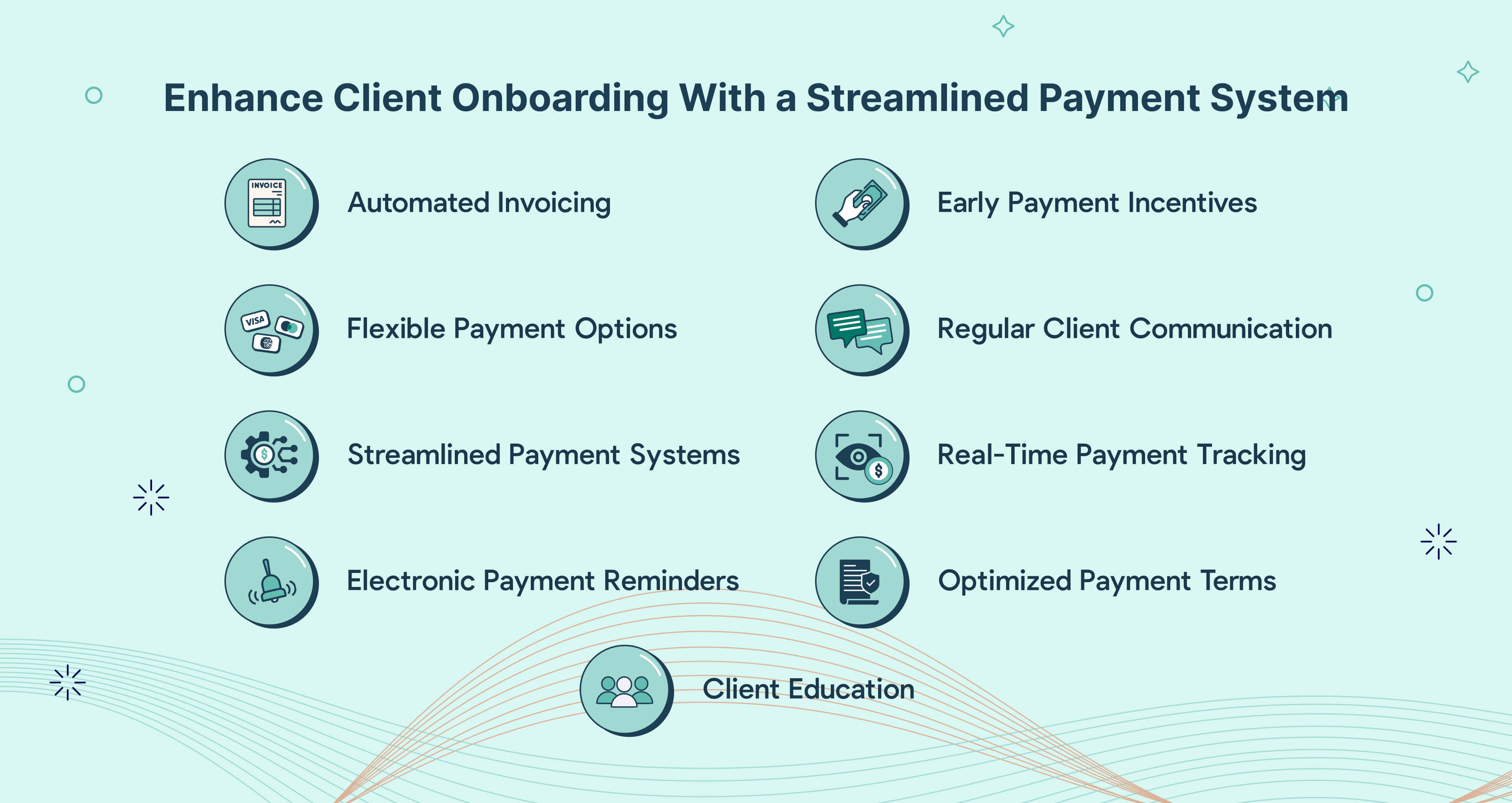
Integrating payment systems into onboarding has several benefits, from increased client satisfaction and financial transparency to more straightforward billing.
These tasks are streamlined by programs like FlexPoint, which lessen administrative strains and provide a seamless client experience.
Here are nine ways integrated payment systems enhance your client onboarding process.
1. Automated Invoicing:
According to statistics from UserGuiding, 97% of businesses believe good user onboarding is essential for effective product growth.
Automated invoicing is integral to this process as it lowers payment friction. Automation also fosters trust by offering clients a predictable and professional billing experience.
As explained earlier, automated invoicing solutions minimize manual errors, reduce administrative workload, and deliver invoices on a set schedule.
Automated invoicing systems can monitor payment statuses, send reminders, and provide real-time information.
Introduce automated invoicing during client onboarding to help clients understand what to expect and reduce confusion about billing schedules and payment timelines.
Explain how the system works—such as automatically generating and sending invoices at set intervals—to help clients maximize the benefits of automated invoicing.
2. Flexible Payment Options:
During onboarding, flexible payment arrangements can be introduced to accommodate specific client circumstances, such as seasonal revenue fluctuations or cash flow challenges.
Flexible, tailored payment terms, such as installment plans or early payment discounts, can strengthen client relationships.
In one Salesforce report, 58% of surveyed consumers report that obtaining a tailored experience is essential when interacting with a brand. Providing customizable payment alternatives contributes to an outstanding client experience.
With customizable payment options, including flexible due dates, installment payments, or even incentives for early payment, your MSP can meet clients where they are.

In effect, you make their experience with your services more personalized and meaningful.
For instance, if a small business client experiences seasonal revenue fluctuations, offering an adjustable payment schedule during slower months can alleviate financial pressure and build goodwill.
According to Atradius's 2023 Payment Practices Barometer survey, 55% of all B2B invoiced sales in the United States are overdue.
Data from QuickBooks also reports that 89% of mid-sized businesses say late payments hinder their growth.
Late payments reduce your MSP's cash flow, making it difficult to pay staff, cover bills, and maintain business operations.
Fortunately, customizable payment terms also reduce the likelihood of payment delays, as clients are more likely to adhere to arrangements that fit their cash flow and financial planning.
3. Streamlined Payment Systems:
Data from Testlio reports that 80% of consumers prioritize a smooth payment process over other eCommerce features.
The data also reports that streamlined payment systems increase customer retention by 15-20%.
Clients should be able to access, manage, and pay their invoices via a simple and user-friendly platform. The simpler this payment process is, the more straightforward your onboarding process will be.
This speeds up the onboarding process and also eases the strain of administrative tasks for both clients and MSPs.
A simplified payment system minimizes obstacles, ensuring new clients can quickly become familiar with your services and make payments without hassle.
For example, when you integrate your billing systems into a single interface, clients can access all necessary information without navigating various platforms or re-entering card data each time they pay.
These features proved invaluable for IT Vortex when the MSP switched to FlexPoint.
Before then, IT Vortex faced considerable challenges with its outdated invoicing system, which required clients to leave the IT Vortex site to complete payments through PayPal.
This process resulted in various obstacles, including clients paying processing fees that became disproportionately high for larger invoices.
The added costs disrupted relationships, particularly with larger clients who believed the procedure was unfair and inefficient.
Furthermore, payments being attributed to PayPal rather than IT Vortex confused and frustrated clients and complicated financial administration.
To address these difficulties, IT Vortex switched to FlexPoint's streamlined payment system. The new system provided clients with a secure, password-free portal for viewing and paying invoices online.
FlexPoint's AutoPay function encouraged prompt payments, while the QuickBooks integration facilitated fast payment reconciliation. This automation eliminated manual data entry, dramatically reducing IT Vortex’s administrative time and costs.
The outcomes were transformative.
IT Vortex reduced payment cycles by up to 30x, enhancing cash flow and operational efficiency.
By eliminating manual invoice administration, IT Vortex saved over $15,000 monthly in invoice fees and reclaimed 60 hours of staff time per year.

4. Early Payment Incentives:
During the onboarding process, explain the availability of early payment discounts and how they work to ensure clients understand how to take advantage of these savings.
Your clients will appreciate you offering financial incentives that help them save money and manage their cash flow more effectively.
Offering early payment incentives can have a tangible impact on improving cash flow and reducing the time it takes to receive payments.
According to PayStand data, companies that utilize early payment discounts see a 15% reduction in their average days payable outstanding (DPO).
For example, you might consider offering a 5% discount on invoices paid within 10 days. This will increase your cash flow and please your clients.
5. Regular Communication:
Maintaining continuous communication during and after onboarding is critical for a successful client relationship.
For instance, sending upcoming payment reminders, providing payment confirmations, or alerting clients to any changes in billing terms fosters transparency and reliability in the client-MSP relationship.
During onboarding, set clear expectations about communication protocols and ask clients about their preferred contact methods—email, phone calls, or a client portal.
Putting the client first demonstrates your commitment to their satisfaction, which benefits your client retention rates.
According to UserGuiding, companies that put customer experience at the center of their business plan report almost two times higher annual growth in:
- Customer retention
- Repeat purchase rates
- Customer lifetime value
Harvard Business Reports that increasing customer retention rates by as little as 5% can increase profits by up to 25% to 95%.
Proactive and personalized communication during onboarding and beyond not only helps clients feel valued but also:
- Strengthens client relationships
- Reduces payment delays
- Supports client retention and growth
6. Real-Time Payment Tracking:
Real-time payment tracking adds a crucial degree of transparency for both clients and MSPs by providing quick access to transaction statuses. Demonstrating the power of this feature during onboarding further strengthens client relationships.
Automation also revolutionizes payment management by removing the burden of manual reconciliations.
Automation optimizes processes that previously required significant time investment, including aligning payments with invoices, rectifying errors manually, and pursuing outstanding balances.
As a result, MSPs benefit from improved cash flow management, helping them confidently make business decisions.
During onboarding, educate clients about the convenience of monitoring and managing their payments through clear, accessible updates.
tekRESCUE, an IT provider based in Texas, is a compelling example of how real-time payment tracking can transform operations.
As tekRESCUE’s business expanded, managing payments and collections became increasingly challenging.
Using QuickBooks proved costly and inefficient.
Its high monthly fees did not justify the time-consuming process of maintaining recurring payments, paused accounts, and different payout methods across multiple spreadsheets.
Seeking a more efficient and cost-effective solution, tekRESCUE turned to FlexPoint.
FlexPoint’s automated invoicing and real-time payment tracking seamlessly integrate with tekRESCUE’s billing processes.
Now, invoices are generated automatically weekly, daily, or hourly.
TekRESCUE receives alerts for every payment, failed transaction, or message, helping them take timely action.
This level of automation and tracking has reduced administrative tasks by 75%, saving tekRESCUE 20 hours each month.
FlexPoint’s secure payment portal also enables tekRESCUE to securely store client credit card and banking information, reinforcing trust and reducing payment friction.
Clients no longer need to re-enter their payment details for each transaction—all payment documents are centralized. Clients can easily view invoices, review upcoming payments, and update payment details.

Automation and real-time payment tracking significantly improved tekRESCUE's cash flow management. By providing accessible and transparent payment solutions, they also enhanced client satisfaction.

7. Electronic Payment Reminders:
We’ve touched on the importance of proactive communication, including upcoming payment reminders, for positive client relationships.
However, using electronic payment reminders offers other benefits, too.
During onboarding, MSPs can introduce clients to electronic payment reminder options. Take the time to explain how these reminders help them stay current with payments and avoid potential disruptions to service.
By familiarizing clients with these reminders early on, MSPs effectively mitigate the risk of missed or late payments, thereby preventing service disruptions and maintaining solid relationships.

This proactive strategy establishes clear expectations and equips clients with the necessary tools to manage their cash flow.
A 2019 Journal of Consumer Affairs study examined the effect of payment reminders.
8. Optimized Payment Terms:
Defining precise and efficient payment terms during onboarding is essential for cultivating an effective financial relationship with clients.
Payment terms specify the due dates, acceptable payment methods, and any relevant fees or discounts, thereby ensuring clarity and structure.
Optimized terms can decrease ambiguity, improve cash flow predictability, and reduce payment delays.
Regularly assess and adjust payment terms to ensure they are relevant and advantageous to both parties.
For example, offering net 30 payment terms may be advantageous for certain clients, stipulating that payments are due 30 days after the invoice.
Conversely, others may find net 15 arrangements or early payment discounts more beneficial.
Flexible terms, including dividing substantial payments into manageable monthly installments, can mitigate client cash flow issues and promote goodwill.
During onboarding, explicitly convey the payment terms, including any incentives or penalties linked to prompt or late payments.
Moreover, establishing terms that align with clients' needs demonstrates the MSP's attentiveness and readiness to collaborate for mutual advantage.
9. Client Education:
Finally, client education is a cornerstone of effective onboarding for MSPs.
If you educate clients during onboarding, this effort can serve as the foundation for a mutually beneficial relationship.
Educating clients on payment procedures can enhance engagement, decrease late payments, and elevate overall satisfaction.
Clients with a comprehensive understanding of payment processes, invoice management, and automated reminders are more inclined to engage with and gain advantages from your payment systems.
According to a TSIA study, 68% of customers report using products more after training.
Providing detailed guides, live demonstrations, or interactive tutorials on navigating your payment portal, setting up automated payments, and accessing real-time tracking features can demystify the process for clients.
This proactive strategy improves financial transparency, decreases late payment rates, and helps minimize payment friction.
For example, clients can manage their cash flow more effectively by leveraging automated payment reminders and flexible payment options.
Conclusion: Transforming MSP Client Relationships with FlexPoint

A well-structured client onboarding process lays the groundwork for lasting, successful relationships between MSPs and their clients.
By addressing key challenges like inconsistent invoicing, complex payment procedures, and cash flow concerns, MSPs can create a successful onboarding journey that builds trust and fosters loyalty.
FlexPoint serves as a valuable partner in this journey.
With features like automated invoicing, flexible payment options, secure portals, and real-time tracking capabilities, FlexPoint simplifies processes and provides meaningful value to MSPs and their clients.
MSPs can streamline administrative tasks, improve client satisfaction, and concentrate on core services instead.
FlexPoint’s integration with MSP business models goes beyond payment processing; it reshapes client engagement strategies and operational efficiency.
Revolutionize your MSP's client onboarding experience with FlexPoint's automated payment solutions.
Discover how our integrated systems can enhance efficiency and client satisfaction.
Visit our website or contact us today to learn more and schedule a demo.