
MSP Accounting
FlexPoint vs Other Accounts Receivable Automation Software: Which Is Best for MSPs?


.png)
Managed service providers (MSPs) evaluating accounts receivable (A/R) automation software often encounter generic tools that only solve part of the problem. Many platforms offer basic invoice reminders or payment portals, but they don’t cover the full receivables workflow an MSP needs.
Beyond simple invoices, finance teams at MSPs handle recurring service contracts, usage-based billing, and complex projects.
Generic A/R tools struggle to align with PSA (professional services automation) software data and often lack deep integration with accounting systems.
For example, they might send invoice emails or accept online payments; however, they fail to automate collections, reconciliation, and real-time reporting across systems.
MSP finance teams require more than just a “Pay Now” button or a simple reminder email. Instead, they need automation that mirrors their business models and keeps everything in sync with their PSA and accounting software.
In this article, we compare FlexPoint with other accounts receivable automation tools and explain why MSP-specific automation drives faster payments, fewer errors, and stronger cash flow.
We’ll explore the shortcomings of generic solutions and demonstrate how FlexPoint’s MSP-focused workflows fill those gaps.
{{toc}}
Why MSPs Compare Accounts Receivable Automation Solutions
What starts as a straightforward monthly invoice process quickly becomes a web of recurring charges, usage-based fees, project work, and software pass-through costs—all of which need to be tracked, sent, and collected on time.
At the same time, MSPs are under pressure to keep cash flowing, reduce billing errors, and reconcile payments without spending hours each week on manual tasks.
That’s when MSPs start looking beyond basic invoicing tools and begin comparing accounts receivable automation platforms.
Below, we outline the most common reasons MSPs begin evaluating their options:
1. Rising A/R Aging:
Late client payments create significant cash-flow pressure for MSPs. Over time, overdue invoices pile up, tying up capital that MSPs need for payroll, vendor invoices, and growth initiatives.
In fact, 86% of businesses report that up to 30% of their monthly invoiced sales are regularly overdue, a situation that drains cash flow and falls far outside the healthy norm.
When such a high portion of revenue is delayed, MSP owners feel the squeeze on working capital and profitability.
2. Manual Follow-Ups:
Too often, finance teams spend hours each week chasing down unpaid invoices. They send reminder emails, place phone calls, and track responses on spreadsheets.
This manual follow-up is time-consuming and error-prone. A recent PYMNTS study found that 81% of businesses have to contact clients multiple times to collect a single overdue invoice.
For MSPs with dozens or hundreds of clients, this labor-intensive process isn’t sustainable. It diverts valuable time away from strategic financial management and forces staff to act as debt collectors.
3. Billing Complexity:
MSP billing is rarely one-size-fits-all.
A typical MSP may bill recurring managed services at a fixed monthly rate, usage-based services (such as cloud licenses per user), one-time project fees, and pass-through costs for hardware or software, sometimes all on the same invoice.
This complexity increases the risk of errors when done manually. Invoices might miss usage charges or miscalculate tiered pricing.
Finance teams wrestling with multiple billing models often resort to spreadsheets and manual checks. This slows down the billing cycle and can lead to mistakes.
The more complex the billing, the more likely an MSP is to seek an automation solution that can handle all these scenarios accurately.
4. Disconnected Systems:
One of the biggest challenges is keeping systems in sync.
MSPs rely on a PSA platform to manage services and time entries, a separate accounting system (such as QuickBooks or Xero) for financials, and, in some cases, standalone payment tools.
When these systems don’t communicate with one another, data falls through the cracks. An invoice created in the PSA might not match what’s recorded in accounting. Payments received via a portal might not update the PSA contract status.
Disconnected systems lead to duplicate data entry and manual fixes for discrepancies. This not only wastes time but also causes reporting errors.
5. Reconciliation Pain:
Even after an MSP receives payments, tracing them back to invoices and bank deposits can be a headache.
Without automation, bookkeepers must manually match each payment (and deduct processing fees) to the correct invoice in accounting software.
Partial payments or batched deposits from credit card processors further complicate matters. The result is often hours spent every month reconciling bank statements with invoice records.
A study by Modern Treasury found that over a third of finance teams spend about 9 hours per month on reconciliation.
For MSPs, that’s time that could be better spent on financial analysis or client service. Rising transaction volumes only amplify the reconciliation burden if there isn’t an automated solution in place.
6. Scalability Needs:
As an MSP grows, the volume of invoices and payments grows with it. A process that worked with 20 clients may break down with 200 clients.
Many MSPs start by using native features of their accounting software or PSA for billing and collections.
However, as they scale, MSPs find that those basic tools don’t automate enough of the workflow.
Instead, they need a solution that can handle sending thousands of invoices, processing automated payments at scale, and providing real-time visibility into hundreds of receivables.
MSPs compare A/R automation solutions when their current process can’t keep up with growth. They look for a platform that eliminates manual work and supports their expansion without requiring a proportional increase in headcount.
What to Look For When Evaluating an MSP-specific A/R Automation Solution:
When comparing A/R solutions, MSPs should evaluate a few key capabilities:
- Support for all billing models: The software must seamlessly handle recurring subscriptions, usage-based fees, one-off projects, and pass-through expenses.
- Automated collections and AutoPay: The ability to automatically charge clients (with their permission) on due dates and send scheduled reminders for late invoices.
- Deep integration with PSA and accounting systems: This ensures invoices, payments, and credit memos sync in both directions to avoid data mismatches.
- Real-time A/R visibility and accurate reconciliation: The solution should provide finance leaders with an up-to-date view of who has paid and automatically reconcile payments to the books.
Keeping these criteria in mind helps MSP decision-makers identify which platform best meets their needs.
Next, we’ll look at how FlexPoint compares side-by-side with some common A/R tools in the MSP space, and where those generic tools often fall short.
FlexPoint vs Other Accounts Receivable Automation Tools: Side-by-Side Comparison
Many MSPs begin their search for A/R automation tools by looking at popular accounting or payment solutions such as QuickBooks, Xero, ConnectBooster, or WisePay.
While these tools offer useful features, they often automate only pieces of the accounts receivable process. MSP-specific challenges, such as aligning with PSA data or handling complex contract billing, reveal gaps in these generic platforms.
Below is a comparison of FlexPoint versus these other tools.
Throughout this comparison, you will see how FlexPoint provides a more comprehensive solution for MSP billing and collections.
1. FlexPoint vs. QuickBooks (Native A/R Tools)
QuickBooks (including QuickBooks Online) is primarily an accounting software with basic A/R functions. The software allows MSPs to create invoices and record payments; however, it provides only rudimentary automation.
For example, QuickBooks can send invoice emails and let clients pay online. However, many users report that it lacks advanced collections workflows.
For example, payment reminders are limited to 5 schedules only. Beyond that, users need to manually create a new schedule each time they want to send copies of all open invoices to all clients.
QuickBooks also doesn’t offer AutoPay (automatic charging of saved payment methods on a schedule) out of the box, which many MSPs use to ensure recurring services are paid on time.
To enable AutoPay in QuickBooks, users must subscribe to QuickBooks Payments, an add-on not included by default.
Another limitation is the lack of MSP-specific billing logic.
The software was not built to automatically calculate tiered pricing, pull in usage data from an MSP’s PSA, or handle pass-through expenses in a single workflow.
An MSP using QuickBooks alone often ends up doing those calculations outside the system and then inputting summary invoice lines.
QuickBooks Payments doesn’t offer native connections to PSA platforms such as ConnectWise PSA, Autotask, HaloPSA, and SuperOps. Because of this, key service data, such as ticket entries, device counts, or changes to contract terms, won’t automatically appear in your invoices.
While it’s possible to sync these tools using third-party connectors, doing so introduces more complexity. MSPs must either re-enter data manually or rely on middleware that can break, misalign fields, or fail to update in real time.
These gaps can lead to incorrect invoices, billing delays, and extra admin work for your finance team.
FlexPoint removes these issues by directly connecting your PSA and QuickBooks accounts.
The platform pulls real-time data from your PSA, builds invoices based on current agreements and usage, and pushes those records into QuickBooks for accounting, without relying on external sync tools.
In addition, FlexPoint handles collections and client AutoPay, and tracks invoice activity, including when emails are opened.
The platform serves as the A/R layer between systems. FlexPoint ensures that MSPs send accurate invoices, get paid on time, and avoid the overhead of patching together disconnected tools.
Flexpoint also brings in MSP billing intelligence.
For instance, FlexPoint can generate invoices based on PSA agreements, automatically apply tiered pricing or per-user fees, and then push them to QuickBooks.
Moreover, FlexPoint gives MSPs control over payment processing fees (including compliant surcharge options to pass on credit card fees), which QuickBooks Payments does not natively support.
QuickBooks alone is a basic tool, whereas FlexPoint + QuickBooks delivers a full A/R automation solution.
2. FlexPoint vs. Xero-Based A/R Tools
Xero is another popular accounting platform used by some MSPs.
Like QuickBooks, Xero excels at general ledger, reporting, and basic invoicing. However, it is not an MSP-specific A/R automation tool.
Out of the box, Xero has limited or no built-in PSA integration for MSP billing data.
If an MSP uses Xero, they typically rely on separate integration tools (such as Wise-Sync or custom connectors) to get invoices from a PSA into Xero. This reliance means more moving parts and potential points of failure.
Similarly, Xero doesn’t provide as robust collections automation.
You can send invoice reminders; however, advanced features such as configurable dunning schedules, automated payment retries, or tailored communications for different client segments are not part of Xero’s core offering.
Another challenge is that Xero often requires multiple add-ons to meet MSP needs.
For instance, an MSP might use Xero for accounting, but then add a separate payment portal or use a tool such as GoCardless for direct debit, and another add-on for automated reconciliation.
All of these pieces can increase cost and complexity. FlexPoint centralizes these functions into one workflow.
With FlexPoint, MSPs using Xero can let FlexPoint handle the billing, collections, payment processing, and reconciliation. However, Xero remains the system of record for accounting.
FlexPoint integrates directly with Xero, so invoices and payments post automatically. The platform effectively turns Xero into a complete A/R automation solution by filling in the gaps.
FlexPoint provides:
- A branded client payment portal (Xero lacks a built-in self-service payment portal for MSP clients)
- Automated deposit matching (so bank deposits reconcile instantly rather than being entered manually in Xero)
- Two-way PSA data synchronization
Xero gives you solid accounting, but FlexPoint + Xero gives you a streamlined A/R process tailored for an MSP’s recurring revenue models.
3. FlexPoint vs. ConnectBooster
ConnectBooster (a Kaseya company) is a payment portal used by some MSPs to facilitate client payments and collections.
However, ConnectBooster’s focus is narrower than some other options.
ConnectBooster doesn’t fully automate the invoice creation or complex billing calculations; those are still done in the PSA or accounting software.
This gap creates opportunities for errors and additional administrative work, especially when processing batched credit card deposits or handling multiple payment methods.
Another limitation is the handling of advanced MSP billing models. In practice, MSPs using ConnectBooster may still need to perform calculations in their PSA or manually, leaving the automation is only partial.
FlexPoint differentiates by automating the end-to-end A/R lifecycle.
From invoice generation (driven by PSA data or FlexPoint’s own billing engine) to payment collection and automated reminders, through to reconciliation, FlexPoint handles everything in one platform.
FlexPoint automatically matches payments to deposits and updates the accounting system without manual effort.
The platform also provides more flexibility and control.
Perhaps most importantly for the MSP owner experience, FlexPoint’s user interface is modern and intuitive, whereas some users find ConnectBooster’s interface complex and dated.
4. FlexPoint vs. WisePay
WisePay (formerly known as Wise-Sync) is a payment processing solution closely integrated with the ConnectWise ecosystem.
The software enables MSPs using ConnectWise Manage (PSA) and ConnectWise Sell to collect payments and sync invoices to accounting.
WisePay handles basics such as invoice payment links and some notifications, but it has notable limitations.
First, WisePay only caters to MSPs who are “all-in” on ConnectWise: if your MSP uses a different PSA, such as Datto/Autotask or HaloPSA, WisePay isn’t a viable option. It’s a vendor-specific tool that creates a form of lock-in.
MSPs who prefer flexibility to switch systems or use a mix of tools find WisePay limiting.
Second, WisePay’s A/R workflow automation is limited.
The platform provides “Pay Now” buttons and a combined invoice/payment portal for ConnectWise. However, it doesn’t support advanced features such as customized AutoPay rules or client financing options.
WisePay onboarding can also be cumbersome (reports of lengthy merchant account applications and slow approval processes are common).
FlexPoint stands out as a more flexible and feature-rich alternative to WisePay. The platform is vendor-agnostic: FlexPoint integrates with ConnectWise PSA, Autotask, HaloPSA, SuperOps, and others. In addition, FlexPoint integrates with QuickBooks Online, QuickBooks Desktop, and Xero, for accounting. This means an MSP isn’t forced into a single ecosystem.
FlexPoint’s platform offers faster onboarding (many MSPs can start transacting within 24 hours, compared to the drawn-out WisePay setup) and yearly contracts.
In terms of functionality, FlexPoint provides a full MSP-specific A/R automation:
- Automated invoice creation from any integrated PSA
- Custom AutoPay that can charge clients on schedule with rules
- Comprehensive branded client portal with full invoice history (WisePay’s portal doesn’t give full historical transparency to clients)
FlexPoint also includes two-way syncing with accounting at no extra cost.
Moreover, tasks such as deposit reconciliation are handled automatically by FlexPoint, enabling finance teams to close their books faster.
FlexPoint delivers everything WisePay promises, but without the ecosystem restrictions and with much deeper automation.
In summary, most “generic” A/R tools used by MSPs automate only parts of the process:
- QuickBooks and Xero handle invoicing and accounting, but lack collections automation
- ConnectBooster and WisePay handle payments but leave gaps in billing and reconciliation.
FlexPoint is designed to automate the entire MSP receivables lifecycle and bridge those gaps.
In the next section, we’ll delve into how FlexPoint’s features deliver an MSP-specific A/R automation experience that outperforms these piecemeal solutions.
How FlexPoint Delivers MSP-Specific Accounts Receivable Automation
FlexPoint is purpose-built for MSPs, so its features align with the real-world billing and collections scenarios MSP finance teams face.
Here’s how FlexPoint addresses the needs of MSPs with specialized A/R automation:
1. Automated Billing Across All MSP Models:
FlexPoint supports every billing model an MSP might use.
Whether you charge fixed monthly fees, tiered rates based on the number of users or devices, usage-based fees (such as cloud consumption), pass-through expenses, or one-time project invoices, FlexPoint can automate it.
The platform pulls data from your PSA (agreements, time entries, tickets, etc.) to automatically generate invoices with accurate calculations.
For example, if a client’s bill includes recurring services, hourly project work, and some hardware purchases, FlexPoint consolidates them into a single invoice and applies any predefined pricing rules.
This automation eliminates manual invoice preparation and ensures no billable items are missed.
MSPs can scale their billing without needing additional headcount because the system handles the heavy lifting.
2. Automated Payment Collection and AutoPay:
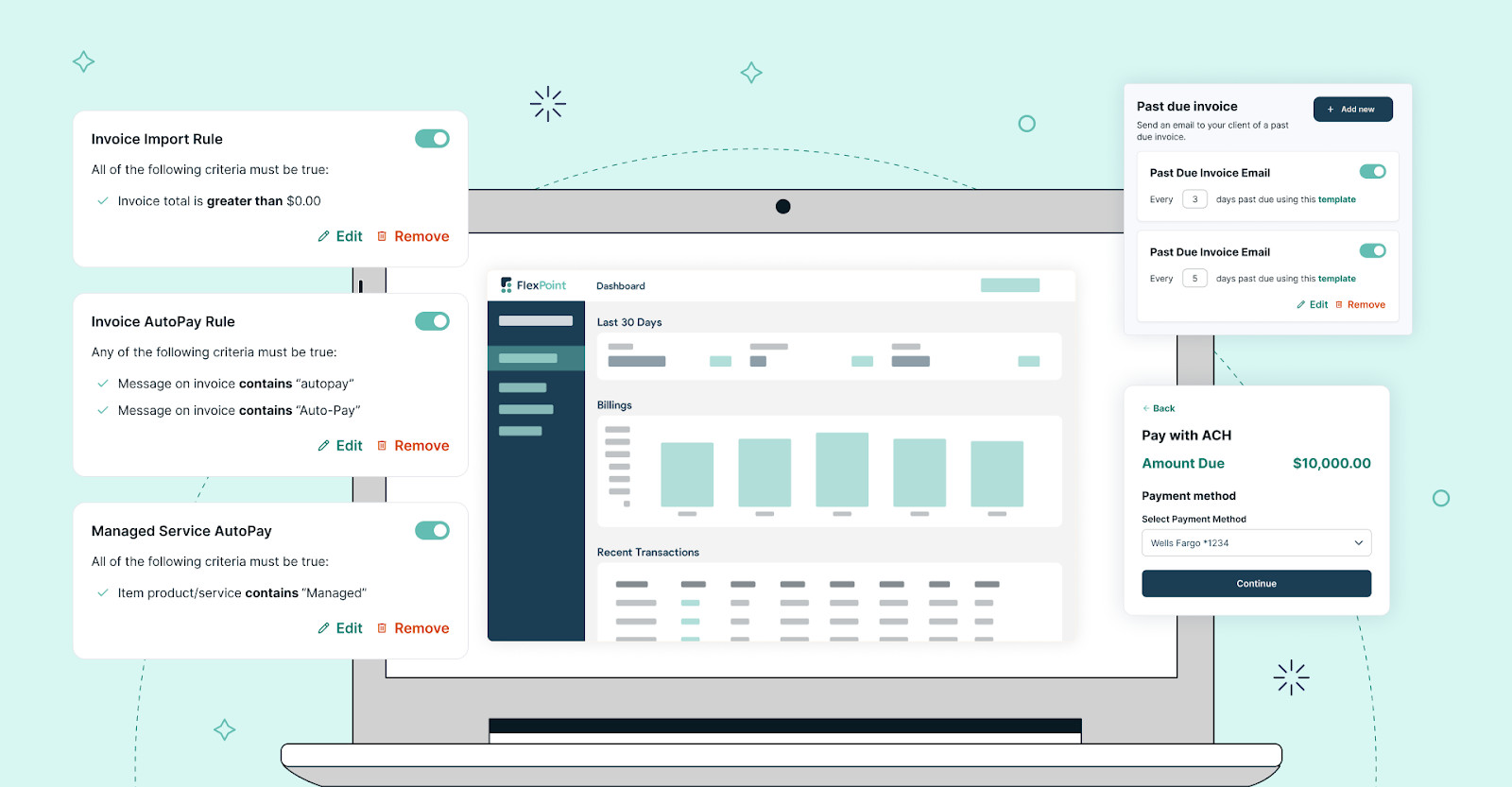
Getting paid on time is much easier with FlexPoint’s payment automation.
MSPs can offer AutoPay, which allows clients to save a payment method and authorize automatic charges on invoice due dates.
On the day an invoice is due, FlexPoint will charge the client’s card or bank account (ACH) in accordance with the rules set forth.
Even clients who don’t enroll in AutoPay can pay through the FlexPoint-branded portal using various methods (credit card, ACH, etc.), and FlexPoint will send them timely reminders.
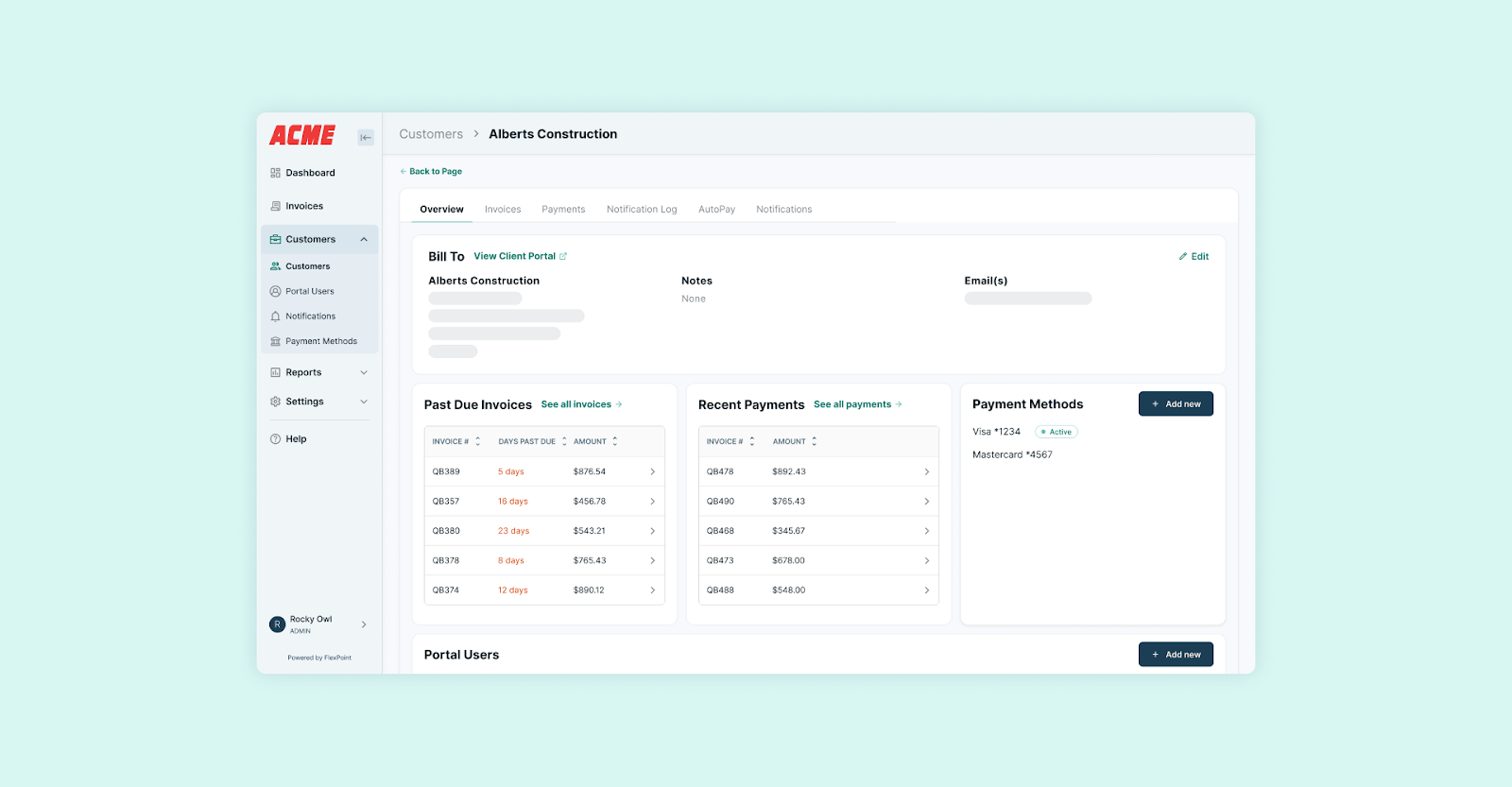
Essentially, invoices are issued, and payments are received with minimal human intervention.
3. Automated Collections Workflows:
In cases where a client doesn’t pay by the due date, FlexPoint steps in with automated collections.
You can configure reminder emails and follow-up sequences to send at intervals (e.g., a gentle reminder 3 days before the due date, another on the due date, a past-due notice 5 days after, and so on).
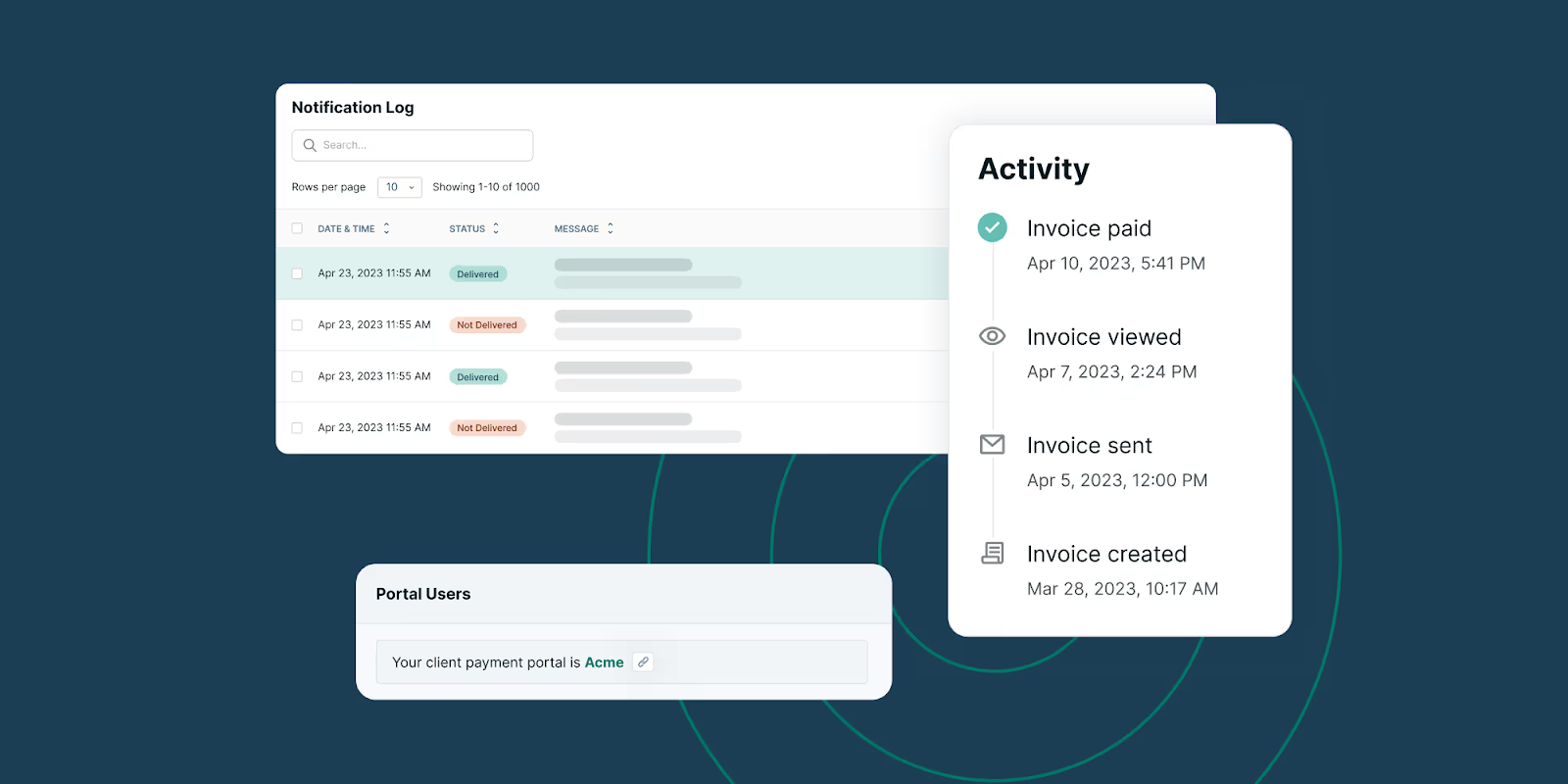
FlexPoint’s system tracks email opens and client clicks, so you know if the client saw the invoice or needs a nudge. These dunning workflows run continuously without requiring the finance team to manually track each account.
If a payment is overdue, FlexPoint can escalate messaging or alert the MSP team for further action when certain thresholds are met.
By automating the collections process in this way, MSPs maintain steady cash flow and drastically reduce the hours spent chasing payments.
Many manual tasks, such as sending “please pay” emails or resending invoices, simply vanish.
4. Two-Way PSA and Accounting Sync:
FlexPoint acts as a bridge between an MSP’s PSA system and their accounting software.
The platform has native integrations with major MSP tools (such as ConnectWise PSA, Datto Autotask, HaloPSA, SuperOps, and others) and with accounting platforms (QuickBooks Online, QuickBooks Desktop, Xero).
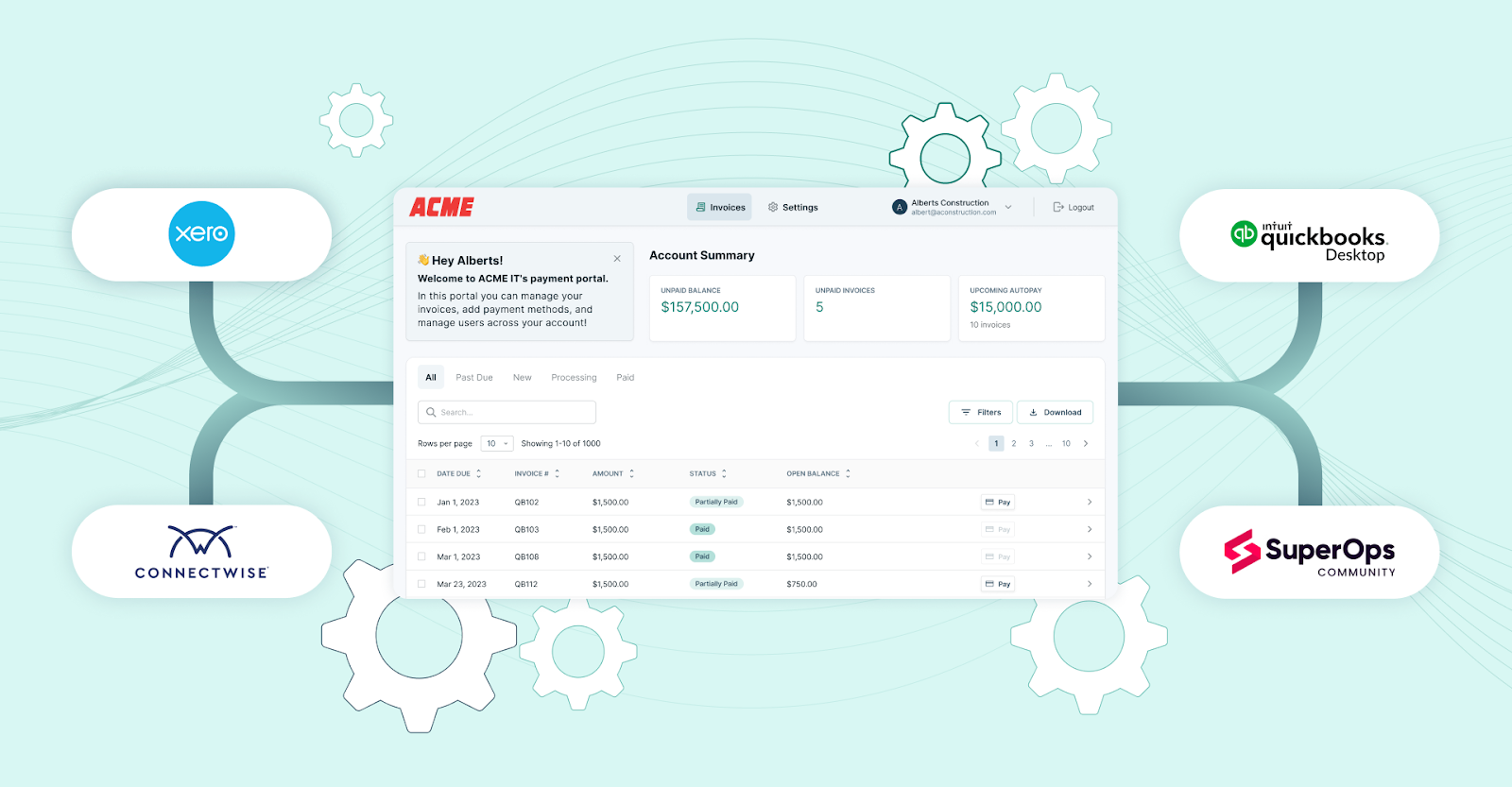
This two-way sync means that whenever FlexPoint creates an invoice or records a payment, those updates are automatically reflected in the accounting books.
Likewise, any updates to PSA (such as a contract adjustment or a credit memo) can sync to FlexPoint.
The benefit is data consistency: no more double-entry or worrying that the numbers in QuickBooks differ from the PSA.
This integration prevents data mismatches and ensures the finance and service delivery teams always view the same information.
5. Instant Deposit Reconciliation:
A standout feature of FlexPoint is its ability to automatically reconcile payments and deposits.

When a client pays an invoice through FlexPoint (whether by credit card or ACH), FlexPoint knows the exact net deposit that will hit the MSP’s bank (factoring in any processing fees).
Once the deposit from the payment processor is received by the bank, FlexPoint matches it to the corresponding payments and breaks down the fees. All of this is logged and synced to accounting.
The result is no more hunting through bank statements and payment reports to tie things together; it’s done for you.
This is a tremendous time-saver and also improves accuracy, since manual reconciliation can sometimes miss items or misallocate payments.
For MSPs processing many payments per week, automated reconciliation ensures the books are up to date and that revenue isn’t “lost” due to an oversight in matching records.
6. Real-Time A/R and Cash Flow Visibility:
Because FlexPoint centralizes billing and collections and keeps everything in sync, it provides real-time dashboards and reports on A/R status.
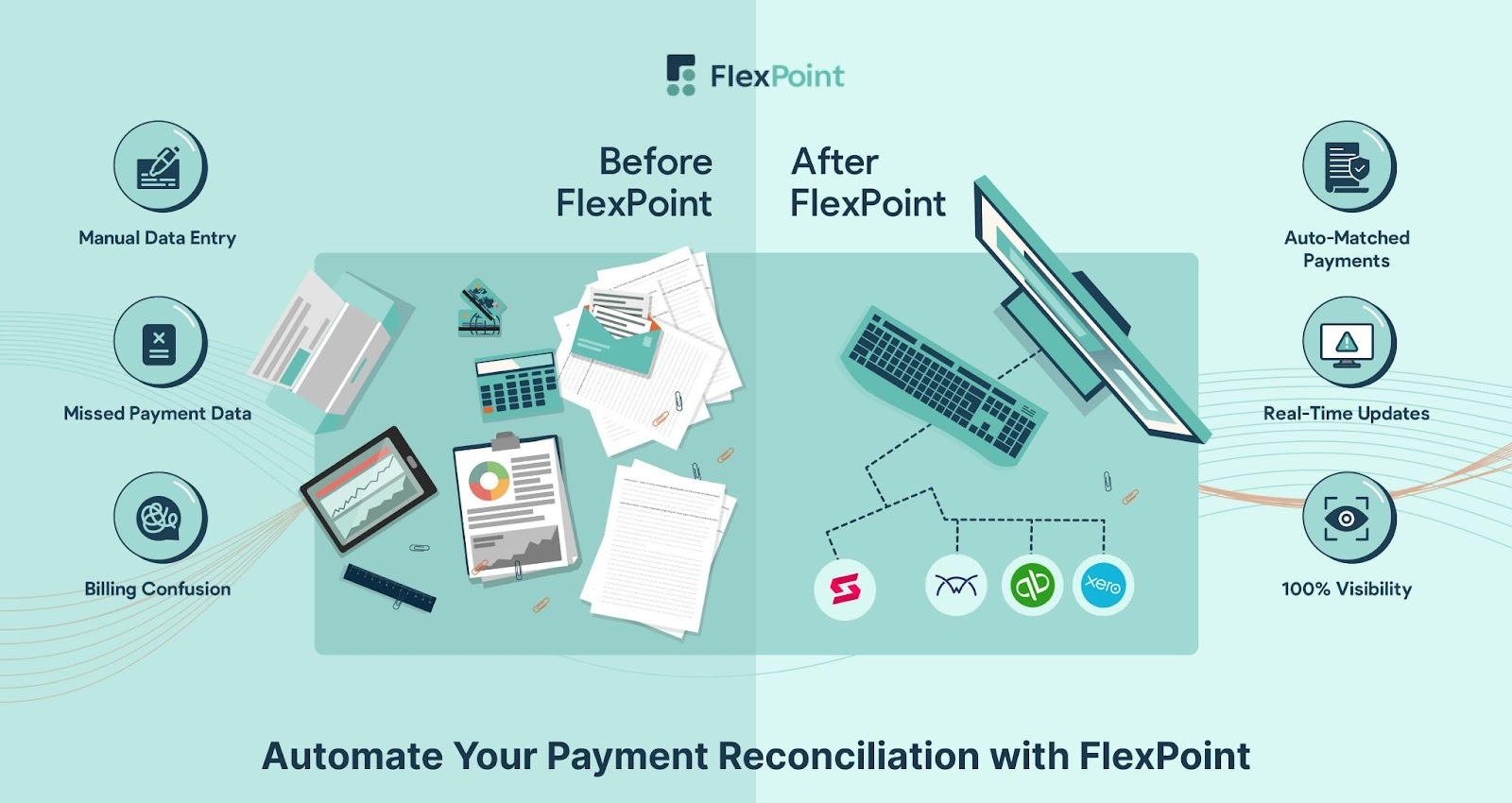
MSP finance leaders can instantly see which invoices are coming due, which are overdue (and by how long), and which clients might be consistently late.
Cash flow projections become more accurate because the system knows the AutoPay collection schedule and average payment times. This visibility allows MSPs to spot potential issues (such as a client aging into a risk category) and take proactive action.
It also means that at any given moment, the team can trust that the A/R aging report is accurate without having to compile data from multiple sources.
By replacing fragmented processes and multiple tools with one unified platform, FlexPoint enables MSPs to get paid faster and with far less effort.
The platform was built specifically for MSP financial workflows, as evidenced by features such as PSA integrations, surcharge management for credit card fees, and support for the many billing scenarios MSPs juggle.
The outcome for MSPs is a dramatic reduction in manual workloads.
For example, TekRESCUE, a Texas-based MSP, saw exactly that benefit.
As the company grew, managing billing and accounts receivable in QuickBooks and spreadsheets became overwhelming for one person.
Juli Brinkley, their Office Administrator, was spending hours each week manually tracking recurring invoices, payment methods, and client status changes.
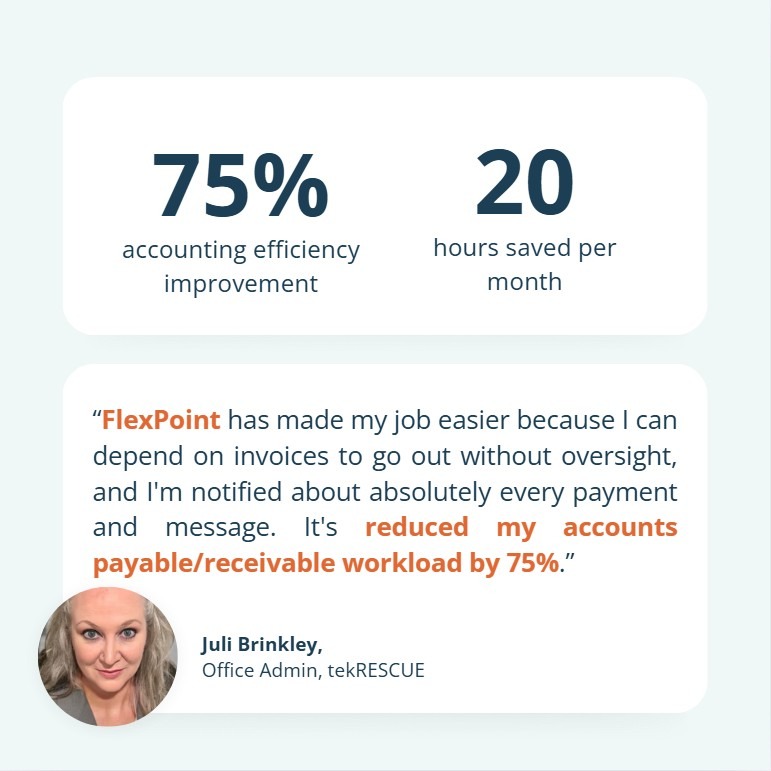
Once tekRESCUE switched to FlexPoint, she gained back 20 hours per month.
Her A/R workload dropped by 75%, and the team gained confidence knowing invoices were going out automatically, and client updates were accurate.
For FlexPoint users, results such as this are common: cleaner, more accurate financial records, healthier cash flow, and fewer surprises.
Conclusion: Why FlexPoint Is the Best Accounts Receivable Automation Solution for MSPs
Generic A/R tools often struggle to keep up with the complexity of MSP billing and the need for end-to-end automation.
MSPs who rely on basic accounting software or standalone payment portals eventually hit limitations, whether due to a lack of automated collections, limited integration with PSA data, or tedious monthly reconciliation.
These gaps can lead to delayed payments, higher processing costs, and frustrated finance teams.
FlexPoint stands out as the best choice for MSPs because it was engineered to address their specific challenges. The platform doesn’t just handle one part of accounts receivable; it automates the entire journey from invoice to payment to reconciliation.
FlexPoint’s deep integration with the tools MSPs already use (both operational and accounting) eliminates double entry and errors.
Supporting complex billing arrangements and automating follow-ups, FlexPoint ensures MSPs get paid on time without constant manual intervention. The result is faster cash inflows, reduced workload, and confidence that financial records are accurate across the board.
FlexPoint delivers what MSPs need for accounts receivable: a single, MSP-tailored platform that accelerates cash flow, reduces manual effort, and scales with your business.
If you’re comparing A/R solutions, you’ll find that FlexPoint consistently fills the gaps left by alternatives, making it the most effective automation layer for MSP billing operations.
Ready to upgrade your accounts receivable process?
Schedule a demo and compare FlexPoint directly to the A/R tools you use today.
Additional FAQs: FlexPoint Accounts Receivable Software
{{faq-section}}

MSP accounts receivable automation software is designed to streamline managed service providers' invoicing and payment collection processes.
Instead of relying on manual invoicing, reminders, and reconciliation, an A/R automation tool will:
- Generate invoices (often using data from the MSP’s systems, such as PSA)
- Send them automatically to clients
- Collect payments (via credit card, ACH, installment payments, etc.)
- Automatically match those payments to the books
The goal is to get MSPs paid faster and with less effort.
Typically, signs include:
- Spending too much time chasing late payments
- Dealing with many overdue invoices
- Struggling with billing errors as you scale
If your finance team is manually sending many reminders or spending hours reconciling payments, it might be time to adopt automation.
Many MSPs switch when they reach a growth point where manual methods break down.
Yes. FlexPoint is designed as an all-in-one receivables platform for MSPs. The platform can replace standalone or white-label payment portals, manual invoice emailing, separate credit card processors, and even some functions of your PSA’s billing module.
By integrating with your PSA and accounting system, FlexPoint becomes the central hub for billing and payments. MSPs no longer need one tool for invoicing, another for sending reminders, and another for payment processing. FlexPoint covers all these.
FlexPoint improves cash flow in a few ways:
- By automating reminders and offering AutoPay, it significantly reduces late payments, meaning you get money in the door faster.
- The platform allows MSPs to pass through credit card fees or encourage ACH payments (including Same-Day ACH), saving on processing costs and preserving profit margins.
- With real-time tracking of who has paid and who hasn’t, you can proactively manage any slow-paying clients before they become big problems. The result is more predictable and steady cash inflows.
Many MSPs find that after implementing FlexPoint, their average collection times shorten and their team spends far less time on uncollected revenue. Learn more about MSP customer success stories that have transformed their billing operations after switching to FlexPoint.


