

.png)
For MSPs, accurate billing is about trust.
Clear, correct invoices show clients you value transparency and professionalism.
But even accidental mistakes can damage your reputation, strain relationships, and cost you business.
Overbilling, in particular, can be devastating, even if it's a mistake.
A single error can turn loyal clients into skeptics who scrutinize every charge. Negative experiences spread quickly, making it harder to attract new business.
In some cases, overbilling may even trigger legal action or regulatory scrutiny, resulting in costly investigations and long-term reputational harm.
A single billing error can lead to lost clients, legal trouble, and a damaged reputation that's hard to fix.
In this guide, we will explain what overbilling is, why it happens, and how to spot and resolve it before it escalates. We’ll also look at how automated billing tools can prevent errors, improve accuracy, and help maintain your clients' trust and confidence.
{{toc}}
What Is MSP Overbilling?
MSP overbilling occurs when a managed service provider charges a client more than agreed upon in their service contract or statement of work. In other words, overbilling reflects any invoice that exceeds the client’s legitimate financial obligation.
This typically happens when there’s a mismatch between the services delivered and what's displayed on the final invoice the client receives. It might be due to invoicing errors, inaccurate time tracking, duplicate entries, or misconfigured billing systems.
For example, suppose an MSP has a fixed monthly agreement to provide $5,000 worth of IT services, covering 20 hours of IT support.
Due to a system glitch, the invoice mistakenly includes an extra 10 hours of IT support that was never performed, adding $1,500 to the total bill.
In another scenario, a client might be charged twice for the same hardware purchase, such as a $1,500 server that appears twice on the invoice, resulting in a $3,000 charge.
It’s important to note that most overbilling incidents are unintentional.
They often arise from data entry mistakes, software synchronization and integration issues, or miscommunication between internal teams. In many cases, the root cause lies in gaps in billing workflows or a lack of proper oversight, not in intentional misconduct.
Still, intent doesn't erase the consequences. Whether it’s a genuine mistake or a system failure, overbilling can quickly erode client trust, trigger payment disputes, and even expose MSPs to reputational or legal risks.
That’s why preventing overbilling must be a proactive and ongoing effort, not just a reactive measure taken after a client raises a concern.
Accurate billing is essential for protecting revenue and for maintaining the integrity and professionalism that clients expect from their MSP.
5 Common Causes of MSP Overbilling
Understanding the root causes of overbilling is essential for developing effective prevention strategies.
Let’s review some of the most common reasons for overbilling that MSPs might overlook
- Inaccurate Time Tracking: A common cause of MSP overbilling is erroneous time tracking. For example, a technician may forget to switch client time codes, bill internal work to a client, or charge for tasks already covered in the contract. These errors often result from unclear billing rules, reliance on manual tracking, and a lack of automated error checks. Clearer policies, better training, and automation can significantly reduce these mistakes.
- Double Billing or Duplicate Entries: This occurs when disconnected systems and manual data entry result in the same work being logged in multiple places. For example, a technician might record the same task in the PSA, billing, and project tools separately. Without proper integration, duplicate charges can easily slip through unnoticed.
- Misalignment with Client Agreements: Outdated contracts, unclear service terms, or undocumented verbal changes can create confusion. Technicians may bill for work they believe is outside the agreement, while clients assume it’s included. Keeping contracts current and documenting all changes is critical for avoiding disputes.
- Poorly Integrated Billing Systems: Managing multiple disconnected tools often requires manual data transfers, which increases the risk of duplicate entries, missed updates, and incorrect charges, especially at month-end. As MSPs add more tools, the problem grows, creating data inconsistencies and a higher risk of errors.
- Complex Pricing Structures: Complex pricing structures increase the risk of overbilling, especially when managing custom bundles, tiered rates, and special discounts. When services like emergency support and project work have different rates, billing errors can easily occur. Without robust billing tools, staff may default to standard rates, overlook discounts, or apply incorrect charges.
5 Consequences of Overbilling for MSPs
Even minor overbilling incidents can trigger consequences that threaten an MSP's financial stability.
Understanding these risks helps MSP leaders protect revenue and maintain strong client relationships.
Let’s review the financial and business implications that overbilling can have on your MSP business.
- Damaged Client Trust: When clients discover billing mistakes, trust often erodes quickly. In some cases, they might start questioning every charge. This can turn a smooth partnership into a tense one, where you spend more time defending invoices than delivering value. Even minor errors can make clients question past bills, suspect overcharging, and closely watch future work. Fixing the damage is hard; refunds or discounts may help, but clients might still decide to leave.
- Lost Business Opportunities: Overbilling often pushes clients to seek other providers, even if you offer refunds or credits. Former clients may stop referring you and instead warn others, which can harm your reputation. In close-knit industries, these stories spread quickly, damaging your reputation. Replacing these clients costs time, money, and effort, while public perception takes much longer to repair.
- Reputational Damage: Research shows that 60% of clients will leave after a single negative interaction. Most will share it publicly. It can lead to negative reviews that outweigh the dozens of positive ones you’ve worked hard to earn and maintain, thereby hurting your credibility. Each new complaint adds to the damage, making potential clients wary and forcing you to spend more on reputation management. Even if the issue is fixed, the lasting impression of being untrustworthy can make winning new business much harder.
- Legal and Compliance Risks: Repeated or serious billing errors can trigger legal action or regulatory scrutiny. This may lead to lawsuits, investigations, and penalties for contract breaches or fraud. Even if you win these legal challenges, the process is expensive and disruptive, and it may expose your internal practices to outside review. Public legal disputes can harm your reputation and drive away future clients. In severe cases, it might even lead to criminal investigations against executives.
- Operational Inefficiencies: Even minor billing errors can be time-consuming to resolve and involve multiple departments. This distracts leadership from their main revenue-generating work, slows down customer service, and disrupts ongoing projects. Over time, repeated issues waste resources, frustrate staff, slow service delivery, and limit growth opportunities.
How to Identify MSP Overbilling Issues
We’ve previously looked into the causes and potential implications of overbilling.
Now, let’s review how you can quickly and effectively identify overbilling issues before they escalate.
- Regular Invoice Audits: Compare invoices against technician time logs, project notes, and contract terms to confirm accuracy. Use standard checklists to spot incorrect rates, duplicate entries, or charges already included in service packages. Track red flags such as sudden cost spikes or overlapping time entries. Keep detailed audit results to spot patterns, improve processes, and prevent repeat mistakes. Always treat audits as a vital business function, not just a routine task, to reduce errors and strengthen control.
- Reconcile PSA and Billing Systems: To ensure accurate invoicing and avoid client disputes, you must regularly reconcile your PSA and billing systems. Generate exception and variance reports to uncover recurring issues caused by integration gaps, training shortfalls, or inconsistent processes. Address discrepancies before invoices reach clients.
- Analyze Client Feedback: Document all billing-related questions and disputes, noting the charges in question, the client’s concern, and the resolution. Over time, this creates a dataset to identify recurring pain points, such as unclear contracts, confusing invoices, or inconsistent billing. Use regular reviews and surveys to uncover hidden trends.
- Monitor Revenue Patterns: Establish baseline revenue expectations for each client to quickly spot unexpected fluctuations. Investigate anomalies, such as unusual time entries or ticket volumes, before they affect client trust or trigger disputes. Use tools that quickly flag and investigate issues, such as questionable time entries or service tickets.
{{ebook-cta}}
Practical Strategies to Prevent MSP Overbilling
Preventing overbilling isn’t just about avoiding mistakes. It’s also about protecting trust, strengthening relationships, and ensuring long-term growth.
The following practical strategies give MSPs clear, actionable ways to safeguard revenue integrity while showcasing the professionalism and accuracy clients expect from a reliable technology partner.
1. Automate Billing and Tracking
A significant cause of overbilling is manual billing across disconnected systems.
If your business tools are disconnected, your technicians might have to log time and services in multiple tools, like ticketing platforms and billing software.
This can lead to duplicate entries, missed updates, and inaccurate invoices.
These errors can damage client trust and harm your reputation. Clients may start questioning every charge, while staff waste time fixing mistakes instead of focusing on more valuable work.
To avoid this, you must automate billing and easily track payments by integrating PSA tools (such as ConnectWise PSA, Autotask, HaloPSA, SuperOps), billing software (such as FlexPoint), and accounting platforms (such as QuickBooks Online, QuickBooks Desktop, Xero).
A connected billing workflow automatically flows service data from service delivery to invoicing, eliminating duplicate data entry and reducing human error.
Automated billing builds trust through accurate, transparent invoicing and helps you grow more efficiently.
2. Simplify Pricing Structures
A survey found that 80% of consumers prefer businesses with transparent, explicit pricing, leading to a 15% increase in customer retention.
Billing mistakes are more likely when pricing structures aren't clearly defined or consistently applied across clients, services, or technicians.
You can prevent overbilling by simplifying and standardizing your pricing model.
This means you must clearly outline what each service includes, how it’s billed (hourly or flat rate), and apply the same pricing rules to all clients.
A simpler pricing model makes billing faster, more accurate, and easier to manage.
As a result, teams spend less time fixing mistakes, and clients better understand their charges, which builds trust. It also leads to more predictable revenue, fewer billing disputes, quicker payments, and a stronger reputation for the MSP.
3. Train Employees on Accurate Billing
According to BilledRight, well-trained staff can help reduce error rates from 15% to 5% and resubmission rates from 25% to 10%.
You can effectively prevent overbilling by setting up regular, structured training focused on accurate billing.
Regular training should go beyond “how to send an invoice” and emphasize accuracy, transparency, and understanding client contracts.
Employees must stay up to date on client agreements and how they affect billing, using real-life examples and hands-on training with your PSA tools.
Ongoing training helps employees build confidence and reduce mistakes.
They learn to follow the proper steps, track time correctly, and spot issues early.
This leads to more accurate invoices, fewer client disputes, and a stronger reputation for your MSP.
4. Establish Billing Reviews
Setting up regular billing reviews is a simple but powerful way to catch and fix billing mistakes before sending invoices to clients.
This involves conducting internal audits, random checks, and team reviews to ensure that all charges align with the work performed and the client’s contract.
These reviews should happen regularly (weekly, monthly, or along with billing cycles) and be part of a routine, not just done when problems arise.
Teams should be trained to spot red flags and compare time logs with actual services. While automation can help by highlighting errors, human review is still key.
Billing reviews help you keep invoices accurate, reduce client disputes, and build long-term trust. They lead to cleaner records, quicker payments, and fewer lost revenues.
Clients notice and value this attention to detail, boosting your reputation for honesty and professionalism. These reviews also help spot internal issues, such as poor ticket notes or poor logging habits, allowing you to improve operations and service delivery.
5. Enhance Client Communication
Providing clients with detailed payment instructions on invoices improves payment times for 70% of businesses.
Improving client communication is a simple but effective way to stop overbilling.
It starts with setting clear billing expectations, explaining what services will be charged for, how rates work, and when invoices will be sent.
Your team should also confirm services as they’re completed by sending weekly updates or closing ticket summaries.
Going a step further, walking clients through invoices and explaining key charges helps prevent confusion before it turns into a problem.
Clear communication makes clients feel more confident and reduces the likelihood they will question bills.
This means quicker payments, fewer disputes, and stronger long-term relationships. Over time, this builds trust, brings in more referrals, and protects the MSP’s reputation and revenue.
How FlexPoint's Billing Software Helps MSPs Eliminate Overbilling Risks
For MSPs committed to eliminating overbilling and ensuring accurate, transparent invoicing, FlexPoint’s billing software provides a complete, all-in-one solution.
By automating critical billing workflows and offering real-time visibility into billing data, FlexPoint addresses the root causes of invoicing errors while strengthening client trust. This combination not only reduces billing risks but also helps MSPs maintain dependable, long-term client relationships.
1. Automated Billing Accuracy Checks
FlexPoint automatically syncs data as services are delivered and recorded in your PSA tool. This helps to capture and sync real-time details such as service hours, contract terms, and MSP-specific usage metrics.
FlexPoint's automation ensures invoices are generated with clear, itemized charges, including credit card surcharges where applicable (subject to individual state and federal laws). These details prevent confusion and reduce the risk of payment disputes or chargebacks.
Therefore, eliminates the need for manual data entry and ensures consistency across all platforms.
IT Vortex, a New Jersey-based MSP, was spending at least five hours per month manually attaching invoices, sending out links, and chasing down payments.
Their previous payment methods, such as PayPal, required customers to leave IT Vortex’s site and incurred processing fees that clients had to pay.
Hence, IT Vortex sought a more integrated and user-friendly platform to automate invoicing and reconciliation, eliminate manual errors, and improve the client payment experience.
FlexPoint automated IT Vortex’s invoicing and payment processes.
IT Vortex receives deposits, and transactions are automatically reconciled and entered into QuickBooks. This ensures that deposits go directly to their bank account and QuickBooks without manual entry, and everything auto-reconciles.
This directly led to "payment numbers always match", ensuring invoices precisely reflect services delivered and significantly reducing the risk of manual entry errors and overbilling.
As a result, using FlexPoint, IT Vortex achieved:
- Increase in payment cycle speed by 30x from 2x.
- Save $15,000+ every month on invoices.
- Save 60 hours annually in manual invoicing.

2. Integrated, Real-Time Reconciliation
FlexPoint integrates with leading PSA platforms, including ConnectWise PSA, Autotask, HaloPSA, and SuperOps, as well as accounting software such as QuickBooks Online, QuickBooks Desktop, and Xero.
This connectivity is crucial for a unified financial ecosystem where information flows seamlessly between systems.
When services are provided and documented in a PSA tool like ConnectWise PSA, FlexPoint automatically pulls this data to generate invoices. Alternatively, if invoices are generated and sent via the PSA or accounting software, FlexPoint ensures the billing data is synced across all platforms.
FlexPoint automates the reconciliation process, eliminating the need to manually match payments to invoices and bank deposits.
This ensures financial information is consistent across all platforms, reducing errors and the time MSPs spend on manual data entry.
Take, for instance, Skycamp Technologies, an Ohio-based MSP facing significant reconciliation challenges as it juggles multiple payment processing platforms.
Their QuickBooks ACH lacked full integration with their invoicing platform, which meant they had to manually process each monthly ACH payment because invoice amounts changed based on customer license counts.
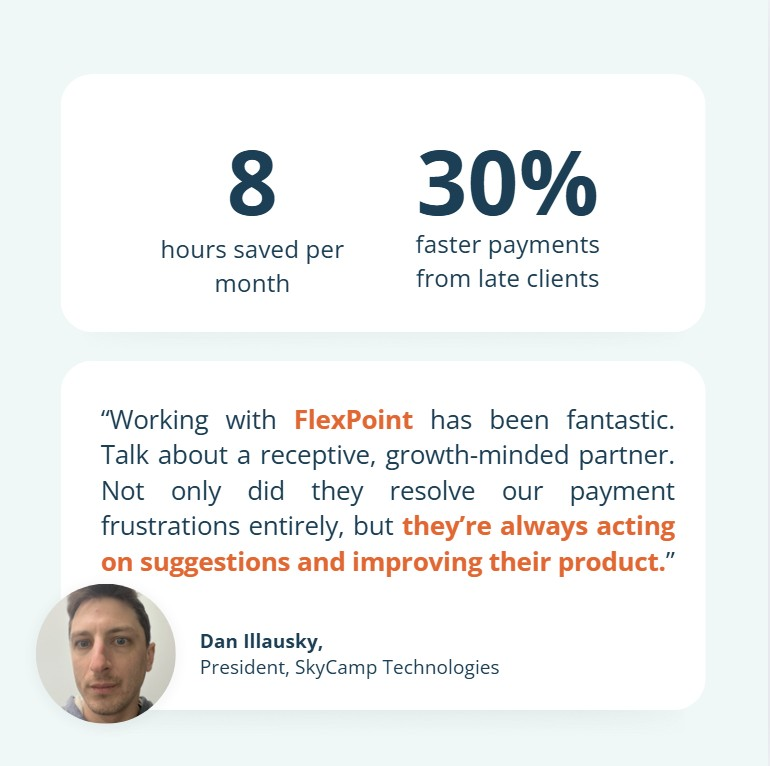
Dan Illausky, President at SkyCamp Technologies, discovered FlexPoint, and the onboarding process was described as easy, including QuickBooks syncing. FlexPoint's solution proved to be the ideal fit for their needs.
FlexPoint implemented auto-syncing and reconciliation with QuickBooks Online, eliminating PSA processing issues.
This ensured that all of SkyCamp’s accounting was consolidated in one place, making reconciliation a low-maintenance task.
By addressing manual processing tied to varying customer license counts and eliminating "PSA processing issues," FlexPoint directly addressed manual entry errors.
This helps reduce overbilling risks, ensuring invoices precisely match services delivered.
As a result, using FlexPoint, SkyCamp Technologies achieved:
- 8 hours saved per month in administrative work.
- A 20% increase in AutoPay use among clients.
- 30% faster payments from late clients.
3. Customizable Invoicing Workflows
FlexPoint enables you to define specific rules and criteria for your invoicing. This reduces duplication and prevents incorrect billing.
FlexPoint's AutoPay feature allows you to set custom rules for automated invoice payments.
These rules can be applied universally to all clients or tailored for specific customers. Criteria may include certain service items (e.g., "Managed") or the minimum invoice amount.
By automating these processes and ensuring data consistency across platforms, FlexPoint minimizes billing discrepancies and improves operational efficiency.
4. Transparent Client Portals
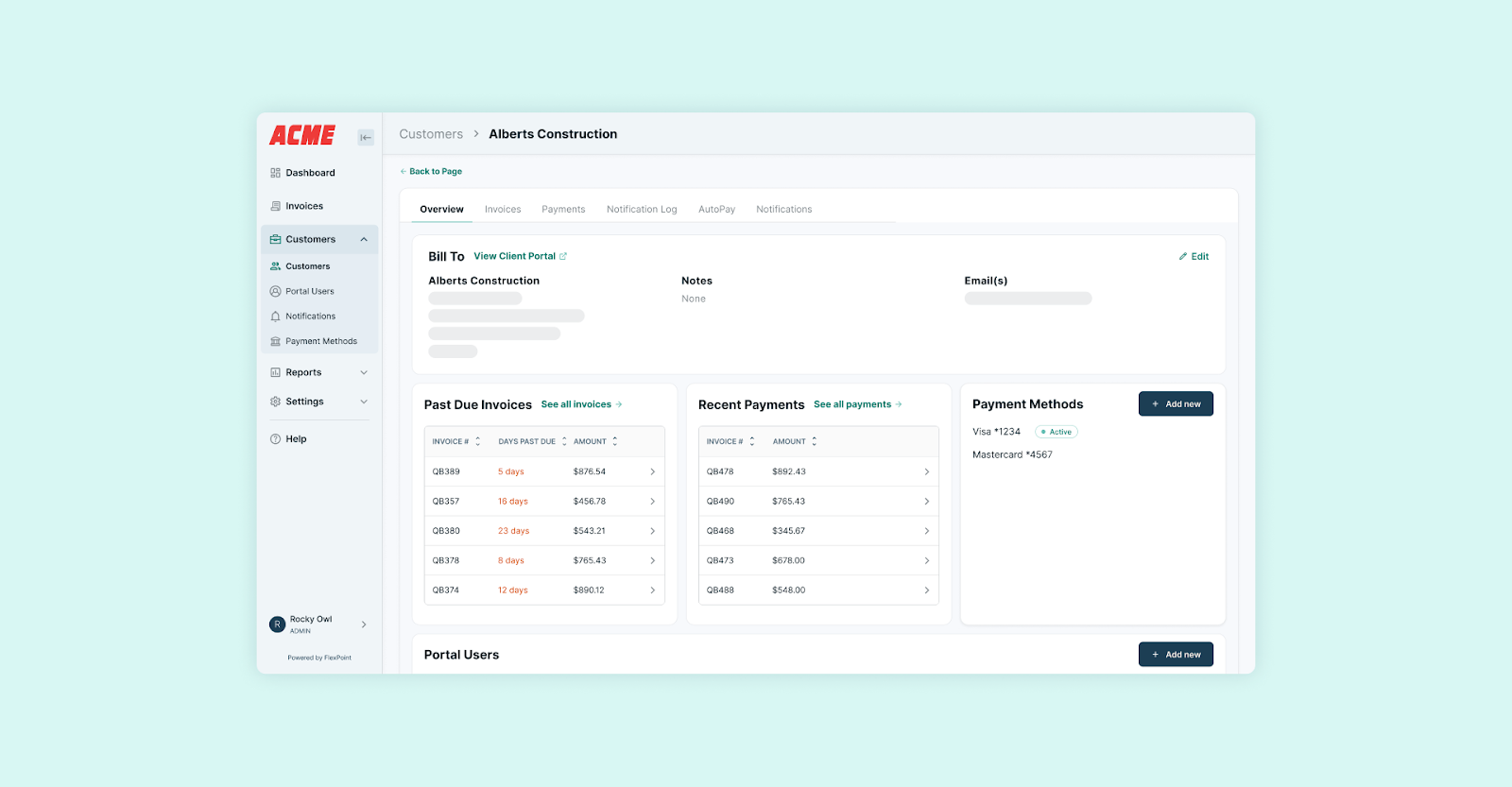
FlexPoint’s client portal gives MSP clients 24/7 access to their billing information in a secure, professional, and user-friendly interface.
This empowers clients to manage their accounts independently, reducing the need for direct contact with the MSP's support team for routine inquiries, and also ensures transparency.
Clients can view current and past invoices, track payments, and review detailed transaction histories in one place. Payment methods and invoice statuses update in real time.
This self‑service transparency reduces routine inquiries, speeds issue resolution, and minimizes payment friction and disputes.
Consider, for example, Excellent Networks, a Texas-based MSP.
Mark Luna, President of Excellent Networks, found that his team was spending significant time and money on manual invoicing.
His company used to send invoices through ConnectWise and primarily collected payments via checks, which sometimes got lost in the mail.
This fragmented and manual accounting process was "all over the place", leading Mark to seek a tool to streamline invoicing and eliminate this multitasking.
He researched what other MSPs were using as payment portals and found FlexPoint.
With FlexPoint’s portal, clients can check their invoices and pay bills online.
Mark no longer had to send individual invoices or deal with the end-of-year rush of invoice requests from accountants. It significantly increases transparency for clients and quickly resolves billing inquiries or concerns.
Hence, the company's invoice turnaround time was reduced from 25 days to just five days.
Also, the branded portal's convenience led clients to prefer FlexPoint’s ACH and AutoPay options, effectively eliminating credit card fees for Excellent Networks.
As a result, using FlexPoint, Excellent Networks achieved:
- 80% faster payments.
- 24 hours saved per year in billing time.
- $10k+ saved in annual credit card fees.

Conclusion: Protect Your MSP Reputation Through Accurate Billing
In the MSP industry, reputation and credibility are directly tied to long-term success.




.png)