

Sage Intacct is only one part of your financial stack.
Yes, it supports multi-entity operations, real-time reporting, and dimensional accounting, all of which are critical for MSPs managing recurring revenue at scale.
But the MSPs getting the most value from it are not using it in isolation. They are connecting it to the rest of their systems to create a unified quote-to-cash workflow.
This guide breaks down the most important Sage Intacct integrations for MSPs, what each one actually does, and how to build a stack where your tools work together instead of operating as disconnected systems.
Not sure if Sage Intacct is right for your MSP vs. QuickBooks Online? We broke that comparison down in detail here.
{{toc}}
Why Integrations Matter More for MSPs Than Most Businesses

Most MSPs rely on at least three core systems:
- A PSA for service delivery, ticketing, and billing triggers
- An accounting platform (like Sage Intacct)
- A payment or AR platform for collecting client payments
Without integrations, these systems do not communicate in real time, which creates very real problems. For example: financial reporting lags behind operations, teams manually export and import data, invoice and payment data becomes inconsistent, and delayed cash flow.
For an MSP billing monthly across dozens or hundreds of clients, even small inefficiencies snowball quickly.
Sage Intacct is built to solve this problem on the accounting side. It offers:
- A robust open API
- A large integration marketplace
- Support for real-time data synchronization
But having access to integrations is not the same as using the right ones.
All Sage Intacct Integration Options
Sage Intacct connects to hundreds of third-party tools across nearly every part of your business operations.
But integrations are a double-edged sword.
They can either simplify your life or unnecessarily clutter it. Most people want to find that golden mean between the two where everything works automatically while also maintaining minimal workflow.
For the purpose of this article, we will only cover the essential integrations.
For MSPs, the essential integration layers are:
- PSA integration
- Payments and AR automation
- AP automation
Everything else is optional based on business complexity.
It is worth noting that Sage does offer some of these natively, including AR automation and vendor payments (not a native PSA).
And while native, these options are not the most robust options for MSPs.
Professional Services Automation (PSA) Integrations
Your PSA is where your business actually runs.
If it is not tightly integrated with Sage Intacct, your financial data will always be behind your operational reality.
Here are the most relevant PSA integration paths for MSPs.
HaloPSA

HaloPSA offers a direct Sage Intacct integration that supports billing for time, materials, and contracts.
The setup includes a one-click wizard, and the integration is two-way: customer and service item data can be pulled from Sage Intacct into HaloPSA, and billing data flows back out into Sage invoices automatically.
For MSPs already running HaloPSA as their PSA of choice, this removes the need for a third-party connector between their service delivery platform and their accounting system.
Time logged, contracts billed, and materials charged all flow through to Sage Intacct without manual export steps.
mConnect

While ConnectWise PSA does not integrate directly with Sage Intacct like Halo does, ConnectWise did develop a tool purpose-built for MSPs wanting to connect the two: mConnect.
It automatically synchronizes customers, vendors, items, projects, agreements, sales invoices, and purchase orders from ConnectWise to Sage Intacct in real time.
The sync is bidirectional where it counts most: customer payments recorded in Sage Intacct transmit back to ConnectWise immediately, so invoice balances stay accurate in both systems.
GL accounts and dimensions are controlled from within ConnectWise PSA, meaning your existing account structure drives how transactions post. There is no manual importing or exporting involved once it is set up.
For MSPs on ConnectWise, this is the integration that gets your PSA and your accounting platform speaking the same language. Without it, you are either doing manual data entry or living with a financial picture that is perpetually out of date.
SuperOps

SuperOps is designed as a modern, cloud-native alternative to more legacy systems. And it brings together PSA and RMM functionality in a single platform, which is a big part of why many newer MSPs are moving in this direction.
At the same time, SuperOps does not currently offer a direct, native integration with Sage Intacct. That means there is no out-of-the-box connection between the PSA and the accounting system for syncing invoices, payments, or financial data.
Instead, MSPs typically bridge that gap using FlexPoint.
SuperOps has a built-in integration with FlexPoint that is configured using an API token generated within the platform. Once connected, invoices created in SuperOps are automatically pulled into FlexPoint, where payments can be processed and tracked.
Payment status then flows back into SuperOps, keeping the PSA aligned without manual updates.
From there, FlexPoint connects directly to Sage Intacct and handles the accounting side of the workflow. Payments are synced and reconciled into Sage Intacct automatically.
This creates a connected system even though SuperOps itself does not integrate directly with Sage Intacct.
For MSPs that have adopted SuperOps and want their financial stack to keep up, this is currently the most practical and widely used way to connect operations to accounting without building a custom integration.
FlexPoint integrates with Autotask and with Sage Intacct, syncing payment and reconciliation data back to Sage Intacct automatically.
Payments and AR Automation Integrations
This is where most MSPs leave the most value on the table.
Getting invoices out is not the hard part. The real uphill battle begins after the invoice is sent: payments need to be collected, tracked, reconciled, and reflected accurately in your financials.
When that process is manual, it creates delays, inconsistencies, and a constant drain on your finance team.
For MSPs running a recurring revenue model, this is not a small inefficiency. It directly impacts cash flow.
FlexPoint
FlexPoint is a payments and AR automation platform built specifically for MSPs, and it now integrates directly with Sage Intacct.
Instead of sitting as just another tool in your stack, it acts as the connection point between your PSA, your accounting system, and your client payment experience.
In practice, this means invoices flow out of your PSA and into a structured payment workflow without anyone needing to export or re-enter data.
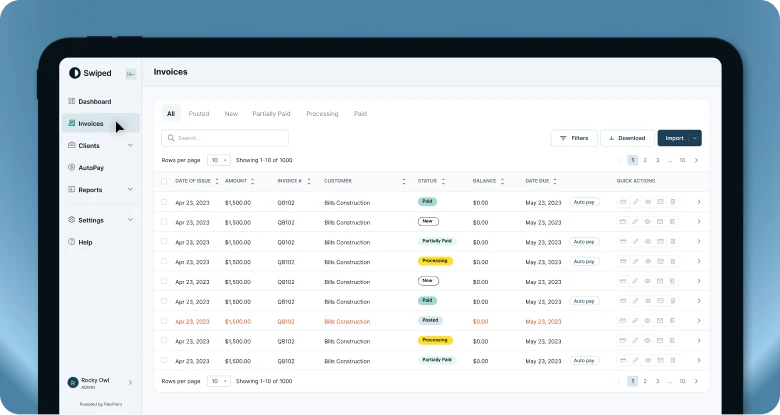
Clients receive a consistent, branded experience where they can pay via ACH or card, save payment methods, and enroll in AutoPay.
Once a payment is made, the transaction is reconciled back into Sage Intacct automatically. Your team is not chasing payments, manually posting transactions, or trying to match records across systems.
One of the most important pieces here is AutoPay. For MSPs, recurring billing only works as intended when payments are actually recurring.
When clients are set up on AutoPay, the variability in cash flow starts to disappear. Payments become predictable, and your team spends far less time following up.
You can now integrate FlexPoint with Sage Intacct for faster, scalable billing operations. Learn more here.

What FlexPoint handles for MSPs on Sage Intacct:
- Automated invoicing from your PSA, synced to Sage Intacct with no manual export or import
- A branded client payment portal where clients can pay by ACH or credit card, save payment methods, and enroll in AutoPay
- AutoPay setup without awkward conversations. FlexPoint provides template communications to help MSPs transition existing clients to AutoPay smoothly, and the portal prompts clients to save a payment method when they log in
- Same-day payment processing and real-time reconciliation back into Sage Intacct
- FlexLine Financing, which lets clients spread invoices of $10,000 or more over 1 to 12 months directly inside the payment portal, with approval typically within one business day
- Full two-way data sync, customizable invoices, and a financial dashboard with real-time visibility into billing, payments, and cash flow
See the full integrations list here.
If you're considering other AR platforms that integrate directly with Sage, there are a few alternatives:
ConnectBooster is a direct Sage Intacct integration built specifically for MSPs and IT service providers. It offers a payment portal, AutoPay, and automatic reconciliation into Sage Intacct.
Paystand integrates AR and AP automation directly inside Sage Intacct and is best known for its zero-fee bank payment network. It is not built for MSPs specifically but works well for businesses looking to reduce transaction costs on high-volume payments.
The key difference between FlexPoint and these alternatives is that FlexPoint is the only option in this list that covers the full billing cycle from PSA to payment portal to Sage Intacct reconciliation, with AutoPay, FlexLine Financing, and Same-Day ACH.
AP Automation Integrations
Accounts receivable usually gets the attention, but accounts payable becomes just as important as MSPs grow.
As vendor relationships expand and hardware or subcontractor costs increase, manually managing outgoing payments can create the same kinds of inefficiencies that AR does on the incoming side.
Ramp

Ramp combines corporate cards, expense management, and AP automation into one platform, with a direct integration into Sage Intacct.
For MSPs, the combination matters: rather than running a separate tool for employee expenses and a separate tool for vendor payments, Ramp handles both inside the same system and syncs everything back to Sage Intacct automatically.
Ramp's OCR auto-fills bills down to each line item, and its automation rules handle GL coding, approvals, and receipt matching without manual intervention.
The integration supports custom fields and UDDs from your existing Sage Intacct configuration, so your reporting structure is maintained without rebuilding anything.
Stampli
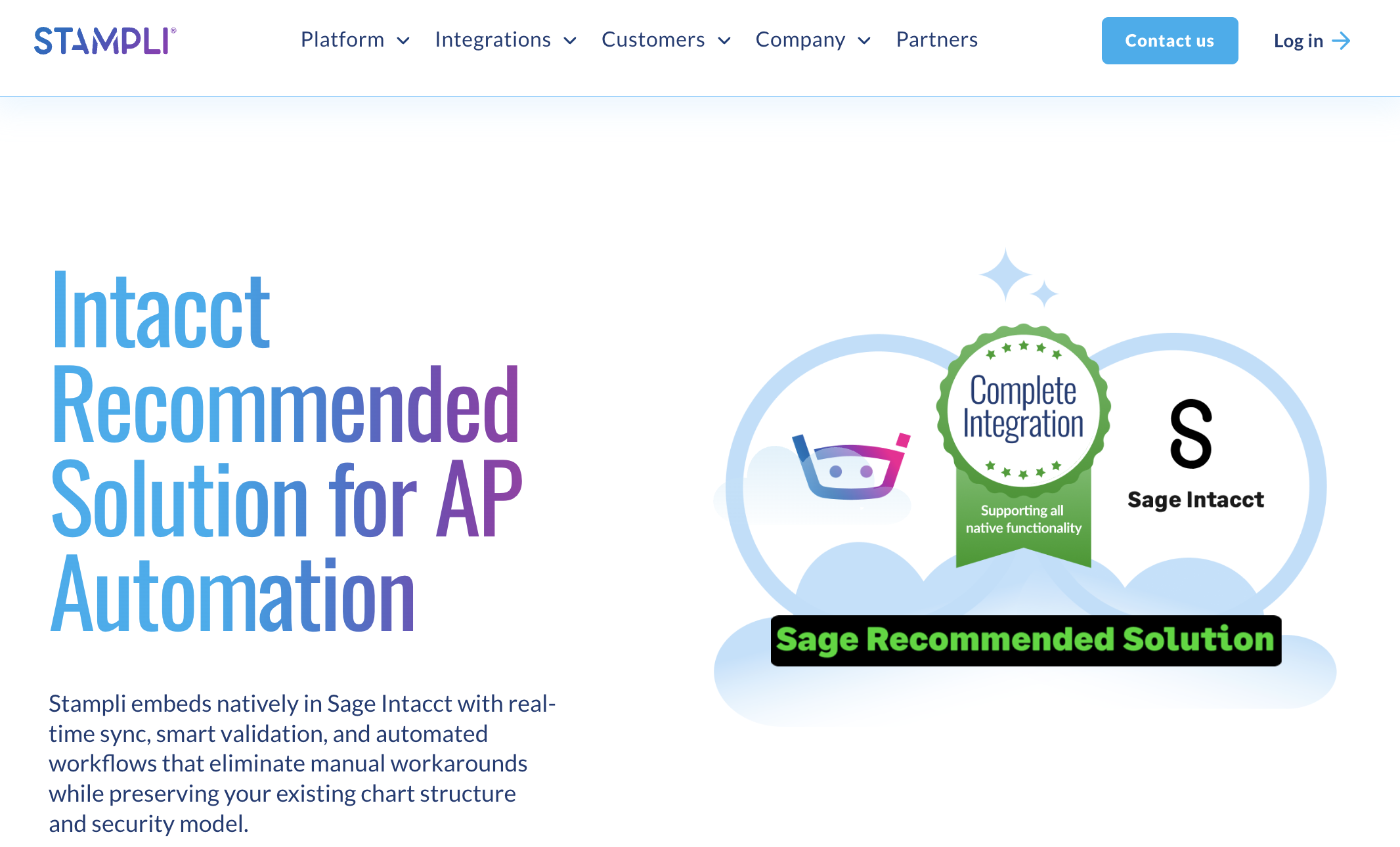
Stampli is a Sage-recommended solution with a marketplace-validated connector, which means it is pre-built for Sage Intacct and requires no custom development to set up.
Stampli embeds itself natively with Sage Intacct and keeps data flowing in both directions, with lists, status flags, custom fields, and business rules behaving exactly as if they were working inside Sage Intacct itself.
For MSPs who have invested in configuring Sage Intacct with custom fields and Smart Rules, Stampli honors that existing setup rather than working around it.
It also includes duplicate invoice detection that validates vendor, invoice number, and amount against both systems before processing, so bad data does not reach your general ledger.
Tipalti

For MSPs managing a significant volume of vendor payments, particularly those working with international subcontractors or hardware suppliers across multiple countries, Tipalti is one of the most capable AP automation tools available on the Sage Intacct Marketplace.
It handles the entire AP cycle from supplier onboarding and invoice processing through to payment and reconciliation, syncing everything back to Sage Intacct in real time.
Suppliers self-onboard through a portal, choosing their preferred payment method. Tipalti then handles OFAC screening, 2-way and 3-way PO matching, global payments in 120 currencies, and tax compliance automatically.
For domestic-only MSPs with simpler vendor structures, Ramp, Stampli, or Sage Vendor Payments will cover most needs. Tipalti becomes the right answer when your AP needs expand internationally.
How to Think About Your Integration Stack
It is easy to look at a marketplace full of integrations and assume more is better. In practice, that approach usually creates more complexity than it solves.
The goal is not to connect everything. It is to connect the systems that handle the most critical data flows in your business.
For most MSPs, that starts with two relationships.
1. The connection between your PSA and Sage Intacct determines how accurately your operations translate into financials.
2. The connection between your billing process and your payment system determines how quickly revenue turns into cash.
If those two areas are not fully automated, that is where the biggest opportunity exists.
From there, accounts payable becomes the next layer to refine once the core systems are stable and the business has reached a level of complexity that requires deeper financial insight.
Build Your Ideal Sage Intacct Stack
No two MSPs run the same stack.
The right Sage Intacct integrations depend on your PSA, your biggest operational pain point, and where you are in terms of scale. Answer three questions below to see the combination that fits where your business is right now.
Closing the Gap Between Sage Intacct and Getting Paid
FlexPoint exists to solve a very specific problem that most MSPs run into as they scale. There is a gap between invoicing and actually getting paid, and that gap is usually filled with manual processes, delays, and inconsistent client experiences.
By integrating directly with Sage Intacct and sitting alongside your PSA, FlexPoint connects that final piece of the workflow.
Invoices move through a structured payment process, clients have a clear and consistent way to pay, and transactions are reconciled automatically back into your accounting system. The result is not just time saved, but a highly predictable and reliable cash flow.
For MSPs running Sage Intacct, it turns the financial stack into something that operates as a system rather than a collection of tools.